

What does cost per lead mean?
Cost per lead is spend divided by leads, and that one line is where most explanations stop. One published definition describes something else entirely, and the difference is not a detail of wording.
The common reading makes cost per lead a measurement. You spent money, some leads arrived, and dividing one by the other tells you what each one cost.
The other reading makes it a price. A vendor delivers leads and bills you for each one, so the number is not something you calculate afterwards. The number is the rate on the invoice.
Online advertising payment model in which payment is based on the number of qualifying leads generated.
MarketingTerms.com, Cost Per Lead (CPL) read 10 September 2026
- The definition names it an online advertising payment model in which payment is based on the number of qualifying leads generated. No division, no campaign, no period.
- The paragraph underneath places it between cost per impression, where the publisher carries none of the performance risk, and cost per sale, where the publisher carries all of it.
- Read against the four definitions in the table above, this is the only one describing who gets billed rather than what to divide.
One name, two arrangements.
| The metric | The pricing model | |
|---|---|---|
| What it is | A number you work out | A rate you are billed at |
| Who defines a lead | You do | The contract does |
| When you find out the cost | After the spend | Before it |
| Where the risk sits | With you, because the spend happens either way | With the seller, who is paid on delivery |
| What it is set against | Cost per acquisition, further down your funnel | Cost per mille and cost per click, further up it |
Both readings are in use and neither is wrong. The trouble starts when a number produced under one is compared against a number produced under the other.
Formula inputs: which spend and which leads count
Take the metric reading and the formula still leaves the hardest question open. Spend on what, exactly, and counted how far back. Two published definitions answer it differently and the gap between them is salaries.
A third published scope holds the numerator to advertising and campaign spend. Three published scopes means a cost per lead is not comparable until somebody says which one produced it.
Cost Per Lead (CPL) is defined as the gross marketing cost expended to acquire a lead for your business. It can be calculated by dividing your total marketing spend by your total number of new leads acquired from a specific channel or group of channels …
First Page Sage, average cost per lead by industry last updated 8 May 2025, read 7 September 2026
- The definition says gross marketing cost, which takes in the salaries and tools that produced the campaign.
- The formula under it says total marketing spend, which is the same scope written as arithmetic.
- The paragraph beneath is the rarer thing: a definition of what a lead is, counted whatever the conversation leads to.
A store spending forty thousand on ads and paying a hundred thousand in salaries reports one cost per lead under the first definition and a much smaller one under the second.
Neither figure is dishonest. Only one of them is comparable with anybody else's, and only if you know which they used.
The line falls in a different place on each page. One page counts every dollar spent on the campaign, including ad spend, creative production, software subscriptions and agency fees.
Another names the payroll outright: ad spend plus in-house payroll, consultants, fixed costs and so on. A third stops at total marketing spend and leaves the boundary to you.
What the divisor hides
The denominator is worse, because only one of the pages opened here defines it at all. A newsletter signup, a pricing-page download and a demo request each count as one lead unless you say otherwise.
Say you have not yet decided which events count as a lead. The analytics skill writes you that tracking plan before any number gets divided.
That makes the metric easy to move in the wrong direction. Widen what counts as a lead and your cost per lead falls immediately, with nothing about the business having changed.
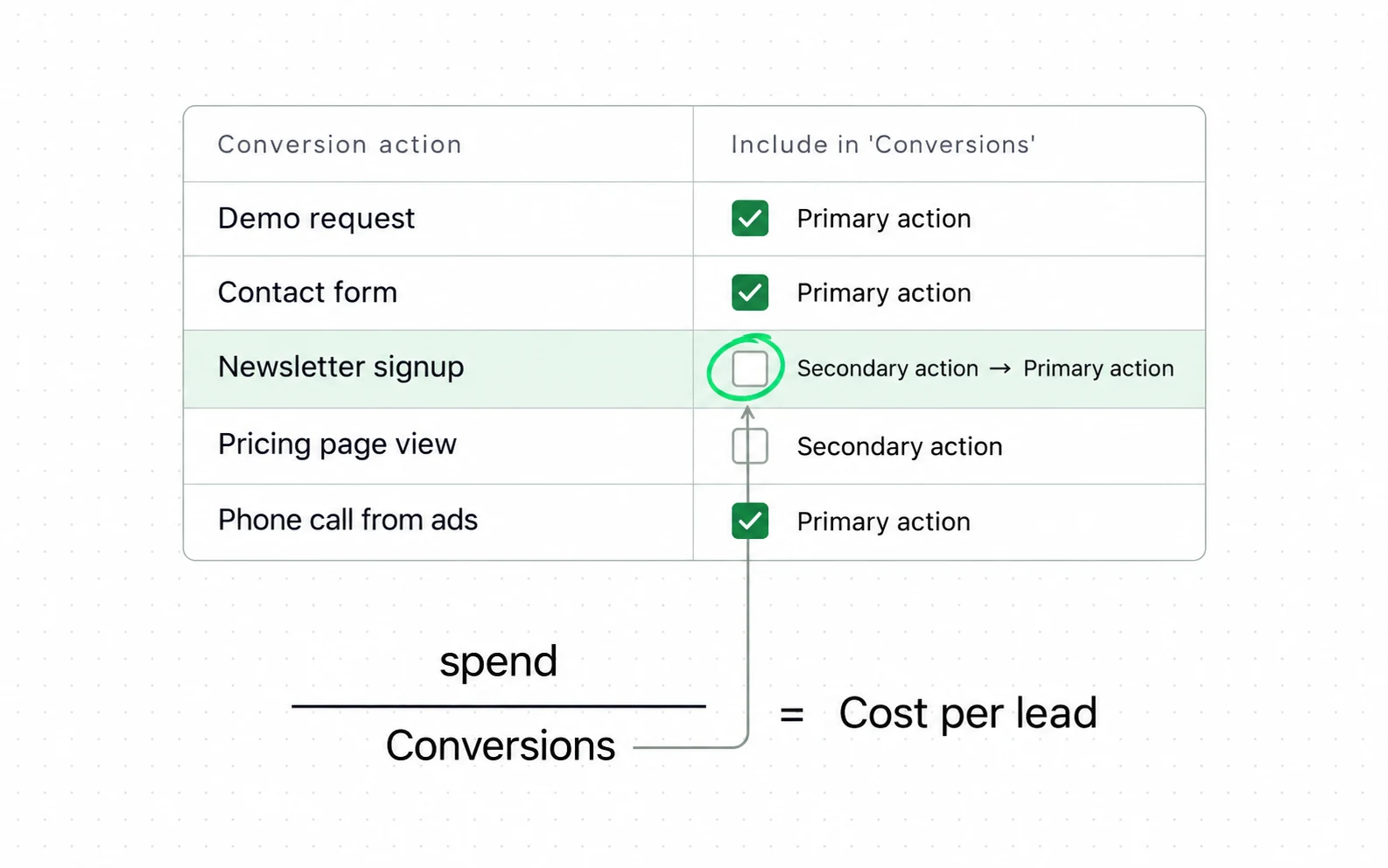
Where the bar sits is the subject of marketing qualified lead, and it decides this number before any spending does.
Why the two readings do not mix
Buying leads at a fixed rate and measuring what your own leads cost sound like the same activity described from two sides. They differ in one place that decides everything downstream.
Under the metric, you set the bar. You decide a demo request counts and a newsletter signup does not, and your number reflects that choice.
Under the pricing model, the bar is a term in your contract. The seller is paid on delivery, so the definition of a qualified lead is what you are negotiating, whatever your rate is.
No public example of such a clause turned up, so take this as the shape of the arrangement and never as anybody's actual terms.
Wikipedia frames that arrangement against impression and click pricing, where you pay for a view or a visit and carry the risk that neither turns into anything.
That is a real advantage of buying on this basis, and it is also where the incentive sits. Paying per lead moves your risk to the seller and moves your definition there too.
Neighbouring metrics often used as substitutes
Three neighbouring numbers get used as substitutes for this one, and each answers a question further along the same sequence. Reading them as interchangeable is how a cheap lead looks like a good one.
Four numbers, four points in the sequence.
| Number | What it counts |
|---|---|
| Cost per click | Somebody who arrived |
| Cost per lead | Somebody who left their details |
| Cost per qualified lead | Somebody who cleared a bar you defined |
| Cost per acquisition | Somebody who bought |
The pair that matters most is the first and last. A falling cost per lead beside a rising cost per acquisition is worth opening.
Cheaper leads that convert less often would produce it. So would a change in your sales process, or in how long your deals take.
Report the two together, or the improvement in one hides the decline in the other.
Fixing the lead definition before reading published figures
Two things sit downstream of this number and both change what it means. Neither is a benchmark, because a benchmark cannot help until your own definitions are settled.
The first is the bar. Fix what counts as a lead, write it down, and stop moving it, because every change in it moves this number without touching the business.
The second is what happens after. A lead you paid for and never contacted cost the same as one you closed, which is the arithmetic behind lead nurturing.
Then, and only then, read the published amounts. What they say and why they disagree is the work in our B2B lead generation cost per lead page.
Record the scope beside the number every time you show it. Spend including salaries or not, and what you counted as a lead, in the same line as the figure.
Say you want that scope fixed before the buying starts: that is where B2B PPC agency work begins at our search marketing agency.
Sources
- First Page Sage Average cost per lead by industry, defining the numerator as gross marketing cost, last updated 8 May 2025
- Wall Street Prep Cost per lead formula and calculator, scoping the numerator to ad and marketing campaigns
- Mailchimp Understanding cost per lead, resource page
- Google Set up your web conversions, Google Ads Help
- Klipfolio Cost per lead: formula, benchmarks and tips
- MarketingTerms.com Cost Per Lead (CPL), defining it as an online advertising payment model in which payment is based on qualifying leads
- AppsFlyer What is cost per lead, mobile glossary
Questions people ask
How do you calculate cost per lead?
Divide the money you spent by the leads it produced. Every definition that treats it as a metric uses that shape, and one of them treats it as a price instead.
What goes into the spend is where they part. One published definition uses gross marketing cost, which takes in salaries and tools. Another uses what you spent on a campaign, which does not. The same month produces two different answers.
What counts as a lead?
A lead can mean a direct connection by email, phone or in person with somebody interested in buying, counted whatever the conversation leads to.
That is the only published definition of the unit itself. The others divide by a lead count without saying what fills it. A newsletter signup and a demo request are not the same event.
Is cost per lead the same as cost per acquisition?
No. Cost per lead counts somebody who raised a hand. Cost per acquisition counts somebody who bought.
The gap between them is your qualification and sales process, so a falling cost per lead beside a rising cost per acquisition means the leads got cheaper and worse.
What is a good cost per lead?
That question has amounts behind it and they belong elsewhere. Published benchmarks disagree because they use different scopes and mostly publish no sample size, which our B2B lead generation cost per lead page works through.
Before any benchmark helps, settle two things on your own side: what went into the spend, and what you counted as a lead.

