

What is a marketing qualified lead?
A marketing qualified lead is a contact marketing has judged ready for a sales conversation. The judgement is usually a score, and the score is usually built from two things: what the person did, and which company they work for.
HubSpot ships the term as a lifecycle stage. Its definition is a contact "that your marketing team has qualified as ready for the sales team."
Both definitions point at you. That is the most useful thing to know about the term: your MQL and somebody else’s are not the same object.
Signals that go into the score
Most scoring models mix three kinds of signal: what the person told you, what the person did, and what should pull the score down. The third one is the one teams forget to build, and leaving it out is worse than getting the weights wrong.
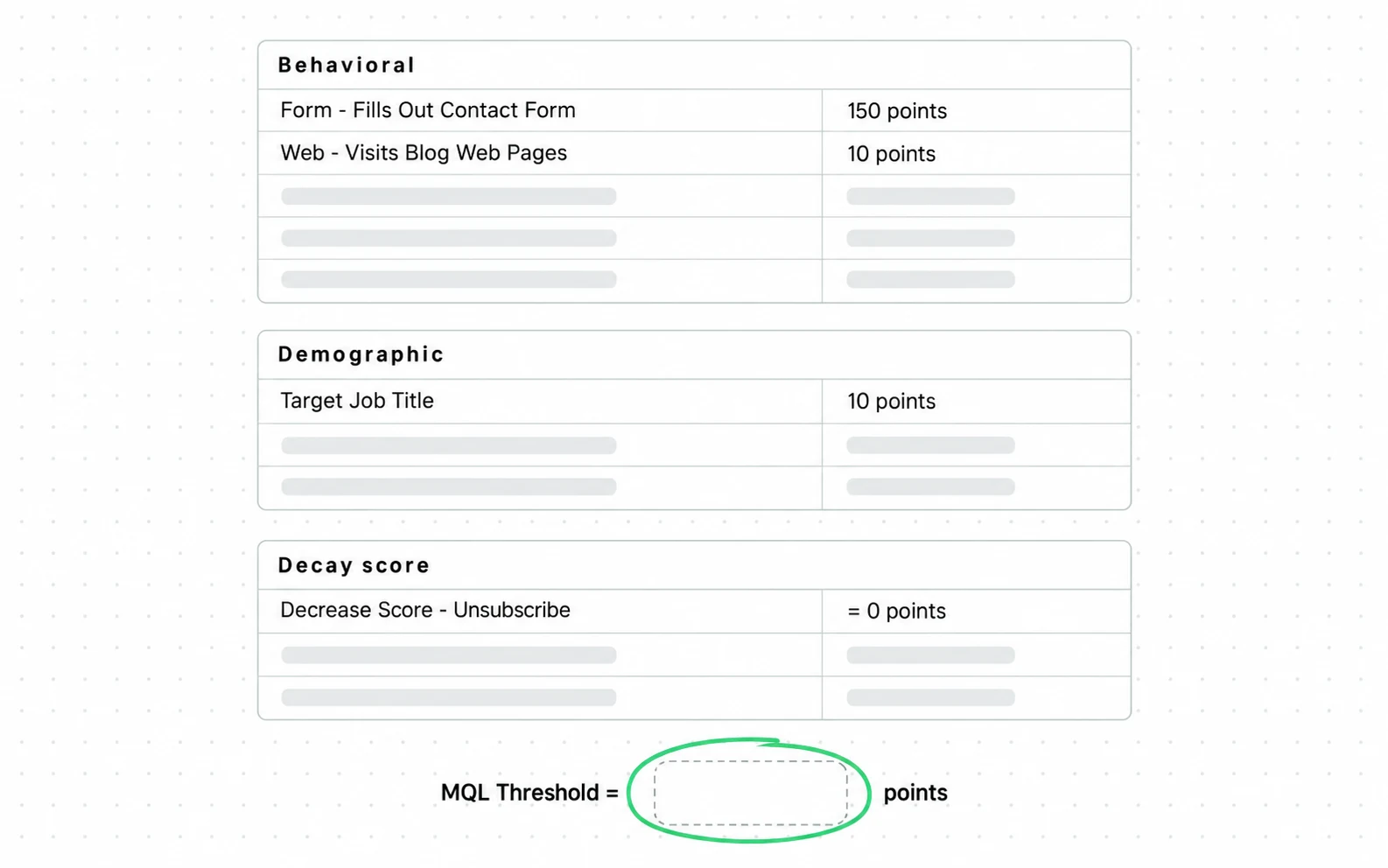
- Behavioural, demographic and decay: the same three signal types, in a model somebody published, not described.
- A contact form is worth 150 points here and a blog visit 10. The gap between those two numbers is the model’s real opinion about intent.
- The last line reads "MQL Threshold = xx points." The one number that decides everything is left blank, because it belongs to whoever fills the template in.
Say you publish six posts and a consultant reads all of them while researching a client project. Explicit and implicit signals both push that record up. Only a negative rule keeps it out of the sales queue.
How many of those records reach the MQL stage varies a lot by where they came from. First Page Sage publishes lead to MQL rates by channel for B2B SaaS.
Those rates come from its own clients, for example a paid search lead against an organic one, and the report assumes you execute well.

Setting the MQL bar as a business decision
A bar set low sends people to sales who are not ready. A bar set high sends fewer people than your reps can work. Neither is a definitional question, and no published table can tell you which way yours is wrong.
That makes the threshold a capacity question. It should be driven by sales capacity and sales feedback: enough leads to keep sales busy, and not so many that they cannot prioritise.
For example, say you have two reps and a scoring model that produces six hundred MQLs a month. The model is not wrong. The bar is.
-
Write the definition as one sentence
Fill in the blanks: an MQL is somebody who works at [company profile] and has done [action], and is not [exclusion]. If you cannot fill all three, the model has a hole.
-
Get sales to sign the sentence
Not the score, the sentence. A rep who disagrees with the sentence will reject the leads no matter what number you attach to it.
-
Set the number from capacity
Count how many new conversations your reps can hold in a month, rank last quarter’s leads by score, and cut the list there.
-
Check where your closed deals scored
If a third of last quarter’s wins sat below the line, your problem is the model. Moving the line will only hide it.
The last step is the one that separates two problems people usually treat as one. A threshold in the wrong place and a model reading the wrong signals look identical in the funnel, and they need different fixes.
Terms confused with an MQL
Three terms sit close enough to this one that teams use them interchangeably in meetings and then disagree about the numbers afterwards. The differences are small to say and large to measure.
Four terms, and who makes the call in each
| Term | Who decides | Based on |
|---|---|---|
| Lead | Nobody | The person gave you a contact detail |
| Marketing qualified lead | Marketing | A score built from fit and behaviour |
| Sales accepted lead | A sales rep, on receipt | The rep agrees it met the bar and takes it |
| Sales qualified lead | A sales rep, after contact | A conversation happened and there looks like a deal |
One more mechanical detail catches people out. HubSpot notes that its automatic lifecycle updates "will only move the stage forward," so a rejected lead does not drop back on its own.
Somebody has to move it. Otherwise your MQL count keeps climbing while the quality falls.
Marketing qualified lead handoff to sales
Once the definition is written down, the next question is what happens at the handoff and how to read the rate between the two stages. Both are covered in the comparison that sits alongside this page.
Start with the difference between an MQL and an SQL. That is where the published conversion rates live, and where they disagree. Then look at what your reps are agreeing to when they accept one.
For instance, buying against your definition is B2B PPC agency work at our search marketing agency.
Sources
- HubSpot Use contact and company lifecycle stages: defines the marketing qualified lead stage and states that automatic updates move a stage forward only
- Klipfolio SQL vs. MQL: defines an MQL as a prospect who meets the criteria the marketing team sets
- Salesforce MQL vs. SQL, by Paul Bookstaber: defines an MQL as a lead marketing deems likely to convert based on preset criteria
- Cognism MQL vs SQL, by Joe Barron: recommends an agreed score threshold and regular review of borderline leads between the two teams
- Adobe MQL vs. SQL: differences and strategies to increase revenue, placing the difference at intent to buy
- Sponge How to Create a Better Lead Scoring Model, by Jessica Sprinkel: argues the MQL threshold should be set from sales capacity and feedback
- First Page Sage B2B SaaS Funnel Conversion Benchmarks: lead to MQL and MQL to SQL rates by channel from 50 or more B2B SaaS clients in the 10 to 100 million dollar revenue range
Questions people ask
What is a MQL and SQL?
An MQL is a lead marketing has judged ready for sales. An SQL is a lead a salesperson has looked at and kept after contact.
The two stages sit next to each other in most CRMs. The criteria for both are set by the company, not by any standard.
What is the difference between a marketing qualified lead and a sales qualified lead?
Who made the call. Marketing decides an MQL from fit and behaviour, usually through a score. Sales decides an SQL after talking to the buyer.
Because each team owns its own criteria, two companies can report very different conversion rates between the stages while doing similar work.
What comes first, MQL or SQL?
MQL comes first. Marketing qualifies the lead and routes it, then sales decides whether to accept and work it.
Watch the return path. In most CRMs the stage only advances automatically, so a lead sales rejects stays marked as if it progressed.
How much do qualified leads cost?
Cost per lead varies too widely by channel and industry for a single figure to help. The more useful number is cost per qualified lead, which divides the same spend by the leads that cleared your bar.
That number moves whenever you move the bar, so record the definition next to it or the trend will mislead you.

