

What is a sales qualified lead?
A sales qualified lead is one your salespeople have examined and decided to work. Marketing hands it over and sales looks at it, and where exactly the record earns the label is a choice each company makes for itself.
A sales qualified lead is a contact the sales team has taken on as a plausible customer. HubSpot writes it as "qualified as a potential customer", and a second publisher as a lead with a high probability of converting.
Neither says when. That gap is where two companies drift apart, because one of them counts a rep accepting the lead and the other counts a meeting on the calendar.
Acceptance vs qualification
A handoff gets described as one move and worked as two. A rep first decides whether the lead was worth sending, then decides after contact whether a deal looks possible. Record only the second and the first is gone.
What happens between the handoff and an opportunity
| Stage | When it happens | What it tells marketing |
|---|---|---|
| Sales accepted lead | On receipt, before contact | Whether the bar is set right |
| Sales qualified lead | After sales accepts it | Whether the signals predicted a real need |
| Opportunity | When a deal record exists | Whether the need had a budget |
Say you route forty leads in a month and your reps reject twelve on sight. Without an acceptance step those twelve look the same as leads nobody has opened. Marketing then waits a full cycle to learn what it could have learned on day two.
The vocabulary came from somewhere. Forrester publishes the demand waterfall that put these stage names into B2B, and it kept a separate sales accepted stage between the handoff and qualification for this reason.
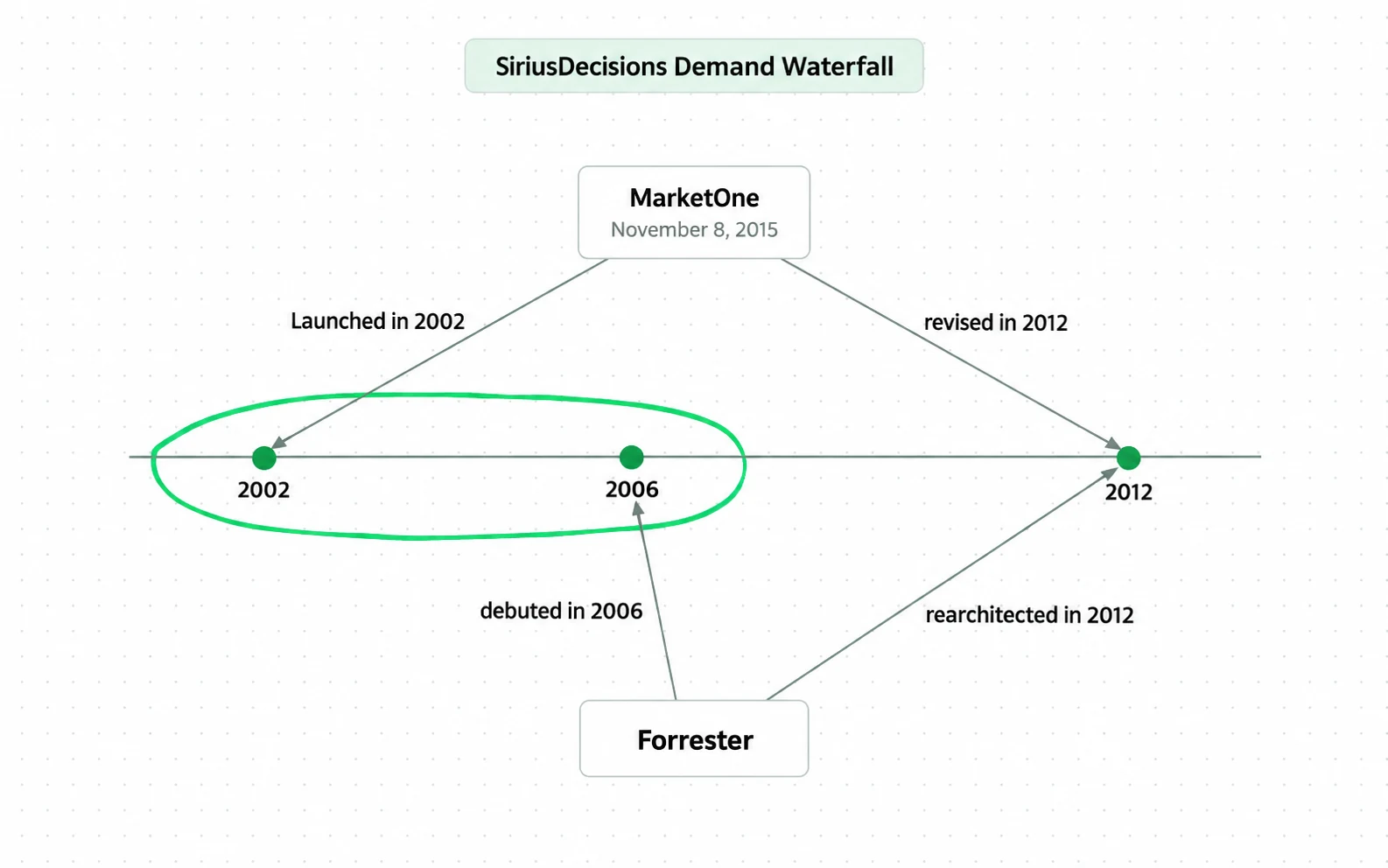
- One model, adopted widely enough that a trade publisher calls it the de facto standard. That is why your CRM ships stages you did not design.
- The headline dates it to 2002. Forrester, which owns the model, writes that it debuted in 2006 and was rearchitected in 2012.
- Ask which version somebody means before you accept a waterfall conversion rate from them.
How the definition changes conversion rates
Because your sales team owns the bar, the same funnel reports different rates depending on where you put it. A bar set at a booked meeting sits further down the funnel than one set at acceptance, so fewer leads clear it.
First Page Sage requires that an SQL "met or booked a meeting with a salesperson." Under that definition their thirty-industry table puts B2B SaaS at 13 percent.
If your own bar sits at acceptance, your rate is counting a different event.
For example, say you count a lead as qualified the moment a rep takes it. Your number will run above theirs on identical work, and only your own data can tell you by how much.
What the stage predicts downstream is steadier. The same publisher gives SQL to opportunity rates by channel for B2B SaaS. Those come from its own clients, on a stated assumption of high execution competence.

So track your own rate over time and record the definition beside it. A rate you can watch move tells you more than a rate measured against somebody else’s bar.
Four checks reps run before keeping a lead
Qualified and unqualified sound like judgements about the person. In practice your rep runs four checks that no platform ships as a standard, and a lead can fail any one of them while looking excellent on the other three.
-
Is there a problem we solve
Interest in the category is not the same as a problem. A reader comparing tools for a project starting next year fails this check today and passes it in nine months.
-
Is this person part of the decision
B2B purchases usually involve several people. One enthusiastic user is a route in, not a buyer.
-
Is there money and a date
A budget with no date and a date with no budget both stall, and they stall in different quarters.
-
Can we serve them
Wrong country, wrong company size, wrong integration. This is the check marketing can automate and often does not.
Of the four, only the last reads data you already hold: country, company size, the integration they run.
The first three ask what your buyer intends, and the usual scoring fields record attributes and actions instead. Somebody has to ask. That is the practical reason this stage exists.
Pairing a supplier’s digital tools with a sales rep makes a B2B buyer "1.8 times more likely to complete a high-quality deal", on Gartner’s reading. Using those tools alone does worse. That measures how buyers work, not how leads are routed.
The same page says most buyers prefer a rep-free experience. Put the two together and you get one instruction: the rep has to arrive where the buyer is already working.
For example, if your buyer is halfway through a trial, the useful move is a rep who has read the account. Deciding which buyer that is happens at this stage.
Stage before a sales qualified lead
The stage before this one is where most of the argument happens. That is where the bar gets set, and where the published conversion rates come from. Read the two together.
Look at the comparison first, then at how marketing builds the score that feeds this stage.
Suppose more of your leads should reach that stage: that is B2B SEO agency work.
Sources
- HubSpot Use contact and company lifecycle stages: defines the sales qualified lead stage and notes it carries sub-stages stored in the lead status property
- Zendesk Sales qualified lead: defines an SQL as a lead with a high probability of converting that has shown intent to buy and met fit requirements
- Forrester Meet the Newest SiriusDecisions Demand Waterfall, by Jessica Lillian: the model that put these stage names into B2B, dating the original waterfall to 2006 and rearchitecting it in 2012
- First Page Sage MQL to SQL Conversion Rate By Industry: publishes an SQL definition requiring that the lead met or booked a meeting with a salesperson, with rates for thirty industries
- First Page Sage B2B SaaS Funnel Conversion Benchmarks: SQL to opportunity rates by channel from 50 or more B2B SaaS clients in the 10 to 100 million dollar revenue range
- Gartner The B2B Buying Journey: reports buyers are 1.8 times more likely to complete a high-quality deal when supplier digital tools are used together with a sales rep
- MarketOne The SiriusDecisions Demand Waterfall explained: Part II, describing the waterfall as the de facto standard for managing demand generation and dating its launch to 2002
Questions people ask
What is considered a sales qualified lead?
A lead a salesperson has examined and decided to work. Companies differ on when that happens: some count it when a rep accepts the lead, others only after a meeting.
Both are defensible. Write down which one you use, because the choice moves your conversion rate by more than most campaign changes will.
What is a MQL and SQL?
An MQL is a lead marketing judged ready for sales, usually through a score. An SQL is a lead sales examined and kept.
The two stages are consecutive. The criteria for both belong to the company, not to any standard.
How to get sales qualified leads?
Start with an acceptance step. If reps mark each routed lead as accepted or rejected with a reason, marketing finds out within days which signals were wrong.
The second lever is the negative rules in the score: wrong country, wrong company size, competitor domains. Those keep records out of the queue that no amount of nurturing will fix.
What is a qualified vs unqualified lead?
Qualified usually means a rep has checked four things, though no platform publishes them as a standard. For example: a problem you solve, a person who is part of the decision, money with a date on it, and a customer you can serve.
Unqualified usually means one of those failed today. Many of them pass later. That is why a rejection reason beats a deletion.

