

Who draws the line between an MQL and an SQL?
If you are trying to settle an argument about which leads count, the thing to know first is that no outside body has settled it. The criteria are yours to set. HubSpot and two other publishers each define the stages that way.
Every published platform definition ends in the same place: a team decides. That is where the argument you are having really sits.
The standard treatment puts the difference at intent to buy. No measurement sits behind that line, so it tells you where to look and not where to put it.
How four publishers define a marketing qualified lead, in their own words
| Publisher | What it says an MQL is |
|---|---|
| HubSpot, product documentation | "a contact or company that your marketing team has qualified as ready for the sales team" |
| Klipfolio | "a prospect who meets the criteria your marketing team sets" |
| Salesforce | a lead marketing "has deemed likely to become a customer based on preset criteria" |
| Cognism | "a prospect who has shown interest in your product or service but isn’t yet ready to buy" |
None of those is a bar. They all point at whoever is holding the pen, which in your case is you and your sales team.
Four practical differences
Strip out the interest language and four things separate the two. Who decides. What evidence they use. What the lead does next. And what breaks when the bar sits in the wrong place, too low and too high.
The two stages, criterion by criterion
| MQL | SQL | |
|---|---|---|
| Who decides | Marketing | Sales |
| Usual evidence | A score built from pages viewed, forms filled, emails opened, company fit | A conversation, or a booked meeting |
| What happens next | The lead gets routed to a rep | The rep works it toward an opportunity |
| Failure when the bar is too low | Reps stop opening the queue | Nothing, because the lead never got here |
| Failure when the bar is too high | Reps run out of work | Pipeline thins two months later |
The second row is where two companies stop being comparable. A score is something you set. A booked meeting is an event that either happened or did not.
For example, if one company counts scores and another counts meetings, their conversion rates are not the same measurement. Putting them side by side tells you nothing.
What is a marketing qualified lead (MQL)?
An MQL is whatever your scoring model says it is, which sounds like a dodge until you look at what the platforms ship. HubSpot gives you eight default stages. Two of them, MQL and SQL, are defined by which team acted on the lead.
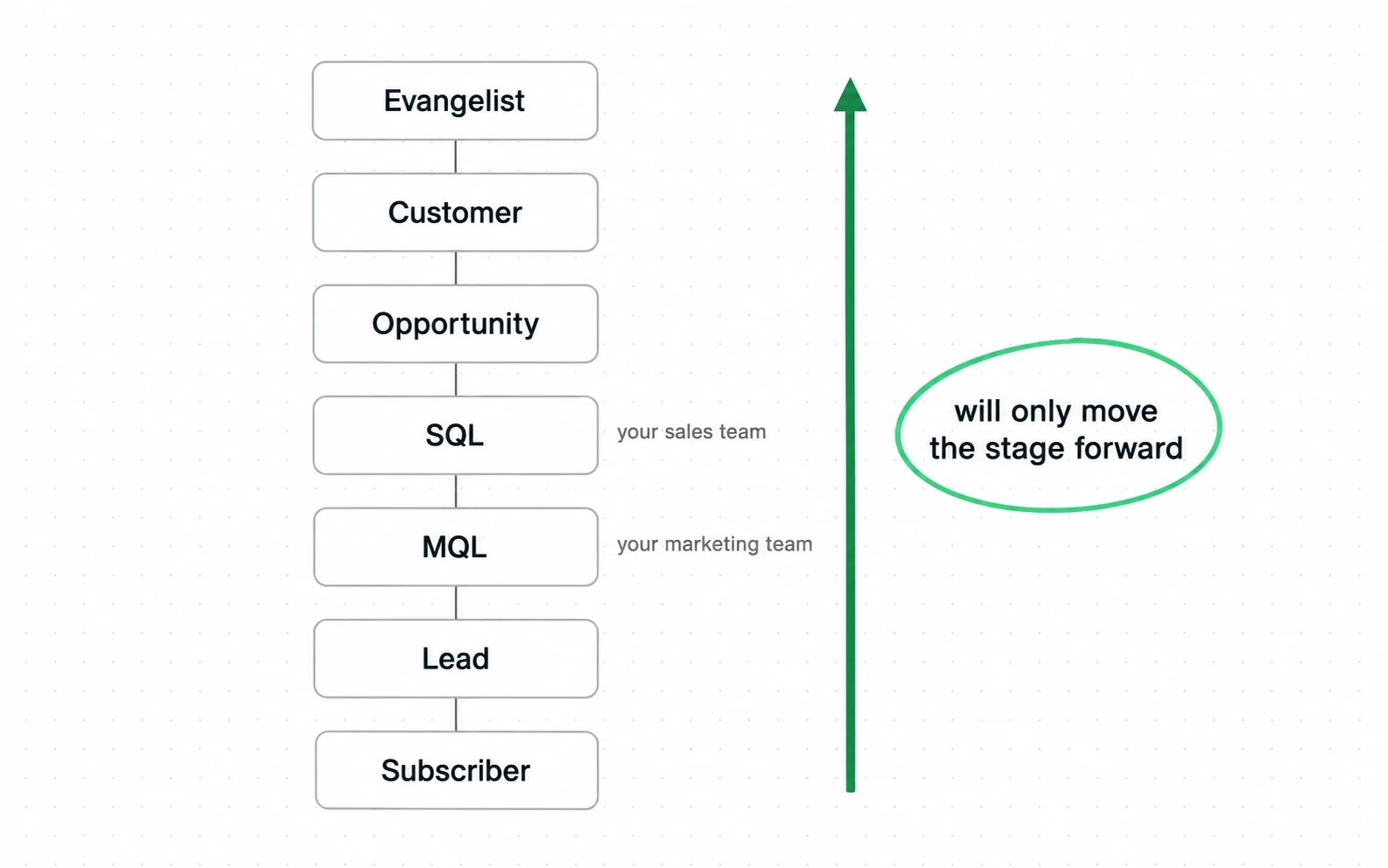
- Eight stages, and the two in the middle are the ones this page is about. Seven of the definitions name an actor or an event, and the eighth, Other, is a catch-all. None names a threshold.
- The stage sits on the contact record, so it counts people. A B2B deal is usually several people at one company, which is where this model starts to strain.
- HubSpot also notes that its automatic updates "will only move the stage forward." A lead sales rejects does not fall back on its own, so somebody has to move it or your MQL count keeps climbing.
That forward-only rule has a cost you can count. Say you have a rep working forty MQLs in a month who rejects thirty of them. Unless somebody sends those thirty back, your funnel still shows forty leads that reached sales.
So before you measure anything, find out whether your system can move a lead backwards. If it cannot, the number you are about to calculate is counting a queue, not a decision.
What is a sales qualified lead (SQL)?
An SQL is a lead a salesperson has looked at and kept. That sounds simple. But most funnels run two separate steps here, and mixing them is the most common reason two teams argue about one number.
The two steps are acceptance and qualification. A rep accepting a lead means they agree it was worth sending.
A rep qualifying it means they have talked to the buyer and think there is a deal. The demand waterfall that gave B2B this vocabulary put a separate stage between them for exactly that reason.
A sales accepted lead happens within hours of routing, and it tells marketing whether the bar is set right. That is the fastest feedback marketing ever gets.
A sales qualified lead happens after a conversation, and it tells you whether the signals predicted a real need. An opportunity happens when a deal record exists with a value on it.
Skip the first step and rejected leads look exactly like leads nobody has opened yet. Marketing then gets blamed for both.
The handoff itself still earns its place. Gartner reports that B2B buyers are "1.8 times more likely to complete a high-quality deal" when they pair a supplier’s digital tools with a sales rep. Working through those tools alone does worse.
That measures how buyers use tools and a rep together, not how leads get routed. For example, it says nothing about which lead should reach the rep first.
What it does support is keeping a rep in the path at all. That is the reason to draw this line and draw it well.
Benchmarks for the MQL to SQL rate
Everybody arrives wanting a number to aim at. A table of them is published online, and you should read it. You still cannot use it as a target, and the reason sits inside the same table.
First Page Sage publishes MQL to SQL rates for thirty industries from its own client data gathered between 2019 and 2025. B2B SaaS sits at 13 percent. Legal Services and Real Estate sit at 10 percent, HVAC and Business Insurance at 26 percent.

Half the table sits in the lowest band and B2B SaaS is in it.
Look at what sits above 20 percent: HVAC, insurance, hotels, heavy equipment. What those industries share is not published alongside the table, so check the pattern in your own market before you trust it.
The second argument is stronger and it comes from the same publisher. Their B2B SaaS funnel report, dated 11 June 2025, breaks the same step down by channel.
It reads 26 percent for PPC, 30 for LinkedIn, 39 for webinars, 46 for email and 51 for SEO. The lowest channel is double the industry figure.
Both numbers can be true at once, and the reason is printed on their own page.
SQLs are any lead that in addition to the criteria above, have also (a) moved through marketing to sales with an intent to buy; (b) been vetted by a salesperson and determined to be a good fit; and (c) met wor booked a meeting with a salesperson.
First Page Sage, MQL to SQL Conversion Rate By Industry read 5 September 2026
- Their SQL requires that the lead "met or booked a meeting with a salesperson." That is an event, and it sits further down the funnel than a rep simply accepting a lead.
- The channel report covers five sources and states an "assumption of a high level of competence" from the team running them. The industry table has no such condition, and it includes traffic the channel table leaves out.
- The headline says 2026 Report. The publication date under it says 3 October 2024, and the data runs to 2025. A year in a benchmark title is a label, not a measurement date.
A rate is not good or bad on its own. Judge it against a definition, a channel mix and a set of companies, and check all three before you borrow anybody’s number. Then make sure yours is computed the same way twice.
-
Fix the denominator
Count MQLs created in a period, then follow that same group forward. Dividing this month’s SQLs by this month’s MQLs mixes two different cohorts and moves whenever volume moves.
-
Fix the window
Decide how long an MQL has to become an SQL before it stops counting. Thirty days and ninety days give you different answers from identical data, and a B2B cycle is long enough that the choice matters.
-
Fix the unit
One company can send you four contacts. Decide whether that is four MQLs or one, and apply the same rule at both ends.
-
Write the three choices next to the number
Then anybody comparing your rate to a published one can see immediately whether the comparison holds.
Setting a bar from sales capacity
If a benchmark cannot give you a target, something has to. The most useful answer we found in practice is also the least glamorous: work backwards from how many conversations your reps can hold in a week.
The MQL threshold should be driven by sales capacity and sales feedback. Qualify enough leads that sales is busy, but not so many that they cannot prioritize what matters.
That turns a definitional argument into arithmetic.
-
Count the conversations you can hold
Say you have three reps who can each work twenty-five new leads a week properly. That is seventy-five a week, or roughly three hundred a month.
-
Sort last quarter’s leads by score
Take the scoring model you already have and rank every lead it touched, highest first.
-
Cut at three hundred
Whatever score sits at that line is your threshold. You did not pick the number. Your capacity picked it.
-
Check what the cut throws away
Look at the deals you closed last quarter and find where they scored. If a third of them sat below the line, your model is ranking on the wrong signals and no threshold will fix that.
-
Revisit it when capacity moves
A new rep, a quiet quarter or a longer cycle all change the answer. The bar is a dial, not a definition.
Step four is the one people skip, and it is the one that separates a threshold problem from a scoring problem. Those need different fixes, and no benchmark can tell them apart for you.
Cases where counting leads misleads
Sometimes sharpening your MQL definition is wasted work, and the case is common. If several people at one company are evaluating you at once, a model that qualifies one contact at a time is counting the wrong unit.
The organisation that put MQL and SQL into common use said this first. Forrester, which owns the SiriusDecisions demand waterfall, published a new version in 2017 built around demand units instead of leads.
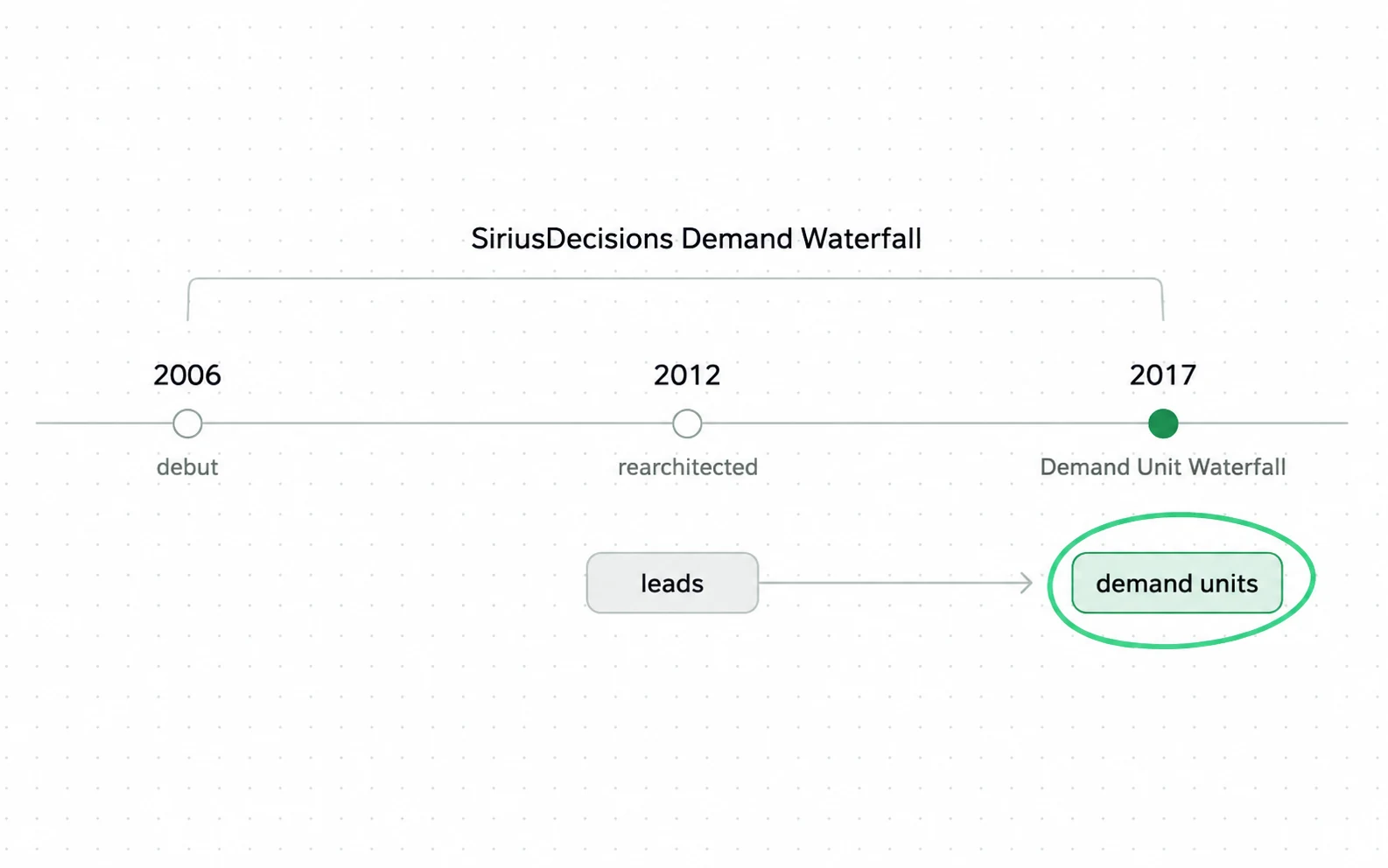
- Forrester defines a demand unit as "a buying group that has been organized to address a need the organization is challenged with." The thing you qualify is the group, not the contact.
- The same post says the waterfall debuted in 2006 and was rearchitected in 2012. Explainers that date it to 2002 are working from something other than the publisher.
- Note what did not happen. The stages were not deleted, so this is not an argument for abandoning qualification. It is an argument about what you are qualifying.
A second case belongs to software you can try before you buy. One publisher places the product qualified lead alongside these two for product-led companies, where the signal is what somebody did inside the product.
So if your best leads arrive through a free trial, a form-fill score is reading the wrong file.
Neither case retires the line. Both change what sits on either side of it, and that is worth settling before you spend a quarter tuning a scoring model.
Settling it is most of what gets sold as sales and marketing alignment, and the benefit figures that programme is usually defended with do not survive being traced.
Suppose your definition is settled: buying against it is B2B PPC agency work at Addition, a search marketing agency.
Sources
- HubSpot Use contact and company lifecycle stages: product documentation listing eight default stages with a definition for each, and stating that automatic updates move a stage forward only
- Forrester Meet the Newest SiriusDecisions Demand Waterfall, by Jessica Lillian: announces the Demand Unit Waterfall, defines a demand unit as a buying group, and dates the original waterfall to 2006 with a 2012 rearchitecture
- First Page Sage MQL to SQL Conversion Rate By Industry: rates for thirty industries from client data gathered between 2019 and 2025, with published MQL and SQL definitions, the SQL requiring a booked or held meeting
- First Page Sage B2B SaaS Funnel Conversion Benchmarks: MQL to SQL by channel from 50 or more B2B SaaS clients in the 10 to 100 million dollar revenue range, stating an assumption of high execution competence
- Gartner The B2B Buying Journey: reports that buyers are 1.8 times more likely to complete a high-quality deal when they use supplier digital tools together with a sales rep, not independently
- Salesforce MQL vs. SQL: What Are They? How Do They Help You Sell?, by Paul Bookstaber, carrying a 21 percent MQL to SQL figure attributed to Gartner through a link that redirects to a general pipeline guide
- Klipfolio SQL vs. MQL: defines an MQL as a prospect who meets the criteria the marketing team sets, and puts the core distinction at timing
- Cognism MQL vs SQL: What They Mean and Why They Matter, by Joe Barron, recommending an agreed score threshold and regular review of borderline leads
- Amplitude MQL vs SQL: positions the product qualified lead alongside both for product-led companies, where in-product behaviour is the signal
- Sponge How to Create a Better Lead Scoring Model, by Jessica Sprinkel: argues the MQL threshold should be driven by sales capacity and feedback, not a fixed score
- Adobe MQL vs. SQL: differences and strategies to increase revenue, the first result for this term, placing the difference at intent to buy and citing no measurement
Questions people ask
What comes first, MQL or SQL?
MQL comes first. Marketing qualifies a lead against its own criteria and routes it to sales, and sales then decides whether to accept and work it.
In most CRMs the stage only moves forward on its own, so if sales rejects a lead somebody has to move it back by hand.
What is a good MQL to SQL ratio?
No table can hand you a target. First Page Sage puts B2B SaaS at 13 percent across its client base. Its own channel report for the same industry runs from 26 to 51 percent, because the two reports count different things.
Set your bar from what your reps can work, then track your own rate over time. A rate you can watch move tells you more than a rate measured against somebody else’s definition.
How can I convert an MQL to SQL?
Faster routing and a real acceptance step do most of the work. If a rep has to agree a lead met the bar before it counts, marketing finds out within days which signals were wrong.
The other half is the scoring model itself. Check where last quarter’s closed deals scored: if they sat below your threshold, raising the threshold will make the rate look better and the pipeline worse.
What is the key difference between a marketing qualified lead and a sales qualified lead?
Who made the call. Marketing decides an MQL from behaviour and fit, usually through a score. Sales decides an SQL after contact with the buyer.
That is the whole difference, and it is why neither term has a fixed meaning across companies. The criteria belong to the two teams, and they are worth writing down in one sentence each.

