

Lead nurturing defined by lead state
Most definitions of lead nurturing describe an activity you run. One describes a person and their state, and that difference decides who belongs in a sequence at all.
One definition is the process of providing valuable offers and resources that persuade prospects to advance through the sales funnel. A second is building relationships with potential customers by providing relevant resources and personalized content that guide them through the sales funnel.
A third definition puts the person at the centre instead of the machinery. It is the process of cultivating leads that are not yet ready to buy. The subject is the person and their state. How you turn that state into an enrolment rule is left open, and nothing published closes it, so the decision is yours.
That distinction carries further than it looks. A definition built on activity describes what you send. A definition built on state describes who receives it. So do the mechanical decisions further down. Enrolment, exit and suppression are all decisions about who.
Before any of this, look at how many programmes exist at all. If you are about to argue for one internally, the base rate is worth holding. In the only survey on this subject that publishes its sample, more people reported no programme and no plans than reported one they can measure.

Three platforms with three vocabularies
Nurturing reads like a sequence until you open a workflow builder. Inside it, three words carry every real decision you make: trigger, rule and delay.
The three words have exact meanings and get used loosely. A trigger, in Mailchimp’s wording, is "an event or action that adds a contact to a flow." A rule is "a type of step that defines how and when a contact moves along a set path." A time delay "prevents contacts from continuing down the flow path for a period of time that you choose."
Klaviyo draws the same line with different words. It lists five trigger types for you to pick from: list, segment, metric, date property and price drop. People "qualify to enter a metric-triggered flow when they take a specific action (for example, placing an order)." Delays stay separate: "each time delay creates a waiting period between one component and the next."
How wide is the set of things that can enrol your contacts? Mailchimp groups its starting points into five kinds. Contact activity, such as a tag being added. Dates, such as a birthday. Shopping activity, such as an abandoned cart. Marketing activity, such as an email open. And API or integration events. A sequence can begin on any of those, which is why the first design question is never what to write.
HubSpot calls entry enrolment and names four automatic types, event, filter, webhook and schedule, plus manual enrolment. Its event example is a form submission: objects "will enroll when an event has happened. For example, when a form has been submitted."
The same mechanism, in three product vocabularies
| Platform | What it calls entry | How entry is described | What sets the spacing |
|---|---|---|---|
| Mailchimp | starting point, or trigger | An event or action that adds a contact to a flow | time delay |
| Klaviyo | trigger | Five types: list, segment, metric, date property, price drop | time delay |
| HubSpot | enrolment trigger | Four automatic types plus manual enrolment | no separate delay definition |
One of those definitions is the bridge between the two halves of this page. It is the only one that says what the cadence keys on: determine the campaign goal, message flow, content offers, communication channels, and overall cadence based on previous interactions. Previous interactions is the kind of thing a metric trigger reads. It names no product and nothing else picks the line up. That page gives the input and stops there; the platform help pages give the machinery and never say why.
Two lead nurturing behaviours that surprise people
Both of the rules below are written down in platform help pages, and neither turns up in advice about nurturing. Both change what a real programme does on an ordinary Tuesday, and both are settings, not accidents.
The first is who can enter twice. HubSpot documents its default plainly: "records are only enrolled in workflows the first time they meet the workflow enrollment triggers or are enrolled manually."
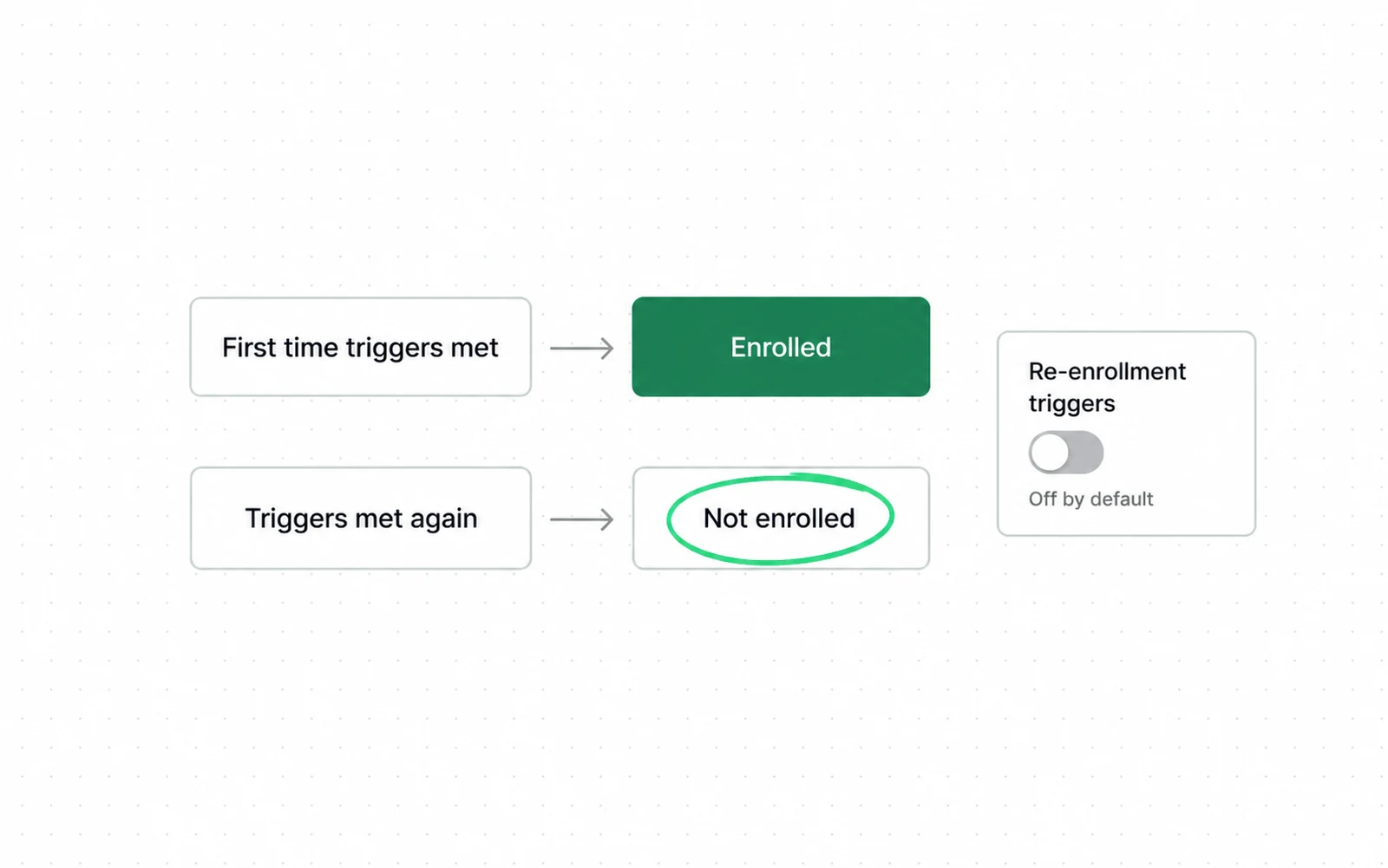
- Someone who downloads a second guide six months later does not enter the sequence again.
- Re-enrolment exists and is a deliberate setting, not the default.
The second is what happens to someone who qualifies to leave while a delay is running. Braze documents it directly, and the behaviour is not what most people would guess.
When a user performs the exit event, Braze immediately marks them to exit the Canvas. … If they’re in a Delay step, they remain in that step until the delay period ends.
Braze documentation, Canvas exit criteria read 6 September 2026
- The exit is registered at once. Leaving the journey waits for the delay to finish.
- A thirty day delay means a person who converts on day one is still inside it on day twenty nine.
Braze adds that a marked person moves to no later step. Two vendors publish rules about entry and exit that decide what a person who converts mid sequence experiences, and advice to nurture never mentions that such rules exist. Open your own builder and check what a converted contact receives. For instance, put a test address through the sequence, mark it converted on day one, and read what arrives over the following month.
How much does nurturing software cost?
Running a sequence means using something that stores the triggers and counts the delays. Those prices are published on each pricing page and you can check them yourself, which is more than can be said for the other half of the bill.
Klaviyo publishes a free tier: up to 250 profiles and 500 emails a month, with support by email. A first sequence for a small list costs nothing in licence terms on that plan.
HubSpot publishes three tiers on its marketing pricing page. Starter starts at $7 a month per seat with 1,000 marketing contacts. Professional starts at $800 a month with 2,000 contacts and three seats, plus a one time onboarding fee of $3,000. Enterprise starts at $3,600 a month with 10,000 contacts and five seats, plus $7,000 onboarding. Those are the figures printed on the page on 6 September 2026, and it does not separately state whether the monthly prices assume annual billing. Both vendors revise them, so read the current page before budgeting.
The other half of the bill is not on any pricing page. In the Ascend2 survey, creating targeted and engaging content was the most cited difficulty and determining the cadence the least cited, though the survey measured what people found hard, not what they spent.

Content ranked first among the difficulties that survey asked about. A sequence nobody reads is a delay with a bill attached, and where a budget goes next is a judgement the survey does not make.
Suppose the sequence needs pages a buyer would open. Writing those is B2B SEO agency work at our search marketing agency.
Write entry and exit rules before the emails
A nurture programme can be built starting from a set of emails, with the mechanics added afterwards. Four decisions taken in the other order produce a sequence you can explain to somebody else, and each one is a setting.
-
Name the entry event
Not a category, an event your tool can see. A form submission, a segment membership, a specific action. For instance: submitted the pricing form, works at a company with more than fifty staff, has not booked a call. Each of the three platforms above calls this something different, and each of them requires it before anything else can be configured.
-
Decide whether anyone can enter twice
HubSpot enrols records once by default. Suppose a lead downloads a guide in March, goes quiet, and downloads another in October. If you never touched the setting, October does nothing. Decide which behaviour you want, then set it deliberately.
-
Write the exit before the emails
What makes somebody stop receiving this? A booked call, a purchase, a reply, a sales owner assignment. Braze documents that a delay can hold someone after they qualify to leave. Check what your own tool does in that window before you assume it ends at once.
-
Set the spacing from the entry event, not from a template
Cadence follows previous interactions. That instruction is useful because you can test it. Somebody who requested pricing and somebody who read one blog post should not sit in the same delay. If your sequence cannot tell them apart, look at the entry rule before you rewrite anything.
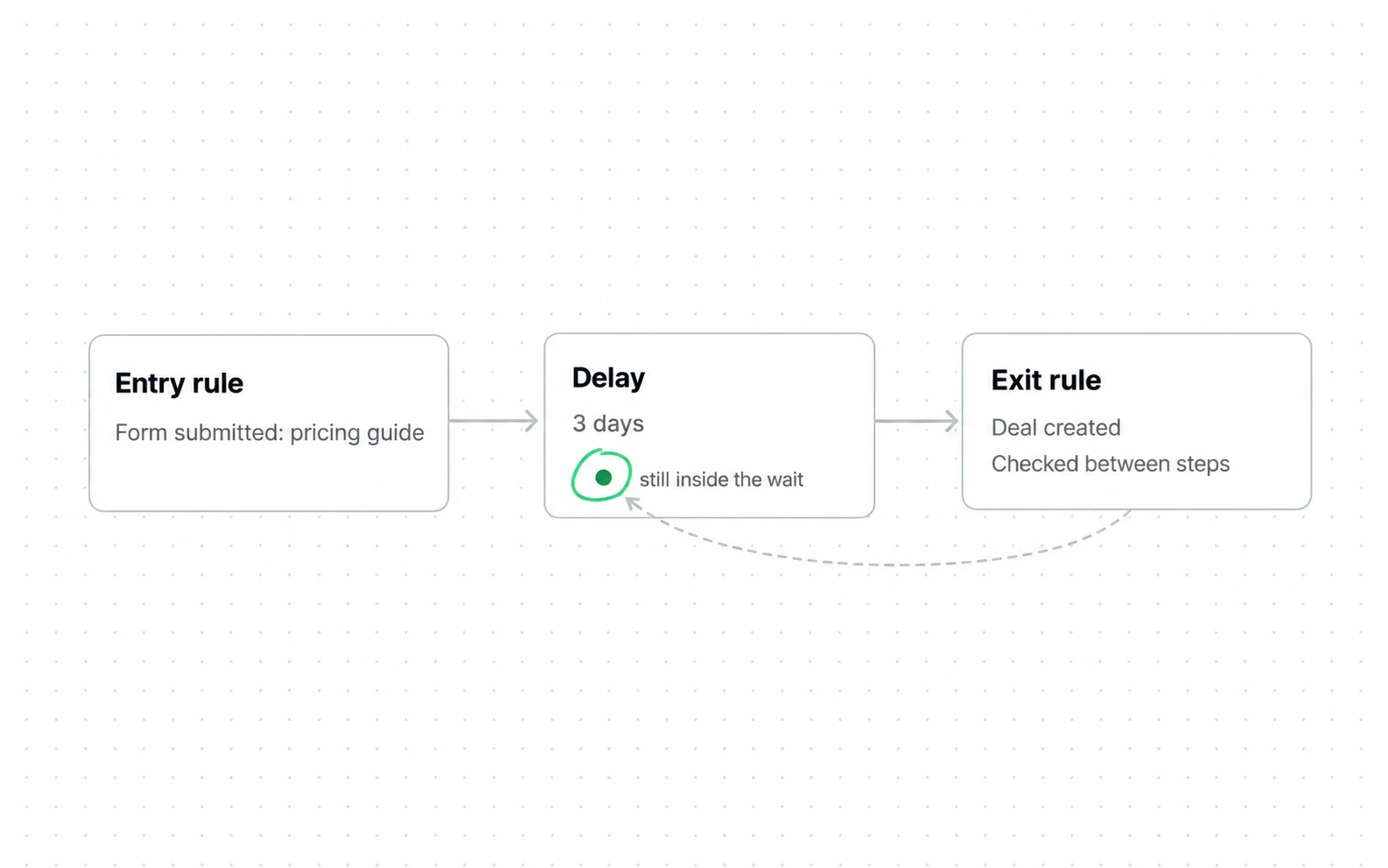
Everything a guide would call strategy sits downstream of those four. The messages, the offers, the channel mix all follow from who is in the sequence and what gets them out of it.
Judging a benchmark by who produced it
One survey on this subject publishes its sample, and that alone puts it above the citations floating around it. It also makes clear why its numbers are not a B2B answer, and the reason is printed on its own methodology page.
Ascend2 surveyed 325 marketers between 19 and 26 April 2021 and printed who they were. Split by primary channel, the panel is 47 percent B2C, 31 percent B2B and 22 percent both equally. Fifty eight percent work at companies with fewer than fifty employees.

A B2B reader quoting the headline figures from that report is quoting a panel that is mostly not B2B. That is not a reason to discard it. Saying so when you use it is what separates a citation from a decoration.
One page shows what happens when the date goes missing instead. It says today that according to a December 2015 Ascend2 study, 59% of B2B companies say that creating relevant content is their biggest obstacle to lead nurturing success. Trade coverage of that research was published on 14 December 2015, which places the study in or before that month. The same firm published a fresh study in 2021 with its sample printed on page three.
No comparison is drawn between the two figures here. Nothing shows the two surveys asked the same question of the same kind of panel. The smaller observation holds anyway. A decade old number is still in wide circulation, and its age is visible only to a reader who follows the citation.
One more habit is worth building, and this report supplies the example. Its page on programme status says "over two-thirds (35%) of marketers responding to the survey have a working plan to nurture leads in place." Thirty five percent is not over two thirds. The 35 comes from adding the two in place answers on its own chart, 18 and 17. The number is sound. The sentence describing it is not.
That matters because the sentence travels further than the chart. Anybody quoting the report from its prose inherits an over two thirds claim about a figure that is closer to a third, and nothing in the quotation shows the mistake. Read the chart, not the summary above it, whenever you are about to repeat a number.
The same report names which channels people use. Email leads at 69 percent, social media follows at 67, then website personalisation at 38, paid advertising and retargeting at 34, and mobile automation at 14. Those figures sum past 100 because respondents picked more than one, so read each as the share who named that channel.
This panel put social almost level with email. Personalisation and retargeting came in at roughly half that rate. If your plan is an email sequence and nothing else, make that choice on purpose.
For your own programme the measurement is simpler than any benchmark. Pick a window, count unique people, not enrolments, and decide up front whether a re-enrolment counts once or twice. Then count three things: how many entered, how many left through your defined exit instead of unsubscribing, and how long the converters spent inside.
Sources
- Oracle What is Lead Nurturing: defines it by the state of the lead, and names what cadence is based on
- Salesforce What is Lead Nurturing: definition plus a personal observation that most leads take 12 to 24 months to convert
- IBM Lead Nurturing: definition, and statistics about AI adoption, not about nurturing
- INFUSE Lead Nurturing Campaigns: a case study reporting two lead touches
- Business News Daily Lead nurturing examples and strategies: no figures, and the advice to strike the right balance
- Mailchimp About marketing automation flows: definitions of a trigger, a rule and a time delay
- Mailchimp All the marketing automation flow triggers: starting points grouped into five categories
- Klaviyo Flow trigger types: list, segment, metric, date property and price drop, with the delay defined separately
- HubSpot Set your workflow enrollment triggers: four automatic trigger types and the first time only default
- HubSpot Create workflows: enrolment timing and the rule that an enrolled record cannot re-enrol until it finishes
- HubSpot Marketing Hub pricing: Starter, Professional and Enterprise with their onboarding fees
- Klaviyo Pricing: a free tier capped at 250 profiles and 500 emails a month
- Braze Exit criteria: what happens to a user who qualifies to leave while sitting inside a delay
- Ascend2 The State of Lead Nurturing, published May 2021: 325 marketers surveyed between 19 and 26 April 2021, with the respondent profile printed
- Marketing Dive Creating relevant content is the main obstacle to success: dates the Ascend2 study Oracle cites to 14 December 2015
Questions people ask
How many emails should a lead nurturing sequence have?
No published number sets it. What enrols a person, and what qualifies them to leave, decides it instead. Only one page says what the decision keys on: cadence based on previous interactions.
Build the entry and exit rules first. The count falls out of them.
What is the difference between a trigger and a delay?
A trigger decides who enters. Mailchimp calls it "an event or action that adds a contact to a flow." A delay decides spacing once they are in.
Klaviyo draws the same line, listing five trigger types and defining a delay as a waiting period between one component and the next.
Can the same person go through a nurture sequence twice?
By default in HubSpot, no. Its documentation says records are only enrolled the first time they meet the enrolment triggers or are enrolled manually, and a record already enrolled cannot re-enrol until it completes the workflow. Re-enrolment is a setting you turn on deliberately.
What happens if someone buys in the middle of a sequence?
That depends on what you built. Read the help pages for your own platform before you assume. Braze states that a user who performs the exit event is marked to exit immediately, but if they are inside a delay step they remain in that step until the delay ends. Check what your own setup sends during that window.

