

What ROAS measures and leaves out
ROAS is revenue attributed to a campaign divided by the cost of that campaign. Google Ads writes it as a percentage: 5 dollars in sales divided by 1 dollar in ad spend gives a 500 percent target ROAS. Most ecommerce teams say it as a multiple instead, so the same number is a 5x.
One cost in, one revenue out.
The word return covers one cost only. ROAS counts the ad spend and nothing else. Return on investment includes the total cost of a campaign, the software, design and distribution around it, while ROAS isolates the direct ad spend. Neither of them counts what the product cost you.
| Metric | What is in the denominator | What is in the numerator |
|---|---|---|
| ROAS | Ad spend only | Revenue attributed to the ads |
| ROI | Ad spend plus the costs around the campaign | Revenue, or profit, depending on who is speaking |
| Profit on ad spend | Ad spend | Gross profit, not revenue |
Why do two tools report different ROAS for the same spend?
The formula is arithmetic and the arithmetic is not where the disagreement comes from. The numerator is a number some tool decided to attribute to your ads, using a window you chose and a model it chose, and different tools make different decisions.
The numerator is a decision, not a count.
Start with the window. Google Ads records a conversion for a set period after the ad interaction, and that period is a setting.
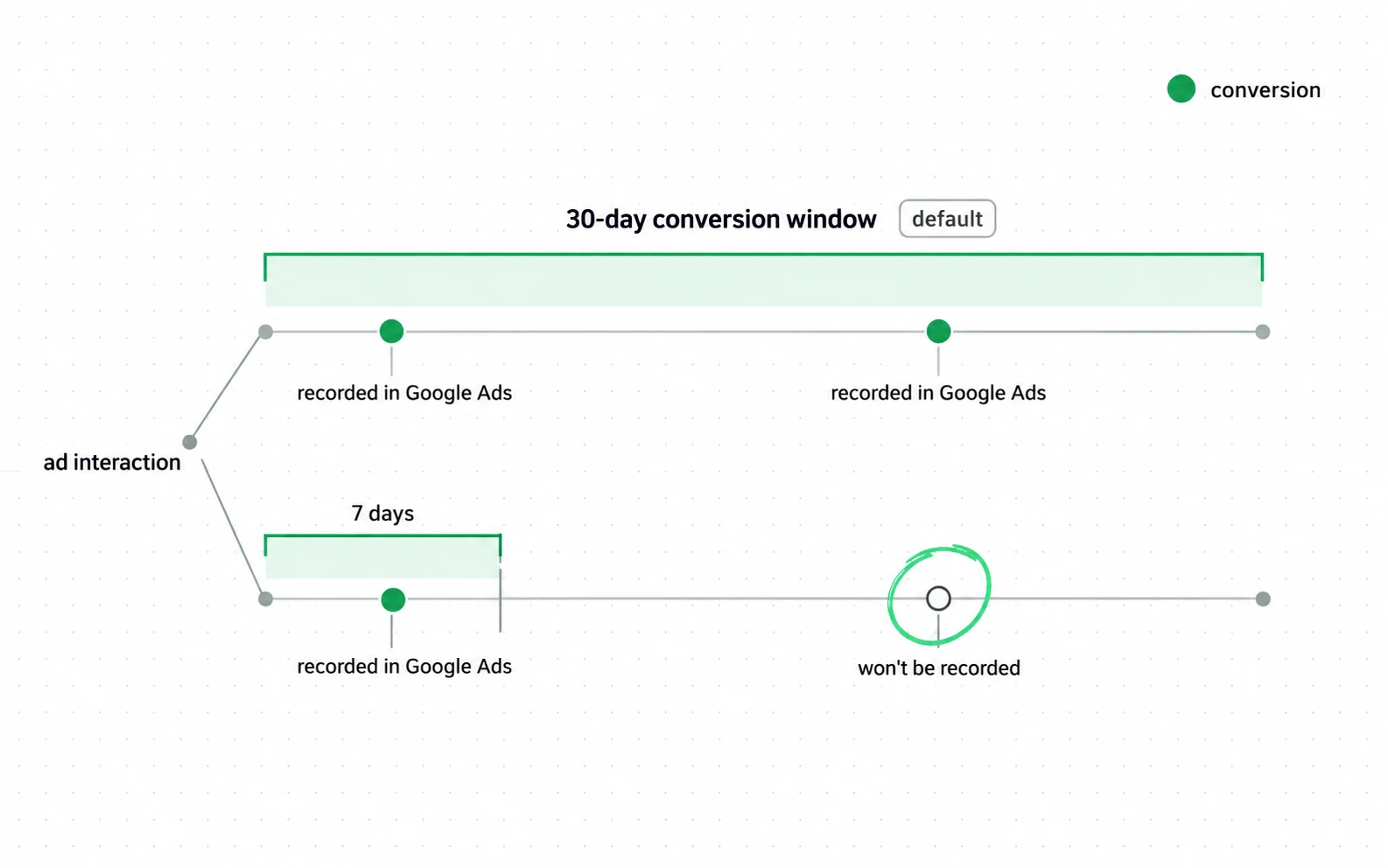
- A conversion window is a period, and the page says it is editable per conversion action. So it is a decision, not a measurement.
- The example on the page runs the arithmetic in the other direction: shorten the window to seven days and conversions that happen later stop appearing in the report.
- The default is thirty days after a click. Two accounts with different windows produce different ROAS from identical spend and identical orders.
Suppose you have to reconcile the two numbers before you move budget. That is the whole subject of the attribution skill: one source of truth for your count, never a sum across platforms.
Then the model. Shopify’s marketing reports default to last click, giving all the credit to the last channel the customer touched, with a 30-day lookback. Google Ads has its own attribution model, and it works with the values your own conversion tracking sends. Its Target ROAS documentation says the platform predicts future conversions and values using the conversion values you report. So the numerator on one screen begins in your tag setup, and the numerator on the other begins in Shopify’s. If the value being sent is itself a rate, not an order total, then what a conversion rate is decides the number before any attribution runs.
| Where you read it | What decides the numerator | Default window |
|---|---|---|
| Google Ads | Its attribution model and the values your tracking sends | 30 days after a click, 1 day after a view |
| Shopify marketing reports | Last click, from tracked campaigns and UTM parameters | 30 days |
| Your accounts | Orders that settled and were not refunded | Whatever the month is |
One more setting to check before you compare two months: Google states that changing a conversion window applies to conversions going forward and does not recount the ones already recorded. A window change is therefore a break in the series, not a restatement of it.
What counts as a good ROAS?
People ask this four different ways and get the same answer back. The benchmark in circulation is 4 to 1, and the threshold it is standing in for moves with a number that is different for every store.
Break-even ROAS is one divided by your gross margin.
One glossary states the 4 to 1 figure and cites no sample for it. A sample could exist; what it could not be is right for every store.
The reasoning is one step. ROAS has not paid for the goods. If your gross margin is 40 percent, every 2.50 of revenue leaves 1.00 of gross profit, so 2.50 of revenue per 1.00 of ad spend is exactly break-even. Below it you are buying orders at a loss.

Reading the other three questions off the same table
That table also answers the other three questions in the box. A ROAS of 1 returns exactly the spend and has paid for none of the goods, so it is a loss everywhere. A 2.5 is break-even at a 40 percent margin, below the floor at 30 and clear of it at 50. A 5x means five dollars of revenue per dollar spent, and whether that is good is the same question again.
ROAS vs profit and vs Target ROAS
The first mix up is treating ROAS as though it were a profit measure. It is a revenue measure with one cost subtracted. Ad spend is rarely the biggest thing standing between revenue and profit. Goods, shipping, payment fees and returns all sit outside it.
A rising ROAS can arrive with falling profit. Move budget onto a product that looks efficient and sells at a thin margin, and the ratio improves while the contribution does not.
The second is the bidding strategy with the same name. Target ROAS in Google Ads is an automated bidding strategy, not a report, and it has entry requirements. Google lists at least 15 conversions in the past 30 days for Search and Shopping, and at least 50 in 35 days for Demand Gen campaigns. Below those thresholds it is not a target you have chosen, it is a strategy that has too little to learn from.
Where the same three letters stop being a report
Google Ads · Campaign settings · Bidding · Strategy
Maximize clicks
Maximize conversions
Maximize conversion value
Target CPA
1Target ROAS
Manual CPC
- The marked row is a setting, not a column. Everything else on this page is a number you read afterwards; this one is an instruction you give beforehand.
- It carries entry requirements the list does not show: Google names at least 15 conversions in 30 days for Search and Shopping, and 50 in 35 days for Demand Gen.
- Below those, choosing it does not set your target. It hands the bidding to a system with too little to learn from.
Which is the same trap how Google Ads works sets in a different place: the number you type is an input to a system, not an instruction to it.
Related guides: click pricing and conversion rate
That is the term and the threshold. How the price of each click is decided, and why Google publishes six inputs and your bid is one of them, is our guide to how Google Ads works.
One rule from it belongs here: what you pay is not what you bid.
If the constraint turns out to be the site and not the auction, the cheaper fix sits on the other side of the click. What a visit is worth is where that gets measured, the subject of conversion rate optimization.
Work out your gross margin on your best-selling product, divide one by it, and compare the answer to the ROAS your ad account is reporting. The two cover different ground, one product against every campaign, so read a shortfall as a question, not a verdict: either the account is buying orders at a loss, or the mix is carrying products whose margins are better than your best seller’s. Both are worth finding out, and the campaign-level version of the same division is the one that settles it.
Suppose your account is running under that break-even line: fixing it is PPC agency work at Addition, a search marketing agency.
Sources
- Google Ads Help Target ROAS: the formula, conversion values from your own tracking, and the minimum conversion thresholds
- Google Ads Help Conversion windows: 30-day click default, 1 to 90 day range, changes are not retroactive
- Google Ads Help Attribution models: comparing last click against data-driven attribution
- Shopify Help Center Marketing reports: last-click default, 30-day lookback, and the note that the sales figure can differ
- AppsFlyer ROAS glossary entry: ROAS isolates ad spend while ROI includes the costs around the campaign
- BigCommerce Return on ad spend glossary entry, stating a 4 to 1 benchmark This page carries no publication date of its own.
Questions people ask
What is a good ROAS?
The lowest ROAS that is not a loss is one divided by your gross margin. At a 40 percent margin that is 2.5; at 20 percent it is 5.0. Anything published as a universal benchmark is answering a question about someone else’s margins.
Is a roas of 1 good?
No. A ROAS of 1 means the campaign returned exactly what it cost, before you paid for the product, the shipping or the payment fees. A ROAS of 1 is a loss on any store with a cost of goods.
Is a 2.5 roas good?
A ROAS of 2.5 is exactly break-even at a 40 percent gross margin, below the floor at 30 percent, and clear of it at 50. Clearing the floor is the first gate, not the last one: shipping, payment fees and returns all sit above it.
What does 5 roas mean?
Five dollars of attributed revenue for every dollar of ad spend. Whether it is good is the same question as before: at a 20 percent gross margin, 5x is exactly break-even.

