

What do you buy in a Google Ads auction?
There is no fixed price and no position you can buy. An auction runs every time somebody searches. Your ad competes in that one auction, against whoever else is eligible for that search at that moment.
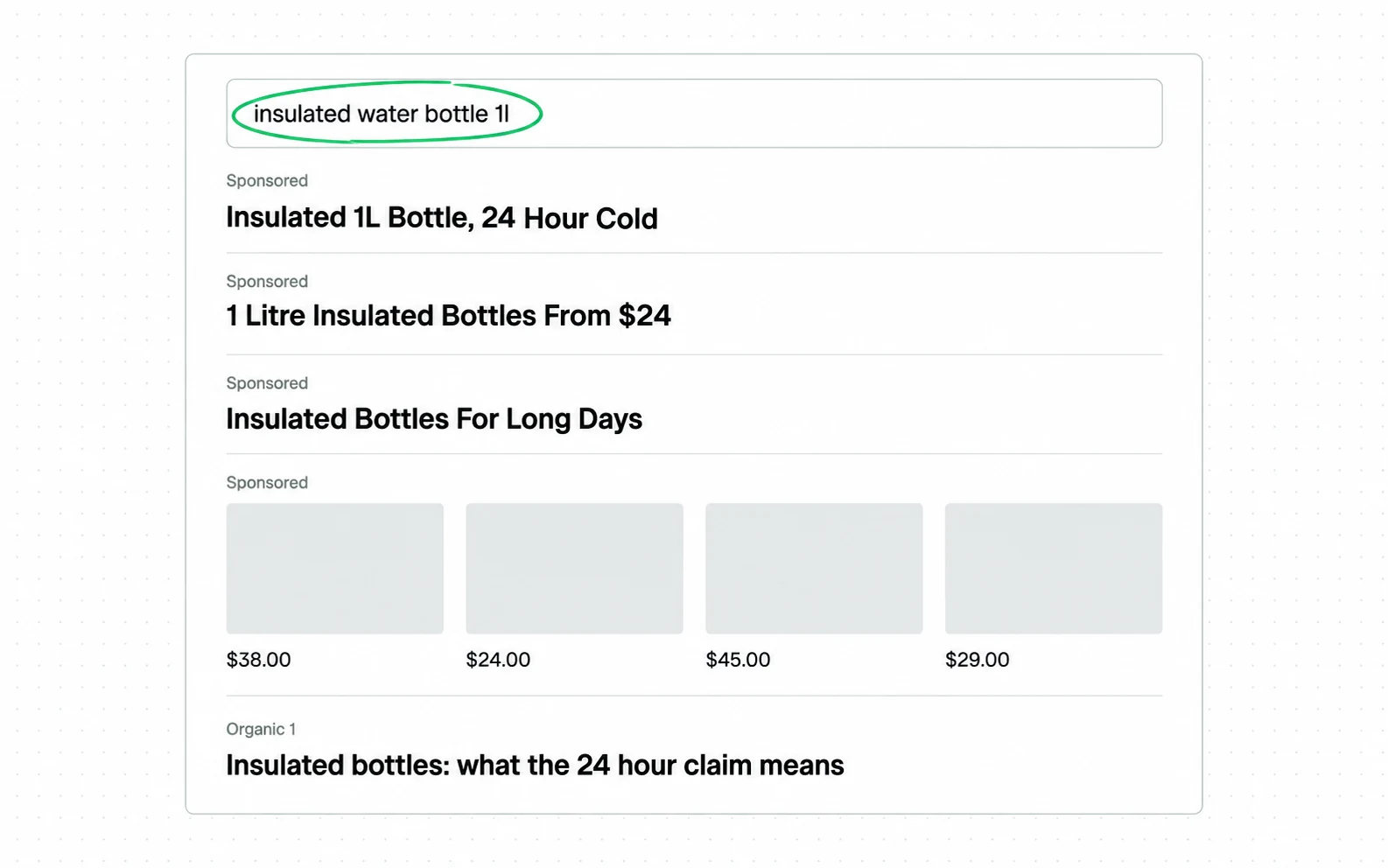
There is no fixed price.
That is why two people looking at the same keyword report see different costs. That is also why the position you had yesterday is not yours today. Nothing is reserved, and every impression is a separate contest. Ads inside ChatGPT may or may not work the same way. Treat its auction mechanics and its performance as unknown until you have campaign data of your own.
Advertising has arrived inside assistants too, and what OpenAI has published about it is collected in ChatGPT Ads, with its own sources. Nothing on this page describes how that pricing works.
The same auction runs for Google Shopping ads. There the bid attaches to a product in a feed, not to a keyword, and what the feed contains decides what can be bid on.
Because the auction reruns constantly, the levers that matter are the ones that apply every time. A one-off bid increase changes one variable. Improving what makes your ad eligible changes which contests you are in at all.
Ad Rank scores are calculated based on many factors, including your bid amount, the quality of your ads and landing page, the Ad Rank thresholds, the competitiveness of an auction, the context of the person’s search … and the expected impact of assets and other ad formats.
support.google.com, Ad Rank: Definition read 10 September 2026
- Bid is named first and then five more things follow it, one of which is the other advertisers in that auction. Half the list is not yours to set.
- Ad Rank is calculated twice in one auction: once to decide whether you show at all, and again to decide where. Losing on the first pass is not a low position, it is no ad.
- The context list is worth reading slowly. Location, device, time, the wording of the search, and the other results on the page. That is why the same keyword reports two different costs to two advertisers.
Six Ad Rank inputs
That contest is not a black box, and the list of inputs Google weighs is short. Google's Ad Rank page names six of them. Three are the ones to check when a campaign will not move.
| Input | What it means |
|---|---|
| Your bid amount | The most you will pay for a click. You rarely pay it |
| The quality of your ads and landing page | How relevant and useful your ad and destination are to that search |
| Ad Rank thresholds | The minimum you have to clear to show at all |
| The competitiveness of the auction | Who else is eligible for this particular search |
| The context of the search | Location, device, time, the exact terms, what else is on the page, user signals |
| The expected impact of assets and ad formats | Whether your sitelinks, callouts and other assets are likely to be used and to help |
Three inputs to check first
Six inputs, and three of them decide whether you appear at all.
Those three are not footnotes. Thresholds decide whether you appear at all. Context decides which auction you are in. Asset impact means the shape of your ad changes its rank, not just its clickthrough rate.
One of the context signals is whether the person has been to your site before. That is a campaign type of its own, and Google Ads remarketing has its own audience thresholds, exclusions and budget logic, so it gets its own guide.
| Lever | Why it sits here | |
|---|---|---|
| 1 | Clear the thresholds | Or nothing else applies |
| 2 | Improve ad and landing page quality | Compounds, and lowers what you pay |
| 3 | Add and earn the assets | Changes the shape of the ad in the auction |
| 4 | Raise the bid | Immediate, linear, and the most expensive |

Quality Score as a diagnostic readout
Quality Score is widely treated as the quality input to the auction, and the documented input is the quality of your ads and landing page. The Ad Rank page lists something else in that slot, and the difference between the two changes what you can do about a low score.
Quality Score is a readout, not a lever.
The common explanation runs the other way and gives Ad Rank three inputs. Google’s own page lists six, and the three that go missing are the ones that explain why your campaign is stuck.
What the page says instead is the quality of your ads and landing page. Quality Score is a separate, one-to-ten reporting number built from three components, and those three are the actual levers: expected clickthrough rate, ad relevance, and landing page experience.
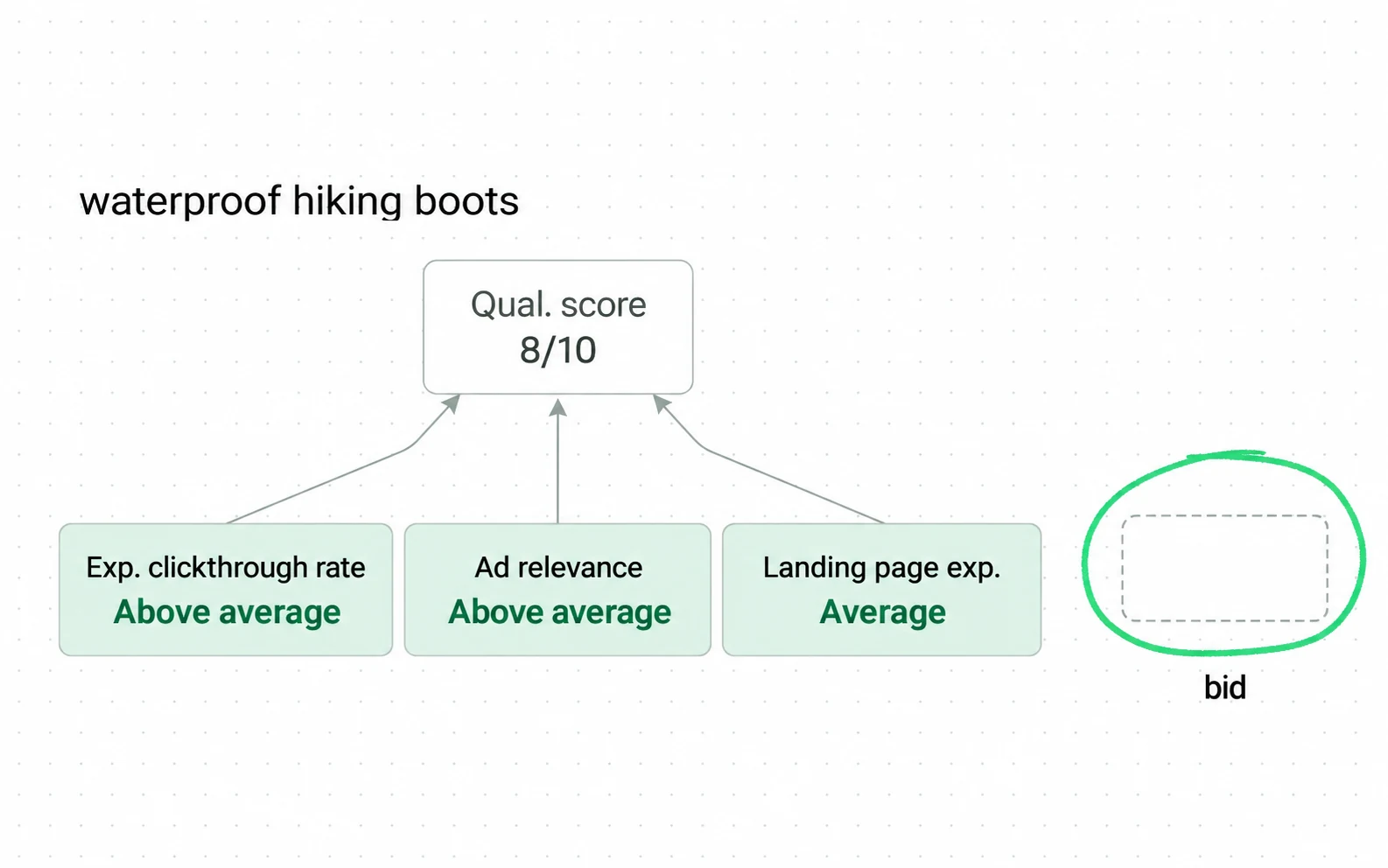
The confusion is the same one that makes teams steer by a conversion rate instead of revenue. That is why what a conversion rate is has to be settled first: a readout gets treated as a control.
The difference sounds academic until you watch what it does to a meeting. Teams set a target Quality Score, chase it, and pause keywords for scoring low. The number is an aggregated readout that lags what it reports. Chase it and you are optimising a summary instead of the thing it summarises.
Ad relevance and landing page experience are the two the auction shares with organic search, which is why how AEO and SEO differ matters to a paid account too.
None of this makes the three components irrelevant. The three components can be inspected separately, so manage each one and not the combined score. Jyll Saskin Gales makes the practical case in Search Engine Land: rising CPCs are usually a quality problem wearing a bidding costume, and the fix is your lowest sub-score. So stop managing Quality Score and manage the three components instead. They fail for different reasons and have different fixes.
- Expected clickthrough rate is about the ad matching the intent of the search. Tighter query-to-ad matching fixes it, not exclamation marks.
- Ad relevance is about the ad matching the keyword. Not running one ad against a bag of loosely related terms fixes it.
- Landing page experience is about the destination doing what the ad promised. That component is the one most often broken by somebody else's decision, usually a homepage redirect.
Why an ad never shows
An ad that gets almost no impressions while the budget sits untouched has a documented cause. Raising the bid is the instinct, and Google documents a separate gate that a higher bid alone may not open. The barrier is not always the bid.
Google documents Ad Rank thresholds as a separate concept, with their own page, and what determines them is specific. Lower quality ads have higher thresholds. Ads appearing higher on the page have higher thresholds than ads appearing lower; and thresholds vary by the user's location, their device, and the nature of their search terms.
Landing page experience is one input among those six. Treat page speed as an unverified contributor to landing page experience. What is published is Core Web Vitals, the one place a number to hit has been published at all, on the organic side.
Read that list again with a stuck campaign in mind. Your bid is one of the things it names, and a bid does not move the rest. If your quality is low your threshold is high, so you can outbid a competitor and still fail to clear the bar.
Start a Google Ads account with no conversion data
The guidance above assumes an account with performance history. Thresholds decide whether your campaign appears at all, and in your first month the bidding strategy has no conversion history to use. Your new account has no conversion data, so the strategies that need it have nothing to work from.
Nothing exists to optimise against yet.
The mistake is structural, so no amount of bid tuning fixes it. Define the conversion event before you touch the setup.
Smart bidding optimises against your conversion data, and Google documents that these strategies use conversion history. Your new account has none, so the mechanism has nothing to optimise on while it collects some.
The cost of starting Smart Bidding without conversion history is not published, so the reasoning here is the mechanism and not a measurement.
The same rule decides when a Performance Max campaign is worth switching on. Our own rule puts it after your first search campaigns have produced some conversion history. Nobody states it in those terms.
What to check first
Say you want the month-one structure for an account like yours written out. The ads skill has it, and its Google Search playbook moves you to automated bidding at fifteen conversions.
-
Start on Maximize Clicks, not on a conversion strategy
This is our standing rule and it applies to every account we launch. It rests on a mechanism and not on a published trial. With zero conversion data a conversion-based strategy has nothing to optimise against, so your first job is buying enough clean traffic to produce a signal. Somebody has measured the reverse mistake too. In December 2025 Optmyzr analysed billions of impressions and found that accounts manually overriding Smart Bidding after it had signal paid higher CPCs for lower return. What the signal should be pointed at is contested. Google's own guidance reports roughly 25 percent more conversions when Target CPA campaigns move from phrase to broad match. In September 2023 Optmyzr measured 2,637 accounts and found 72.5 percent getting better ROAS on exact. The two are not measuring the same thing. Google counts conversion volume on eligible Target CPA campaigns, and notes that more budget may be needed. Optmyzr counts which match type produced better ROAS in accounts running mixed strategies. Volume at a higher cost and return per pound are different questions, and the conclusion is that neither number tells you what your account will do.
-
Move to smart bidding once you have five to ten conversions
This is our own operating standard and not a Google threshold. The reasoning is that a conversion strategy needs conversions to learn from; how many is a judgement we have settled on, not a number anyone has published.
-
Get conversion tracking right before spending anything
A campaign optimising toward a broken conversion event is worse than one optimising toward nothing, because it is confidently wrong. Check the event fires, once, on the right page.
-
Structure by what the searches are worth, not by what is easy to segment
Splitting by device or location fragments data the bidder already prices at auction time. Split when the value differs enough to price differently. Otherwise consolidate and let the auction do its job.
-
Send the click to the page that matches the ad
Landing page experience is one of three components behind quality, and the homepage redirect is the most common way to break it. The ad promised something specific. Deliver that.
-
Batch your significant edits
Google says the learning period restarts after a significant change and names targeting, the bid strategy and the optimisation event among them. The duration varies, and a significant budget change can trigger another learning period. So batch your edits, on the grounds that four separate restarts are worse than one. That is reasoning, not a measured cost.
If you want the account run for you, the Google Ads agency team at Addition, a search marketing agency, covers the setup and the ongoing auction work as one job.
Click price and daily budget versus the monthly charge
Once your first month is behind you the questions turn to money, and three of them come up constantly. What you pay per click, whether a small daily budget is workable, and why the monthly charge is bigger than the daily number times thirty.
What you pay against what you offered
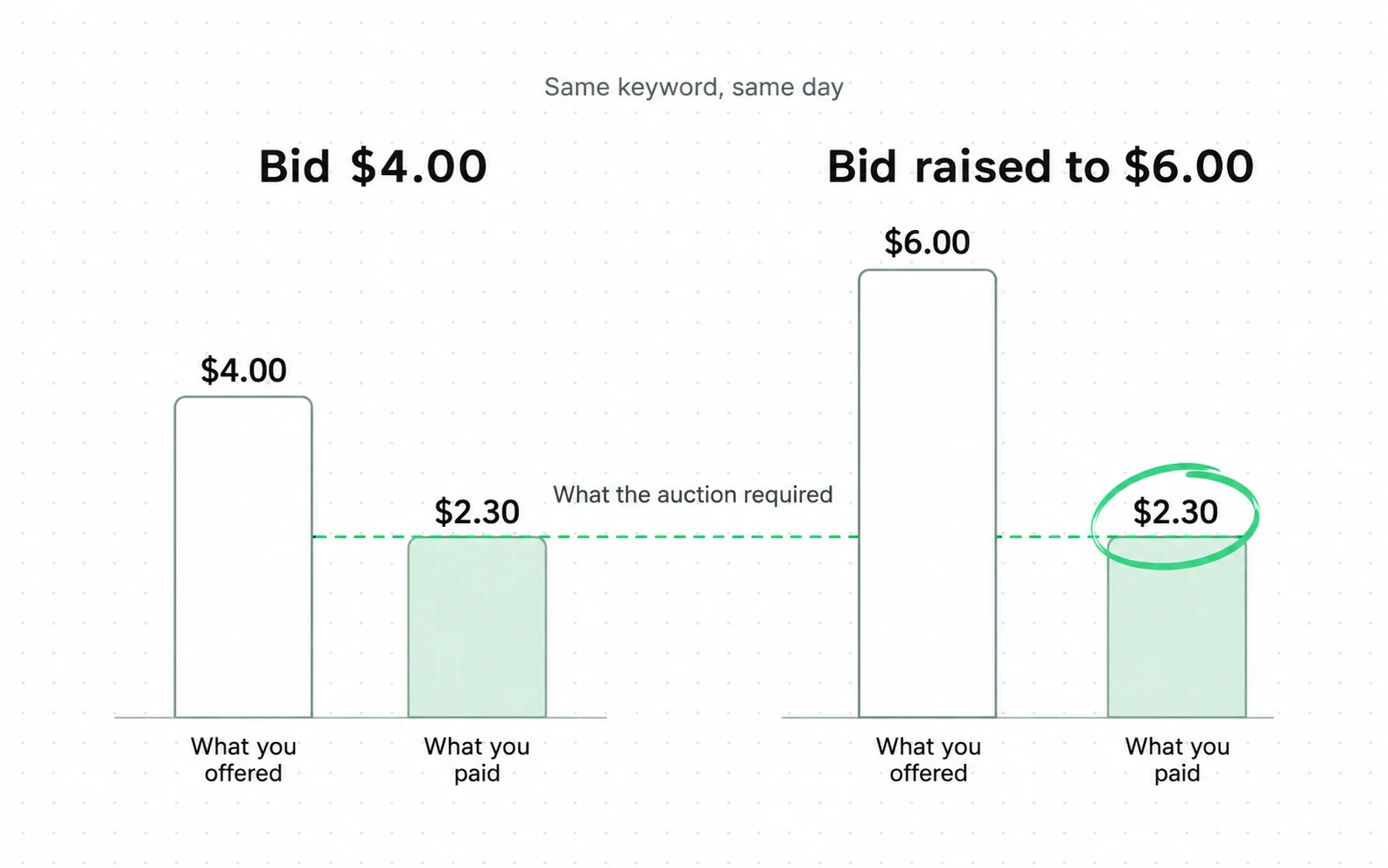
Your bid is a ceiling, not a price.
Your bid is a maximum, and Google says you usually pay less than it. Raising it raises your ceiling, and whether it raises what you pay depends on the auction you land in.
The design behind that behaviour is the generalized second-price auction, set out in peer-reviewed papers by Hal Varian in 2009 and by Edelman, Ostrovsky and Schwarz in 2007. Neither paper describes today’s implementation, so they explain why paying less than your bid is possible and not what your account will pay.
Quality is the cheaper lever, because better quality lowers the threshold you have to clear.
Tinuiti's July 2025 quarterly benchmark draws on more than four billion dollars of managed spend. That series is the closest thing to a public price record for your sector.
Is twenty dollars a day workable?
It depends entirely on your cost per click, and the arithmetic is short. At two dollars a click, twenty dollars a day is ten clicks. If your site converts at two percent, that is one order every five days, which is too little data to make a decision with inside a month.
A click you paid for and then wasted costs twice. So end the arithmetic at revenue per visitor, not cost per click. That is where conversion rate optimization picks it up.
So do not ask whether the budget is big enough in dollars. Ask whether it produces enough events to learn from before you run out of patience.
If it does not, the lever is what the money is spread across, not how much of it there is. Narrowing the targeting concentrates the same spend on fewer auctions, and whether those auctions convert better is something only your own account answers.
Why the charge is bigger than you expected
The overspend is capped monthly, not daily.
Daily budgets are averages, not caps. Google spends more on a high-traffic day and less on a slow one, balanced across the month. The monthly limit is the real ceiling; the daily figure is a target inside it. A charge that looks like an overspend is usually the averaging working as documented.
Whether that monthly figure is better spent here or on earning the position is the question SEO or paid search works through with the click-share data.
Google Ads numbers worth reporting
Those three money questions all end at the same place: what you report. Most accounts get judged on cost per click and Quality Score. Neither tells you whether the auction work is succeeding. Two other numbers do, and one of them separates two failure modes that look identical from outside.
One number, split two ways.
Start with impression share, and specifically the two reasons you lose it. Lost to budget is a money problem with one fix. Lost to rank is not one problem at all. Rank comes from all six inputs. It could be a bid, a competitor who just arrived, a threshold you are under, a quality component, or the context of the search. The report names the family, not the member. Both look the same from outside, and they have opposite fixes.
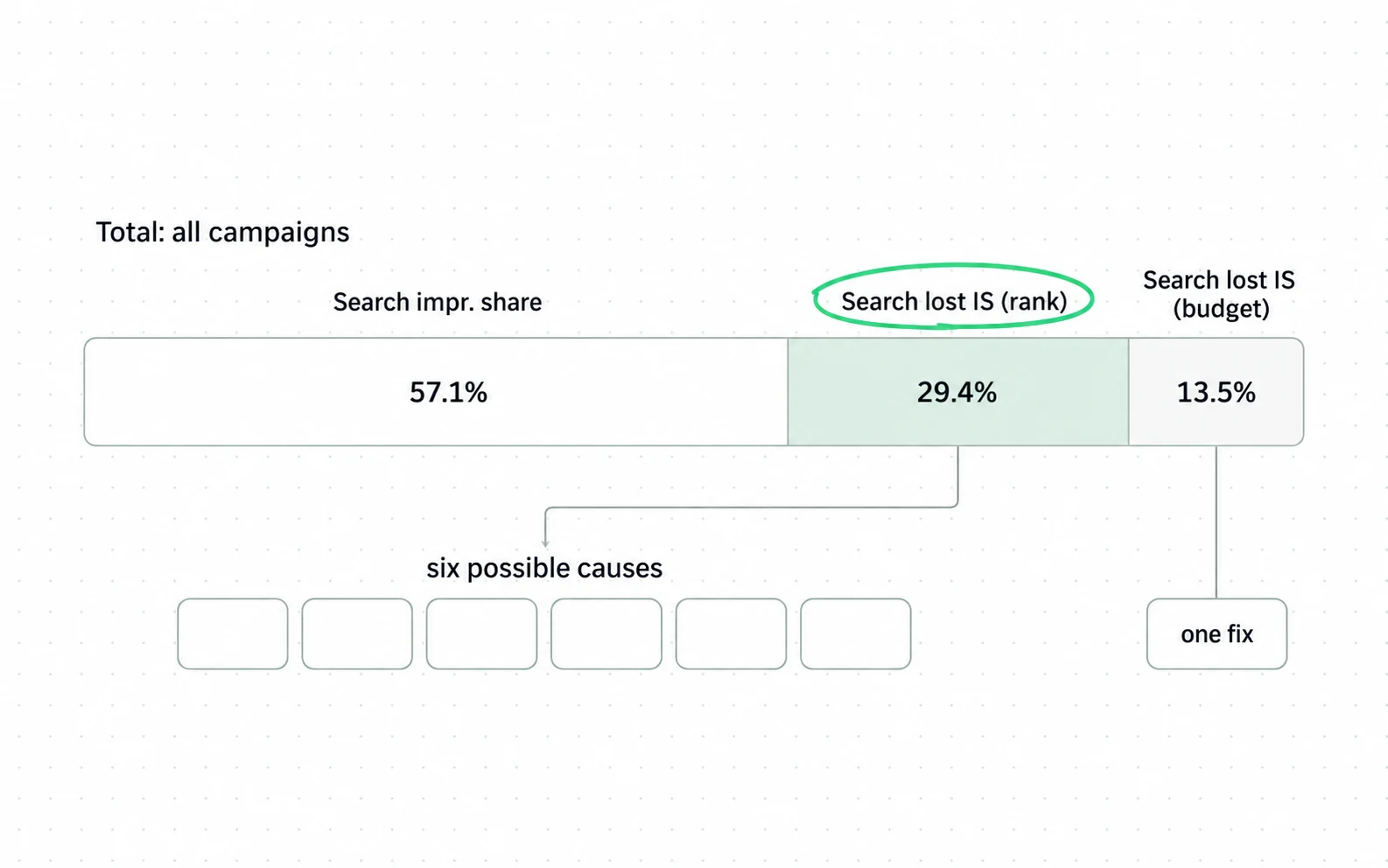
That split is the most useful diagnostic in the account. Check it before you act on anything above. Losing share to budget while you chase quality is a wasted quarter.
Two more reads of the same report
In the Auction Insights report, read overlap rate alongside impression share to see how often each competitor appeared when you also appeared. Check one more overlap first. In July 2025 Optmyzr measured 503 accounts and found Search and Performance Max keyword overlap in 91 percent, with Search converting about 19 percent better where they overlapped. A campaign that looks incremental in the report can be buying traffic you already had.
Read that overlap finding next to the click losses that arrive when an AI answer appears above the results. AI search engine optimization covers those, because the two move the same denominator from opposite ends.
For the wider picture, Merkle has published a quarterly paid-search spend and click series since 2011, so it covers more years than most published series in this channel. Then the outcome number. Not cost per click, which measures the auction, not the business, but cost per acquisition against what a customer is worth to you over a year. A rising cost per click alongside a falling cost per acquisition means you are buying more expensive clicks that convert better.
That reads as a decline on the first number and an improvement on the second. Read the account on cost per click alone and you will call the whole thing a decline.
The auction only prices the click. What happens after it, the domain of conversion rate optimization, decides whether the acquisition side of that ratio ever moves.
The outcome number most accounts settle on is return on ad spend, and it only tells you something once you know what a good figure would be for your margin.
Open your account and split impression share lost to rank from impression share lost to budget. Ten minutes, and it tells you which of the two families your problem sits in.
Identifying which lever inside rank is responsible still needs the list above.
Sources
- Edelman, Ostrovsky and Schwarz Internet Advertising and the Generalized Second-Price Auction, American Economic Review 97(1)
- Optmyzr Broad match versus exact match study, 2,637 accounts Measured 3 years ago, on a surface that has moved since.
- Optmyzr Is Performance Max cannibalizing your Search campaigns? 503 accounts Measured 14 months ago, on a surface that has moved since.
- Google Ads Help Bidding documentation: Smart Bidding, Maximize Clicks, and broad match with Smart Bidding (Google internal data)
- Tinuiti Digital Ads Benchmark Report Q2 2025, $4B+ managed spend Measured 14 months ago, on a surface that has moved since.
- Merkle, Dentsu Digital Marketing Report, quarterly paid search spend and click series since 2011 This page carries no publication date of its own.
- Brad Geddes, Adalysis Quality Score component analysis across client accounts
- PPC Hero Auction Insights analysis: reading overlap rate against impression share Measured 10 years ago, on a surface that has moved since.
- Jyll Saskin Gales, Search Engine Land How Google Ads quality score really affects your CPCs
- WordStream Google Ads benchmarks 2025, average CPC, CTR and conversion rate by industry Dated 2025 with no month given, so its exact age is not knowable from the source.
- Optmyzr Smart Bidding override study, analysis of billions of impressions
- Hal Varian Online Ad Auctions, American Economic Review 99(2), the generalized second-price mechanism
- Google Ads Help About conversion windows, the default thirty-day setting
- Search Engine Journal What Is Ad Rank and 3 Ways To Improve It, the three-input explanation pattern Measured 4 years ago, on a surface that has moved since.
- JumpFly Six components of Google Ad Rank and how to improve it without raising bids Measured 3 years ago, on a surface that has moved since.
- Google Ads Help About Ad Rank, the six inputs
- Google Ads Help About Ad Rank thresholds
- Google Ads Help About Quality Score and its three components
- Google Ads Help How daily budgets and the monthly spending limit work
Questions people ask
How do Google Ads work for beginners?
You choose searches you want to appear for and set a maximum you will pay for a click. Each time somebody runs one of those searches an auction runs, and Google decides which ads show and in what order.
The part beginners usually miss is that Google publishes six inputs, and your bid is one of them. The quality of your ad and landing page, minimum thresholds you have to clear, and the context of the search all sit alongside it.
Is $20 a day good for Google Ads?
It depends on your cost per click, and the arithmetic decides it. At two dollars a click that is ten clicks a day. If your site converts at two percent you are looking at roughly one order every five days, which is not enough data to make decisions from inside a month.
When the budget is tight the more effective move is usually narrowing the targeting so the same money buys fewer and better qualified clicks, instead of raising the budget.
Why did Google Ads charge me $500?
Daily budgets are averages, not caps. Google can spend above your daily figure on a high-traffic day and below it on a quiet one, balancing across the month against a monthly limit.
So a charge that looks like an overspend on any given day is usually the averaging behaving as documented. If the monthly total exceeds what the daily budget implies for the month, that is a different problem, and one to check.
What is a Quality Score?
A one-to-ten diagnostic number built from three components: expected clickthrough rate, ad relevance, and landing page experience.
The number is not an auction input. Ad Rank is calculated from the quality of your ads and landing page, not from the score. Manage the three components. The score is the readout.
How do you improve Quality Score?
By fixing its three components separately, because they break for different reasons. Tighter matching between the search and the ad improves expected clickthrough rate. Not running one ad against a bag of loosely related keywords improves ad relevance.
Landing page experience is the one most often broken by a decision made elsewhere, usually a redirect that sends specific ad traffic to a general homepage. The ad made a specific promise. The page has to keep it.

