

Where do ChatGPT ads appear in a conversation?
OpenAI announced advertising in ChatGPT and documents it in its own help centre. Ads appear within the thread, next to or below the answer, carrying a Sponsored label. Who sees them depends on region and account type, and OpenAI keeps the list of live markets on its own page.
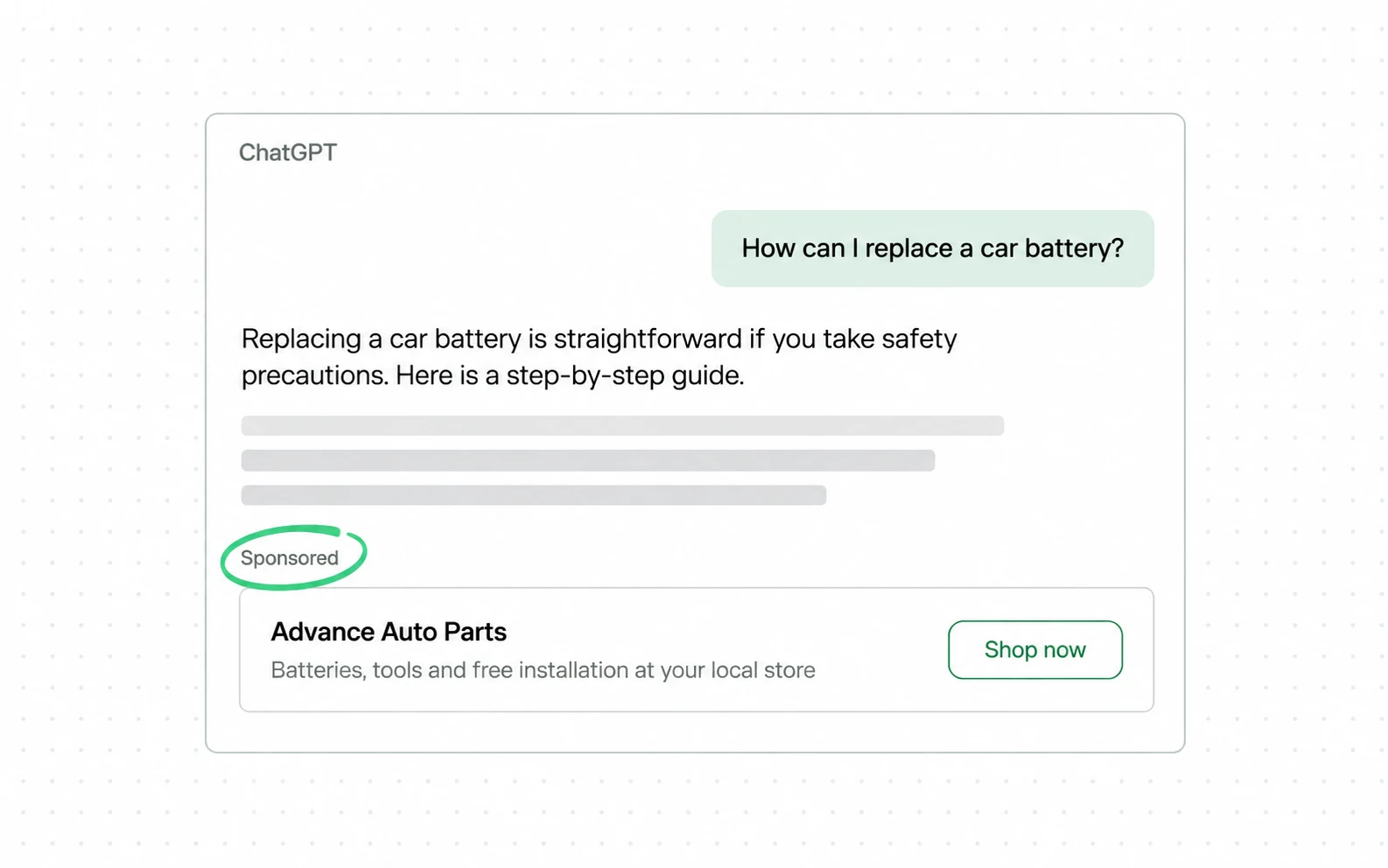
The test launched in the United States, with eligibility set by which account tier a person is on. If you are checking whether your own customers can see these ads, that pair of conditions is the thing to check.
Omnicom, WPP and Dentsu lined up brands for the pilot. That tells you the size of the launch and nothing about whether the ads worked, and the two are easy to read as one thing.
Imagine a shopper asks ChatGPT for running shoes. The product cards that come back are organic results, chosen by a different system, and our ChatGPT shopping guide covers how.
Relevance-weighted second-price ad selection
OpenAI explains how an ad gets chosen, in its own help centre, in a single phrase: a relevance-weighted second-price auction. The second-price part works the way the Google Ads auction does; the relevance weighting is the difference. That phrase is doing a lot of work, and three things fall out of it that change how you would build a campaign here.
-
Your bid is multiplied by relevance, not read on its own
A more relevant ad can outrank a higher bid. Buying position with money alone is not available here in the way it is on a keyword auction.
-
The winner pays the second price
You are charged what it took to beat the ad below you, not what you were willing to pay. Bidding closer to your true ceiling is less punishing than it feels.
-
Matching reads the conversation, not a search term
OpenAI documents that ad selection works from the context of the exchange. There is no keyword list to write, so the lever a Search campaign is built around has no counterpart here. Whether that costs you anything is not something anyone has published a figure for yet.
Independent audit of 3602 ad-bearing conversations
That is what the platform documents about itself. One independent look exists. Researchers at the University of Pennsylvania and Haverford College ran the first empirical study of advertising inside a large language model interface. They deployed 91 automated accounts carrying different demographic and location signals, sent prompts, and recorded every conversation that produced an ad, screenshot included. They also published the raw archive.
Most of the ads did not follow a shopping question.
The paper is an arXiv preprint, so it has not been through peer review. Its method is described and its data is open. That makes it usable, and it is still not peer reviewed.

The shape of that chart matches what OpenAI says about matching. Shopping prompts account for 827 of the 3,602 conversations in that archive. Roughly three quarters of the ads appeared beside something else. The channel behaves like a context channel, not a search channel, in what OpenAI publishes and in the ad archive alike.
That has a consequence on the creative side. If the ad lands on a problem, the landing page should answer the problem before it shows the product. Dropping that visitor onto a category grid fights the mechanism, which is a conversion rate optimization problem before it is a media one.
One distinction matters here, because Search Engine Journal argues the opposite for AI referral traffic: a visitor who arrives from a cited AI answer is already informed and wants a decision path, not a pitch. Both are true. Someone who read an answer that named you has finished their research. Someone who saw your ad inside a recipe has not started it. The difference between being quoted and being clicked is the same split we take apart in AEO vs SEO.
OpenAI's four crawlers and why OAI-AdsBot matters
Before any of that reaches a shopper, something has to be able to read your pages. OpenAI runs four crawlers and they do four different jobs. People confuse them constantly, usually while trying to opt out of AI training. The confusion is expensive and it does not announce itself. Block the wrong one and you either achieve nothing you wanted or quietly break something you needed.
| Crawler | What OpenAI says it does | What blocking it costs you |
|---|---|---|
| OAI-SearchBot | Surfaces sites in ChatGPT search results | You disappear from ChatGPT search |
| GPTBot | Crawls content that may train the foundation models | You opt out of training, and the page stays in ChatGPT search |
| OAI-AdsBot | Validates the safety of pages submitted as ads | Your ad landing page cannot be reviewed |
| ChatGPT-User | Fetches a page when a user action requires it | Live user-initiated fetches fail |
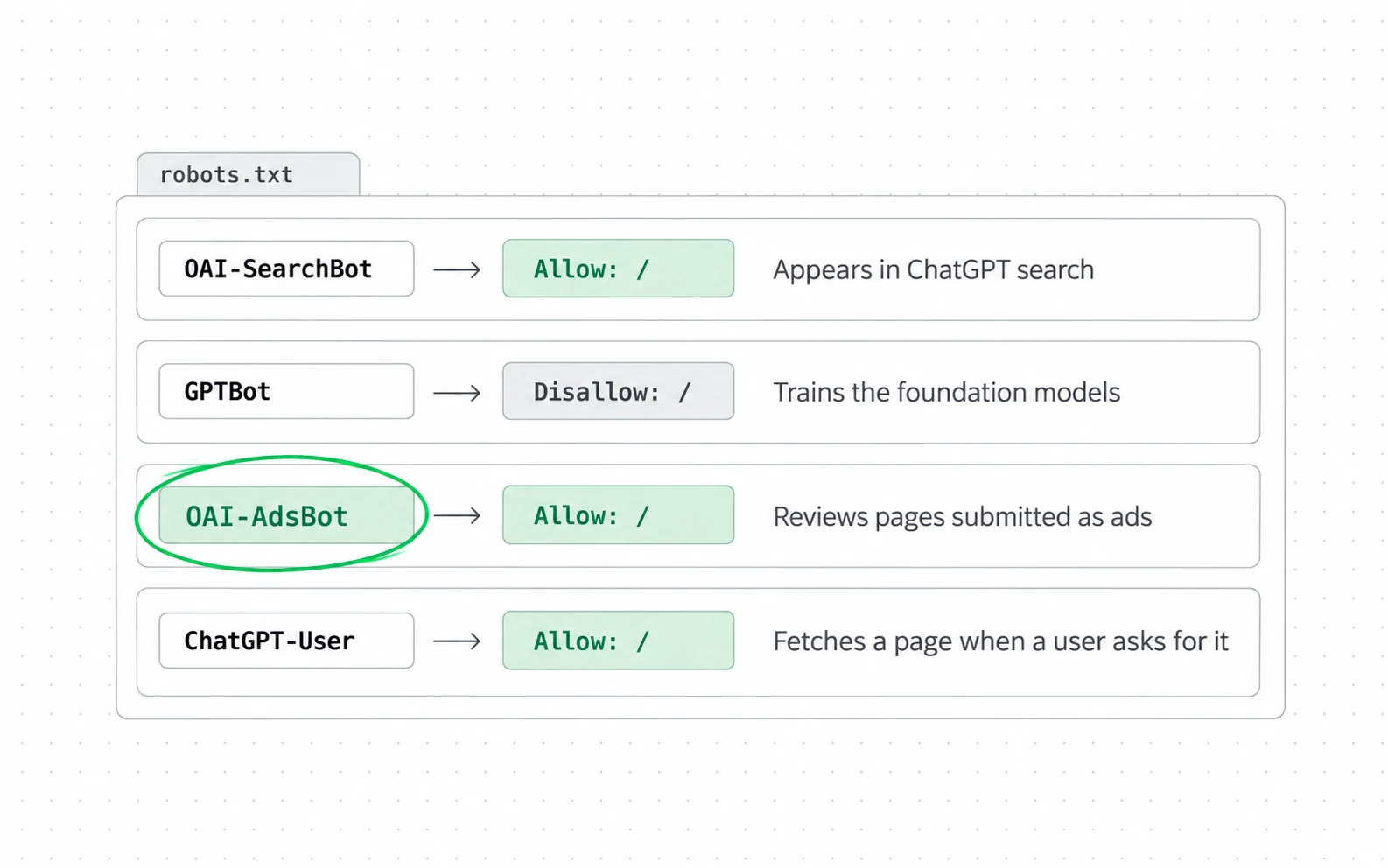
The four documented roles turn an opt-out into four separate decisions. Read down the last column and the single Disallow line most stores wrote makes three of them by accident.
The bot that visits an ad landing page is not the crawler most robots files were written against.
OAI-AdsBot only visits pages submitted as ad landing pages. It does not crawl the wider web, and OpenAI publishes the IP range it uses. It was added to the documentation in April. The same distinction decides whether you show up in AI answers at all, which is AEO vs SEO: a different question with the same plumbing behind it.
When you submit an ad, OpenAI may visit the landing page to ensure it complies with our policies. We may also use content from the landing page to determine when it’s most relevant to show the ad to users. OAI-AdsBot only visits pages submitted as ads, and the data collected by OAI-AdsBot is not used to train generative AI foundation models.
OpenAI developer documentation, Bots read 7 September 2026
- It visits the landing page of a submitted ad to check it against policy, and it visits nothing else.
- It also reads the page to decide when the ad is relevant, which makes the landing page part of the targeting, not only the destination.
- The user agent string is published, so you can find it in your own logs.
How much do ChatGPT ads cost?
Access settled, the question a budget holder asks is what it costs. Most coverage answers that with a shrug. The question has an answer. OpenAI publishes the buying model in its own help centre: three objectives, a stated starting point for bids, and a documented auction behind them. What buyers pay comes from elsewhere.
| Objective | You pay for | OpenAI guidance |
|---|---|---|
| CPM | One thousand impressions | Use when the goal is reach |
| CPC | A valid click | Suggested opening bid of $3 to $5 per click |
| oCPC | A click, optimised toward conversions | Use once conversion signal exists |
On the market side, buyers reported a cost around sixty dollars per thousand impressions at launch, falling to roughly twenty five dollars in some accounts since. Both figures come from what buyers see, not from the platform, so neither is a published price.
Say you want those bids and feeds run against your own catalogue: that is ChatGPT Ads management at Addition, an AI search agency.
Why is no ChatGPT ads return figure published?
The cost side is documented from both directions. OpenAI publishes the bid model and buyers report what they pay, and neither says what the money comes back as. That gap is the one that decides whether a store should be here at all, because the other questions here have documented answers and this one has only interested ones.
OpenAI documents the buying model and the opening bid. No comparable figure exists for what an advertiser earns.
OpenAI gives bid guidance and explains the auction. There is no published performance benchmark for this channel: no average click-through rate, no conversion rate, no figure for what a dollar returns here.
The figures that do circulate come from parties selling into the channel, and each of them discloses that. Search Engine Land named the same gap in a headline, calling it premium prices and limited data.
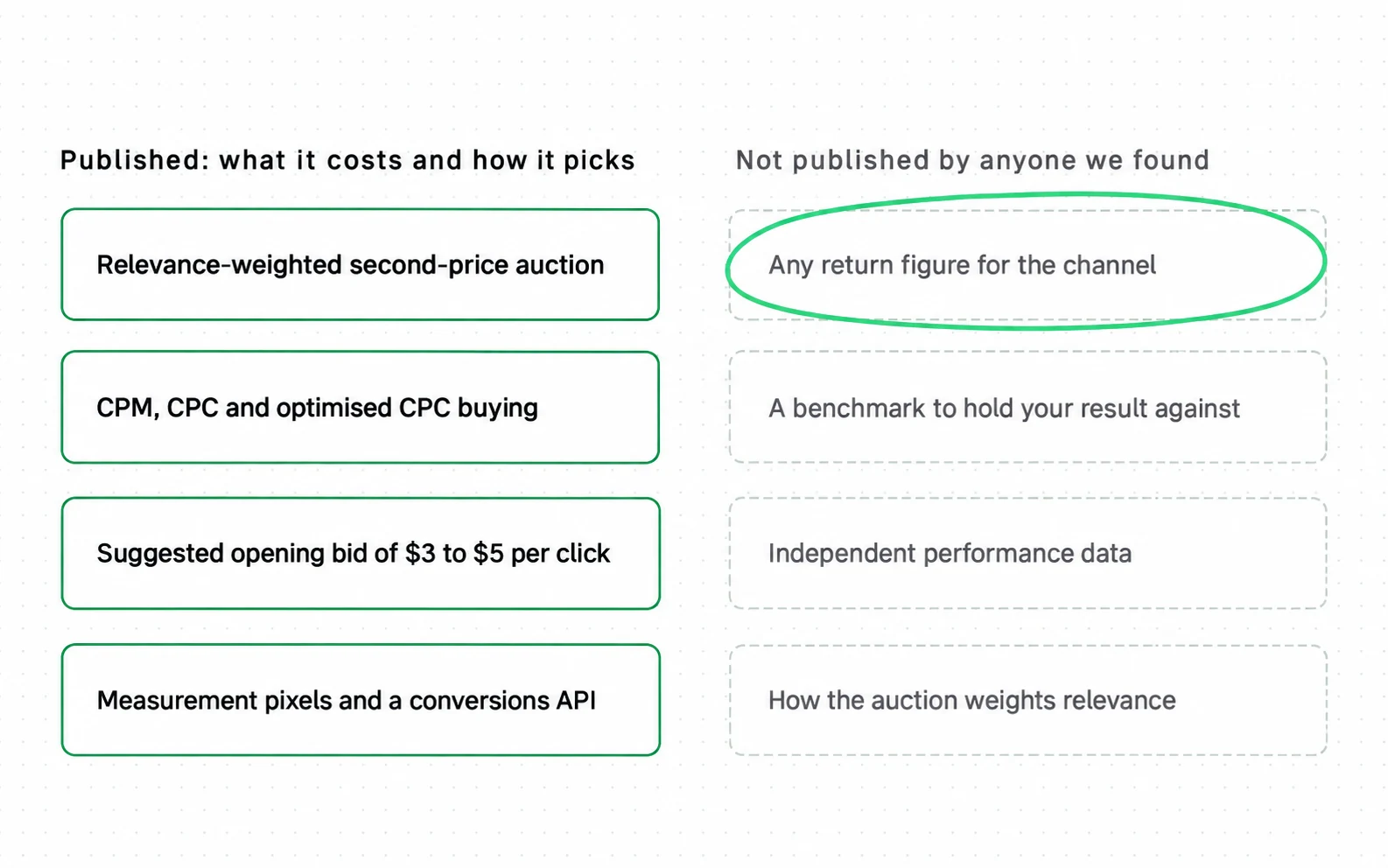
Nobody is hiding the cost. What nobody has is the return. Treat that asymmetry as a budgeting decision, not a footnote.
A channel with a known cost and nothing published to compare the return against is a budget for finding something out, not one expected to earn a return. Your own before and after is measurable; what nobody can tell you yet is whether the result is a good one. The budget you put here is buying an answer to whether the channel works for your product, and it should be sized that way.
A common framing splits your budget roughly seventy, twenty and ten across channels that already deliver, promising ones, and entirely new ones. No source cited here measures that split, so treat it as a habit of the trade and not as a finding. Two parts get skipped. Write the scale-or-kill criterion before the test starts, because most test budget goes on experiments run too long without a decision rule. And set the target by working backwards from customer lifetime value, not from a benchmark that does not exist yet.
Product carousel feed sources
One part of this channel can be watched without a published number. Ask ChatGPT for a product recommendation and you get a row of cards. Where those products came from is the question, and it is where the research stops agreeing with itself. Two published analyses reach opposite conclusions, and the disagreement itself is the useful part.
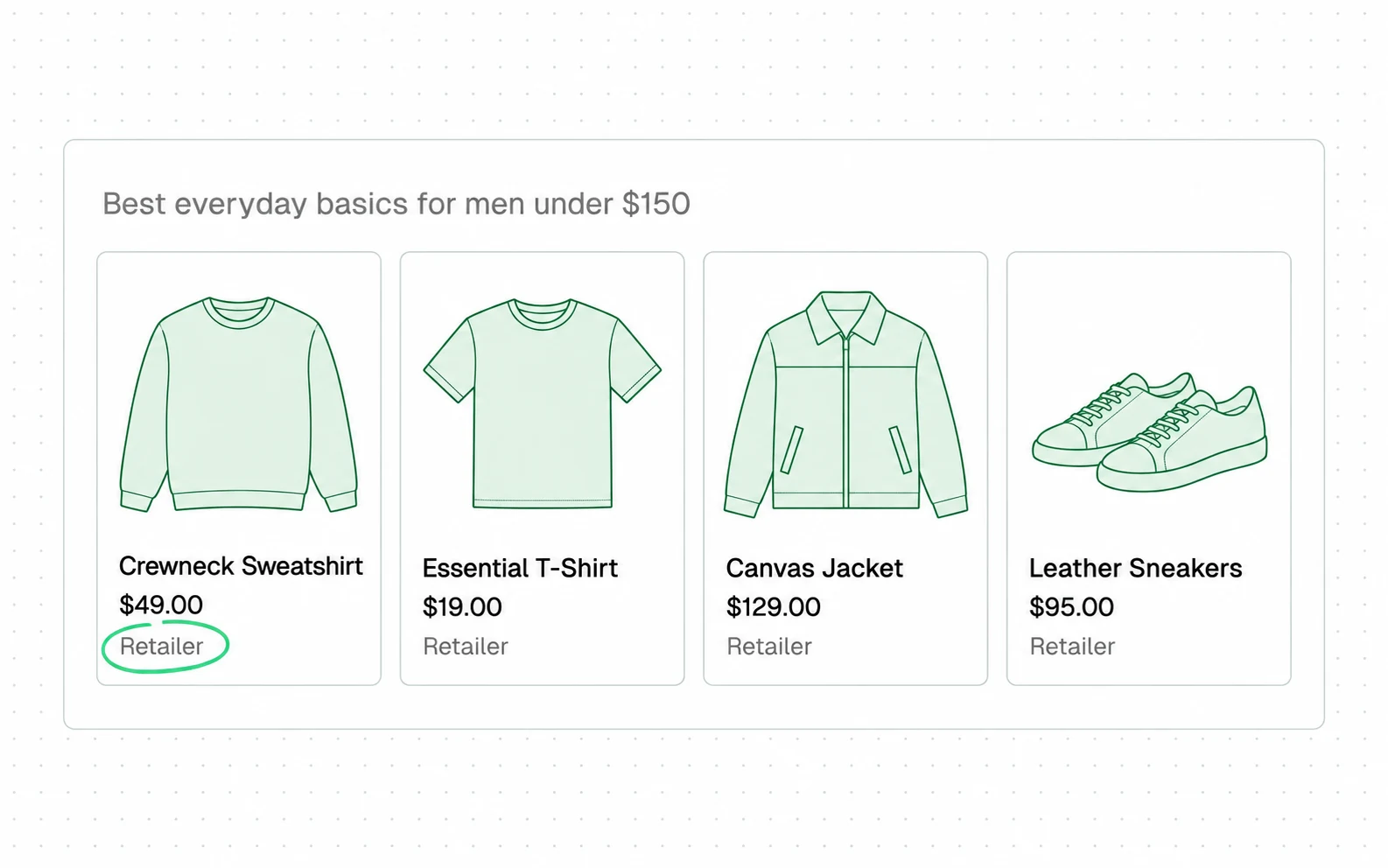
Two studies, two answers, one feed.
An analysis published by Search Engine Land took 43,000 carousel products and looked for each one in Google Shopping and in Bing. It found a strong match in Google Shopping for 83 percent of them, against 11 percent in Bing. Only 70 products, or 0.16 percent, appeared in Bing alone.
The feed behind that carousel now has a named path. Criteo joined as OpenAI's first adtech integration partner in March 2026. The integration partner reports more than a thousand brands live through it, with AI-referred conversion rates approaching twice those of traditional search in electronics and home categories. That is a party measuring its own channel, so read the figures as a claim and not a benchmark. Against it sits Kaiser and Schulze in Marketing Science. On the authors’ own summary of the study, affiliate links convert about 86 percent more often than ChatGPT traffic and organic search about 13 percent more often. They cannot both be generally true. The samples differ, the incentives differ, and nobody neutral has measured this channel yet.
Position matters more than platform
The more useful finding in the 43,000-product analysis is about position, not platform. Matches concentrate near the top: the first ten Google Shopping positions carry sixty percent of them, and the first twenty carry eighty four percent.

A separate Search Engine Land study argues the opposite direction: that Bing rankings shape which brands ChatGPT recommends. The two may be measuring different things, since product matching and brand recommendation are not the same outcome. Neither settles the other.
| The carousel analysis | The brand study | |
|---|---|---|
| What it measured | Whether a specific product also appears in a shopping index | Which brands appear in recommendations |
| Sample | 43,000 carousel products | Brand visibility across queries |
| Conclusion | Google Shopping explains 83 percent of matches | Bing ranking shapes brand selection |
You do not need to settle this, because the question itself has moved. ChatGPT has its own product feed. You upload a catalogue in Ads Manager and sponsored placements come from it, on a path neither study measured.
That feed is not a copy of a Google Shopping export, and the differences are structural. Our comparison of ChatGPT shopping vs Google Shopping sets out the formats and the update cadence with the source that publishes them. And the price the shopper sees is the one the feed supplied, not the one on your live product page. That is how the documented mechanism reads. Check it yourself if you run a promotion the feed has not caught up with.
| Field | What the card shows | What your product page shows |
|---|---|---|
| Price | The value in the feed at its last refresh | The value your store is charging right now |
| Availability | The stock state in the feed | The stock state at this second |
| Title and image | The feed entry | Whatever the page template renders |
| Promotion | Only if the feed carries it | Live, the moment you publish it |
If you run Google Shopping ads already, the useful comparison is field by field: the same product, two feeds, two refresh clocks.
Putting the three findings to work in an ecommerce store
Put the three findings next to each other and a shape appears. The channel runs on context, not keywords. The product feed turned out to be its own surface, not an export of another one. And nobody can tell you yet what any of it returns. That combination points at three pieces of work.
-
Write context, not product description
Use the context hints to describe the conversations where the ad should appear, not the product itself. What belongs there is a description of the conversations you want to appear inside. Your ad may surface in an exchange with nothing to do with your category and has to make sense on its own.
-
Ask ChatGPT how it describes your category
A cheap and concrete method: see how the model itself talks about your product and the problem it solves. That language is a preview of the context your ad will land in.
-
Feed the product feed separately
OpenAI has documented the catalogue upload as its own surface since June 2026, with its own refresh cycle and its own ranking inputs. Treating it as an export of something else is the error that costs placements.
Context beats keywords here.
The thread running through all three is the same: in this channel the winner is not the store that describes its product best, but the one that recognises its customer problem best.
Those three are the strategy, not the build. The screens themselves, from the verification queue through the budget floor to the ad review that reads your landing page, are set out in how to run ads on ChatGPT.
How to measure a channel with no benchmark
Measurement is the piece of that work with nothing to lean on. There is no industry figure to hold your result against, so the only number worth anything is your own, taken the same way every time.
Decide the window before you launch it.
Three things separate a readable test from a wasted one. Start by settling what a conversion rate is, because a channel with no benchmark leaves your own denominator as the only check on the number.
- Decide the conversion window before launch. In a context channel the person was not shopping when they saw the ad, so a last-click window sized for search will under-count this channel and you will kill it on bad evidence.
- Measure against customer lifetime value, not a first order, because working backwards from lifetime value is the only target available when no benchmark exists.
- Write the scale-or-kill rule before spending, with a number and a date. Most test budget is lost to experiments that ran long without a decision rule attached.
What does not exist is anything to compare your result against. That is why the comparison has to be your own, taken before and after on the same definition each time.
Some early numbers have surfaced, and they are small. Digiday interviewed seven ad executives in May 2026. One advertiser with a $250,000 commitment managed to spend $2,500 of it in four weeks. An agency saw almost no activity for a month after launch, and fill rates improved 30 to 50 percent over six weeks from a low base. Those early observations did not establish whether the ads worked.
Put the two together and the shortage has two halves. Inventory was thin enough that a committed budget could not be spent, and attribution was thin enough that the limited spend those advertisers managed could not have been judged anyway.
Those are separate findings, and the two-part diagnosis is ours. It matters to you because a first test here can fail for a reason that has nothing to do with your product.
The forecasts do not close the gap either. The 2026 advertising target reported for OpenAI is $2.5 billion. A market forecaster puts the entire US standalone chatbot ad market, ChatGPT and Copilot and Google AI Mode together, under $1 billion for the same year. A projection is not a measurement and both of these are projections. The larger figure is more than twice the smaller one, and that gap matters before a budget meeting.
ChatGPT ads: what to watch next
Whatever you measure today has a short shelf life here. The channel is young and moving, so check three things instead of assuming them before you plan. All three stood as described in August 2026, and each one can change without an announcement.
- Which markets the ads are live in, since OpenAI updates the list on its own page
- Whether in-answer ad formats expand beyond the current sponsored card
- Whether OpenAI ever publishes performance data, which would change the budgeting case entirely
Before anything else, open your robots.txt and check whether OAI-AdsBot is allowed. It takes ten minutes, it costs nothing, and it is the one line that decides whether an ad of yours can serve at all.
While you wait for those to settle, fix the landing pages. Whatever this auction returns, OAI-AdsBot reviews the landing page before the ad shows. A page that answers the visitor's problem is useful in every channel on this list.
For the buying decision between the two surfaces, ChatGPT shopping vs Google Shopping puts what can be checked about each side by side.
Sources
- Digiday As ChatGPT ad delivery improves, the doubts it created are not easily fixed, seven ad executives interviewed
- The Information OpenAI first advertisers cannot prove ChatGPT ads work (headline only; body paywalled)
- eMarketer ChatGPT ad revenues may fall 90% short of OpenAI 2030 target (projection, not measurement)
- Criteo Criteo joins OpenAI advertising pilot in ChatGPT, first adtech integration partner
- PPC Land Over 1,000 brands live on ChatGPT ads via Criteo, AI conversions near 2x (integration partner measuring its own channel)
- Maximilian Kaiser (WU Vienna) and Christian Schulze (Frankfurt School), the study’s own companion site organicLLM.org, the authors’ summary of the Marketing Science paper, carrying the adjusted conversion comparisons: affiliate about 86 percent more often than ChatGPT traffic, organic search about 13 percent, and ChatGPT ahead of paid social
- Maximilian Kaiser and Christian Schulze, Marketing Science Frontiers: ChatGPT Referrals to E-Commerce Websites: How Do LLMs Compare Against Traditional Channels?, Marketing Science 2026; first-party Google Analytics data from 973 ecommerce sites across 24 categories and $20 billion in revenue, August 2024 to July 2025, comparing more than 50,000 ChatGPT-referred transactions against 164 million from traditional channels
- OpenAI Testing ads in ChatGPT, official announcement
- CNBC OpenAI to begin testing ads in ChatGPT in the U.S., tier eligibility
- Adweek Omnicom, WPP and Dentsu line up brands for the OpenAI pilot
- OpenAI Ads in ChatGPT
- OpenAI Ads in ChatGPT: The Basics
- OpenAI Create Campaigns for ChatGPT Ads
- OpenAI Overview of OpenAI Crawlers
- Lurie, Encarnacion, Metaxa and Friedler The Beginning of ChatGPT Ads, arXiv 2608.05008, preprint
- Search Engine Land ChatGPT sources 83% of its carousel products from Google Shopping
- Search Engine Land Bing, not Google, shapes which brands ChatGPT recommends
- Search Engine Land ChatGPT ads come with premium prices and limited data
- Search Engine Land Optimizing for ChatGPT Shopping: how product feeds power GEO
- Search Engine Journal OpenAI crawler docs now list OAI-AdsBot for ChatGPT Ads
- Search Engine Journal ChatGPT Ads now offer CPC bidding between $3 and $5
- Search Engine Journal AI referrals are recreating the oldest mistake in conversion optimization
Questions people ask
Does ChatGPT have ads?
Yes. OpenAI announced them and documents them in its help centre. They appear inside the conversation with a Sponsored label, and availability depends on region and account type.
How much do ChatGPT ads cost?
OpenAI supports CPM, CPC and optimised CPC buying, and suggests an opening bid of three to five dollars per click for click campaigns.
On the market side, buyers reported roughly sixty dollars per thousand impressions at launch, falling to about twenty five dollars in some accounts since.
How does ChatGPT decide which ad to show?
Through a relevance-weighted second-price auction. Your bid is multiplied by relevance, not read alone. The winner pays the second price. And matching works from the context of the conversation, not from a keyword list.
Can ChatGPT ads be measured against other channels?
Not yet in any published way. OpenAI documents the buying model and the auction but publishes no performance benchmark, and we found no independent dataset that fills that gap.
Does blocking GPTBot stop my ads or my visibility in ChatGPT?
No, and this is the most common mistake. GPTBot is the training crawler. Search visibility is managed with OAI-SearchBot, and ad landing pages are reviewed by OAI-AdsBot. Blocking the wrong one either does nothing you wanted or breaks something you needed.
