

Which should you build first: ChatGPT or Google Shopping?
Build the surface you can inspect first. Google publishes what its Shopping matching runs on, what the feed must contain and how the auction prices a click, and all of it is readable. Treat the ChatGPT surface as worth preparing for and not yet worth reallocating to, because the evidence available about it is thinner than the confidence around it.
One side can be checked. The other is reported.
Three situations, and the middle one overrides the verdict:
- No assistant traffic in your logs. Put the effort into the surface you can inspect and price.
- Assistant traffic already arriving. Both, and read the logs before reallocating anything.
- A Merchant Center feed already running. The fields overlap, so a second feed costs less than the first did. Spend still follows profitability, not measurability. Our ChatGPT shopping guide covers that setup.
That is not a judgement about which will matter more. It is a statement about what a decision can rest on today. If you are already seeing assistant referrals in your logs, the order flips, and the next sections say so. If you are not, put the budget where you can defend it.
Five merchant questions answered for each side
That verdict rests on what each side lets you check, so here is the check itself. Five questions a merchant would ask before spending anything. The left-hand column comes from documentation read on the day; the right-hand column is assembled from second-hand accounts, because the primary pages did not open.
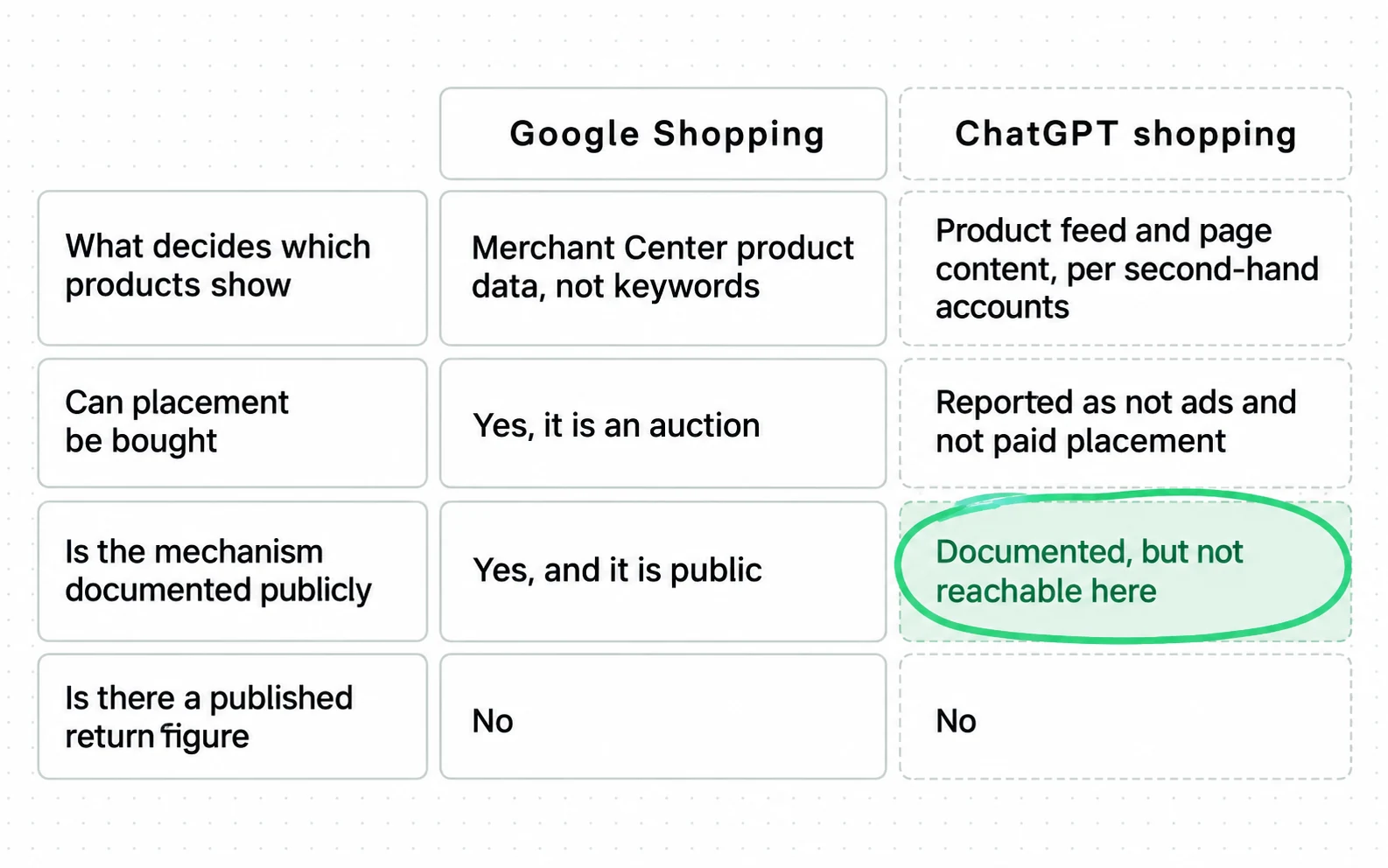

The Google column is short because the mechanism is short. Shopping ads use Merchant Center product data, not keywords, to decide how and where to show, and the required attributes are seven fields with published limits. What that means for a store is set out in Google Shopping ads.
Google Shopping: feed matching and auction
A product listing appears because your feed matched a search and your entry won an auction, where your bid is a single input and five others sit beside it. Both halves are documented, and both are inspectable in an account you control.
A matching rule and a price, both published.
The matching runs on product data, not keywords, so your lever is the feed. The price runs through the same auction as every other Google ad. Six inputs decide position and cost, and your bid is only one of them. The other five are set out in how Google Ads works. Whether the return is acceptable is arithmetic against your margin, not a benchmark, which is what a good ROAS is. Whether automated bidding is even available to your budget is a published threshold: 15 conversions in 30 days for Target ROAS on Search and Shopping.
Shopping ads use your existing Merchant Center product data (not keywords) to decide how and where to show your ads.
support.google.com, About Shopping ads read 10 September 2026
- The parenthesis is Google's, not ours. There is no keyword lever on this surface, so the feed is the whole of what you control.
- Read the note underneath as well. Your landing page, your images and your feed can all be used to enrich the ad, and some of that enrichment is generated.
- Opting out is not a checkbox. It is a request to an account manager, processed in three to five business days.
| Question | Answer for Google Shopping |
|---|---|
| Who decides which products appear | Google, matching against your product data |
| Can you pay to appear | Yes, and the price is an auction outcome |
| Can you see what you paid for | Yes, per product group |
| Is the mechanism documented | Yes, and it is short |
The surface grew in the categories that were measured.
In the Similarweb analysis Aleyda Solis published in February 2026, product listing ads went from 13 to 20 percent of clicks on the top 5,000 US headphone queries between January 2025 and January 2026. On jeans they went from 11 to 18 percent.
Search Engine Land covered both figures alongside the advertiser side of the same period. Four US categories in one panel, two of which moved sharply, one slightly and one not at all. It describes those queries, not the market.
None of that is paid placement in the assistant sense. ads inside ChatGPT are a separate auction with its own crawler and its own feed.
| What you control on Google Shopping | Where it lives |
|---|---|
| Which products are eligible | The Merchant Center feed and its required attributes |
| What a product is called | The title field, 150 characters |
| What you pay | A bid, as one of six auction inputs |
| Which queries you never match | Negative keywords |
| Which queries you do match | Nobody. Google matches from your data |
Whether the paid side of that surface is worth a test is a separate question from the feed, and setting up ChatGPT ads walks the account, the budget floor and the crawler requirement that decides it.
ChatGPT shopping through second-hand accounts
Everything in this section is second-hand. No claim in it comes from OpenAI itself, so treat it as other people’s account of the specification, and every number in it as one step further from the source than the Google side.
OpenAI publishes none of this openly, so treat every figure below as reported and not confirmed.
Which side of this comparison we could read
Fetch log — 2 September 2026
1403 openai.com/index/chatgpt-shopping-research/
403 openai.com/shopping/
403 help.openai.com/.../product-visibility-in-chatgpt
403 help.openai.com/.../shopping-in-chatgpt-search
2404 brodieclark.com/chatgpt-shopping-early-review/
3200 support.google.com/merchants/answer/7052112
- 1Four OpenAI addresses, including its own announcement, refused the request. Everything below is somebody else’s account of what those pages say.
- 2The top-ranked independent review was gone too, so the second-hand account is also thinner than it looks.
- 3The other side opened. That asymmetry is the finding, and it is why this page recommends the surface you can check.
| Field | Google Merchant Center | ChatGPT feed, as reported |
|---|---|---|
| Identifier | id, required | id, listed |
| Title | Required, 150 characters | Listed |
| Price and availability | Both required | Both listed, plus inventory quantity |
| Update cadence | Scheduled or on push | Reported as often as every 15 minutes |
| Format | Feed file or API | CSV, TSV, XML or JSON over HTTPS |
On those accounts, merchants submit a product feed in CSV, TSV, XML or JSON, pushed over HTTPS to an allow-listed endpoint. The fields will look familiar to anyone with a Merchant Center feed: id, title, description, link, image_link, price, availability, brand and condition, plus flags for search and checkout eligibility. Updates are described as possible every 15 minutes.
The claim that matters most for a budget is the one about payment: results are described as not ads and not influenced by paid placement, relying on feed quality, relevance and user context. That sentence is unverified at source here, and it is the one a merchant would most want verified.
That is the opposite arrangement from Google Shopping ads, where the feed is the same object but the placement is bought.
One thing about ChatGPT commerce has been measured independently, and it covers the advertising surface, not this one. An audit of 3,602 real ads found most of them appearing in conversations that were not shopping questions. That work, and what OpenAI does publish about its ad auction, is in ChatGPT Ads.
Three cases that overturn the verdict
Our verdict is to build the verifiable surface first. Three things would make that the wrong order, and the first is measurable on your own site today.
Your own logs may already say something different.

The first is traffic that is already arriving. If your server logs show ChatGPT-User or OAI-SearchBot fetching product pages, and your analytics show assistant referrals, that is evidence about your store and not about the platform. A published figure describes somebody else’s population, and this one describes yours. It does not prove the shopping surface is sending them, it says nothing about what a visit was worth, and it is still the one reading you can take today. What to do with that traffic is AI search engine optimization.
Two exceptions that depend on your account
The second is saturation. If your Google Shopping auction is already at the price where the order stops being profitable, then more effort there buys nothing, and preparing a feed for a second agentic commerce surface is the cheaper move even under uncertainty.
The third is timing. Preparing a product feed is largely the same work twice: the fields overlap heavily with Merchant Center. A store that has done it once has less to do the second time, though a second feed still needs inventory quantities, policy documents and an endpoint, so cheaper is not free. The catalogue decisions underneath both feeds are the same ones, and they are set out in ecommerce SEO.
| Where this page would cost you money | What to check instead |
|---|---|
| Assistant referrals are already arriving | Your server logs, by user agent, over 30 days |
| Your Shopping auction is already unprofitable | Cost per order against contribution per order |
| You already maintain a Merchant Center feed | How much of it a second feed would reuse |
Grep your access logs for OAI-SearchBot and ChatGPT-User over the last thirty days, and count the product URLs they fetched. That count is about your own pages and nobody else’s population. It does not identify which ChatGPT surface sent anything, it does not price a visit, and it still arrives sooner than the industry will settle the general question.
For instance, feeding your catalogue into the paid side of that surface is ChatGPT Ads for Shopify.
Sources
- Google Ads Help About Shopping ads: they use Merchant Center product data, not keywords, to decide how and where to show
- Google Merchant Center Help Product data specification: seven required attributes, title limited to 150 characters
- Lengow ChatGPT product feed: fields, formats, 15-minute updates, and the statement that results are not ads This page carries no publication date of its own.
- OpenAI Bot documentation: allow OAI-SearchBot in robots.txt, and the four crawlers with four jobs
- Aleyda Solis Product listing ad click share rose in the measured categories, Similarweb data
- Search Engine Land Paid search click share doubles as organic clicks fall, with retailer paid-click figures
- Google Ads Help About Ad Rank: six inputs decide position and price
- Google Ads Help Target ROAS: at least 15 conversions in the past 30 days on Search and Shopping
- Perplexity Bot documentation: robots.txt tags for publishers, and a crawler not used for training
- Brodie Clark ChatGPT-5 shopping versus Google Shopping, the first organic result for the query in September 2026 This page carries no publication date of its own.
Questions people ask
Which AI is best for shopping?
No published measurement compares them on merchant outcomes. What can be compared is what each publishes about how products are chosen, and on that the surfaces differ sharply: Google documents a feed specification and an auction, and the OpenAI equivalents were not readable to us.
What is better than Google Shopping?
For a merchant the answer today is that something is being built alongside it, not in place of it. Product listing ads took a rising share of clicks in the categories one 2026 analysis measured, so the surface people expect to be dying is the one with the measured growth.
Is ChatGPT more trustworthy than Google?
On shopping specifically, the useful version of the question is which claims can be checked. Google publishes its matching rule and its auction and both can be read. The equivalent OpenAI claims reach a merchant through other people.
How do I get my products into ChatGPT?
Published accounts describe a product feed submitted over HTTPS to an allow-listed endpoint, with fields close to a Merchant Center feed. Before that, check the crawlers can reach your product pages: OpenAI recommends allowing OAI-SearchBot in robots.txt, and Perplexity points publishers at robots.txt tags for the same reason.
