

What does Google say AI search optimization requires?
This gets sold as a new discipline. Google says the opposite in its own documentation, in one flat sentence. The sentence is true. What it leaves out matters more.
There are no additional requirements to appear in AI Overviews or AI Mode, nor other special optimizations necessary.
Google Search Central, AI features and your website, last updated 10 December 2025
Eligibility is not selection. And before either, there is the phrase itself: what AI search optimization is separates the two jobs it names.
The same page states the condition for being a supporting link, and it is just as plain. A page has to be indexed and eligible to be shown in Google Search with a snippet. If you have blocked snippets with nosnippet, data-nosnippet or a tight max-snippet, you have opted out of the thing you are trying to win.
So the entry ticket is ordinary technical search work, the same crawl and index work an ecommerce SEO audit checks line by line. That is the strong half of Google's sentence. The weak half is that it describes eligibility, not selection. Being allowed into a room is not the same as being called on, and every measurement below is about the second question.
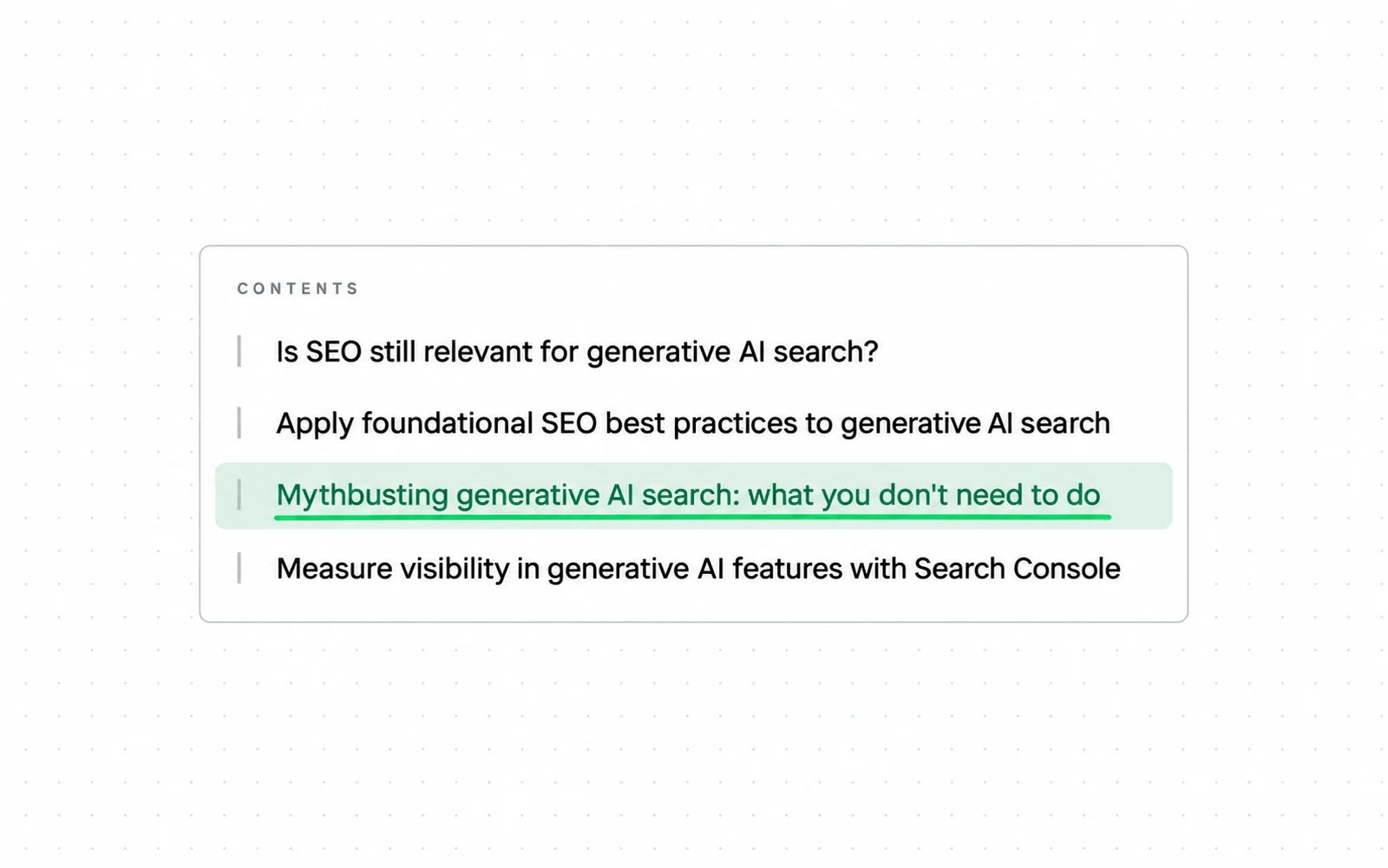
- The contents list is the argument. Google’s own guide has a section called mythbusting, and the things it tells you to ignore are things sold as AI SEO services.
- The first line under the first heading answers the question the whole category is built on: SEO best practices continue to be relevant, because the AI features are rooted in the core Search ranking systems.
- Two mechanisms are named on the page, retrieval-augmented generation and query fan-out. Both describe retrieval from the existing Search index, not a separate AI index you can optimise for.
Where the answer appears on Google's own page, and how often, is set out in the guide to AI Overviews. The term the industry uses for the work is answer engine optimization, and the glossary entry keeps the definition apart from the method.
The other name for this work is generative engine optimization. It has a paper behind it, and that paper measured nine page edits against a fixed set of queries. The guide takes it apart: where the term came from, how its methods held up when a benchmark tested them across six domains, and what the evidence supports doing.
Why can three AI search overlap numbers all be correct?
Being eligible is not being chosen, and every number in this field lives in that gap. Three figures get quoted against each other as if one has to be wrong. All three come from Ahrefs, and they disagree because they count different things. The reason they disagree is the finding.
None of the three contradicts another once the thing each counted is named.
Start with the headline. In March 2026 Ahrefs looked at 863,000 searches and 4 million AI Overview URLs and found 38 percent of cited pages also ranking in the top 10. The same team ran a version in July 2025 and got roughly 76 percent. The overlap halved in eight months.

Three studies, three ways of counting, three answers, and the denominator is doing more work here than the finding is. That is the same problem what a conversion rate is has to settle before any two rates can be compared.
Read the shape, not the top bar. Nearly a third of everything cited sits beyond position 100, past page ten of a search nobody scrolls. So a top-ten position is not a requirement for being cited. That is a smaller claim than saying ranking is ignored, and it is the one the chart supports.
Why the three numbers disagree
The third number, 12 percent, comes from a separate Ahrefs study asking a tighter version of the same question. None of the three states its matching rule: does a citation count as ranking when the exact URL sits in the top ten, or when the domain does? That rule would explain most of a spread this wide. It is a reading, not a demonstration, because nobody states it. What the figures mean for choosing between AEO and SEO is a separate question, and it has its own page.
| Measurement | What it counted | Scale | Result |
|---|---|---|---|
| Ahrefs, July 2025 | Share of AI Overview citations that also rank top 10 | Earlier version of the same study | ~76% |
| Ahrefs, March 2026 | Same question, re-run | 863,000 SERPs, 4M AIO URLs | 38% |
| Ahrefs, separate study | Share of cited URLs that rank top 10, tighter unit, rule not published | Own dataset | 12% |
Carry one more finding from the March study. YouTube accounts for 18.2 percent of citations that do not rank at all, and it is the most-cited domain overall, up 34 percent in six months. If people ask questions about your product out loud, treat that as a channel decision.
Three AI search optimization mistakes that outweigh the checklist
Most of what is sold as AI search optimization is harmless and does very little. These three are different. Two of them break something. The third makes you spend money on a result somebody has measured, and it is close to zero.
Two of these break something.
Blocking the wrong crawler
OpenAI documents four crawlers doing four unrelated jobs. Teams block GPTBot to keep their content out of model training, then wonder why nothing changed in ChatGPT search. Search is a different bot. A fourth one now reviews landing pages for ads inside ChatGPT.
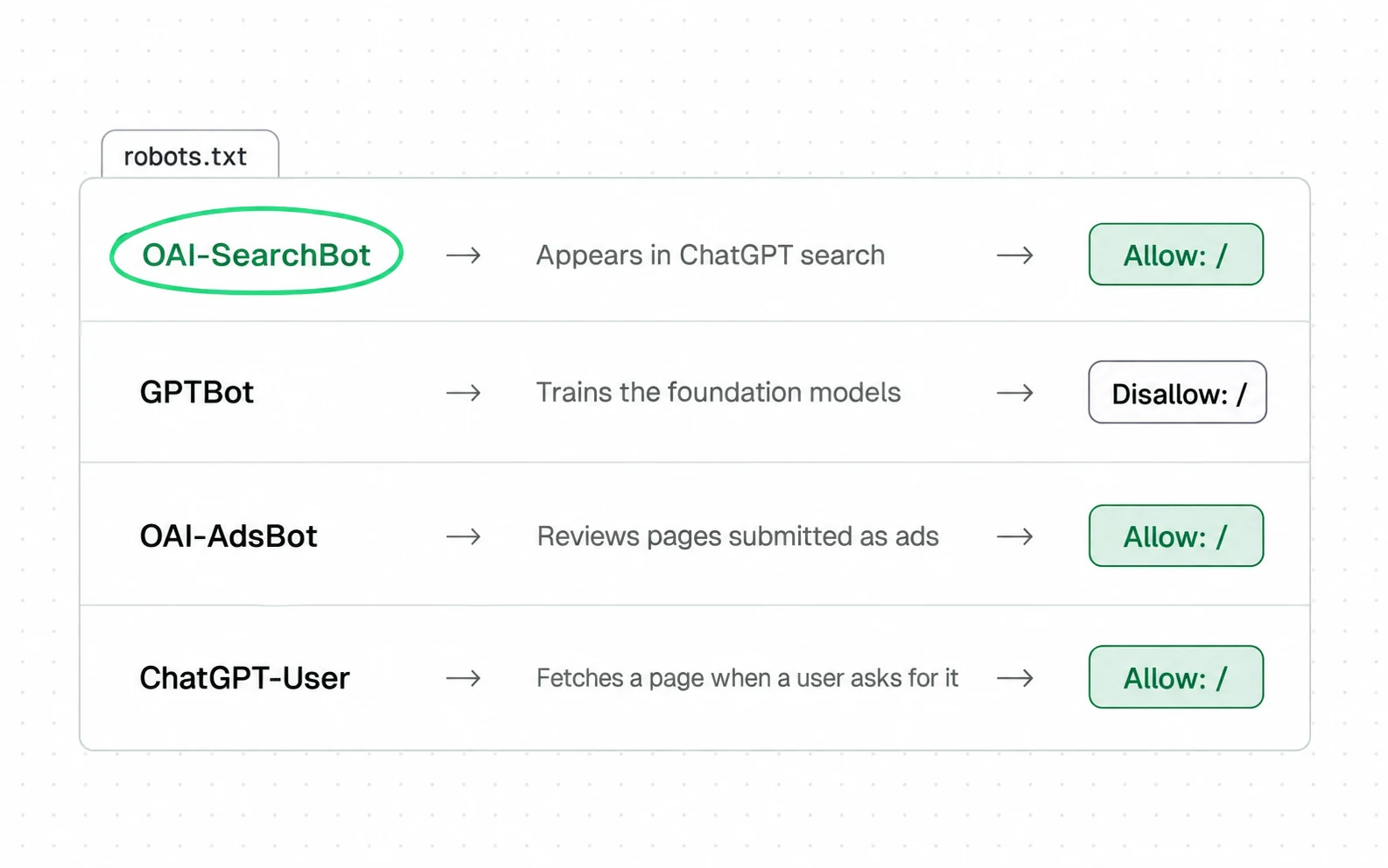
| User agent | What it is for | What blocking it does |
|---|---|---|
| OAI-SearchBot | Appearing in ChatGPT search | Removes you from ChatGPT search results |
| GPTBot | Model training | Keeps your content out of training. Search is unaffected |
| OAI-AdsBot | Reviewing advertiser landing pages | Can break ad review if you advertise |
| ChatGPT-User | Fetching a page a user asked for right now | Stops the assistant reading your page on request |
Expecting schema to buy citations
This one has been tested. In June 2026 Ahrefs published a study by Louise Linehan and Xibeijia Guan. It tracked 1,885 pages that added JSON-LD between August 2025 and March 2026 and matched them against 4,000 control pages at similar citation levels, and measured the 30 days before against the 30 days after.

Now the scope limit, because it changes what the study means for you. Every page in that sample already had more than 100 AI Overview citations before any schema was added. These were pages the answer engine already knew. So the finding is not that schema does nothing. It is that adding schema to an already-cited page does not get it cited more.
Treating llms.txt as settled either way
Four parties have said something about llms.txt, and they are answering four different questions. That is why the quotes look like a disagreement and are not one. Here they are side by side:
| Who | What they say | When |
|---|---|---|
| Google Search | Does not help ranking. Search does not use it for AI features | Stated publicly by Google Search staff |
| Google Chrome, Lighthouse | Agentic Browsing moved into the default config and checks for a valid llms.txt at the domain root. If the file is missing the audit returns Not Applicable, because the file is optional | Lighthouse 13.3, 7 May 2026 |
| Web Almanac | Valid llms.txt on 2.13% of desktop sites, 324,184 files | 2025 SEO chapter |
| Ahrefs | 28% of 137,210 domains publish one, and 97% of those files received zero requests in May 2026 | May 2026 |
The OAI-AdsBot crawler decides whether an ad inside ChatGPT can pass landing page review. That is a second reason to read robots.txt as a business document, not a technical one.
The Lighthouse detail is the one that gets misreported. An audit that returns Not Applicable when the file is absent is not a penalty for not having one. The flag signals that Chrome is watching the space, which is a different thing from a requirement.
What the llms.txt file is, who has been measured fetching it, and why the count is still zero in most logs is a page of its own.
How to start AI search engine optimization on a store
The order that follows from the evidence is dull, and you can check every step of it with an ecommerce SEO audit. The work that moves this was already worth doing. The exotic parts of the checklist come last, because that is where the evidence puts them.
Say you want those six steps checked page by page on your site. The audit table in the ai-seo skill covers the same things, and it separates Google’s position from the other engines for you.
-
Make the page eligible before anything else
Indexed, snippet-eligible, no stray nosnippet or max-snippet directive. Google states this as the requirement for being a supporting link and it is the only stated requirement there is.
-
Check what your robots.txt is doing to the four OpenAI agents
Reading the file for those four agents takes minutes. Deciding what you want it to say takes the hour costed below. Training and search are separate decisions, and one line can settle both by accident.
-
Write sections that survive being lifted out
An answer engine quotes a passage, not a page. A section that only makes sense after the two above it cannot be quoted. This is ordinary editorial work, not a separate discipline.
-
Cover the questions your buyers ask
Do not write question-shaped headings for their own sake. Use real questions, answer them in the first two sentences underneath, and include the specific detail a competitor would have to leave vague.
-
Keep structured data for what it does in classic search
Rich results and entity clarity in classic search. Ship it for those reasons and stop counting it as an AI move until somebody tests it on pages that are not already cited.
-
Publish llms.txt if it costs you an hour, and expect nothing
Ahrefs measured 97 percent of published files receiving no requests at all in a month. SE Ranking found no measurable relationship between having the file and being cited, across 300,000 domains. Otterly logged 62,100 AI-bot visits over 90 days of which 84, about 0.1 percent, touched llms.txt. That is a near-zero expected return on a near-zero cost, which is a defensible trade and not a strategy.
AI search engine optimization pricing: no separate rate
None of that arrives as its own line on a quote. There is no separate market rate for AI search optimization, because in practice there is no separate service. What you are buying is search work with a slightly different emphasis, and the way to price it is to say what the emphasis costs on top.
There is no separate market rate.
Agency retainers for ecommerce search work sit in a wide band, for a real reason. Content volume differs by an order of magnitude between a ten-product store and a ten-thousand-product catalogue. Anyone quoting a single number for this without asking about your catalogue is quoting a number for a different business.
The parts specific to AI answers cost very little on their own. A robots.txt review is an hour. An llms.txt file is an hour. Restructuring a page so its sections stand alone is editing time you were spending anyway if the content was any good. The expensive part, and it is the same expensive part it has always been, is producing pages that deserve to be cited.
When you want the channel run instead of explained, ecommerce SEO services at Addition, an AI search agency, cover all of it as one job.
How far do clicks fall when an AI answer appears?
This is the number everyone wants, and it is the number with the widest published spread. Two serious measurements landed at different places, and a third data point from Seer Interactive suggests the trend is not a straight line down.
The spread here is the finding.
Ahrefs compared 150,000 keywords with an AI Overview against 150,000 informational keywords without one. In their first pass the top-ranking page lost 34.5 percent of its clicks. Re-run on December 2025 data, that had grown to 58 percent.
Seer Interactive measured it from the other end, using client Search Console data across 3,119 search terms and 42 organisations. Their September 2025 figure was a 61 percent fall in organic clickthrough and 68 percent in paid. That is the first published sign that this is not only an organic problem.
Pew Research Center measured the same question from the side you cannot see, tracking 68,879 queries from a panel of 900 US adults in March 2025. Visits where an AI summary appeared ended in a click on a search result 8 percent of the time, against 15 percent where no summary appeared.

Then the part that has not filtered through yet. Seer's 2026 update reports that after eighteen months of decline, organic clickthrough on AI Overview queries rose 85 percent across January and February 2026. That rate is still well below searches with no AI Overview, so call it a rebound, not a recovery. A number that only shows the fall is describing last year.
Fewer, better-qualified visits can be worth more than a lot of poor ones. So judge this on revenue per visitor, not sessions, exactly as in conversion rate optimization.
Seer also reports that being cited inside the answer is worth 35 percent more organic clicks than not being cited, and 91 percent more on the paid side. That is the largest published difference between cited and uncited pages. It is a difference, not a payoff. Nobody has run the experiment where citation is the thing varied, so pages good enough to be cited may simply be pages good enough to be clicked.
What to track on your own store
For your own store, three things are worth tracking and none of them requires a tool you do not have. Impressions against clicks in Search Console, watched as a ratio. The gap between them is where this shows up. Branded search volume, which tends to move when you are being named in answers you cannot see. And assisted conversions from organic, because an answer that does not get clicked can still be the reason somebody came back a week later.
One more finding changes what "AI visibility" can even mean as a number. Kevin Indig worked with 3.7 million citations across 20,000 prompts and three engines. Only 2.37 percent of cited URLs appear in all three for the same prompt, and 91 percent live on a single engine. Profound, counting 680 million citations, shows why: Wikipedia supplies 47.9 percent of ChatGPT top sources while Reddit takes 46.7 percent of Perplexity top-tens against 21 percent in Google AI Overviews. Each engine reads a different library, so a single visibility score averages three unrelated things.
Citation overlap across three engines, 20,000 prompts
The dark centre is every URL all three engines cite for the same prompt. Almost everything else sits in one circle only.
Start with the ten-minute job. Read your own robots.txt against the four OpenAI agents, and write down which of the four jobs you are currently blocking. Every later decision starts from that list.
Sources
- Kurt Fischman, SSRN Does schema markup predict AI citation? 730 citations, 75 commercial queries, 1,006 pages
- SE Ranking, via Search Engine Journal llms.txt shows no clear effect on AI citations, 300,000 domains
- Otterly The llms.txt experiment, 62,100 AI-bot visits over 90 days
- Kevin Indig, Growth Memo The Consensus Gap: 3.7M citations, 20,000-prompt sample across three engines
- Profound AI platform citation patterns, 680 million citations, August 2024 to June 2025 Measured 15 months ago, on a surface that has moved since.
- Pew Research Center Do people click links in Google AI summaries? 900-adult panel, 68,879 queries Measured 14 months ago, on a surface that has moved since.
- Google Search Central AI features and your website
- Ahrefs 38% of AI Overview citations pull from the top 10, 863,000 SERPs and 4M AIO URLs
- Ahrefs 76% of AI Overview citations pull from the top 10, earlier version of the same study Measured 14 months ago, on a surface that has moved since.
- Ahrefs Only 12% of AI cited URLs rank in Google's top 10 Measured 13 months ago, on a surface that has moved since.
- Ahrefs We tracked 1,885 pages adding schema. AI citations barely moved. 4,000 control pages
- Ahrefs llms.txt study, 137,210 domains
- Ahrefs Update: AI Overviews reduce clicks by 58%, 300,000 keywords
- Seer Interactive AIO impact on Google CTR, 2026 update, 3,119 search terms across 42 organisations
- Seer Interactive AIO impact on Google CTR, September 2025 update
- OpenAI Overview of OpenAI crawlers
- Chrome for Developers Lighthouse agentic browsing, llms.txt audit
- Web Almanac 2025 SEO chapter, AI crawlers and llms.txt adoption Dated 2025 with no month given, so its exact age is not knowable from the source.
- Search Engine Journal Schema markup did not move AI citations in Ahrefs test
Questions people ask
How to optimize for AI searches?
Start by making sure the page is eligible: indexed, snippet-eligible, and not blocked by a stray nosnippet or max-snippet directive. Google states that as the requirement for being a supporting link, and says there are no additional requirements beyond it.
After that, the work that shows up in the evidence is writing sections that still make sense when quoted on their own, and covering the questions buyers ask. The exotic parts of most checklists have either been tested and found flat, or not tested at all.
Is SEO dead now with AI?
No, but the reward for ranking has changed. Ahrefs measured the overlap between AI Overview citations and top 10 rankings at roughly 76 percent in July 2025 and 38 percent in March 2026.
So ranking still supplies a large share of what gets cited, and it no longer supplies most of it. Nearly a third of citations now come from pages beyond position 100. That is a second game running alongside the old one, not a replacement.
Is llms.txt mandatory?
No. Google Search says it does not help ranking and that Search does not use it for AI features. Chrome's Lighthouse added a check for it in the default config in May 2026, but that audit returns Not Applicable when the file is absent, because the file is optional.
Ahrefs found that 97 percent of published llms.txt files received no requests at all during May 2026. It costs about an hour to publish, so it is a defensible thing to do and not something to build a plan around.
Why is schema markup important for SEO?
For rich results and entity clarity in classic search, which is what schema markup was designed for and where it still earns its place.
For AI citations specifically, the one controlled comparison available measured almost nothing. Ahrefs tracked 1,885 pages adding JSON-LD against 4,000 controls and found changes indistinguishable from noise in AI Mode and ChatGPT, and a small decline in AI Overviews. Every page in that sample was already heavily cited, so it says nothing about a store starting from zero.
What is the best AI for search engine optimization?
The question usually means which tool, and the answer is that no tool has published evidence of moving AI citations. The measurement tools in this space, ours included, report what is happening. None of them changes it.
If you mean which AI surface to care about: Google AI Overviews and AI Mode carry most of the published measurement, and ChatGPT carries the least.

