

What is answer engine optimization?
Answer engine optimization is the practice of structuring and enhancing content so that AI-powered platforms select it as a cited source when generating an answer. That is the industry’s own wording, and it is as precise as any definition published.
It names being quoted instead of clicked. The measurement of it has its own term: what AI visibility is.
The platforms it refers to are the ones that generate answers instead of only listing links: Google’s AI Overviews and AI Mode, ChatGPT’s search features, Perplexity, Copilot and the assistant products. Success here is a citation inside an answer. A position in a list is a different thing.
| Term | What the industry says it optimises for | Unit of success |
|---|---|---|
| SEO | Position in a list of links | A ranking, and the click that follows |
| AEO | Being cited inside a generated answer | A citation |
| GEO | Generative systems broadly, as the wider discipline | Varies by definition |
Platform documentation for publishers
What the answer engines publish for publishers is about access, not optimisation: how to let their crawlers in, and what happens to a page once they can read it. Nothing in it asks anything new of your writing, and that is the first thing to know before buying work sold under this name.
Access instructions, not optimisation advice.
Google, OpenAI and Perplexity documentationWhat the companies behind the answers tell publishers
Addition’s own summary of each platform’s publisher documentation, read 2 September 2026. The rows are our condensed wording of the platforms’ sentences. Google’s sentence is quoted exactly in the paragraph below.

For example, the seo-aeo-geo skill puts that question, can your page be fetched and indexed, in its fourth layer. It sits after structure and before entity signals, and you can run it on your own pages.
Google’s wording is the most direct: there are no additional requirements to appear in AI Overviews or AI Mode, nor other special optimizations necessary. OpenAI’s publisher advice is about access: allow OAI-SearchBot in robots.txt and allow requests from its published IP ranges. Perplexity’s is that webmasters can use robots.txt tags to manage how their sites interact with it.
That does not make the work imaginary, and it does not mean writing is irrelevant. What Google rules out is a separate requirement, not the ordinary business of answering a question clearly. The platforms locate their published guidance upstream of the writing: in whether the page can be fetched and indexed at all. Reading your own robots.txt for these agents is part of an ecommerce SEO audit, and it is the step that has to come before any of the writing advice applies.
| Crawler | Company | What it is for |
|---|---|---|
| OAI-SearchBot | OpenAI | Surfacing sites in ChatGPT search results |
| GPTBot | OpenAI | Making the foundation models more useful and safe |
| ChatGPT-User | OpenAI | Fetching a page when a user asks about it |
| PerplexityBot | Perplexity | Surfacing and linking sites in results, not model training |
| Perplexity-User | Perplexity | Visiting pages when a user asks |
Why the term still names a real change
A term the platforms do not use can still name a real change, and this one does. What they document asks nothing new of your writing. What changed is the surface your page is read into, and how much of your reader gets answered first.
The answer sits above the links now.
Search Engine Land reported AI Overview presence ranging from 12 to 33 percent of queries depending on the vertical. Separately, the Similarweb analysis Aleyda Solis published in February 2026 found classic organic click share falling in all four categories it measured, by between 11 and 23 points year on year. The two figures come from the same coverage of the same period; the ground for treating them as one measurement is not published.
Set against that, three things did not change: the page still has to be indexed, access still runs through the robots.txt file you already have, and the advice the platforms publish is the same advice as before. That split is why the term exists and why the work under it is not new.
So the surface has changed even where the advice has not. A page cited in an answer and never clicked has still been read by somebody, and no ranking report will show that. A page that ranks first under an answer box may be getting fewer clicks than it did a year ago. That is the real content of the term, and it is a measurement problem more than a writing one.
Is answer engine optimization a separate technical requirement?
The most expensive misreading of this term is that it implies a second technical stack: a different markup, a different file, a different set of tags that answer engines read and search engines do not.
The prerequisite is the ordinary one.
Google states that to be eligible as a supporting link, a page must be indexed and eligible to appear in Search with a snippet. That is the entry requirement, not ranking itself. A page can clear it and still appear nowhere. The AI systems that are not Google reach the page through crawlers you allow or block in the same robots.txt file you already have.
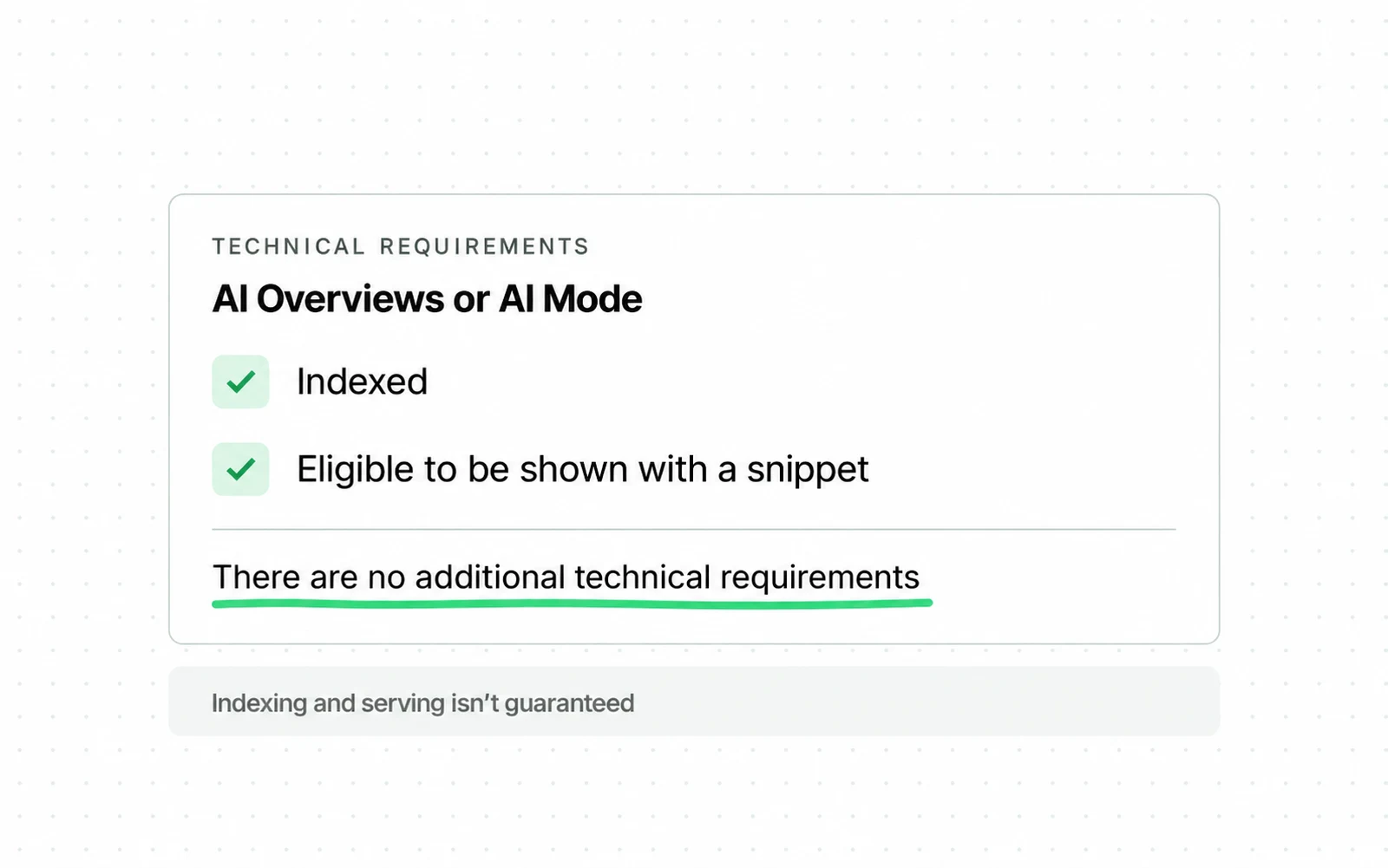
- Two conditions, and both of them are ordinary search conditions: indexed, and snippet-eligible. Then one sentence closing the door on a third.
- The highlighted note is the other half of the entry gate: meeting every requirement still does not guarantee that Google crawls, indexes or serves the page.
Ordinary technical search work produces every eligibility condition the platforms name: indexing, snippet eligibility, crawler access. That is why AI search engine optimization sets it out as one job, not two. That says the entry gate is shared. It does not say how much of the outcome the technical half decides. Whether to spend on it before ordinary search work is a separate question, answered in AEO vs SEO.
Where the two do part ways, in what each one costs and what it can be measured by, is the subject of how AEO and SEO differ.
A third name, generative engine optimization, came out of a 2024 research paper and not the industry. It means something more specific than either of these. What the paper measured and what later testing did to it is in the generative engine optimization guide.
Related reading: AI search engine optimization
That is the term, where it came from and what the platforms say about it. What four independent studies measured about which pages get cited is a longer subject, and it is taken apart in our guide to AI search engine optimization.
One rule from it belongs here: the four studies disagree, and the disagreement is the finding.
The four studies, and what each one measured, are in the guide to AI search engine optimization.
Read two lines in the file at yourstore.com/robots.txt before you spend anything on this. That file is plain text and it tells crawlers which paths they may fetch. Look for OAI-SearchBot and PerplexityBot: no mention of them at all is the clean result, because the default is allowed. A block there is one documented reason those platforms would not reach you, and it is the cheapest of the reasons to rule out. Two lines are not a full reachability diagnosis: server rules, IP blocking and rendering can all stop a crawler that robots.txt permits.
If those two lines read correctly and you still are not named in the answers, the work that follows is our answer engine optimization engagement.
Sources
- Google Search Central AI features and your website: no additional requirements to appear in AI Overviews or AI Mode, nor other special optimizations necessary
- OpenAI Bot documentation: OAI-SearchBot, GPTBot, ChatGPT-User and OAI-AdsBot, with their stated purposes
- Perplexity Bot documentation: PerplexityBot and Perplexity-User, and robots.txt tags for publishers
- Frase Answer engine optimization: the practice of structuring content so AI platforms select it as a cited source This page carries no publication date of its own.
- Search Engine Land Paid search click share doubles as organic clicks fall, with AI Overview presence by vertical
- Aleyda Solis Organic click share fell 11 to 23 points across four US categories, Similarweb data
Questions people ask
What is AEO vs SEO?
In industry usage, SEO optimises for a position in a list and AEO for a citation inside a generated answer. The distinction does not appear in platform documentation. Google says no special optimization is necessary for AI Overviews. The other platforms publish crawler access rules and not content advice.
How to answer engine optimization?
Start by checking that the crawlers can reach you. OpenAI recommends allowing OAI-SearchBot in robots.txt; Perplexity points publishers at robots.txt tags. After that the work is the same technical and editorial work that makes a page eligible to rank.
What is an example of AEO?
A product page written so that one paragraph answers a specific buying question completely, and is therefore quotable on its own. Nothing about that is new; what is new is that the quote can now appear without the click.
What is the best answer engine optimization tool?
The platforms publish no tool and endorse none. What exists are visibility trackers that sample AI answers and report whether you appeared. That is measurement. Optimising is a different job. Each one samples its own set of prompts, so what a tracker reports is the shape of its sample as much as your visibility. We have not run two of them against the same brand to see how far apart they land.