

AEO vs SEO: which one to pick first?
One half of the order is settled and the other is not. An AI answer is assembled out of pages that are already indexed and eligible to be shown with a snippet. Clear nothing at that bar and an answer engine has nothing of yours to quote. Finding what is missing is the job of an ecommerce SEO audit. AEO is what you add after.
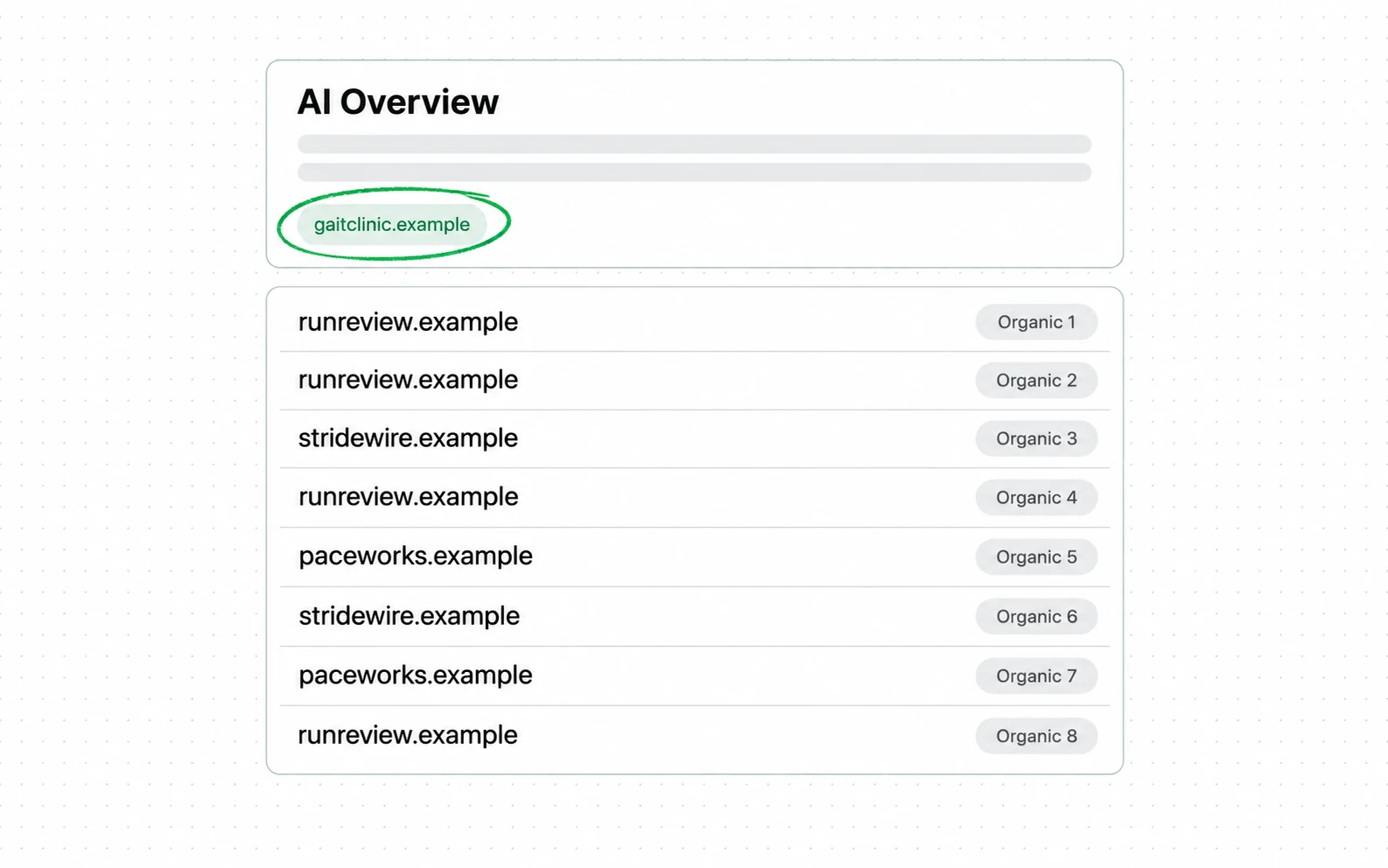
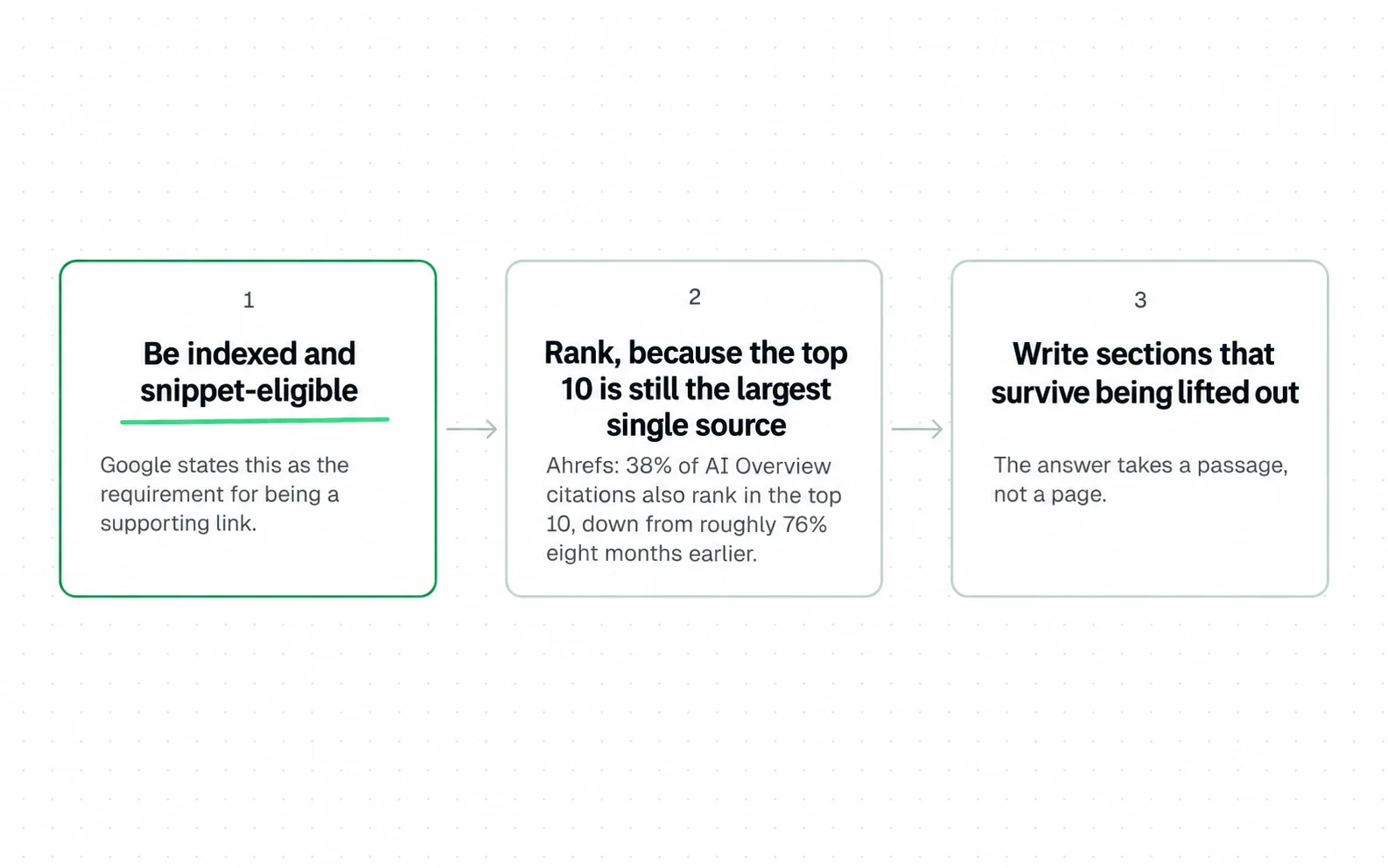
Google settles one half of the order in its own documentation, and not by correlation. To be a supporting link in an AI Overview or AI Mode, it says, a page must be indexed and eligible to be shown in Google Search with a snippet. That is a structural precondition, not a tendency, and it is why an unindexed store has nothing to optimise for an answer engine. It fixes what has to come first; it says nothing about how the budget after that should split.
The measurements then say how much of the answer the ranked list still supplies. The direction matters, and the full evidence base sits in the AI search engine optimization guide. Ahrefs found that 38 percent of pages cited in AI Overviews also rank in the top 10, across 863,000 keyword SERPs and 4 million AI Overview URLs. In their July 2025 version of the same study it was roughly 76 percent.
Indexing is the entry ticket. Ranking is the favourite.
How big that favourite’s share is depends on who measures and how. BrightEdge's parser, watching nine sectors across sixteen months, puts the top-10 overlap at just 16.7 percent. Part of the gap with Ahrefs comes from what counts as a match, and part from which sectors were sampled. Luca Tagliaferro compared five of these studies side by side for Search Engine Land and reached three conclusions. An overlap appears in each of the five. Its size depends on the segment. And any single number you see quoted alone is misleading.
When the answer is neither
When neither is the answer, paid search buys the position outright at the price set by how Google Ads works, while the other two are still earning it.
The exception is narrow and real. If a handful of entrenched domains dominate your category and you cannot outrank them in a year, a citation in the answer puts you on the screen in a place tenth position does not. Which arrives sooner has not been measured, and that is still the one case we would argue for leading with AEO.
Check how often that cited answer shows, by query type, before you lead with it. The AI Overviews guide carries the measurements Google and the tracking studies have published.
To be eligible to be shown as a supporting link in AI Overviews or AI Mode, a page must be indexed and eligible to be shown in Google Search with a snippet, fulfilling the Search technical requirements. There are no additional technical requirements. … Indexing and serving isn't guaranteed.
Google Search Central, AI features and your website read 7 September 2026
- A page has to be indexed and snippet eligible before it can be a supporting link at all. That is a precondition, not a tendency.
- The second half is the part people skip: meeting the requirements does not guarantee anything.
Differences between AEO and SEO that change the work
Order settled, the next question is where the two differ. Most comparisons of these two list definitions. The rows below only include things that change a decision: what you build, how you know it worked, and how long you wait before judging it.
| SEO | AEO | |
|---|---|---|
| The unit that wins | The page | The passage |
| What success looks like | A position in a list | A sentence quoted with your name on it |
| How you measure it | Rank, clicks, sessions | Citation presence and share of the answers you appear in |
| What the visitor arrives with | A query | An answer already formed |
| Typical time to signal | Months | Unmeasured. An answer is reassembled on every request, so the mechanism is faster; nobody has published how much |
| Main failure mode | You rank and nobody clicks | You are quoted and never named |

The gap halved in eight months.
That trend is the number this comparison needs, and it is rarely quoted. It does not reverse the order. Google's eligibility requirement still means an unindexed page cannot be cited at all, and 38 percent from one band of ten ranking positions is still concentration. What it changes is how much of your citation outcome ranking alone can explain, which is now well under half.
The paid equivalent of the same shift already exists: ads inside ChatGPT buy the answer surface that AEO earns.
One row belongs in that table and rarely appears in one: both need a crawlable, indexed site, and they need it equally. That row is the reason we do not sell answer engine work to a store whose pages are not indexed yet.
SEO work that AEO cannot replace
SEO is the work of being findable and credible enough to be a result. SEO is slower than anyone wants and it remains the base layer, because both the list and the answer are drawn from the same index.
That crawl-and-index floor is exactly what an ecommerce SEO audit is for, and nothing on the AEO side substitutes for it.
For an ecommerce store the work is concrete: a site that can be crawled without waste, category and product pages that match how people search, and enough external credibility that the domain is trusted at all. None of that is new and none of it has been replaced.
The work did not change. The payout did.
What has changed is the reward. One 2026 measurement of large sites puts organic traffic down slightly; a separate panel of US searches puts the share ending without a click up. They count different things and neither follows one page, so what your own page collects is a question only your own reporting can answer. The page still has to exist, because the answer is built from it, but the click it earns is not the only thing it is now doing.
Two 2026 measurements sit either side of the same question, and they do not measure the same population. Graphite analysed the 40,000 largest US sites and found organic traffic down just 2.5 percent year over year, with the ten biggest sites growing, nothing like the collapse headlines claim. SparkToro studied a US Google-search panel and found 68 percent of searches now end without any click at all.
One counts traffic arriving at large sites and the other counts searches that go nowhere, so neither contradicts the other and neither explains what your own traffic will do. Reading them together suggests that clicks per search are falling while large sites hold their totals, and that reading is an inference from two samples, not a measurement anybody published.
Google's own liaison frames it as "SEO for AI is still SEO", the platform's position, and it reads like one. On the traffic numbers above it is closer to right than the obituaries are.
What AEO adds beyond SEO
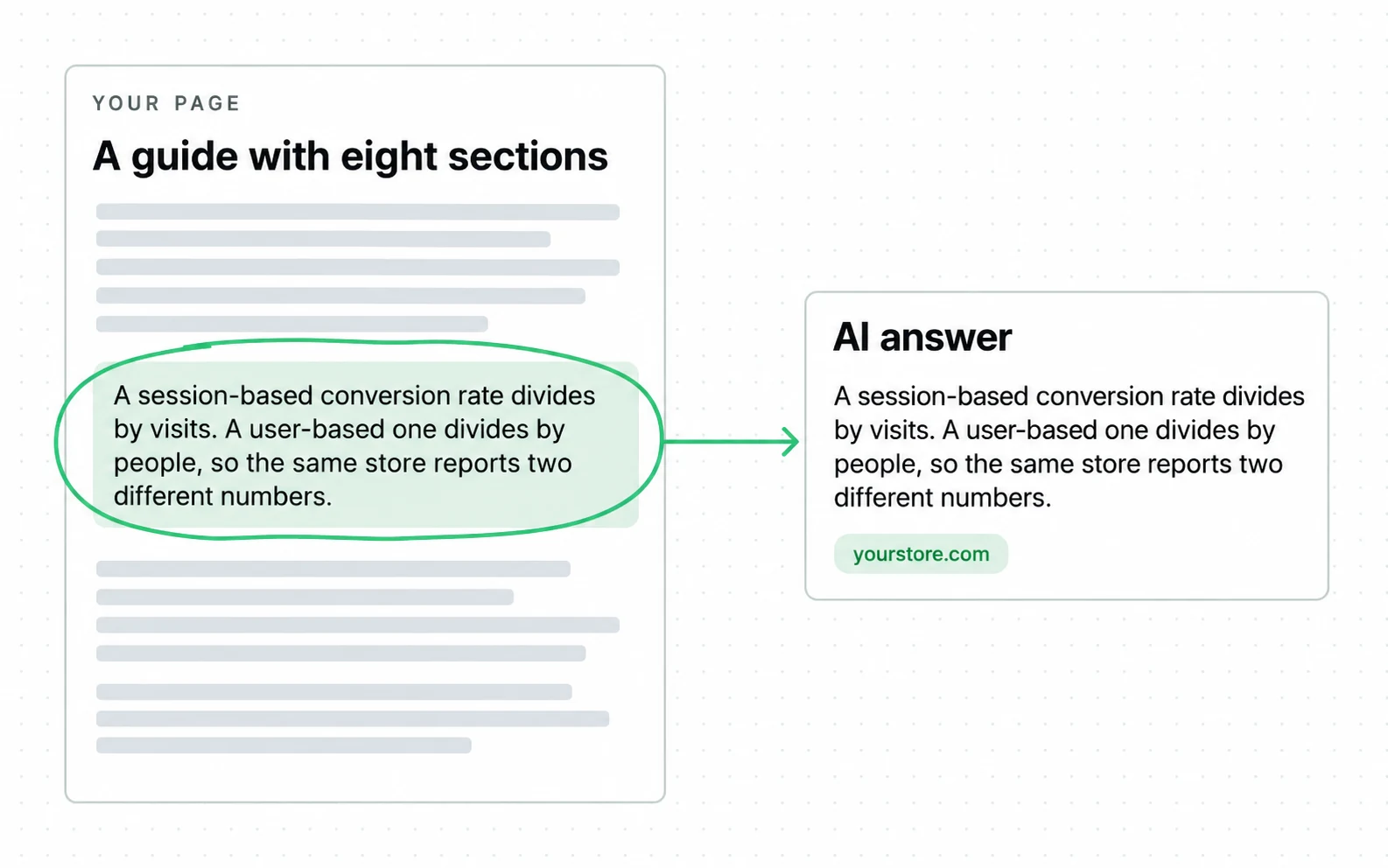
AEO is the work of being quotable. It changes the shape of a page, not its subject. A self-contained answer near the top. Sections that survive being read alone. And claims a machine can attribute to you, not paraphrase away.
- A standalone answer in the first screen. If the rest of the page vanished, the opening should still answer the query completely.
- Sections that hold up out of context. An answer engine takes a passage, so every section has to open with its own answer, not a wind up.
- Claims that carry a source and a date. An unsourced number is easy to paraphrase and impossible to attribute. A sourced one gives the engine a reason to name you.
- Something only you can say. Original measurement is the one input a competitor cannot copy from the same twenty articles everyone else read.
The full method, with the measurements it rests on, is in our AI search engine optimization guide.
That third habit has a peer-reviewed measurement behind it: the Princeton GEO paper by Aggarwal and colleagues (KDD 2024) tested nine page modifications on its 10,000-query benchmark, and the three that added credible quotations, statistics and cited sources produced the largest gains in generated-answer visibility, from roughly 28 to 41 percent on its position-adjusted metric.

Four moves, and three of them are just good writing.
Why it stopped being optional
Two other measurements explain why it now reaches commercial pages and not only informational ones. Semrush tracked AI Overview triggers across more than 10 million keywords through 2025 and watched the informational share fall from 91.3 percent in January to 57.1 percent by October: the summaries moved into commercial queries. And Seer Interactive's 2026 update found pages that earn a citation collect roughly 35 percent more organic clicks than equally ranked pages that do not.
That is why Addition, an AI search agency, treats this as a discipline inside search work, not a separate product. The full method sits on our answer engine page.
If the term itself is the sticking point, the glossary entry on answer engine optimization gives the definition without the sales case.
Is an AI visitor worth more than a search visitor?
This is the question that decides budgets, and it is where the published numbers disagree most. Three serious measurements exist, they used different samples and different comparisons, and they point in three directions.
| Who measured | Sample | Compared against | Result |
|---|---|---|---|
| Semrush, 2025 | 500+ topics, mostly marketing and SEO subjects | Organic search visitors | AI visitors convert 4.4x better |
| Kaiser and Schulze, Marketing Science, 2025 | 973 ecommerce sites, $20B revenue, 12 months | Organic, email, affiliate | ChatGPT referrals convert worse: affiliate 86% more likely to convert, organic about 13% ahead |
| Same research group, 2026 follow-up | 94 ecommerce sites, full year | Non-branded organic only | ChatGPT converts 31% better, but delivers 1.5% of the revenue |
One caution before any of these numbers becomes a target: the visibility scores that report them are not comparable between tools, and a single run sits inside a wide swing. What the score measures is set out in the AI visibility guide.
Three measurements, three answers.
Read the samples before the verdicts. Semrush measured mostly marketing-topic sites, where AI-referred readers are unusually qualified. The peer-reviewed study measured 973 ordinary stores and found the opposite. The follow-up split the comparison properly and found both things at once: a ChatGPT visitor beats a non-branded organic visitor, and there are so few of them that the channel paid out 1.5 percent of what organic did.
A visit is only worth what it earns, so end the comparison at revenue per visitor, not session counts. That is the ground conversion rate optimization covers.
Our reading, and every number above is someone else's: the value question is the wrong first question. Volume is. Conductor reaches the same reading from its own 13,770-domain benchmark: AI is changing discovery, not displacing organic. The rule is ours. Kaiser and Schulze measured ChatGPT referrals at under 0.2 percent of store traffic, and Conductor's benchmark across 13,770 enterprise domains puts all AI referrals near 1 percent. A high-converting trickle is still a trickle. The case for AEO today is position for where the volume is heading, not revenue this quarter, which is exactly why it loses to paid when the runway is short.

When is AEO the wrong thing to buy?
There are three situations where paying anyone for AEO right now is a poor use of money, and two of them are common enough that we turn the work down more often than we sell it.
- Your site is not indexed properly yet. Optimising for citation while pages are blocked, duplicated or invisible is decorating a room with no floor. Fix the crawl first. It does not produce a citation on its own, and nothing else you do can produce one until it is done.
- You sell something nobody asks an assistant about. Some categories are pure impulse or pure brand. If buyers never phrase a question, there is no answer to be cited in.
- You need revenue this quarter. The volume numbers above are the reason, with the caveat they carry: 0.2 percent is the average across 973 stores, not a ceiling on yours, and it counts ChatGPT referrals, not every answer surface. At or near that average the channel is too small to move a quarter, and if you have measured your own share and it is far above it, this reason does not apply to you. Nobody has published how long AEO signals take to move, and the table above says so, but neither discipline moves faster than a paid campaign. If the runway is short, the recommendation is Google Ads first, and search work built underneath it.
Say you want the same line drawn for your own pages. The ai-seo skill draws it: Google’s features rooted in core Search, the other engines rewarding extractable structure.
Search your best-selling category and read the AI answer, looking for one thing: whether anyone it cites is someone you compete with. One query is not your category, so repeat it on three or four and look for whether the same competitor keeps appearing. That is the difference between a datapoint and a signal, and it costs ten minutes.
Sources
- Kaiser and Schulze ChatGPT Referrals to E-Commerce Websites: How Do LLMs Compare Against Traditional Channels?, Marketing Science, 973 sites, $20B revenue, 12 months
- Search Engine Land ChatGPT ecommerce traffic converts 31% higher than non-branded organic search, 94-site full-year follow-up
- Graphite, via Search Engine Land Organic search traffic is down 2.5% YoY, 40,000 largest US sites, Similarweb data
- SparkToro In 2026, less than one third of Google searches still send a click, Similarweb US panel
- BrightEdge Rank overlap after 16 months of AI Overviews, nine sectors
- Luca Tagliaferro, Search Engine Land Why every AI search study tells a different story, five-study comparison
- Conductor The 2026 AEO/GEO Benchmarks Report, 13,770 enterprise domains, 3.3B sessions
- Aggarwal, Murahari, Rajpurohit, Kalyan, Narasimhan and Deshpande GEO: Generative Engine Optimization, KDD 2024, nine modifications on the GEO-bench benchmark
- Pew Research Center Google users are less likely to click on links when an AI summary appears, 900-adult panel, March 2025 data Measured 14 months ago, on a surface that has moved since.
- Semrush AI Overviews are expanding across commercial intent search, 10M+ keywords tracked through 2025 Dated 2025 with no month given, so its exact age is not knowable from the source.
- Seer Interactive AIO impact on Google CTR, 2026 update, 3,119 search terms across 42 organisations
- Ahrefs 38% of AI Overview citations pull from the top 10, 863,000 SERPs and 4M AIO URLs
- Ahrefs 76% of AI Overview citations pull from the top 10, the July 2025 version Measured 14 months ago, on a surface that has moved since.
- Ahrefs Update: AI Overviews reduce clicks by 58%, 300,000 keywords
- Google Search Central AI features and your website
Questions people ask
Will AEO replace SEO?
No, because the answer is assembled from the index that SEO feeds. Google states that a page has to be indexed and snippet-eligible before it can be a supporting link at all.
What is changing is the reward for ranking. The need to rank has not changed. Ahrefs measured the share of AI Overview citations that also rank in the top 10 at roughly 76 percent in July 2025 and 38 percent in March 2026. Ranking still supplies the largest single share of citations, and it explains far less of the outcome than it used to.
What is the difference between SEO and AEO?
SEO optimises a page to appear in a list of results. AEO optimises a passage to be quoted inside a written answer.
The practical consequence is structural. SEO rewards a page that is comprehensive overall. AEO rewards a page whose individual sections still make sense when lifted out on their own.
Is AEO a part of SEO?
In practice yes, and treating it as a separate budget line usually produces worse work in both. The research, the technical base and the credibility are shared.
What is new is the format discipline: answering first, sourcing every claim, and publishing something only you could have written.
Is SEO dead now with AI?
No. Appearing in AI Overviews carries no requirements beyond ordinary indexing and snippet eligibility, and that is Google's own documented position. In Ahrefs' measurement the top 10 remains the single largest source of AI Overview citations.
What died is the assumption that a ranking equals a visit. Ahrefs measured a 58 percent fall in clicks to the top result when an AI Overview is present. Being in the answer is now a separate thing you have to earn.