

What are Google AI Overviews and when do they appear?
An AI Overview is a generated answer placed above the ordinary results, with supporting links inside it. Google does not publish a trigger list, and it does publish a criterion.
A judgement call the system makes per query.
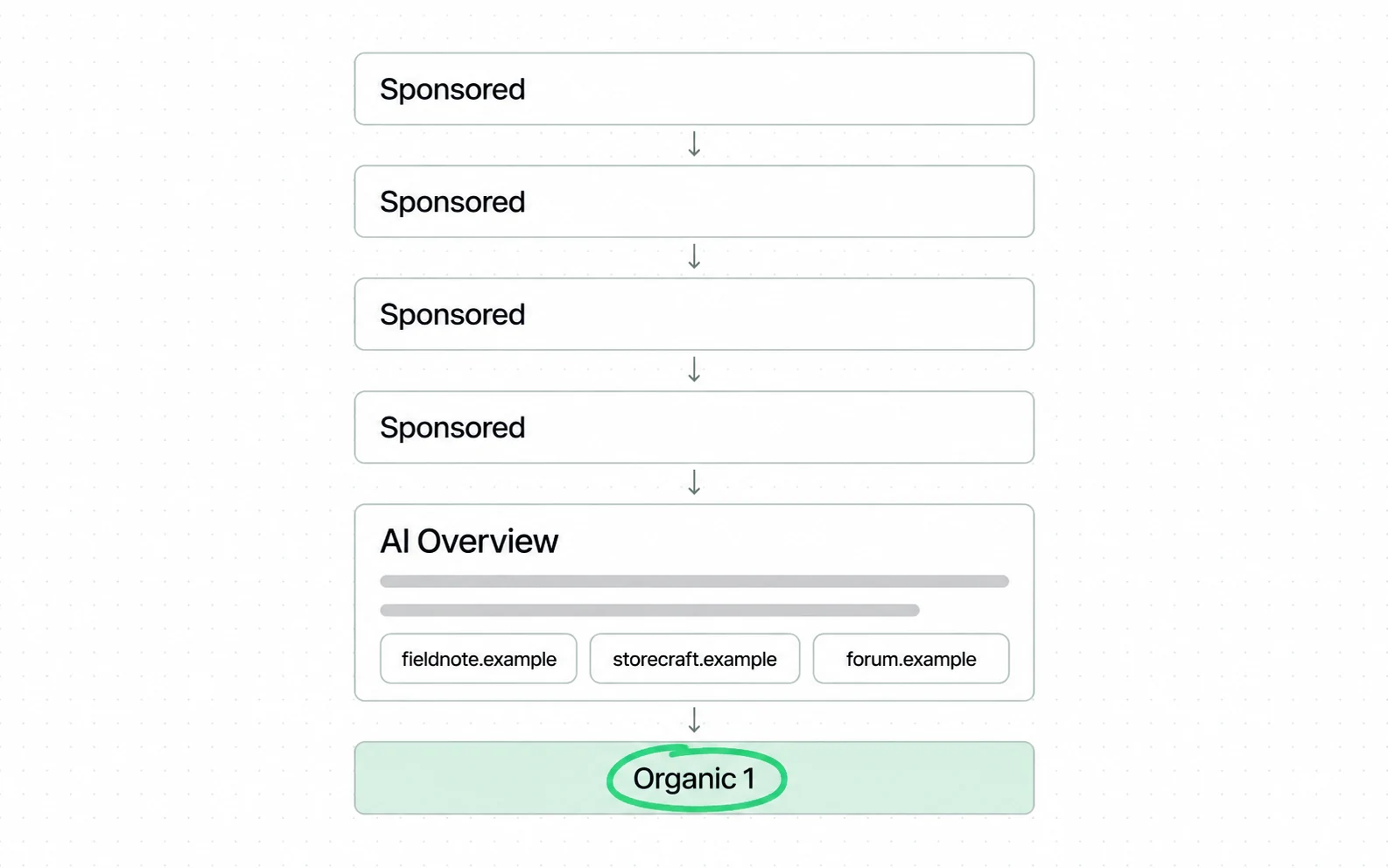
Four ads, then Google’s own answer, then a box of related questions, and the first ordinary result is the seventh thing a buyer meets.
The fourth question that box asks, what triggers one on a given query, is the one Google does not answer. Google gives a criterion and not a trigger list, and the difference matters: a criterion cannot be checked against your page before you publish it.
For the newer AI Mode surface, Google has described the mechanism a little further. It uses a query fan-out technique, issuing multiple related searches at once across subtopics and data sources. Where it does not have high confidence in helpfulness and quality, the response will be a set of web search results instead. So the fallback is the old page.
On scale, Google gives reach and not frequency. AI Overviews are now used by more than a billion people. That is a different claim from how often they appear, which Google does not publish.
What the independent studies measured about being cited in these answers, and where they disagree, is collected in AI search engine optimization.
What makes a page eligible for a Google AI Overview?
Google does not publish how often they appear. It does publish who can be in one, and that part is settled. This is the part with a published rule, and the rule is shorter than the industry built around it. Eligibility here is ordinary Search eligibility, stated in one sentence and followed by a second that removes a whole category of advice.
Indexed, and allowed to show a snippet.
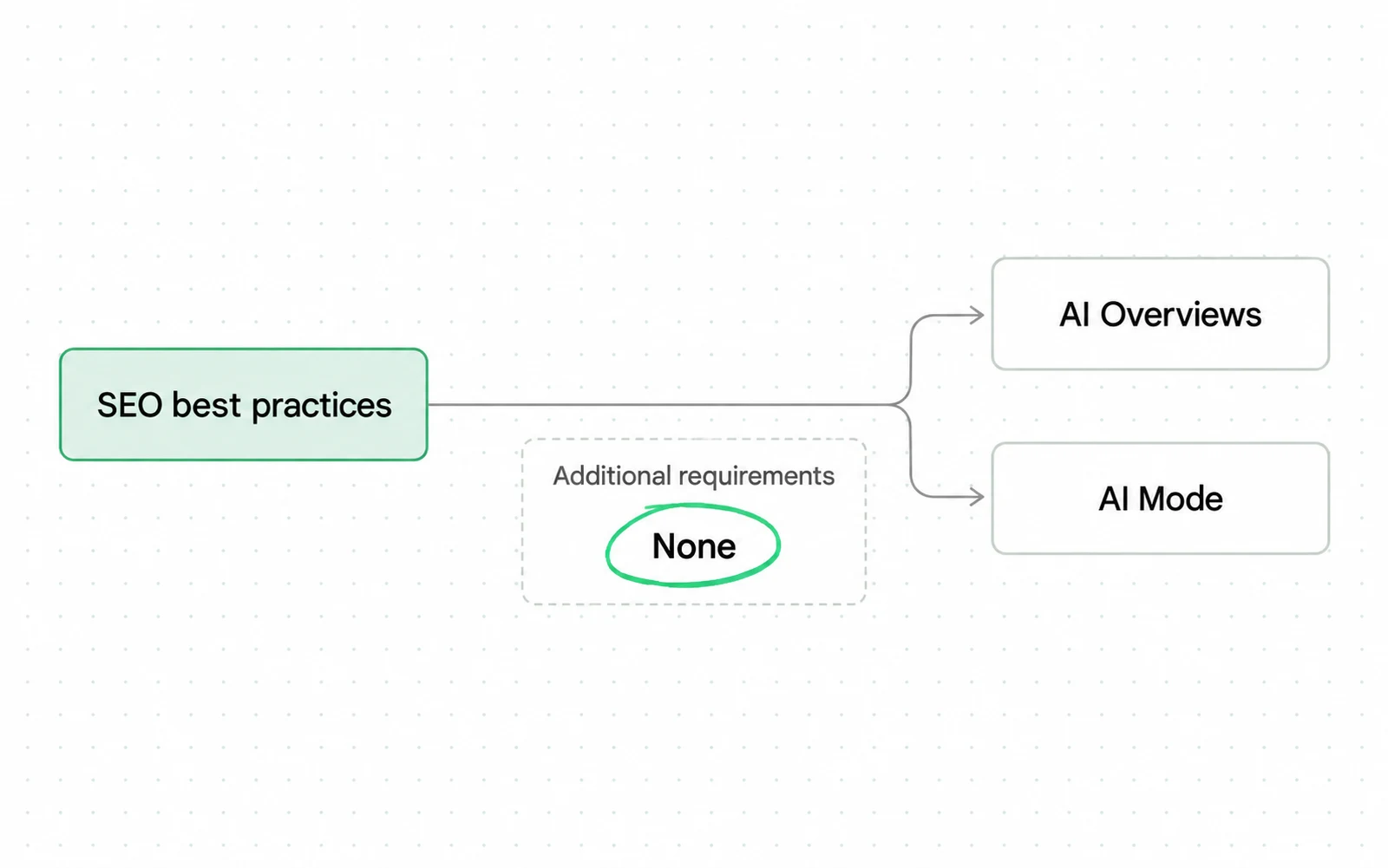
- The sentence is in bold in Google’s own callout. The line is not buried, and it is not a paraphrase of anything.
- The scope is named twice on this page: AI Overviews and AI Mode. Nothing here is a claim about ChatGPT or Perplexity.
- What it rules out is a separate technical checklist. What it does not rule out is everything ordinary indexing already asks of you.
Here is Google’s wording. To be eligible to be shown as a supporting link in AI Overviews or AI Mode, a page must be indexed and eligible to be shown in Google Search with a snippet, fulfilling the Search technical requirements. Then, on the same page, comes the sentence that removes an entire category of advice. There are no additional requirements to appear in AI Overviews or AI Mode, nor other special optimizations necessary.
| Claim you will read | What Google publishes |
|---|---|
| Add special schema for AI | There is no special schema.org structured data that you need to add |
| A separate AI optimisation exists | No additional requirements, nor other special optimizations necessary |
| Get listed in AI Overviews directly | Eligibility is being indexed and eligible to show with a snippet |
| Opt out of AI Overviews | Use nosnippet, data-nosnippet, max-snippet or noindex, which apply to Search |
Four blunt controls
Every control Google names, and what each one costs
The four controls, as they are written
1<meta name="robots" content="nosnippet">
2<meta name="robots" content="max-snippet:160">
3<p data-nosnippet>Not for quoting.</p>
4<meta name="robots" content="noindex">
- 1No snippet anywhere in Search, not only in the overview. The page keeps its position and loses the two lines under it.
- 2A length cap, not a removal, and it applies everywhere the snippet appears.
- 3The narrowest of the four: only the marked part of the page is excluded, and the rest is unaffected.
- 4The only one that removes the page. It removes it from everything, the overview included, which is the trade most opt-out advice describes as the other three.
Google names four: nosnippet, data-nosnippet, max-snippet and noindex. None of them is specific to AI Overviews. The first three restrict what can be quoted from the page while it stays indexed and can still rank; the fourth removes the page from Search altogether. So the trade is real but narrower than it is usually described: you keep your position and lose your snippet, in the overview and in ordinary results alike.
| Control | What it does | What it also does |
|---|---|---|
| nosnippet | Stops any text snippet from the page | The page stays indexed and can still rank |
| max-snippet | Caps the snippet length in characters | Applies across Search, not to the overview alone |
| data-nosnippet | Excludes a marked section of the page | The rest of the page is unaffected |
| noindex | Removes the page from Search | Removes it from everything, including the overview |
A separate control, Google-Extended, governs AI training and grounding in some of Google’s other systems, not the appearance of supporting links here. Other platforms draw the same line in their own documentation. OpenAI separates OAI-SearchBot, which surfaces sites in ChatGPT search, from GPTBot, which serves the foundation models. Perplexity separates PerplexityBot from its user-initiated fetcher and states the first is not used for training. Confusing the two is the most common way a store blocks the wrong thing, and AI search engine optimization sets out the difference.
Three mistakes from treating AI Overviews as a channel
An AI Overview is a surface, not a channel. It has no account, no bid, no report of its own, and each of these mistakes follows from acting as if it did.
How to buy separate work for it
Nothing separate is required, and the eligibility rule is the ordinary one. Work sold specifically as AI Overview optimisation is, on Google’s own account, either technical search work under another name or something the platform has not asked for. That does not make the work worthless. It makes the label misleading, and the label is what gets priced.
How to try turning it off
Google states plainly that features cannot be turned off. What exists are snippet controls, and none of them applies to the overview alone. A brand that dislikes being summarised can stop the quoting with nosnippet and keep its ranking, and it loses its snippet in ordinary results at the same time. The other two are narrower: max-snippet caps the length everywhere, data-nosnippet excludes only the part you mark. That is a real remedy with a real price, and none of it is an opt-out.
Reading a click drop as an overview problem

Compare January 2025 with January 2026 in one vendor’s panel. Classic organic click share fell in all four categories measured, by between 11 and 23 points. Paid share rose in each. Search Engine Land, covering the same analysis, reported AI Overview presence ranging from 12 to 33 percent by vertical. Two single months are not a time series, and at least two things moved at once, so attributing the fall to the overview is a guess. If the paid share is what moved, that is a different page, SEO vs PPC, and the wider practice in AI search engine optimization.
Ordinary search steps that cover Google AI Overviews
Start with the things Google names as requirements. The rest are only worth doing once those hold. None of it is specific to this surface, and Google says so itself. For a store the underlying work is the eight ecommerce topics Google publishes, six of which are structure and data.
-
Confirm the page is indexed and can show a snippet
That is the whole eligibility rule. A page carrying nosnippet is not eligible, and a page that is not indexed is not eligible for anything. On a storefront some of this is set by the platform before you arrive, which is what Shopify decides for you. The wider technical baseline those pages start from is measured every year by the Web Almanac, and it differs by platform, not by effort.
-
Check you have not blocked the wrong crawler
Google-Extended governs training and grounding in other systems, not appearance here. Blocking it does not remove you from AI Overviews. Blocking Googlebot in robots.txt is not removal either. Google states that a blocked page can still appear in results if other pages link to it. That is why noindex and a block are different instruments.
-
Write the answer to one question completely, in one place
A paragraph that answers a specific buying question on its own is quotable on its own. That is our reading and not something Google says. Nobody puts it in those terms, and it is ordinary editorial work in any case: what Google rules out is a separate requirement, not the business of answering clearly.
-
Fix the technical requirements instead of adding markup
Google states there is no special schema to add. That covers this surface only. Product structured data is still worth adding for what Google says it does buy: a richer appearance in Search, shown at each experience’s discretion. Crawlability, indexation and snippet eligibility are the requirements, and an ecommerce SEO audit is how you find out which of them your store fails. Speed is not among them. Core Web Vitals, the one measure here with a published pass mark, is graded separately, and Google never names it as a condition here.
-
Measure impressions and clicks separately
An overview can cite you without sending a click. And a visit that starts with a citation and ends days later gets credited elsewhere entirely. Shopify’s marketing reports default to last click with a 30-day lookback. Impressions holding while clicks fall is the shape to look for, and it is visible in Search Console without any AI-specific tool.
Why none of it is specific to this surface
Suppose you want the crawler-access part of that check done for you, with Googlebot and Google-Extended reported as the separate things they are. That is a section of what the seo-geo skill reports.
None of those steps is specific to this surface. Google makes that point repeatedly. The work that makes a page eligible for an overview is the work that makes it eligible for a result, and ecommerce SEO is where that sits for a catalogue.
The line-by-line version of that check, with what has a published pass mark and what does not, is an ecommerce SEO audit.
AI Overview pricing: nothing to buy but labels
None of that work has a line on an invoice, because there is nothing here to buy. There is no media cost. AI Overviews are not bought, and no product exists to buy your way into one. What has a price is the work sold under the name, and the useful question is what that work would be called otherwise.
A new label on an existing line item.
Understand the label before you read a quote that uses it: answer engine optimization is an industry term, not a platform one, and none of the companies building these answers uses it.
| Line on the quote | What the line really covers |
|---|---|
| AI Overview optimisation | Technical search work, or something Google has not asked for |
| AI schema implementation | Structured data, which Google says is not required for this |
| AI visibility tracking | Measurement, and useful, but not optimisation |
| Content rewritten to be quotable | Editorial work, and the one content lever that is real |
One further label to be careful with: the work is usually sold under answer engine optimization, which is an industry term, not a platform one. The definition it travels under, structuring content so AI platforms select it as a cited source, comes from vendors. It rests on third-party studies, not on platform documentation. What we would ask a supplier: which of these lines would still exist if AI Overviews were switched off tomorrow. The ones that would are the ones worth paying for, and the ones that would not are being priced on a label.
Under whichever label, the work on your pages is AI visibility monitoring.
Search Console numbers that hint at AI Overview impact
There is no AI Overview report in Search Console. There are three numbers in the ordinary data worth watching, and none of them is a diagnosis on its own.
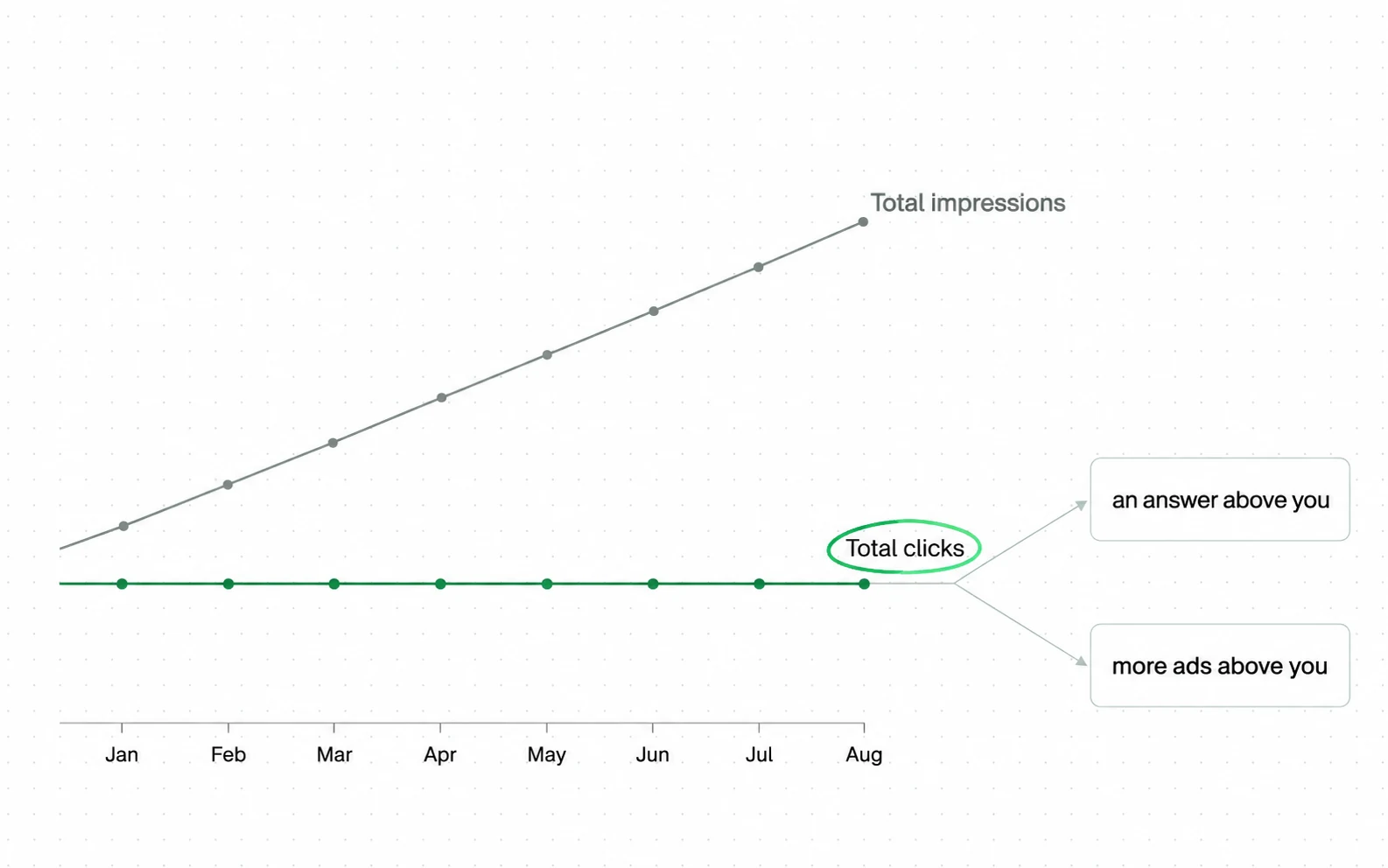
- Impressions against clicks on your best informational queries. Impressions holding while clicks fall is consistent with something above you answering, and it is consistent with more ads above you too.
- Position against click-through rate for the same queries. Holding position while the rate falls says the page above you changed, not your ranking.
- The split between informational and transactional queries. Google describes AI Overviews as appearing where its systems judge generative AI especially helpful, and does not publish which query types those are, so this split is a reasonable thing to check, not a rule.
| What you see | What it suggests | What else could cause it |
|---|---|---|
| Impressions flat, clicks down | Something above you is answering | More ads above you |
| Impressions down, clicks down | You lost visibility | Ranking, seasonality, deindexing |
| Position flat, click rate down | The page changed around you | A new feature, or a competitor’s snippet |
Google publishes no rule about which query types trigger an overview, so your own report is the only evidence about your store. Three shapes of demand, three different amounts of concern:
- Mostly product and category queries. Check it, but expect less. There is no published rule either way.
- Mostly buying-guide and comparison content. Check this first. Buying guides and comparisons are the content most like an answer.
- A mix, which is most catalogues. Split the report before deciding, because an average hides both halves.
Is this your problem?
The third is where a lot of ecommerce panic is probably misplaced, and probably is the right word, because Google publishes no rule about which query types trigger an overview. A store whose traffic is product and category queries sits on a different part of the surface from a publisher answering questions. AEO vs SEO is where that budget question gets settled.
Search three of your top informational queries before you buy anything to fix this, and note whether an AI Overview appears at all. Three queries on one day is a spot check, not a survey, and Google publishes no rule about which queries trigger the feature. So a clean result buys you an order of work, not an all-clear. The check is still worth ten minutes: if none of your three shows an overview, this is not the first thing to spend on.
Sources
- Google Search Central AI features and your website: eligibility, no special optimizations, no special schema, and the four snippet controls
- Google Search Help AI Overviews: features cannot be turned off, and AI Overviews can and will make mistakes
- Google AI Mode in Search: query fan-out, the low-confidence fallback to web results, and reach of more than a billion people Measured 18 months ago, on a surface that has moved since.
- Aleyda Solis Organic click share fell 11 to 23 points across four US categories, Similarweb data
- Search Engine Land Paid search click share doubles as organic clicks fall, with AI Overview presence of 12 to 33 percent by vertical
- OpenAI Bot documentation: OAI-SearchBot for search results, GPTBot for model training
- Perplexity Bot documentation: PerplexityBot surfaces and links sites and is not used for model training
- Frase Answer engine optimization: the industry definition, and the AEO, GEO and SEO split This page carries no publication date of its own.
- Google Search Console Help Performance report: impressions, clicks and position by query
- Google Search Central Ecommerce best practices: eight topics, six of them about structure and data
- Google Search Central Product structured data: richer appearance in Search, shown at each experience’s discretion
- HTTP Archive Web Almanac 2025 Ecommerce chapter: storefront platform performance and technical baselines Dated 2025 with no month given, so its exact age is not knowable from the source.
- Google Search Central Consolidate duplicate URLs: rel=canonical is a strong signal, not a directive
- Shopify Help Center Marketing reports: last-click attribution with a 30-day lookback
- Google Search Central Robots.txt specification: a blocked page can still appear in results if other pages link to it
Questions people ask
What triggers Google AI Overviews?
Google does not publish a trigger list. Its stated criterion is that AI Overviews appear when its systems determine that generative AI can be especially helpful. For AI Mode it says that where confidence in helpfulness and quality is low, the response is a set of web results instead.
How to get AI Overview off Google?
As a searcher, you cannot: Google states that features cannot be turned off, though you can select the Web filter after a search. As a publisher, the only controls are nosnippet, data-nosnippet, max-snippet and noindex, and all four restrict what Search shows from your page generally, not the overview specifically.
How to get Google AI overview?
By being eligible for ordinary Search. Google states that a page must be indexed and eligible to be shown with a snippet, and that there are no additional requirements or special optimizations, including no special schema. Which of your pages is the eligible one is not entirely your choice either: Google describes rel=canonical as a strong signal, not a directive.
Should I trust Google AI Overviews?
Google’s own answer is a qualified no: AI responses may include mistakes, AI Overviews can and will make mistakes, and it recommends checking important information in more than one place. For a business, the practical version is to check what an overview says about your own products.