

Which audit checks have a pass mark?
Open any SEO audit template and every row carries the same weight. A few are measured against a number Google published. Most are measured against what the person writing the template believes.
A checklist row is not evidence.
That is not an accusation. Conventions are usually good, and a page with one H1 and a clean canonical is easier to rank than one without. But a convention and a published threshold are different things. Treat them as the same and you end up with a hundred red rows and no order of attack.
So sort the checklist before you work through it. Which rows have a stated number to hit, which have a documented mechanism behind them, and which are inherited habit. Sort it that way and the order of work stops being a matter of taste. The same question separates AEO from SEO: the answer-engine side has almost no published thresholds at all.
The sorted list is also the order in which ecommerce SEO work gets done afterwards, which is why the audit and the programme share one checklist, not two.
| What kind of evidence | What it covers |
|---|---|
| Google publishes a numeric pass mark | Core Web Vitals |
| Google documents the mechanism but sets no number | Crawling, indexing, canonicals, faceted navigation |
| Industry convention, no published threshold | Most of the remaining checklist |
Core Web Vitals thresholds
Google publishes three metrics with explicit good thresholds. This is the only part of an audit where Google, not the auditor, defines a pass and a fail. Most people skip the second half of the rule.
Run your site migration SEO checks before a redesign or a platform change reaches staging. The thresholds below are what you compare the new build against.
Where a store reads the one pass mark on the checklist

- 1One metric red and two green is still a fail. The assessment is taken from the worst of the three, which is why an average across them tells you nothing.
- 2Field data, not lab data. The distribution bar under each metric is what decides the grade, and it comes from real visits, not a test run.
Additionally, to classify the overall performance of a page or site, we use the 75th percentile value of all page views to that page or site. In other words, if at least 75 percent of page views to a site meet the "good" threshold, the site is classified as having "good" performance for that metric.
web.dev read 7 September 2026
Here is the half that gets dropped. Google assesses these at the 75th percentile of page views, not the average. An LCP averaging 2.4 seconds can still hide a quarter of your visits sitting at five seconds on a mid-range phone. Two further counting rules decide the grade alongside it, and what Core Web Vitals measure sets out all three.
This is the only part of the audit where somebody can tell you, before you start, exactly what finishing looks like. Everything below is worth doing, and none of it comes with that. Google also grades landing pages inside the Google Ads auction, under a separate definition of its own. Know that before anyone promises that one score moves the other.
Two mistakes that undo earlier work
Neither of these is exotic. Both show up in stores that have already been audited, and in both cases the site looks correctly configured to whoever set it up. That is why they survive.
Blocking a page in robots.txt and then telling it noindex
We check this pair first on any audit. Google documents the mechanism directly, and its wording is unambiguous.
For the noindex rule to be effective, the page or resource must not be blocked by a robots.txt file, and it has to be otherwise accessible to the crawler. If the page is blocked by a robots.txt file or the crawler can't access the page, the crawler will never see the noindex rule, and the page can still appear in search results, for example if other pages link to it.
Google Search Central, Block search indexing with noindex, last updated 10 December 2025
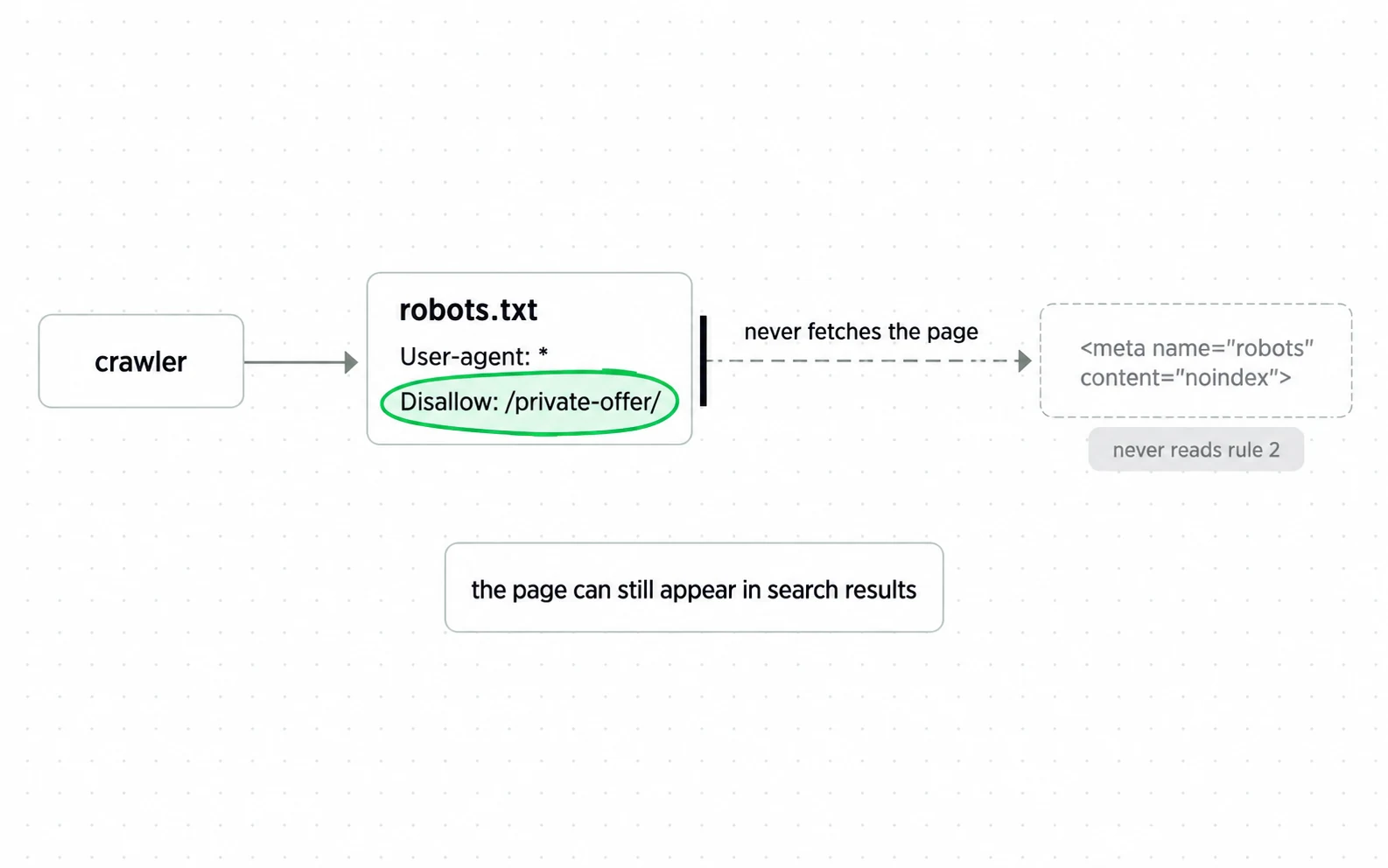
The trap is that it looks doubly safe. You blocked the page and told it not to index, so surely it is gone twice over. Remove the disallow line and leave the noindex. That feels like loosening a lock and is the opposite. A blocked page can hold its place in results on links alone, while the instruction that would have removed it sits unread.
Auditing robots.txt as if only Googlebot existed
Your robots.txt now has a second audience, and it belongs on the checklist. The Web Almanac's 2025 SEO chapter measured how many sites name each AI crawler.

You do not have to block them. Make the decision deliberately instead of inheriting it, and split it by job. Training is a different question from search visibility. OpenAI documents four crawlers doing four different jobs, set out in AI search engine optimization. Blocking the wrong one is the failure mode.
A second difference changes what you ship. Vercel and MERJ instrumented over 100,000 Googlebot fetches and found Googlebot rendered every JavaScript-heavy page in the sample, with a median crawl-to-render delay around ten seconds.
A second study by the same pair, published a month later, tested the AI crawlers and reported that not one of the crawlers it tested renders JavaScript at all. ChatGPT fetched JavaScript files on 11.5 percent of requests and Claude on 23.84 percent, and neither ran them.
These are two studies with two samples, and both are from late 2024, so treat them as measurements of those crawlers in that window.
On that evidence, content that arrives client-side on your site was readable by Googlebot and unreadable by the crawlers those studies tested. Whether it still holds for your store is a question your own log files answer.
| Googlebot | AI crawlers | |
|---|---|---|
| Which study | How Google handles JavaScript | The rise of the AI crawler |
| JavaScript executed | On every JavaScript-heavy page tested | None of the crawlers tested |
| Median crawl-to-render delay | About 10 seconds | Does not arise |
| What it means for your store | Client-side content is still read | Client-side content is not there |
And the blocking itself is now the norm, not the exception. An academic study of 4,079 sites, published on arXiv, found the share blocking at least one AI crawler rose from 23 percent in 2023 to 60 percent in 2025. Inheriting that default without deciding it is the mistake, in either direction.
Faceted navigation and crawl waste
Those two mistakes would matter on a blog. The next one matters most for a catalogue, and generic templates rarely reach it. Google publishes its own documentation about the problem and has put a number on it. Faceted navigation alone accounts for about half the crawling problems reported to Google, with action parameters adding another quarter.
Why the address count explodes
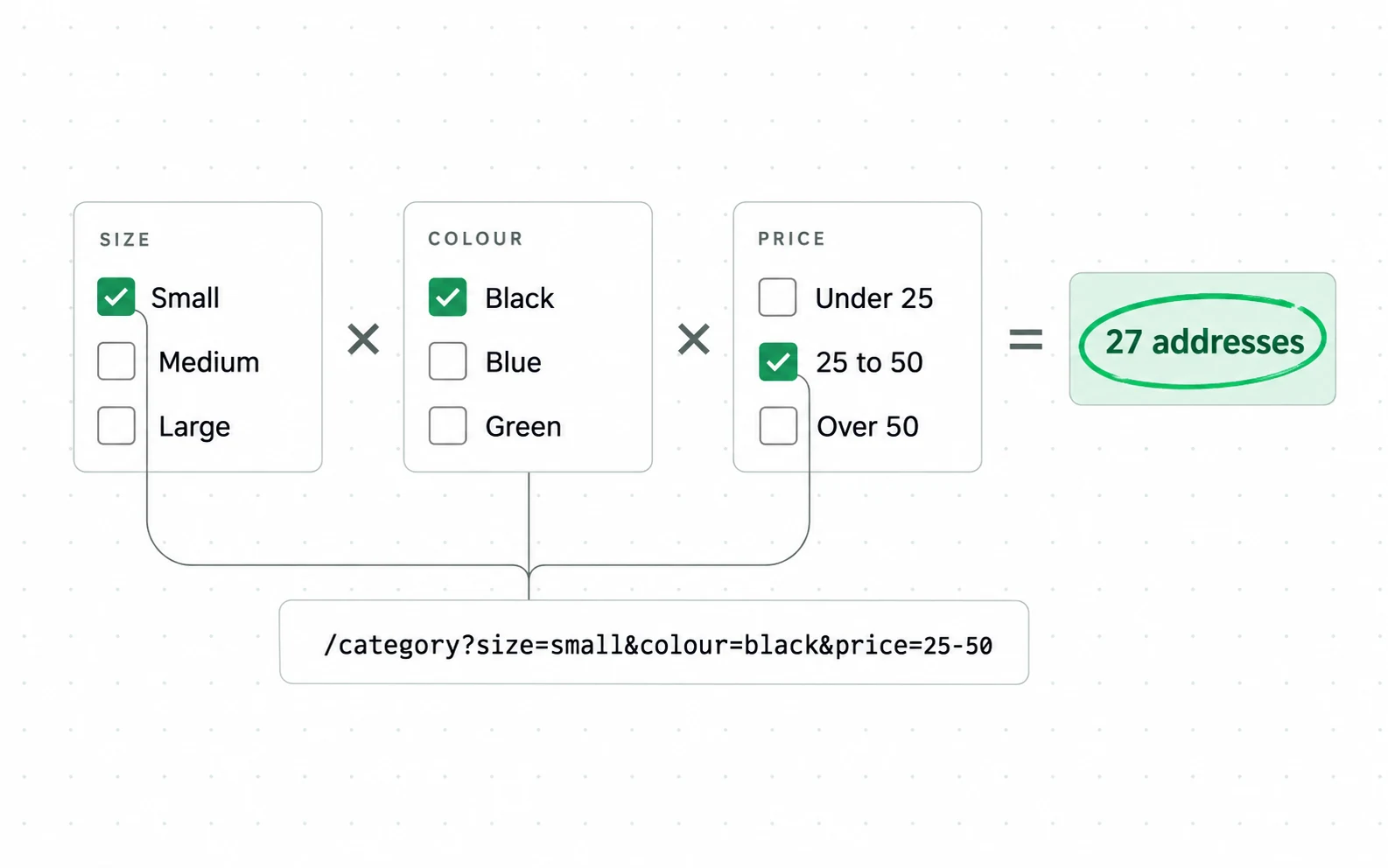
The arithmetic explains it. Portent worked out the combinations for one normal filter set under three matching rules. The spread runs from four figures to thirteen figures. Nothing about the catalogue changed between them, and nobody picked the rule as an SEO decision.

Somebody has measured what that costs, once, on a neighbouring problem. Screaming Frog analysed 7.2 million log events on one ecommerce site. 70 percent of the crawl budget went to internal search result pages with no ranking value at all. Crawl budget here means the time a crawler is willing to spend on your site. Those are search URLs, not filter URLs, and the same mechanism produces both: a template minting an address for every combination a visitor can make. That is one site, so treat the figure as an example and not a benchmark.
Every filter combination on a category page can produce an address. Three filter groups of three options each is 27 addresses from one category. A real catalogue has more groups than that, and they multiply.
What Google says to do about it
Google names the mechanism and sets no number. The conventions you will meet in practice are set out in the faceted navigation guides at Search Engine Land and Search Engine Journal.
Google describes the consequence in its own faceted navigation documentation. A crawler cannot tell whether a new-looking URL is useful without crawling it, so it works through a very large number of them first. Remember the second sentence: if crawling is spent on useless URLs, crawlers have less time for new, useful ones. That is your new product pages waiting behind a queue of colour and size combinations.
On Shopify the filter URLs are generated by the platform, so part of this fix is knowing what the theme already does, which Shopify SEO sets out tag by tag.
Turn those page relationships into an internal linking map before you edit the template.
Google's own recommendations split by intent, and this is the shape of the fix.
| If the combination has no search demand | If you are keeping the combination crawlable |
|---|---|
| Disallow the URL pattern in robots.txt | Use a standard ampersand as the parameter separator |
| Use URL fragments instead of parameters, so no new address is created | Keep the filter order in the URL consistent, so one selection always makes one address |
| Point rel=canonical at the unfiltered version | Return a real 404 for combinations with no results |
| Mark the links rel=nofollow |
Say you want the crawl half of this audit run by an agent: the seo-audit skill crawls your site, scores the same categories and writes you an action plan. The filter arithmetic above is still a decision it hands back to you.
-
Decide, per filter group, whether anyone searches for it
This one is your judgement call, not the tool's. Colour and size usually have real search demand. A three-way price bracket combined with a colour almost never does.
-
For combinations nobody searches for, decide crawling and indexing separately
Google lists four options and they do two different jobs. Robots.txt and URL fragments stop the crawling. A rel=canonical consolidates the indexing signals and leaves the crawling alone, and rel=nofollow does neither reliably.
-
For combinations with real demand, make them properly indexable
Google's guidance here is specific. Use a standard ampersand as the parameter separator. Keep the filter order in the URL consistent, so the same selection always produces the same address. And return a genuine 404 for combinations with no results.
-
Check what your platform is doing by default
Most storefronts ship a default here, and it is rarely the one you would choose. Filters generate more addresses than anything else in a store, so a theme default applies to thousands of URLs at once. Read it before you touch anything downstream. On Shopify the default lives in the theme, which is where Shopify SEO work starts. On WooCommerce there is no single default to inspect, because the filters come from whichever plugin is installed. Look at the actual generated addresses before deciding anything, because the theme has already made a decision for you.
-
Then look at product and category pages themselves
Unique titles that are not just the product name, category pages that say something above the grid, and internal links that reach deep products in fewer than four clicks. Ordinary work, and it only pays once the crawl budget is not being eaten upstream.
Audit pricing: no published range and three drivers
That is the work. What it costs is the question everyone asks next, and the answers you find mostly quote a range somebody invented. No published survey prices ecommerce SEO audits specifically. The closest is Ahrefs' survey of 439 SEO providers, and it prices ongoing work, not a one-off audit: $2,917 a month on average, $111 an hour.
Neither half of that survey prices an audit. The monthly figure buys a retainer and the hourly figure is what those providers charge across all their work, audits included and not separated out. Use $111 as the nearest published hourly rate in the trade, and remember it was never measured against this deliverable.
Three things drive it, and the first one dominates.
- Catalogue size. Auditing a thirty-product store and a thirty-thousand-product store are different jobs, not the same job at different speeds. The second one is mostly about patterns and templates, and the first is mostly about individual pages.
- Whether implementation is included. A findings document and a fixed site are separated by most of the actual work. A quote that seems low is usually a quote for the document.
- Whether anything is measured afterwards. An audit with no follow-up measurement cannot tell you whether it worked, which makes it a purchase, not an investment. That costs more up front and it is the version worth buying.
On the number itself: no published survey prices ecommerce SEO audits, and the ranges in circulation carry no method. So there is no range here. The three questions above are what replaces it.
Ask a supplier two questions before you ask the price. What will you look at that a crawler cannot? And what will you do when you find it? If what you really need is ongoing ecommerce SEO services from Addition, a search marketing agency, a standalone audit is an expensive way to start.
How to tell if the audit worked
Most audits get judged on how many red rows turned green, which measures the auditor, not the store. Watch three numbers instead, and all three are free. None is a conversion metric; once traffic is healthy, the store is judged on revenue per visitor, the number conversion rate optimization moves.
- Indexed pages against pages you meant to index. Not the raw count. The gap between them is the whole point of the crawl work, and if the gap does not close the crawl work did not land.
- Core Web Vitals at the 75th percentile, in field data, not lab data. Lab scores move when you optimise for the lab. Field data moves when real visits get faster, which is the only version Google is grading.
- Impressions on category and product pages, tracked separately from the blog. Technical work on a catalogue should show up in catalogue impressions first, and an aggregate number will hide it. Compare against the same weeks last year, not last month, because this is the number seasonality moves hardest.
Only the first is a direct consequence of the work. A page you asked to be indexed either got indexed or it did not. The other two move for reasons that have nothing to do with your audit: demand, seasonality, whatever else the store shipped that month. Treat a rise in either as a reason to look, not a result to claim.
The two lines that only mean something together

- 1The clicks line, and on its own a total you can feel fine about.
- 2The impressions line, and on its own a total you can feel good about.
- 3Together they are the finding. One line climbs all year and the other does not move, which means more people saw you and the same number came.
When to read them
Three days is not a measurement.
A note on timing that saves arguments later. Crawl and index changes surface over weeks, not days, and the size of the delay scales with the size of the catalogue. Judging a technical fix at day three produces an answer, and the answer is noise.
The answer-engine side of the same store has different failure modes and almost no published thresholds. What the measurements do and do not support is in our AI search optimization guide. One thing is worth doing tomorrow. Open Search Console and read impressions against clicks for the last quarter. The gap between those two lines is the audit finding most stores never see.
Sources
- Gary Illyes, Google, via Search Engine Roundtable Google top crawling challenges: faceted navigation ~50% and action parameters ~25% of reported issues Dated 2025 with no month given, so its exact age is not knowable from the source.
- Portent Faceted navigation and SEO: URL combination arithmetic by matching rule
- Screaming Frog What I learnt from analysing 7 million log file events, one ecommerce site Measured 4 years ago, on a surface that has moved since.
- HTTP Archive Web Almanac 2025, Performance chapter: 48% of mobile origins pass all three Core Web Vitals Dated 2025 with no month given, so its exact age is not knowable from the source.
- Vercel and MERJ How Google handles JavaScript throughout the indexing process, over 100,000 Googlebot fetches
- Vercel and MERJ The rise of the AI crawler, 17 December 2024, testing OpenAI, Anthropic, Meta, ByteDance and Perplexity crawlers
- Ahrefs How much does SEO cost, survey of 439 providers
- Fudge State of Shopify Performance 2026, 500+ stores; states that no reliable sector-level CWV pass rate exists
- arXiv Is Misinformation More Open? robots.txt gatekeeping across 4,079 sites, AI-crawler blocking 23% to 60%
- Google Search Console Help Performance report, impressions and clicks definitions
- PageSpeed Insights About PageSpeed Insights, field data and the 75th percentile
- Digital Applied Faceted navigation indexation decision matrix, naming a two percent of revenue threshold
- Google, web.dev Defining the Core Web Vitals metrics thresholds
- Google Search Central Block search indexing with noindex
- Google Search Central Crawling and faceted navigation
- Web Almanac 2025 SEO chapter, AI crawlers in robots.txt Dated 2025 with no month given, so its exact age is not knowable from the source.
- OpenAI Overview of OpenAI crawlers
- Search Engine Land Faceted navigation and SEO
- Search Engine Journal Faceted navigation: best practices for SEO Measured 21 months ago, on a surface that has moved since.
Questions people ask
Can I do my own SEO audit?
Yes for the parts with published thresholds, and it is worth doing. Core Web Vitals is the one group with a pass mark somebody else set. Two more checks need no judgement either, because each answer is a count you compare against your own intention. Core Web Vitals in field data. An indexed-pages count against what you meant to index. And a read of your robots.txt.
The judgement layer is harder. Which filter combinations deserve to exist. Which category pages compete with each other. And which of the hundred remaining checklist items matter for your particular catalogue. That is experience, not tooling, and no crawler outputs it.
Can ChatGPT do an SEO audit?
It can read a page you paste in and tell you sensible things about it. It cannot crawl your site, see your field performance data, or know which category pages cannibalise each other. All three need access to data it does not have.
So it is useful for the per-page layer and not for the site layer. Anyone selling you an AI-generated site audit is selling you a checklist with your domain name typed into it.
How much does an SEO audit cost?
No published survey prices audits specifically. The nearest published figure is Ahrefs' survey of 439 providers, which puts ongoing SEO at a $2,917 average monthly retainer and $111 an hour.
What can be said is what moves the number. Catalogue size dominates. Whether implementation is included roughly separates a document from a fixed site. And whether anything is measured afterwards decides if you can ever tell it worked. Ask those three questions before asking the price and the quotes become comparable.
What are SEO audits?
A structured check of whether search engines can crawl your site, index the pages you want indexed, and rank them for the terms that matter. For an ecommerce store the specific weight falls on product pages, category pages and the filter combinations they generate.
The useful ones sort their findings into three. Those with a published threshold, which is essentially Core Web Vitals. Those where Google documents the mechanism but never states a number, which is where crawling, canonicals and faceted navigation sit; and the ones that are convention. The order of work follows from that separation.
What does faceted navigation mean?
The filter sidebar on a category page: size, colour, price, brand. Each selection typically produces a new URL, and combinations multiply, so three groups of three options can generate 27 addresses from a single category.
Google documents the problem this creates. Crawlers cannot tell a useful new URL from a useless one without fetching it, so time spent on filter combinations is time not spent discovering your new products.

