

What is llms.txt?
llms.txt is a markdown file at your site root that lists the pages you would like an AI agent to read, with short descriptions. Jeremy Howard proposed it in September 2024 and a second version was published on 10 August 2026. The proposal is explicit about its own status.
A proposal, open for comment.
When you are sold this file, it usually arrives under another name. The work gets called answer engine optimization, and llms.txt is the deliverable most often attached to it.
Its stated purpose is to standardise on using an llms.txt file to provide information to help agents use a website. The format is an H1 heading, an optional summary in a blockquote, and H2-delimited lists of links. It sits at the root, or at any path, covering the pages under that path. It sits alongside the rest of the work in AI search engine optimization and replaces none of it.
The entire specification, on one screen
/llms.txt — the whole format, as the proposal defines it
1# Northam
2> Menswear built for warm weather. Linen, cotton and blends,
> made in Portugal and shipped from the UK.
3## Products
- [Linen blazers](https://northam.example/collections/linen-blazers): the full range
- [Size guide](https://northam.example/pages/sizing): measurements by garment
## Policies
- [Returns](https://northam.example/pages/returns): 30 days, unworn
- 1An H1 with the site name. This is the only required line in the format.
- 2A blockquote summary. Optional, and the part most files get longest when it should be shortest.
- 3Then sections of links, each with a short note saying what is behind it. That is the whole thing.
The proposal notes that the AI labs publish llms.txt files for their own developer documentation, naming OpenAI, Anthropic and Gemini. That is a fact about their docs sites, not a commitment from their crawlers. The difference between those two things is where the rest of this goes.
| What llms.txt is | What it is not |
|---|---|
| A proposal, open for community input | A standard any body has ratified |
| A file you write and publish | A file any platform has committed to reading |
| A list of pages you would like read | A directive, in the way robots.txt is |
| Published by some AI labs for their own docs | Evidence that their crawlers fetch yours |
Seven measurements across two questions
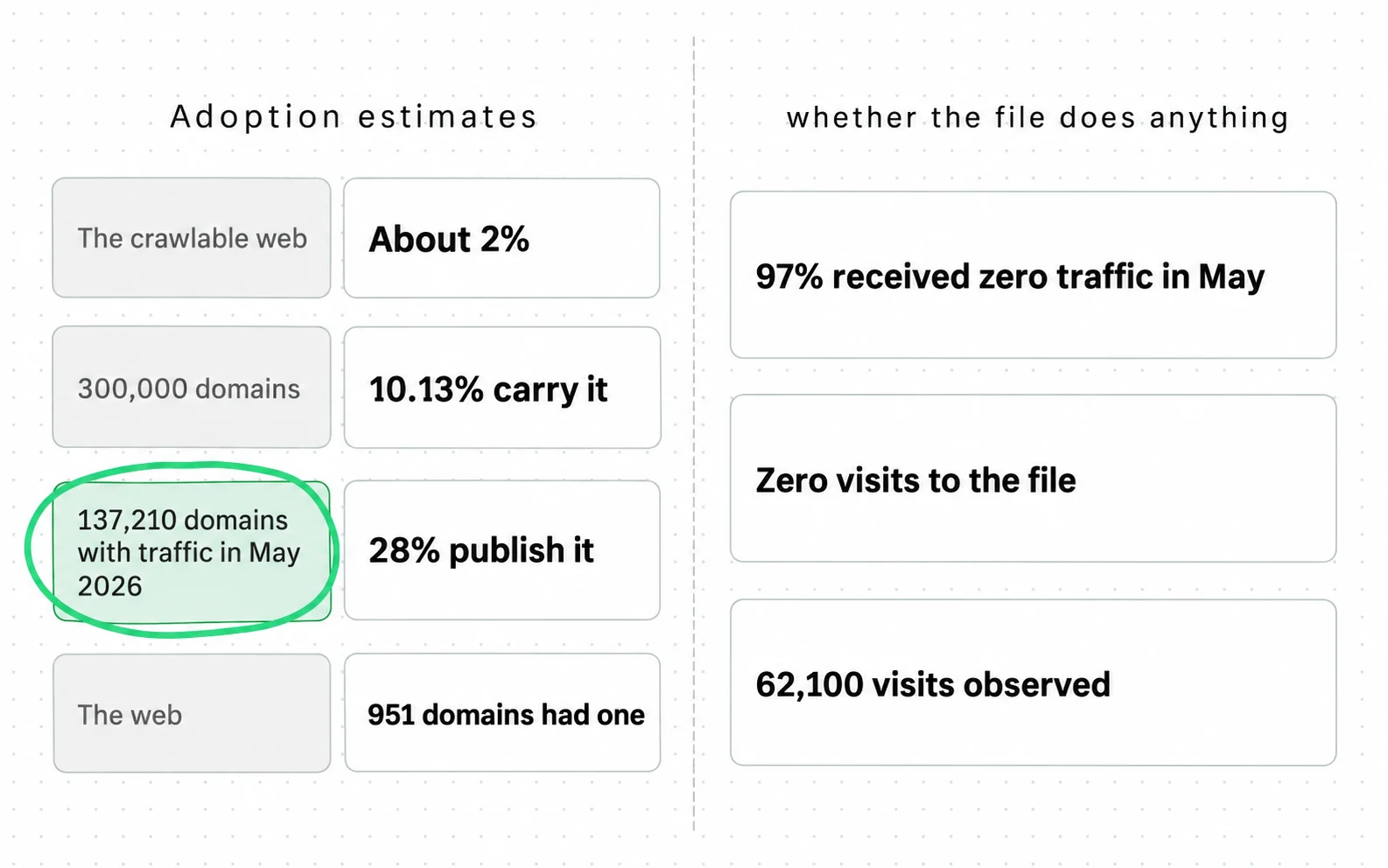
How widely is it used splits into two questions that get quoted as one: how many sites publish the file, and whether anything fetches it. Several organisations have counted, on both, and the answers range across an order of magnitude.
Each of them counted a different web.

Why the spread is not a scandal
A crawl of the whole web and a sample of domains that received traffic are not the same population. Ahrefs measured domains in its own analytics that received traffic in May 2026; the Web Almanac crawls far more of the web, including sites with no traffic at all. Why the shares differ in that direction is a reasonable inference. Neither study tested it. Ahrefs measured 137,210 domains that received traffic in May 2026 and found 28 percent publishing one. The Web Almanac, crawling far more of the web, lands near 2 percent. Both can be right, and neither answers whether the file does anything.
| Question | Which measurements answer it |
|---|---|
| How many sites publish one | Web Almanac, Presenc, Ahrefs, NerdyData |
| Does anything fetch it | Ahrefs traffic figure, Semrush test, Otterly |
| Does fetching it change anything | None of them |
97 percent received zero traffic
In the same study, Ahrefs reported that 97 percent of those files received zero traffic in May. Semrush ran a narrower and more direct test on Search Engine Land: between mid-August and late October 2025 the file received zero visits from Google-Extended, GPTBot, PerplexityBot or ClaudeBot. Semrush also reports Google’s John Mueller saying flatly that no AI system currently uses llms.txt.
Otterly’s experiment is the one result pointing the other way, with 62,100 AI-bot visits observed over 90 days. That is a different setup and a different measurement, so the matter is not settled in either direction.
Three mistakes in llms.txt advice
Two measurements pointing different ways is a reason to look at what each one counted, not a reason to pick a side. The pattern under most llms.txt advice is a category error: treating a file that describes your site as a file that instructs a crawler. A robots.txt file instructs. This one does not.
Reading a tool check as a requirement
Lighthouse added an Agentic Browsing category with an llms.txt audit, and that fact travels as evidence the file is expected. Read the audit itself and it says something narrower.
Treating publication by an AI lab as consumption by its crawler
OpenAI and Anthropic publishing llms.txt for their own developer documentation tells you they think it is useful for agents reading docs. It says nothing about whether their crawlers fetch yours, and their own crawler documentation does not mention the file. OpenAI’s publisher guidance is to allow OAI-SearchBot in robots.txt; Perplexity’s is to use robots.txt tags. Neither names llms.txt.
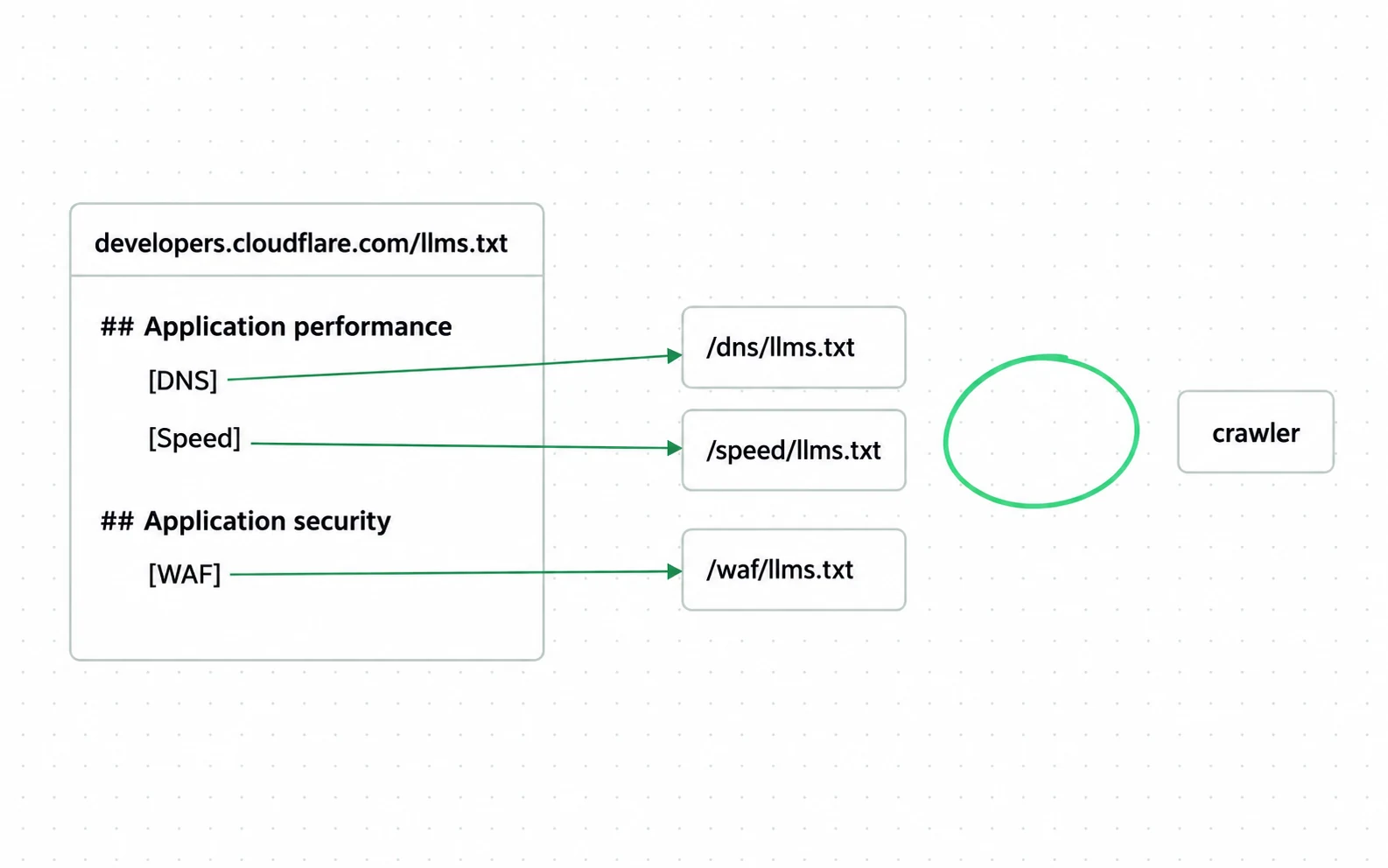
- The file is markdown links, not markup and not a feed. Every line is a product name, a URL and one sentence.
- The pattern here is nesting: the top file points at a per-product llms.txt, not at the pages themselves.
- This is a documentation site, which is the case the format was designed for. Nothing on it resembles a product catalogue or a category page.
| What a platform publishes | Does it mention llms.txt |
|---|---|
| Google, AI features and eligibility | No |
| OpenAI, crawler documentation | No |
| Perplexity, crawler documentation | No |
| Lighthouse, agentic browsing audit | Yes, and marks a missing file Not Applicable |
Spending on it instead of on access
The file cannot help a crawler that is blocked, and blocking is the one failure here whose mechanism every platform documents. Whether your robots.txt lets the named agents through is a question for an ecommerce SEO audit, and it is the check that comes first. Separately, Core Web Vitals carry the only published pass mark in this area, and Google does not name them as an AI-feature eligibility condition.
Treating the file as a small bet on a store
It costs almost nothing and nobody has measured its effect. Treat it as a small bet, not a strategy. Robots directives, which do have documented consequences, come first.
-
Check the crawlers can reach you at all
Open robots.txt and look for OAI-SearchBot, PerplexityBot and the other named agents. A block there is a documented reason a crawler would not fetch you, though Google notes a blocked page can still appear in results when others link to it. A missing llms.txt is not a documented reason for anything.
-
Publish one if it is generated, and do not hand-maintain it
Documentation platforms generate the file from content that already exists. On a storefront, a hand-written list of pages goes stale the week the catalogue changes, and nobody has measured what a stale one costs. What is certain is the maintenance: a recurring task for a file nothing has been shown to read. The same argument applies to the product feed behind Google Shopping ads, which the platform has been generating for years.
-
Keep it small and point at pages that answer questions
The proposal is a reading list. On a store that means guides and category explanations, not every product URL. The same judgement about which pages deserve to exist runs through ecommerce SEO.
-
Do not remove anything else to make room for it
Google states that eligibility for its AI surfaces is being indexed and eligible for a snippet, and AI Overviews sets out what that means. Nothing about llms.txt changes that requirement.
-
Set a review date, not a monitoring habit
The published measurements will change. Reading them again in six months costs less than watching your own log, where a minority of files see any traffic at all and the traffic that does arrive cannot tell you what it changed.
Why the recommendation is this small
Two things would change it. The first is a platform saying it reads the file: OpenAI and Perplexity both publish crawler documentation and neither mentions it, so that statement does not exist yet. The second is a published measurement connecting a fetch to a citation or a visit, and none of the seven measurements above attempts that link.
Say you run the five-lane-seo skill on your store. The file is one of its eight curl checks, and it treats presence as readiness. Read the measurements above before you read that row the same way.
Until one of those arrives, the file is a cheap option on a future that may not come. Buying a cheap option is reasonable. Budgeting for it as a channel is not, and the difference is the entire practical content of this page.
That is a deliberately small recommendation. The recommendation is small because the measurements are. Most of these files see no traffic in a month, a minority do, and Otterly reports tens of thousands of bot visits in its own setup. A thing fetched sometimes, by unclear agents, with no published link to an outcome, is not a lever yet.
How much does llms.txt cost?
Generating the file is close to free on a platform that does it automatically, and a small manual task otherwise. The cost that matters is not the file. It is what gets displaced when a proposal is sold as a requirement.
The file is cheap. The framing is not.
| What you might be quoted for | What the evidence supports |
|---|---|
| llms.txt implementation | Automatic on some documentation platforms, manual elsewhere |
| llms.txt strategy and maintenance | No published measurement links maintaining it to an outcome |
| AI visibility from llms.txt | Ahrefs: 97% of files saw zero traffic in a month, and no study links a fetch to a citation |
| Crawler access review | Documented by every platform, and the first thing to check |
Four claims are each true in one reading and misleading in another. The question that separates the readings is short in every case:
- Adoption is at 28 percent. Of which population, measured how.
- The AI labs use llms.txt. For their own documentation, or when crawling mine.
- Lighthouse checks it. What happens to the score when the file is missing.
- It improves AI visibility. Which published measurement links a fetch to a citation.
The last one has no published answer yet, which is where the subject currently stands.
What we would ask a supplier proposing it: which measurement are you relying on, and does it measure adoption or consumption. The two are usually quoted in the same sentence and they answer different questions. The label the work is sold under, answer engine optimization, is an industry term and not a platform one. Whether to fund it before ordinary search work is settled in AEO vs SEO.
Say you want your pages readable to an assistant with or without the file: that is LLM optimization at Addition, an AI search agency.
Checking server logs for results
The measurement is easy and almost nobody does it. The answer sits in your own server logs, not in anyone else’s study. Three lines, and the third is where the subject runs out.
- Requests to /llms.txt in your server logs, by user agent. That is the question, and on a server whose logs you can read it is a filter, not a tool. On hosting that does not expose raw logs, it needs a CDN log export or nothing at all.
- Whether those requests come from named AI agents or from general crawlers and scrapers. Ahrefs found that of the fetches that did happen, retrieval bots were a small share of AI bot requests.
- Whether anything downstream changes. A file being fetched is not a citation, and no published measurement yet connects the two.
What the answer looks like on your own server
access.log — the four lines this question is about
66.249.66.1 - - [12/Aug/2026:04:11:52] "GET /robots.txt HTTP/1.1" 200 812 "Googlebot/2.1"
120.15.240.64 - - [12/Aug/2026:04:11:53] "GET /llms.txt HTTP/1.1" 404 0 "GPTBot/1.2"
220.15.240.80 - - [12/Aug/2026:09:27:06] "GET /products/linen-blazer HTTP/1.1" 200 41208 "OAI-SearchBot/1.0"
33.101.44.7 - - [12/Aug/2026:14:02:19] "GET /llms.txt HTTP/1.1" 200 1104 "ClaudeBot/1.0"
- 1A request for the file, answered with a 404, because the file is not there. This line is the measurement; it needs no tool.
- 2The same crawler family fetching a product page in the same window. Fetching your pages and fetching your llms.txt are separate behaviours and the log separates them for you.
- 3A 200, so the file exists and something read it. What it changed is the third line of the list above, and nobody has published an answer to that.

The third line is where the subject runs out. Nobody has published a measurement linking an llms.txt file to a citation or to a visit, in either direction.
There is one number about your own site in all of this. Grep your access logs for llms.txt and count the requests in the last thirty days. Whatever number comes back is worth more than every adoption statistic in this field, because it is the only one measured on your site.
The citation measurements that do exist were made without this file in the picture, and they are set out in AI search engine optimization.
Sources
- llmstxt.org The llms.txt proposal: a markdown file to help agents use a website, open for community input
- Ahrefs llms.txt study: 28% of 137,210 domains publish one, and 97% of those files received zero traffic in May
- Semrush llms.txt: zero visits from four named AI crawlers over ten weeks, and the NerdyData count of 951 domains
- Presenc State of robots.txt for AI 2026: 10.13% of 300,000 domains carry an llms.txt file
- HTTP Archive Web Almanac 2025 SEO chapter: llms.txt present on roughly 2 percent of the crawlable web Dated 2025 with no month given, so its exact age is not knowable from the source.
- Otterly The llms.txt experiment: 62,100 AI-bot visits observed over 90 days This page carries no publication date of its own.
- Chrome for Developers Lighthouse llms.txt audit: a missing file is Not Applicable, and providing it is optional
- Chrome for Developers Lighthouse Agentic Browsing: scoring and what the category contains
- Google Search Central AI features: eligibility is being indexed and eligible to show with a snippet, with no special optimizations
- OpenAI Bot documentation: allow OAI-SearchBot in robots.txt, with no mention of llms.txt
- Perplexity Bot documentation: robots.txt tags to manage how a site interacts with Perplexity
- Search Engine Land Coverage of Google, llms.txt and the Chrome Lighthouse audit This page carries no publication date of its own.
- Google Search Central Robots.txt specification: a blocked page can still appear if other pages link to it
- Cloudflare The llms.txt file Cloudflare serves for its own developer documentation
- Frase Answer engine optimization: the industry definition of the work llms.txt is usually sold under This page carries no publication date of its own.
- Google Search Console Help Performance report: impressions and clicks by query
Questions people ask
What is an llms.txt file?
A markdown file at your site root listing the pages you would like AI agents to read, with short descriptions. Jeremy Howard proposed it in September 2024. The format is still a proposal open for community input, not a ratified standard.
Is llms.txt actually used?
Published often, fetched rarely. Ahrefs found 28 percent of 137,210 domains with traffic publish one, and that 97 percent of those files received zero traffic in May 2026. Semrush observed zero visits from four named AI crawlers to one site’s file over ten weeks, and reports Google’s John Mueller saying no AI system currently uses it.
One experiment, by Otterly, reports 62,100 AI-bot visits over 90 days, so the matter is not closed in either direction.
Is llms.txt mandatory?
No. The proposal describes itself as a proposal. No platform requires it. Lighthouse marks a missing file as Not Applicable, not a failure, and notes that providing it is optional.
How to write an llms.txt?
An H1 with the site name, an optional summary in a blockquote, then H2 sections listing links with a short description each. On a store, point at pages that answer questions, not at every product, and generate it if your platform can instead of maintaining it by hand.