

What is AI visibility?
AI visibility is whether an answer engine names or links your brand when someone asks it a question in your category. That is the marketing sense, and the one used here. The phrase attracts one other question.
The results answer the first question the phrase is attached to and not the second. The other one is sitting in the box underneath them.
If the privacy question is why you are here, the short answer is that the settings of whichever assistant you use govern your conversations. The privacy section below quotes one of them. Nothing else here is about you. The rest is written for the first reader.
Three events under one word
Inside the marketing sense the word still covers more than one thing. Three events sit under one word, and no single source documents all three. The vendor separates mentions from citations without touching visits. The paper works inside citations. And Google speaks only about visits. A brand watching its visibility can end up watching any of them.
Jasman Singh at Profound read 11.84 billion citations and found 57 percent going to brand-owned sites, with the split running 47 percent on ChatGPT against 69 percent on Gemini. Your brand is not equally visible on both.
Being named, being linked and being visited are separate. What a mention is worth, to Google and to an answer engine, is the subject of brand mentions.
Suppose you want the page-side conditions for any of the three events scored on your site. The seo-geo skill reports crawler access per bot, and that is where most of the three go wrong.
The term covers more than one event, and Google says so itself. Its own answer names three in a single sentence: a cited source, a name mention, or a direct recommendation. The ladder below is a different three, and the difference is deliberate. It swaps recommendation, which nobody measures, for the visit, which Google itself reports on. Splitting it that way is ours, and each rung is a measurement somebody publishes.
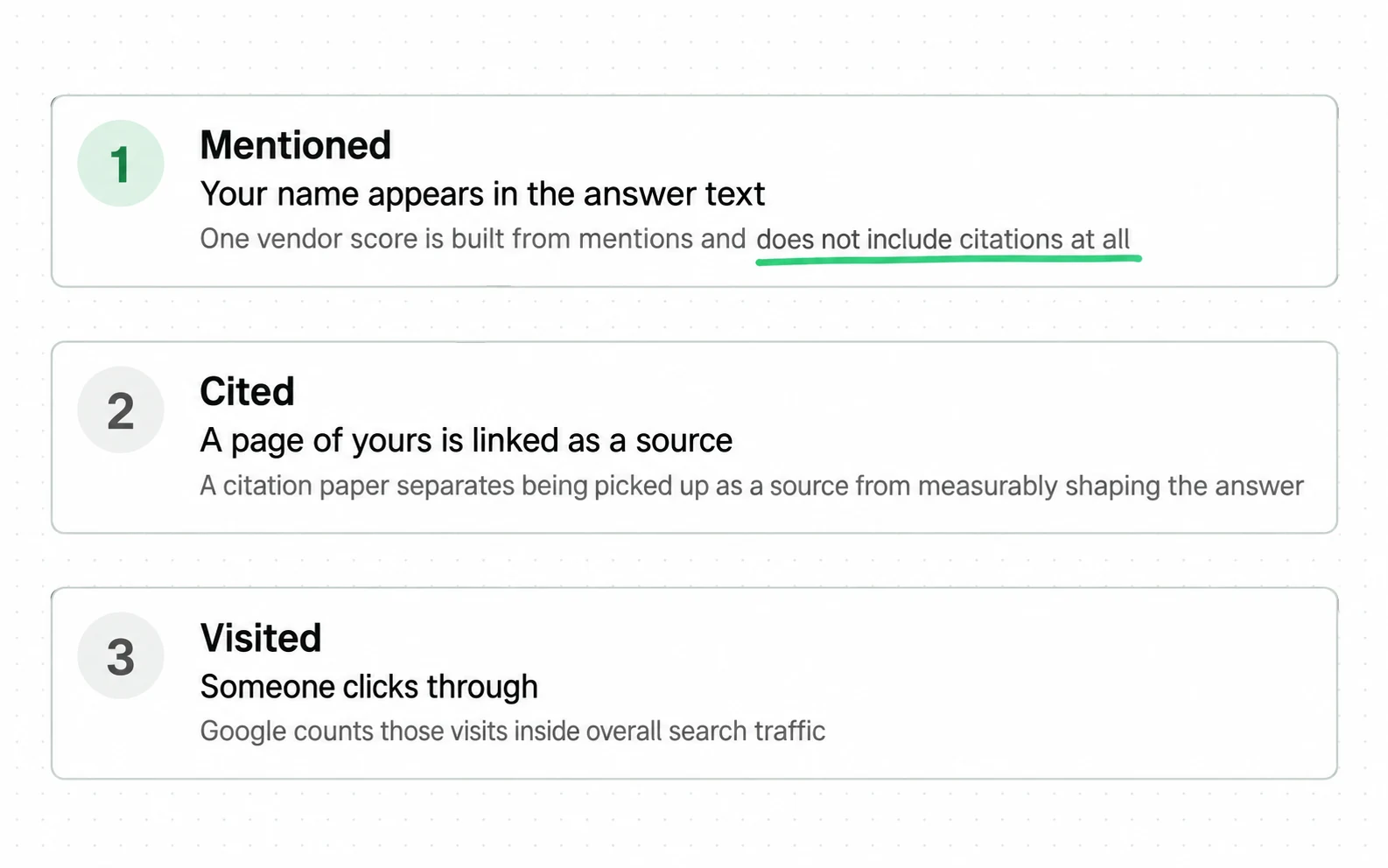
A tracker hands you one number, and the rows above are not interchangeable. That is the part worth carrying out of the ladder. The one vendor publishing its arithmetic counts mentions and excludes citations, so the first question to put to any tool is which of the three it is counting.
| If your number went up | It could mean | It does not prove |
|---|---|---|
| A mention score rose | Your name appeared more often in answer text | That anyone could click through to you |
| Citations rose | Your pages were picked up as sources more often | That the answers leaned on them |
| Search traffic rose | More people arrived from Google, AI features included | Which part of that was AI |
Why measure AI visibility?
What makes the term worth measuring is that the answer arrives assembled. Somebody asking which brand to buy from can read a recommendation without ever seeing a list of links. Your rankings do not tell you.
Two published measurements set the shape of the problem.
The first is that the source mix behind an answer is not the same on every engine. One vendor analysed 11.84 billion citations. Across all of them, 57 percent point at a brand’s own site. On ChatGPT the figure is 47 percent; on Gemini, 69. That is a difference in who owns the pages behind the answers, measured across all brands, not any one of them. What it counts is source ownership across all brands, which is a fact about the engines, not about any brand’s standing on them.
To support this analysis we used 11.84 billion citations across ChatGPT, Claude, Google AI Mode, Google AI Overviews, Google Gemini, Grok, Microsoft Copilot, and Perplexity, spanning 8,061 active Profound categories swept between April 16 and July 16, 2026, of which 7,542 categories had at least 100 citations.
Profound, Where do AI citations come from? (Profound sells visibility tracking) published 30 July 2026, read 7 October 2026
- Eight engines, and the two quoted above are the ends of that range, not the whole of it. Six others sit between them and are not broken out here.
- A three-month sweep, ending in July 2026. The figure is a window, and a reader comparing it against a number of their own has to match the window first.
- The sample is Profound's own category set and its own citations API. Nobody outside the company can re-run it.
The second is that a single reading is not a fact about you. SparkToro ran 12 prompts a combined 2,961 times and found the chance of seeing the same list of brands twice was under one in a hundred. Visibility behaves like a distribution, not a state, so a number taken once measures that run and not the month around it. What that means for the number itself, and for what a tracker costs, is the subject of the AI visibility guide.
The eligibility side is simpler than the measurement side, and Google states it in one sentence. To appear as a supporting link a page must be indexed and eligible to be shown in Search with a snippet, and there are no additional requirements. The work that makes a page eligible is ordinary ecommerce SEO, and the practice built around being cited has its own name in answer engine optimization.
Two confusions: privacy and one word for three counts
Eligibility is the settled part. What stays unsettled is the word itself, and it comes apart in two directions. One sends a reader to the wrong page entirely. The other sends two colleagues into an argument about a number that was never one number. One is a reader arriving with an entirely different question. The other is two marketers reading one word as one quantity when it is three.
Whether anyone can see what you asked
People ask this constantly, and part of it is documented. What happens to a conversation, meaning whether it trains the model and how long it is kept, is written down by the company running the assistant. Who else can see it is a different question, and the documentation below does not answer it.
That documentation is OpenAI’s, and every provider publishes its own, so the page to read is the one for whichever assistant you use. The answer sits with that company, not with anyone writing about it.
A mention and a citation
The second confusion is inside the marketing sense. A brand named in the sentence and a page linked underneath it are two different events, and a score can count either. Two tools reporting different numbers for the same brand may simply be counting different events. So read the number only against its own history and its own instrument.
Where the score itself is discussed
What a visibility score is made of, how far it moves on a repeat, what the tools charge and what a good one looks like are all questions about the number, not the word.
The number has its own page.
Read the AI visibility guide for the arithmetic behind a score, the swing measured on repeat runs, and what the trackers sell. For the practice of being cited, not the measurement of it, generative engine optimization covers what the published studies tested.
Measuring your own baseline, prompt by prompt, is AI visibility monitoring.
Sources
- Google Search Central AI features and your website: a page must be indexed and eligible to be shown with a snippet, and there are no additional requirements
- OpenAI Help Center Data Controls FAQ: model training settings and Temporary Chats
- Daniel Peris, LLM Pulse What an AI visibility score is: a position-weighted rate of brand mentions across a defined prompt set. LLM Pulse sells visibility tracking
- Zhang, He and Yao From Citation Selection to Citation Absorption, arXiv 2604.25707, preprint
- Jasman Singh, Profound Where AI citations come from: 11.84 billion citations, 57 percent to brand-owned sites, 47 percent on ChatGPT against 69 percent on Gemini. Profound sells visibility tracking
- Rand Fishkin, SparkToro AIs are highly inconsistent when recommending brands or products. SparkToro sells audience research software and works in this category
Questions people ask
Can people see what you look up on AI?
One part of this is documented and one is not. On the documented part, what happens to a conversation is a setting. OpenAI’s Data Controls FAQ states that turning off "Improve the model for everyone" leaves conversations in your history while stopping them being used to improve the model. It adds that Temporary Chats are not saved to history and are deleted within 30 days.
Who else can see a conversation is a separate question, and the documentation quoted here does not cover it. That is OpenAI’s documentation. Every provider publishes its own, so read whichever assistant you use.
What does visibility mean in AI search?
It means your brand appearing in a generated answer, but that covers three separate events: being mentioned in the text, being cited as a linked source, and being visited by someone who clicked.
A tracker hands you one number, and which of the three it counts is a choice the tool made. The one published vendor score here is built from mentions and excludes citations, so if a second tool counted citations the two would report different numbers for the same brand without either being wrong. Whether any particular pair does that is a question for the two tools’ own documentation.
Is AI visibility the same as SEO?
On Google the eligibility is the same and the measurement is not. Google states that a page needs to be indexed and eligible to be shown with a snippet, with no additional requirements, so on that engine the work that makes a page findable is ordinary SEO. That sentence is Google’s, and the other engines are not covered here.
What differs is what counts as success, and how steady it is. One vendor ran 12 prompts a combined 2,961 times and found the chance of the same brand list appearing twice was under one in a hundred, so an appearance is a draw, not a standing. No comparable repeat test of classic rankings has been published, so the contrast holds for the AI side only.
How do you measure AI visibility?
With a tracker that asks an engine a set of prompts and records whether you appeared, repeated enough times to be more than a single draw. Google does not report it separately: visits from AI features are counted inside overall search traffic under the Web search type.
Which prompts, how many repeats, which engines and whether a mention or a citation increments the score are all choices the tool makes, and they are what the AI visibility guide goes through.