

What counts as a brand mention?
A brand mention is any reference to your brand online. The split worth drawing is between two events that share a name. Two events share the name, and the confusion between them is where most of the advice goes wrong. What matters is that neither one is evidence about the other.
Record a mention under link building once the publisher adds a crawlable link to your site.
The disagreement is about where the mention sits.
One glossary defines a mention as any instance where a brand, product or service is referenced online. It names the linked and unlinked split and declines to say whether the difference matters.
A public relations guide lists six benefits of mentions and not one of them is search. That is the public relations reading of the same object, and it makes no ranking claim at all.
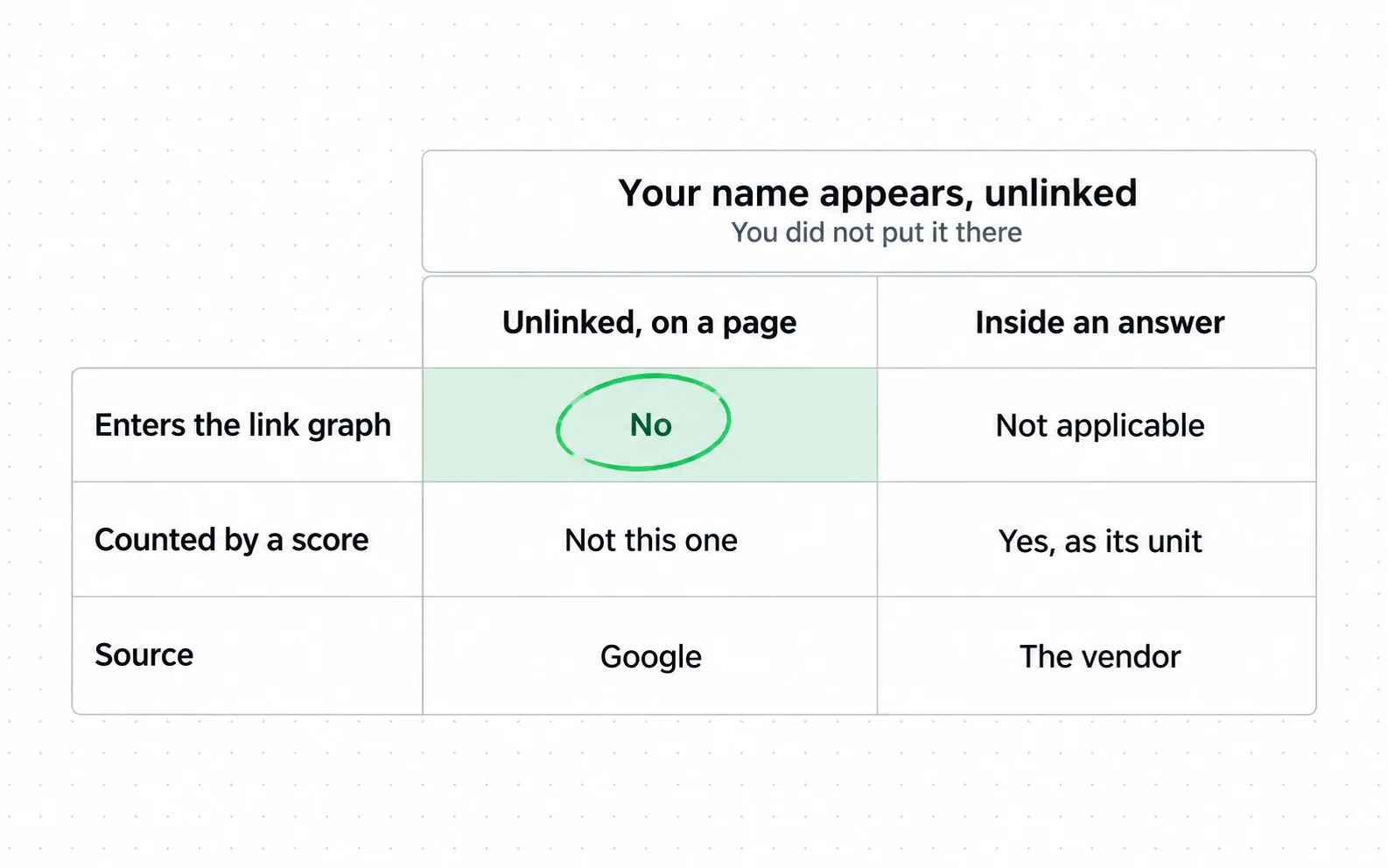
A correlation links the two columns, not a mechanism. That comes later. The left one first, because it is not an inference from ranking data: it is Google’s own wording, said twice.
That second quotation is about one mechanism only. Google is describing its link graph, meaning the structure it builds from hyperlinks between pages. He is not saying that being talked about fails to help a business, and he says so in the same breath. A mention can make people aware of a brand, and that awareness can produce branded searches later. What is ruled out is the direct path people usually mean when they ask. Most definitions avoid the question. A mention "can be linked or unlinked", and the definitions stop there. A PR platform lists six benefits and none of them is search, saying instead that mentions show your brand is part of public conversations. That is a defensible position, and it is a different one from what most link-building advice implies.
One publisher followed five years apart
The clearest way to see what changed is to follow one publisher over time. Ahrefs wrote the standard tactical guide on unlinked mentions in 2020, and published a 75,000-brand study in 2025 that appears to contradict it.
Neither publication mentions the other.
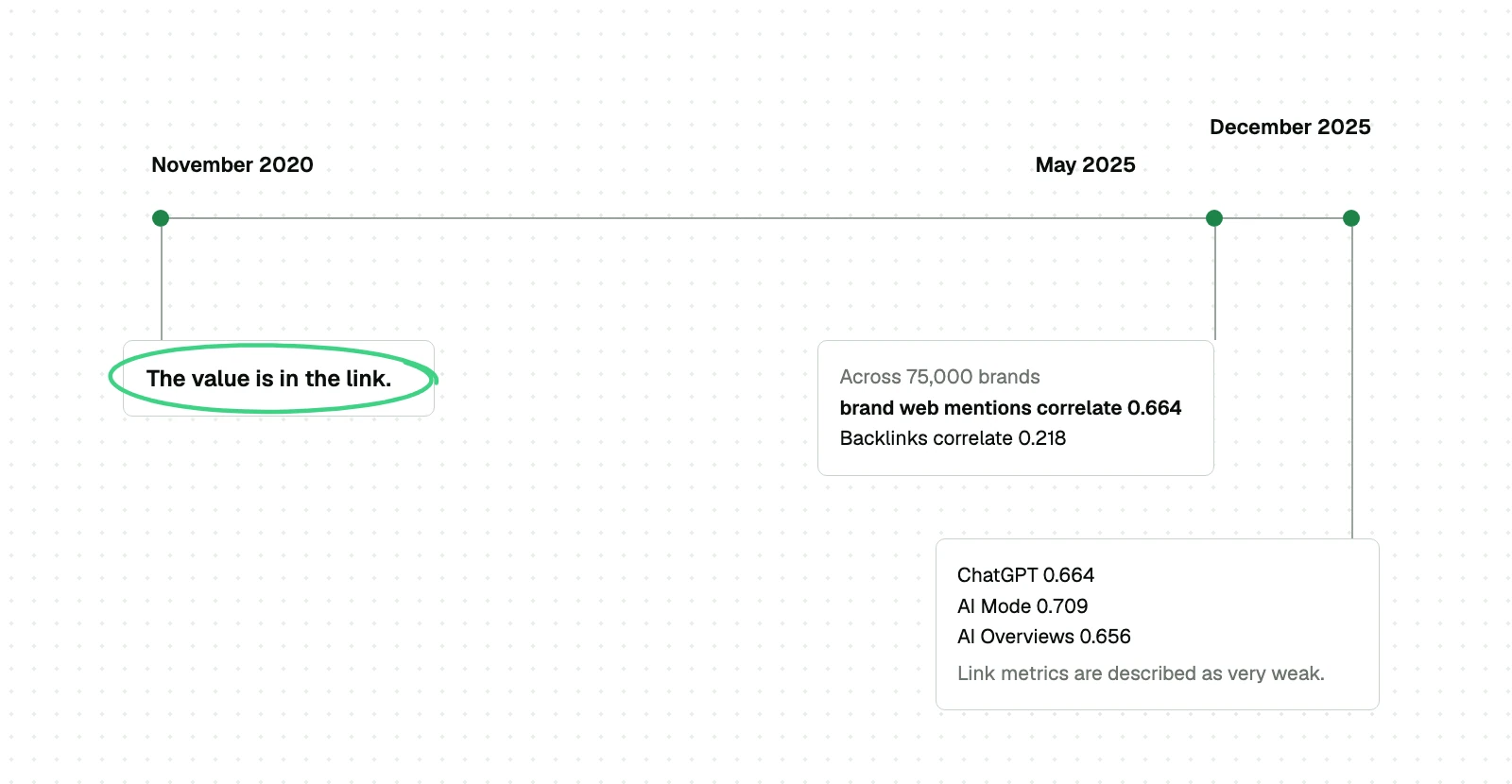
Unlinked mentions signal awareness and do not pass authority. Semrush put it that way in 2024, quoting Google to justify it, and Search Engine Land repeated it in 2025.
Roger Montti traces the belief back to a misread 2012 patent. A patent shows what was filed, not what was used.
Then the measurement changes subject. Across 75,000 brands, Ahrefs found brand web mentions correlating 0.664 with AI Overview visibility, against 0.218 for backlinks. A second study extended it to three surfaces: ChatGPT 0.664, AI Mode 0.709, AI Overviews 0.656, with link metrics described as very weak throughout. The mention did not become more powerful. What arrived is a measurement layer whose unit is the mention, plus a correlation saying that brands with more of them tend to show up more. Neither of those is an engine reading your mention the way Google reads a link; both are reasons the same object now has a second audience.
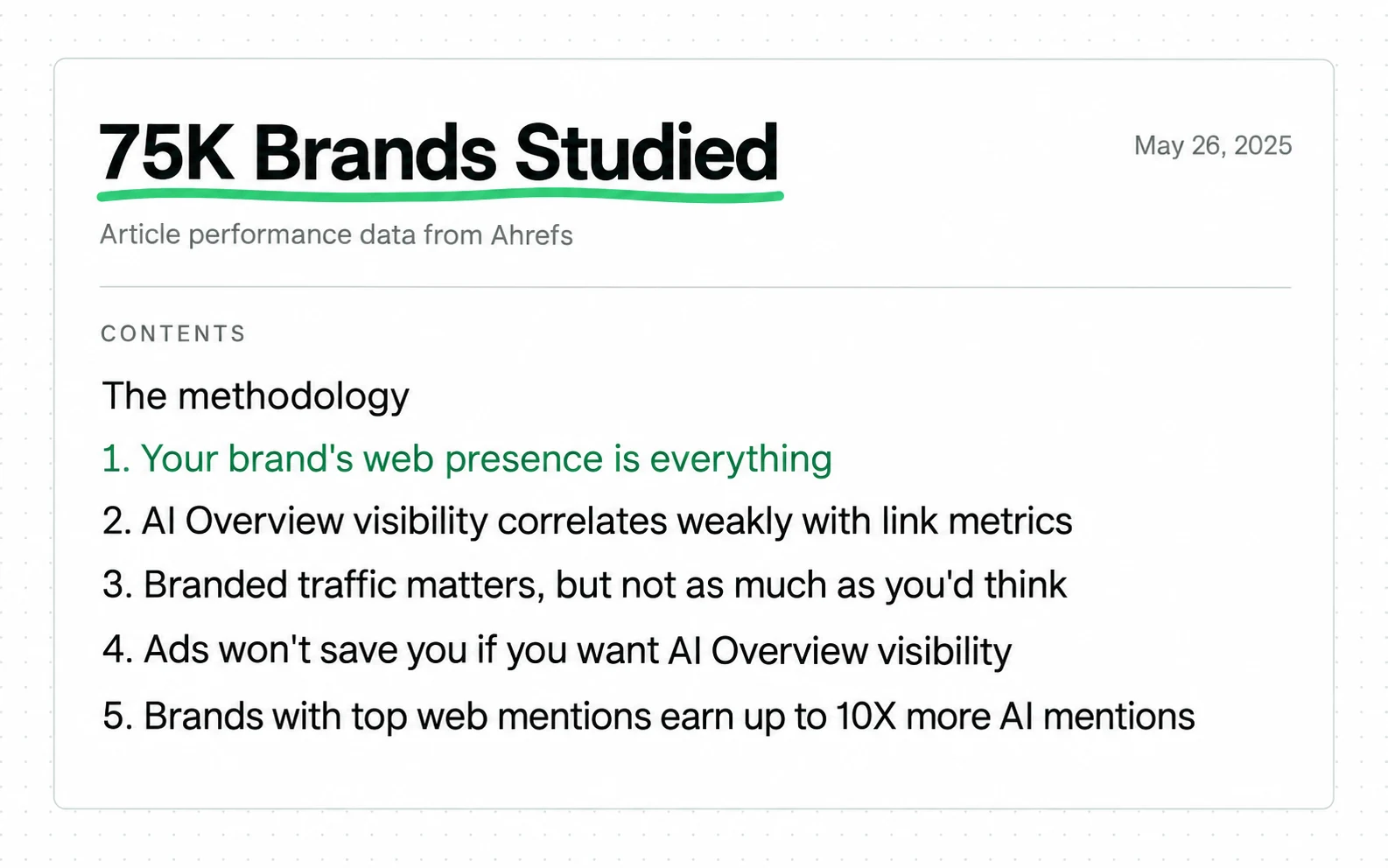
- The sample is in the title, which is unusual enough to note: 75,000 brands, stated before you read a word of the findings.
- The contents list is the finding, in order. Brand web presence first, brand traffic third and qualified as mattering less than expected.
- The method line names a Spearman correlation coefficient. That is the word that turns every downstream retelling of this study into an overstatement.
Read the size of that gap carefully before repeating it. Both studies come from a company selling tools in this category, both state their sample, and both carry a caveat in the authors’ own words. The direction holds across three surfaces and two publications seven months apart, which is more than a single reading. It is still a correlation over brands somebody selected, not a test of what happens when a brand gains mentions. A larger sample looks at a neighbouring object, and the distinction matters. Muck Rack analysed more than 25 million links cited by ChatGPT, Claude and Gemini across 17 industries. Earned media accounted for 84 percent of them, against 0.3 percent from paid or advertorial, with journalism alone at 27 percent. Those are the pages the systems linked to, not the unlinked mentions the correlation study counted. The two measurements sit beside each other; neither confirms the other. The figure has stayed between 82 and 89 percent across three editions since July 2025. That is a pattern, not a snapshot.
Correlation figures quoted as causal claims
The correlation figure travels well, and travelling well is its problem. Between the study and the pitch deck it picks up a causal verb, loses its citation, and gains a claim about Google that Google contradicts.
The source guards against three of these in its own words.

One vendor article shows the whole journey. It reports that branded web mentions are up to three times more influential than backlinks in driving LLM citations, which converts a correlation into an effect. It attributes this to a 75,000-brand study without naming the study, its authors or a link. It also states that Google confirmed its systems recognise both linked and unlinked mentions as signals of site authority, and cites no documentation for it. That is the opposite of the sentence quoted at the top of this page.
The study exists and is easy to find. An uncited claim is not automatically a fabricated one.
Brand mentions: what the evidence supports doing
The practical upshot is that one object, a mention of your brand, is now counted by two things that want different things from it. The older advice is still correct for the older one, and the newer measurements are not advice at all.
Say you want to run the count yourself. The presence pillar of the ai-seo skill lists the sources that get cited. Its monitoring section gives you the method: three to five runs per query, the rate with its sample size.
One of these has an instruction behind it. The other has two measurements and no test.
| If you want | Do this | Because |
|---|---|---|
| Search authority from a mention | Ask for the link | Google states no signal passes where there is no link |
| To appear in generated answers | Nothing here tells you what to do. Two separate measurements exist and neither is a test of an action | Mentions correlate with visibility at around 0.66; separately, 84 percent of 25 million cited links came from earned media, which is the material digital PR produces |
| To know whether it worked | Track mentions and citations as separate counts | One published visibility score counts mentions and excludes citations |
| A number to report | Record the sample behind it | The correlations above are moderate to weak and not causal |
The second row deliberately stops short of an instruction. A distribution of where citations came from is not a test of what happens when a brand pursues one source, not another, and the study makes no such claim. What it does record is how little of the cited material was paid: three tenths of one percent of the links in that sample were paid or advertorial. That is an observation about what was cited, not a test of what happens if you buy some.
How to count brand mentions without fooling yourself
Mentions are easy to count and easy to over-read, and the two failure modes pull in opposite directions. A tool will happily report a rising number that came from a bad week. It will also report it without the sample that would let you compare it to anything.
A rising count can mean a bad week.
Google names the first problem itself. A mention can be positive or negative, and the context is hard to read. That is the reason it gives for not using them as a signal. The free tool most people reach for to count them, Google Alerts for brand mentions, inherits that ambiguity and one more besides. A monitoring tool that reports volume alone inherits exactly that ambiguity. The second problem is the sample. Mention counts move with what you searched for and where, so a figure without its query set and sources behind it cannot be compared with next month’s.
A third surface counts differently again: what a Google Knowledge Panel is is Google asserting the entity exists at all. Inside an answer engine the same distinction has a name and a consequence. Being mentioned, being cited and being visited are three separate events, set out in what AI visibility is. One platform sells a mention-based and a citation-based share of voice as two different measures. Which of the two a percentage counts is the subject of AI share of voice.
Budgeting for monitoring versus being worth mentioning
Two things get funded here and only one of them is a product. Monitoring is a crowded market with a visible price; being worth mentioning is not a line item, and nobody prices the two against each other.
One half reports the number. The other is whatever produced it.
Most of what is written on this is a tool trying to sell you monitoring. What none of them changes is why anyone would write about you. The largest sample here records where the cited links came from, 84 percent earned against 0.3 percent paid, without saying anything about why those pieces were written. A budget that funds the tracking and not the writing is buying a thermometer, which is a judgment, not a finding.
There is a second cost nobody prices, which is the cost of reading the correlation as an instruction. The natural response is to buy mentions, and the citation study offers one relevant observation: three tenths of one percent of the links in its sample were paid or advertorial. It does not say buying does not work; it says almost none of what got cited was bought. On the search side the arithmetic is older and simpler. Convert an unlinked mention into a link and it is worth what the link is worth. Leave it unconverted and it is worth the awareness, which is real but not a ranking input by the platform’s own account.
Earning the mentions that carry a link to your site is one of the link building services at Addition, an AI search agency.
Unlinked brand mentions: ask for the link
Ask for the link. Google’s stated position, hedged as from my point of view, is that unlinked mentions are not used for PageRank or for understanding the link graph. Beyond that the evidence thins: a correlation says mentions travel with visibility, and a separate count says the links these systems cite come overwhelmingly from earned coverage. Neither says what happens when you go and get some.
Two answers, and only one comes from the system doing the counting.
The evidence for the first is a platform statement, repeated. The evidence for the second is a set of correlations its own authors call moderate to weak, plus a citation study with a large sample and a stable result. Treat the first as Google’s stated position, dated 2021 and 2024 and not restated since. Treat the second as a direction, not a dial. And be suspicious of anyone quoting the correlation without the word correlation.
Sources
- John Mueller of Google, reported by Roger Montti in Search Engine Journal Google’s John Mueller on brand mentions: I don’t think we use those at all for things like PageRank or understanding the link graph, and it is too confusing to use as a clear signal Measured 4 years ago, on a surface that has moved since.
- Roger Montti, Search Engine Journal Are brand mentions important to Google’s algorithm: brand mentions are not an SEO factor, and the idea traces to a misread 2012 patent Measured 4 years ago, on a surface that has moved since.
- Joshua Hardwick, Ahrefs Unlinked mentions: you are already halfway towards earning a link, so reach out and convert it. Ahrefs sells SEO software Measured 5 years ago, on a surface that has moved since.
- Louise Linehan, Ahrefs An analysis of AI Overview brand visibility factors: 75,000 brands, brand web mentions at 0.664 and backlinks at 0.218, with correlation is not causation stated by the authors
- Louise Linehan, Ahrefs Top brand visibility factors in ChatGPT, AI Mode and AI Overviews: the same 75,000 brands across three surfaces, with YouTube metrics correlating strongest at about 0.737
- Aleksandra Beka Jovicic, Semrush Unlinked mentions: quoting Mueller that there is no signal passing where there is no link, and advising conversion to links. Semrush sells SEO software Measured 2 years ago, on a surface that has moved since.
- Jolissa Skow, Search Engine Land Unlinked mentions signal awareness but do not pass SEO authority, and LLM citations are determined by what you publish and how much people talk about your brand
- Search Atlas Brand mentions versus backlinks: branded web mentions are up to three times more influential than backlinks, attributed to a 75,000-brand study that is not named. searchatlas sells SEO software
- Linda Zebian, Muck Rack What is AI reading: more than 25 million links from ChatGPT, Claude and Gemini across 17 industries, with 84 percent of citations from earned media and 0.3 percent from paid or advertorial. Muck Rack sells PR software
- Mile Zivkovic, Prowly Brand mentions defined, with six benefits none of which is search: even without links, mentions show that your brand is part of public conversations. Prowly sells PR software Measured 15 months ago, on a surface that has moved since.
- Sprinklr Brand mention glossary: any instance where a brand’s name, products or services are referenced online, which can be linked or unlinked This page carries no publication date of its own.
- Daniel Peris, LLM Pulse AI visibility score methodology: a position-weighted rate of brand mentions across a defined prompt set, which does not include citations. LLM Pulse sells visibility tracking
- Conductor Competitive AI share of voice: a mention-based share and a citation-based share sold as two separate measures This page carries no publication date of its own.
- Google Search results for “brand mentions”
- Google Search results for “unlinked brand mentions”
Questions people ask
What are brand mentions?
Any reference to your brand online, whether or not it links to you: an instance where the brand name, its products or its services are named. Mentions can be linked or unlinked, and carry positive, negative or neutral sentiment.
The distinction that matters is who is reading. Google says an unlinked mention passes no signal to its link graph. A published AI visibility score is built from mentions and excludes citations entirely.
Do unlinked brand mentions help SEO?
Not by Google’s own account. John Mueller has said Google does not use them for PageRank or for understanding the link graph. Reading whether a mention is positive or negative is tooo confusing to use as a clear signal.
The standard instruction is to reach out and convert the mention into a link. That advice is from 2020 and it has not been superseded for search.
Do backlinks still matter in 2026?
For Google’s link graph, the last public statements we found say a link passes a signal and a mention without one does not. They are from 2021 and 2024, and we found no newer one. For answer engines the measured picture is different. One study of 75,000 brands found brand web mentions correlating around 0.66 with visibility, while link metrics were described as very weak.
Those are correlations, and the authors say so explicitly, adding that improving the metrics will not automatically raise visibility. So what the evidence supports is a platform statement on one side and a set of correlations on the other, not one system replacing another.
How do you find unlinked brand mentions?
Monitoring tools do it, and most of what you will find searching for this is one of them. What the tool cannot decide is whether a mention counted for anything, which is the ambiguity Google names as its reason for ignoring them.
Before buying one, be clear what the count is for: converting mentions into links is a search activity, while being mentioned where AI systems cite from is closer to public relations. One measurement of 25 million cited links found 84 percent coming from earned media.

