
What is link building?
Link building starts with a page worth citing. You find an audience for that page and keep the destination live after publication, so the link still leads somewhere useful a year later.
If you asked for the placement, call it link acquisition. An unprompted link from another site counts as link earning.
Google uses links to discover pages and as one signal of topic fit.
A supplier that lists your stockist page can send nearby buyers to your shop.
An editorial article that cites your research gives readers a path to the study and gives search engines context about the linked page.
Say you sell refillable cleaning products. A sustainability publication might cite your packaging study, while a local directory might list your shop address.
Judge a research citation by who reads the study, and a directory listing by whether nearby buyers find the shop.
- Editorial followed link. Inspect the source and context. Check the anchor and destination before you credit discovery or referral value.
- Sponsored or nofollow link. Inspect its qualification and audience. Check the destination before you credit disclosed reach or referral value.
- Internal link. Inspect the source page and anchor. Check the destination before you credit site discovery or navigation.
- Unlinked brand mention. Inspect context and accuracy before you record awareness or a citation opportunity.
Record a mention without a hyperlink in your brand mentions log. It isn't a backlink and won't create a crawlable path to your page.
Link from the study to the related category or service page, as you would when adding internal links for ecommerce SEO.
What makes a backlink valuable?
Judge every backlink by the page it points to. Even a link from a reputable source disappoints readers if the destination does not deliver what the anchor text promises.
First, inspect why the source links. An editor chooses a URL for the evidence it provides; a profile owner who accepts any link makes no such selection. Record that difference in your link log.
Next, read the surrounding paragraph. If you sell warehouse software, a link inside an article about picking errors has stronger topic fit than the same link inside a general founder biography.
Then check the destination. A link to your returns benchmark should take readers directly to the full method and findings instead of making them search your home page for supporting information.
| Check | Question | Useful evidence |
|---|---|---|
| Editorial choice | Could the publisher remove this link without weakening the page? | The link supports a claim or next step |
| Topic fit | Does the surrounding passage match your page? | A passage about the problem your page addresses, using your buyers' terminology |
| Destination fit | Does the landing page deliver what the anchor promises? | Visible evidence or product detail |
| Source quality | Is the source a real publication, business or institution? | Named ownership, useful material and an actual audience |
| Business value | Does the destination give prospective buyers a way to inquire or buy? | Referral engagement or qualified inquiry |
Ahrefs studied the top 20 results for one million high-volume US keywords in January 2025. Referring domains had the strongest backlink correlation with ranking at 0.255. When time is limited, inspect referring-domain gaps first.
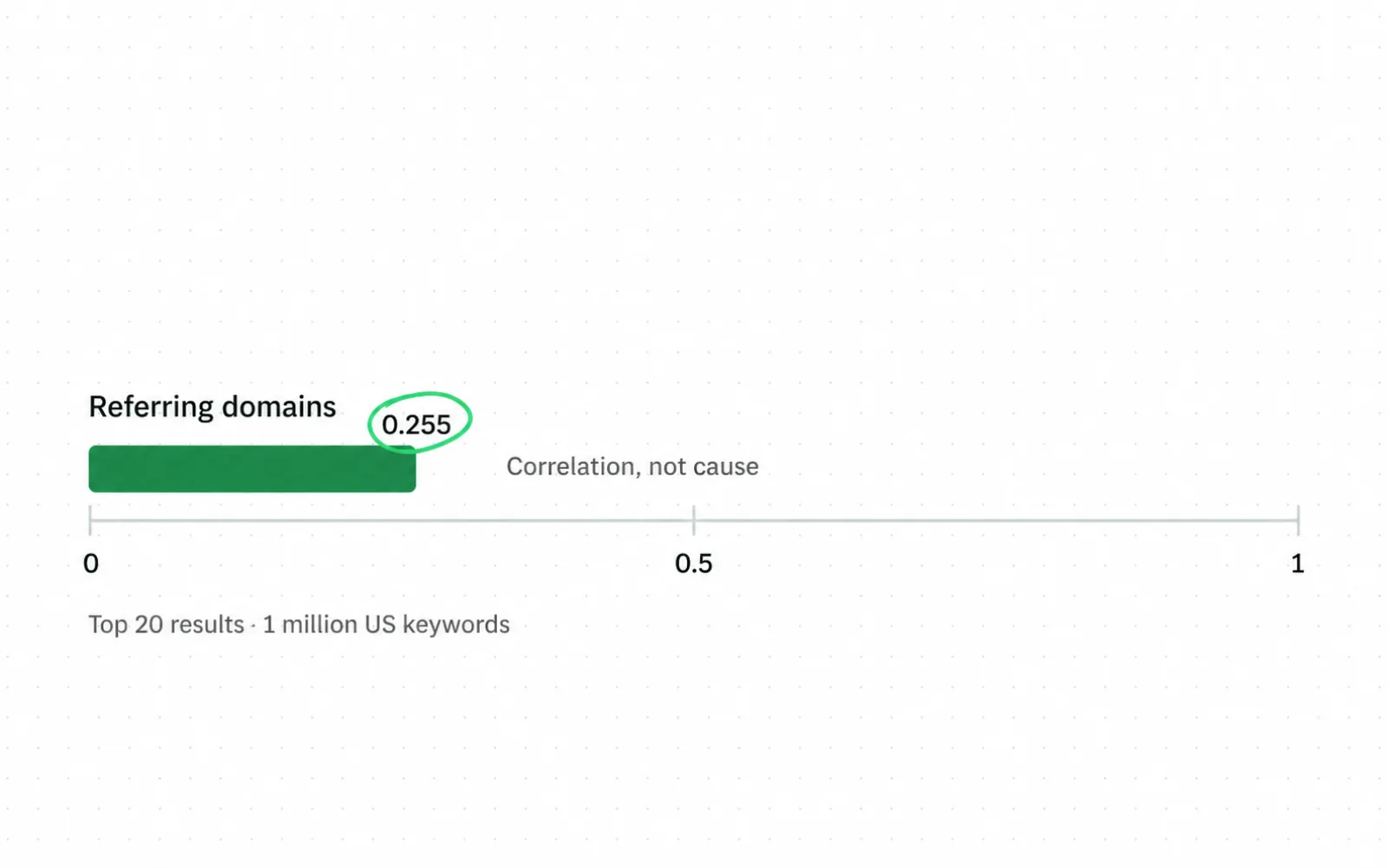
- The method uses the top 20 results for one million high-volume US keywords.
- Referring domains has the largest backlink correlation shown at 0.255.
- Ahrefs prints the correlation warning directly below the values.
Check whether incoming links land on redirects, and list them by destination page in your ecommerce SEO audit.
Flag retired products and pages with no onward path.
For example, a trade association link to a discontinued collection needs a matching redirect. Without that redirect, the referring domain remains in your link report, but readers cannot reach a matching destination.
Earn links with product data and relationships
Create something a publisher would want to cite before requesting a link. That might be a useful product, evidence from your data or access to someone with expertise.
Think of a sizing calculator or compatibility directory. A free template or an integration document you keep current gives readers another reason to cite you.
Say you sell commercial lighting. Architects have a reason to cite a beam angle calculator; an additional product collection gives them no new information to cite.
A data asset turns records you are allowed to use into a finding you can explain and reproduce. For example, analyze the reasons customers gave for returning products.
Support tickets and inventory records are two more places to look. You can use anonymized buying behavior when you explain the sample and its limits.
For example, a workwear store might publish size-return patterns by garment type. Include the date range, order scope and exclusions. Give another writer a table they can verify.
BuzzStream interviewed more than 150 digital PR professionals for its 2026 report. Pitching data-led content was the most common tactic, used by 95.9 percent of respondents.
Your professional contacts can introduce an editor to someone worth quoting. Suppliers and engineers can answer a buyer's technical questions.
| Lever | What you control | Example reason to cite |
|---|---|---|
| Product | A tool, specification or process | A compatibility directory that resolves a buyer question |
| Data | A lawful dataset and method | A returns benchmark with visible scope and exclusions |
| Relationship | Access to a credible person or organization | An engineer who can explain a technical change |
Muck Rack surveyed 1,044 journalists between 30 January and 2 March 2026 and based its report on 897 replies. Seventy percent wanted pitches matched to their beat.
In the same Muck Rack survey, 40 percent wanted original data or research.
Before asking a contact to introduce you to a journalist, check that your story fits the subjects that journalist covers.
Offer a documented finding or expert source through digital PR. Never trade a favor for a link.
Some assets attract links on their own. Others need someone to pitch them to editors.
-
1. Inventory what you control
List useful product functions and data you can document. Add people with expertise.
-
2. Choose a question your audience needs answered
Choose one resource that answers a question a publication's readers already have.
-
3. Publish the evidence
Publish the evidence at a stable URL and explain how you produced it. Name the owner and use a format others can inspect.
-
4. Explain why the resource suits the publication
Explain why the asset serves this page, story or audience.
-
5. Link readers to the next page they need
Add an internal link from the resource to a related commercial page that answers the reader's next question.
-
6. Review each outcome
Track coverage and live links. Keep separate records of what referred visitors do, how search performance changes and what business results follow.
Assign each handoff before outreach starts
| Owner | Recorded decision | |
|---|---|---|
| Asset | Your team | Evidence and stable destination |
| Pitch | Your team | Audience question and source fit |
| Placement | Publisher | Editorial context and final link |
| Reader route | Your team | Matching onward path |
| Outcome | Your measurement owner | Observed use and business result |
The publisher owns the placement decision. Your team is responsible for the evidence, the pages readers reach and the measurement of results.
Use outreach to find editors whose audience already needs the asset. For example, offer the lighting calculator to a publication written for architects.
For example, a payroll platform could compare anonymized onboarding delays by company size.
Avoid link schemes and cheap packages
Google treats a link exchange or paid placement as risky when its purpose is to manipulate ranking credit. Sellers of cheap link packages promise quantity without explaining why an editor would include each link.
Google's spam policy says violations can lead to lower rankings or omission from search results. Detection can happen through automated systems or a manual action.
The policy also names paid advertorial links that pass ranking credit.
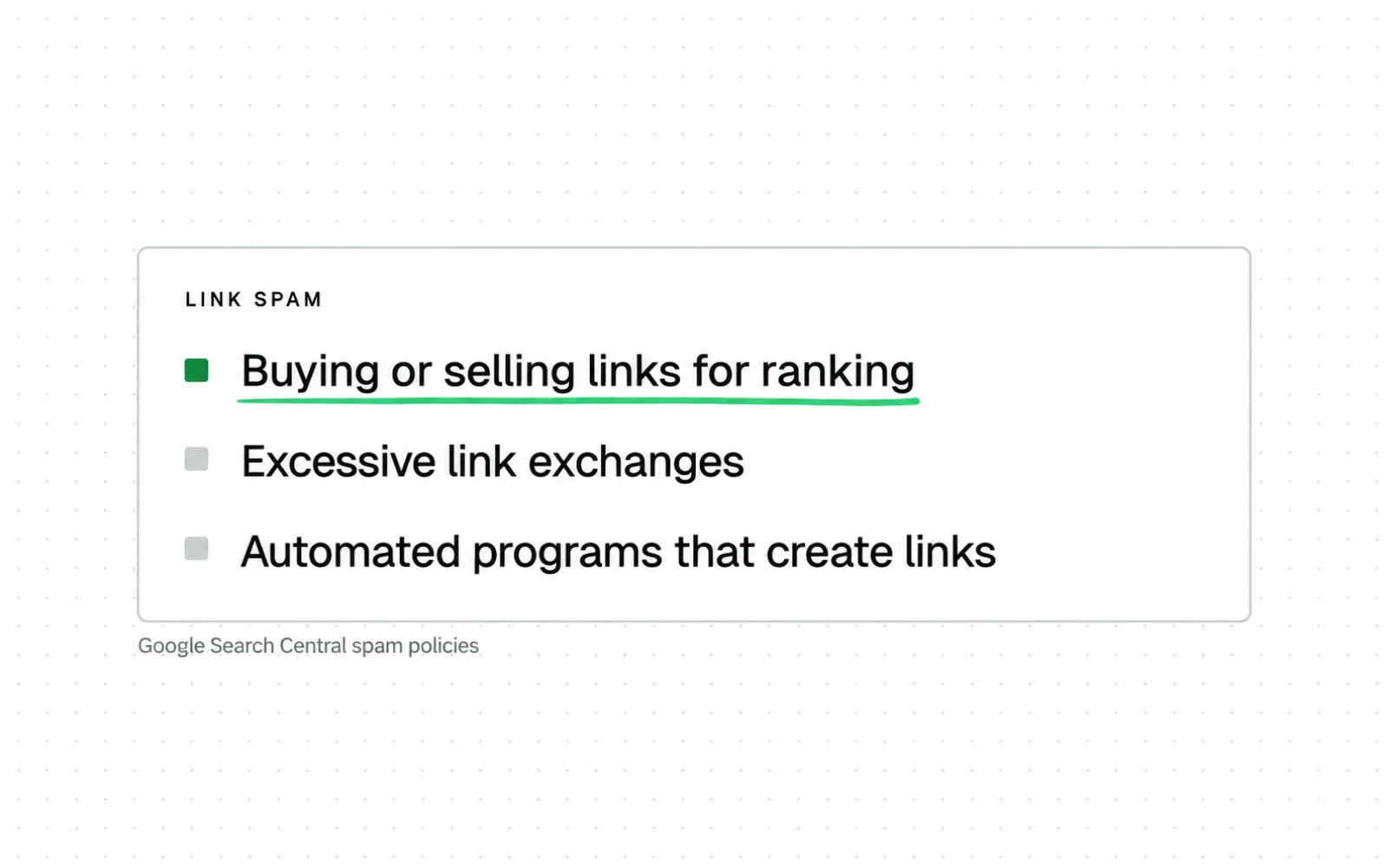
- The policy lists buying or selling links for ranking as link spam.
- Excessive exchanges and automated link programs are on the same list, and vendors sell both as shortcuts.
- Google Search Central owns the policy, so its wording settles what counts.
Paid reach isn't automatically prohibited.
Google asks sites to mark advertisements and paid placements with rel="sponsored", and accepts nofollow as well.
Pay journalists and PR teams for producing material and managing outreach. Calling an undisclosed paid editorial link a production cost does not remove the risk.
| Package promise | Risk signal | Question to ask |
|---|---|---|
| A fixed link count | Quantity is promised before sources are known | Why would each source cite this page? |
| Promised domain scores | A domain score substitutes for an explanation of where and why the link will appear | Where will the link sit and who uses that page? |
| Exact-match anchors | The anchor is controlled for ranking credit | Would an independent editor choose these words? |
| A private site list | Ownership and audience cannot be inspected | Can you review every source before publication? |
| Reciprocal volume | The exchange becomes the reason for the link | Would either link exist without the deal? |
Suppose a seller offers you 100 followed links with exact-match anchor text. You have not seen the source pages or their readers.
If you want the asset and the outreach run as one program, our link building service creates resources for publishers to cite and handles the outreach. For every proposed placement, check who publishes the link, why it belongs on the page and where it takes readers.
What should link building cost?
A link-building package should itemize work you can inspect. Separate the cost of producing resources from the cost of researching publications and contacting editors. Put maintenance on its own line so you can see what each charge buys.
Asset production might include research design, data cleaning and expert interviews. It can also cover writing, development and graphics that explain the findings. You still own that work when a publisher says no.
Before pitching, the team researches publications and decides which ones suit the story. After sending the pitch, the team follows up and helps sources respond to journalists' requests.
Maintenance covers live-link checks, destination repairs, evidence updates and referral records.
| Budget line | What you receive | What not to guarantee |
|---|---|---|
| Product asset | A useful tool, directory or template | A fixed number of editorial links |
| Data asset | A documented dataset and reusable findings | Coverage from named publications |
| Relationship program | A researched publication list, pitches tailored to each outlet and help for sources answering journalists' questions | A reply from every contact |
| Maintenance | Link checks, destination fixes and outcome records | Permanent control of another site |
For example, a small B2B team might fund one quarterly benchmark and focused outreach to publications serving operations leaders.
Then pitch the finding to operations publications through digital PR.
A store might instead fund a compatibility tool and partner documentation through our ecommerce SEO service. The tool serves shoppers and support teams before it earns an external link.
Do not compare proposals only by cost per link. Compare the asset you will keep and the audience you can reach. Then review the risk controls and measurement plan.
Ask your supplier to show the asset, outreach log or maintenance record behind each invoice line.
Measure the links you earn
Start with the live link. Record whether the link belongs in its surrounding passage and what visitors do after clicking it. Use separate fields for changes in search performance, conversions and maintenance work. Assign one person to maintain the record.
Record source and target URLs. Add the anchor and link attribute. Add the surrounding topic, first-seen date and current status. Then connect referral sessions and conversions where your analytics allows it.
Say you earn an industry newsletter link to your returns benchmark. Track the live link and study visits. Record assisted product views and qualified inquiries. Do not claim that the link caused every later sale.
One link needs one inspectable record
link-record.yaml
# example record for one earned editorial link
source: https://publication.example/warehouse-returns
1target: https://brand.example/research/returns-benchmark
anchor: returns benchmark
rel: editorial-followed
topic_fit: returns operations
2status: live
referral: check analytics
outcome: check assisted revenue
- Source and target preserve the route you need to recheck.
- Topic fit records why the link belongs instead of reducing quality to a score.
- Referral and outcome fields prevent a live link from masquerading as a business result.
Ahrefs tracked links to 2,062,173 websites from January 2013. By its 2024 update, Ahrefs found 66.5 percent of those links had rotted.
Check each important link when you refresh its target page and whenever referral traffic stops.
Fix your own redirects first. If a publisher removed or replaced the source page, record the loss before you decide whether outreach is appropriate.
Track whether a live link leads to business results
- 1 Live The source page and target resolve. The link attribute is recorded.
- 2 Matched The surrounding topic and audience align. The anchor and destination do too.
- 3 Used People reach the destination and engage with the evidence or product.
- 4 Visible Search impressions, rankings or qualified discovery change after the work.
- 5 Valuable Referral or assisted journeys contribute to qualified demand or revenue.
Use an ecommerce SEO audit to compare the target page before and after publication. Annotate content updates, technical fixes and demand shifts that happened in the same period.
If several changes happen at once, assess each one's effect before attributing the results to a link.
Keep brand mentions and AI citations next to the backlink record. Attach the URL or answer where each appeared.
Links and AI citations
An AI system selects a source for a response, while a backlink sits on a published web page. Keep both in the same record, because a reader may reach your page through either one and you need to see which page they reached.
Check crawl access and index status before you investigate a missing Google AI citation.
Google says its AI search features use the same core systems as Search, and standard SEO still applies. A page must be crawled, indexed and eligible to show a snippet before it can appear as a supporting link.
Google also says you do not need a special AI text file or special schema for these features. Crawl access, internal links, visible text and correct structured data still matter.
Ahrefs studied 75,000 brands in December 2025 and found brand mentions correlated more strongly with AI visibility than Domain Rating did.
Semrush tested 1,000 domains across five AI surfaces in 2025. Semrush found only a weak tie between its Authority Score and AI share of voice.
On 24 June 2026, Dmitrij Zatuchin reported an arXiv audit of 128 brands in 12 markets and 13 languages. Dmitrij Zatuchin's audit examined 167,551 citations containing a URL.
Citation patterns varied by market and language, so check each market on its own.
- Backlink. A source page links to your URL and creates a crawlable or qualified relationship.
- Brand mention. A page or answer names your brand in that context.
- AI citation. An answer selects your page as support for that response.
- Referral visit. A person arrives through a recorded source and creates an observable session.
Suppose an AI answer mentions your B2B benchmark and cites a publisher's page that does not link to your site. Record the AI answer and the publisher's page it cites. Do not count an earned backlink from that publisher.
Record the appearance in your Google AI Overviews log, then open the cited page and check the claim. Check that the answer represents your findings accurately, that the cited page remains available and that readers can reach the underlying evidence.
Review one recent AI answer that mentions your brand and compare it with your backlink report.
Link building questions
A backlink count cannot tell you why a link exists or what happened after the click. Compare the AI answer with the backlink report side by side, then use the answers below to explain to a buyer what each link did for them.
For example, ask whether a publisher would still cite your page if no ranking metric existed. If the answer is yes, explain that reason in your pitch.
Sources
- Google Search Central Spam policies for Google web search
- Google Search Central Link best practices for Google
- Google Search Central Qualify your outbound links to Google
- Google Search Central Top ways to ensure your content performs well in Google's AI experiences on Search
- Google Search Central SEO Starter Guide
- Semrush Link Building: The Definitive SEO Guide for 2026
- Semrush We Studied 1,000 Domains to Find the Most Important Backlink Factors for AI Visibility
- Ahrefs Google Says Links Matter Less: We Looked at 1,000,000 SERPs to See if It's True Measured 20 months ago, on a surface that has moved since.
- Ahrefs We Analyzed 75K Brands to Identify What Drives Visibility in AI Search
- Ahrefs Link Rot Study: How Many Links Get Lost Over Time?
- BuzzStream State of Digital PR Report 2026
- Muck Rack State of Journalism 2026
- Search Engine Land Link building works better when you think beyond links
- Search Engine Journal Link Building Guide: How to Acquire and Earn Links That Boost Your SEO This page carries no publication date of its own.
- arXiv How Large Language Models Source Brand Reputation Across Languages and Markets
Questions people ask
What is link building in SEO?
Link building earns links from other websites to your pages. Those links give crawlers a route and add topic context. The paragraph around the link should explain why it is there, and your page should answer the question it raises.
What is the difference between backlinks and link building?
A backlink is the link itself. Link building is the process used to earn and qualify links. It also includes maintaining those links.
What is link building versus link earning?
Link building includes creating resources, contacting publishers, evaluating potential links, adding internal links and measuring results. Link earning happens when another site cites the page because it serves that site's audience.
How do I get backlinks for my website?
Start with a page that gives a defined audience a reason to cite it. Publish a useful tool or documented dataset.
Is link building still important for SEO?
Yes. Links still help search systems discover pages and understand topic relationships. Weigh them against content quality, technical access, destination fit and business outcomes.
Is buying backlinks against Google policy?
Buying or selling links for ranking purposes is link spam under Google's policy. Paid advertising and sponsorship can be legitimate when the publisher qualifies the link with rel="sponsored" or nofollow.