

What is a Google knowledge panel?
A knowledge panel is the box of facts Google shows alongside search results, on the right on desktop and at the top on mobile. It appears when Google recognises what you searched for as an entity: a person, an organisation, a place. Google generates it instead of receiving it, and everything else about knowledge panels follows from that.
Google assembles it. Nobody submits it.
Google’s own description is unusually plain. Panels surface key facts to help you understand a subject quickly. They draw on the Knowledge Graph, which Google describes as something like a giant virtual encyclopedia holding over 500 billion facts about five billion entities. The facts come from many places at once, including licensed data for things like sports scores and stock prices.
Claiming and editing a Google panel: the limits
The practical question is not how panels work but what a person or company is allowed to do about theirs. Google answers that on one page, and the answer has a limit in it that the how-to advice rarely quotes.
For example, what you can do is describe your entity in markup Google reads. The schema skill writes you the Organization block with the profile links.
Four verbs, and a limit inside one of them.
| What you might want to do | Can you | Where that comes from |
|---|---|---|
| Create a panel for your brand | No | Panels are generated automatically; there is no way to request or buy one |
| Claim a panel that exists | Sometimes | Google: not all knowledge panels are claimable as of now |
| Edit what it says | No | Automatically generated; verification lets you suggest, not change |
| Add someone to manage it | Yes, once verified | Google’s help article lists authorised representatives |
Google’s blog draws the boundary in softer words: many knowledge panels can be claimed by the subject they are about. Many, not all. And even once verified, the panel is not yours to edit. Hilary Bird’s Search Engine Land guide states the consequence directly. You cannot edit a knowledge panel, because it is automatically generated. What verification buys is the right to suggest, which Google may accept or decline.
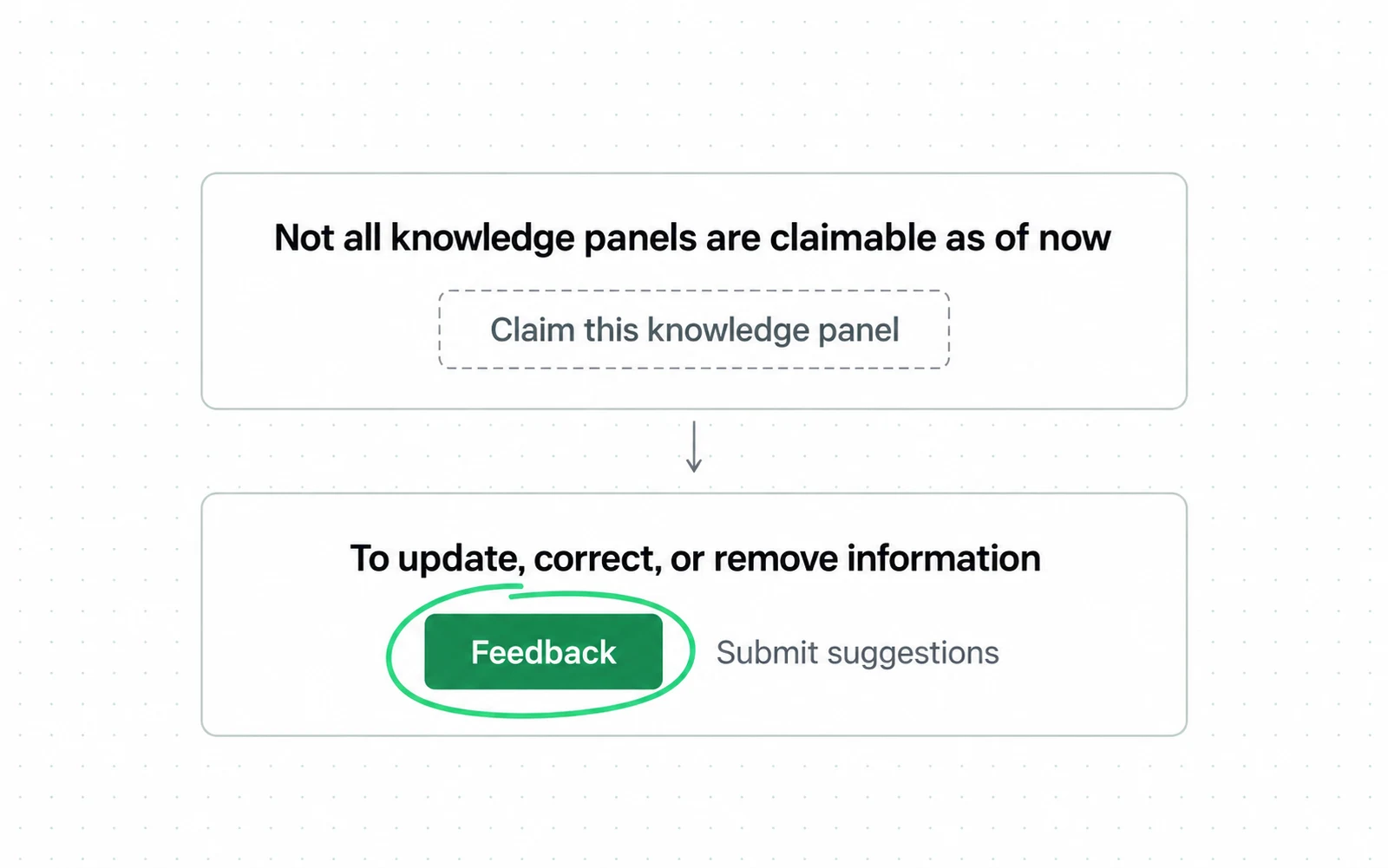
- As of now. Google writes the sentence with an expiry it does not date, and the how-to guides quote the sentence without it.
- The second bullet is the whole of what claiming buys. Submit a suggestion. There is no verb here for changing anything.
Why does a knowledge panel matter for a brand?
A panel is a block of your branded search result that you did not write and cannot edit. That is exactly why it is worth understanding, even though almost none of it is under your control.
One vendor measured how much room it takes.
Semrush measured the space directly, checking ten brands on desktop. The panel took between 10 and 50 percent of the right-hand side of the screen, depending on the brand. That is ten brands, one region of one desktop layout, measured by a company selling SEO software, and it supports a range, not a rule. What it does not measure is what that space does. Nobody has tested whether a panel changes what a visitor clicks, so it shows that a panel takes up room, not that it earns anything.
The second reason is where this fits into the rest of the cluster. A panel is Google asserting that an entity exists and that these facts describe it. That is a different kind of visibility from a page ranking or a mention inside a generated answer. Those two are covered in brand mentions and what AI visibility is, and a panel sits alongside them instead of replacing either.
Three common mix-ups
A knowledge panel gets confused with three different objects, and each confusion needs a different line drawn. Together they cover what it is most often mistaken for.
Three of them, and one has a purchase attached to it.
Axia Public Relations, Google’s help article, and Shopify. Read 4 September 2026Which of the three you are being quoted for
Three distinctions. Two of the objects are earned and the third is bought.

A fourth disagreement is worth carrying, and it decides whether you spend a month on a Wikidata entry. Hilary Bird, writing in Search Engine Land, states that Wikidata is non-negotiable and Wikipedia merely nice to have. Google never names Wikidata. Its blog lists many sources and does mention Wikipedia among them; its help page describes them only as a variety of sources, public sources and licensed data. So the specific absence is Wikidata, on both pages read. That is not a contradiction so much as two kinds of statement. One is a practitioner’s observation. The other is a platform declining to publish a list. Read it in that spirit and not as a requirement.
Related page: getting a panel
This page covers what a panel is and what claiming reaches. What to do if you want one is a separate question, and it has its own page.
The steps are their own subject, and not this page’s.
A procedure does exist, and its three thresholds are search interest, citations from reputable sources, and unique identifiers pointing consistently at one entity. The framing to carry into any of them is the one above: nothing in a procedure creates a panel, because Google describes no way to do that. What it can do is make the entity easier to recognise, which is the same work described in brand mentions. The procedure itself, the six published step lists and the three steps all of them carry, is set out in how to get a Google knowledge panel.
Suppose your entity markup is the missing part: that sits inside our technical SEO service.
Sources
- Google Knowledge Panel Help Get verified on Google: claim and manage a panel, add authorised representatives, submit suggestions, and not all knowledge panels are claimable as of now
- Danny Sullivan, Google Google’s Knowledge Graph and knowledge panels: a virtual encyclopedia of over 500 billion facts about five billion entities, with many panels claimable by the subject they are about Measured 6 years ago, on a surface that has moved since.
- Google Knowledge Panel Help How knowledge panels work: facts come from a variety of sources that compile factual information, plus licensed data, with no database named
- Hilary Bird, Search Engine Land Google knowledge panel guide: search interest, citations and unique identifiers as thresholds, Wikidata described as non-negotiable, and panels cannot be directly edited because they are automatically generated
- Tushar Pol, Semrush Google knowledge panel: an information box for an entity Google has information about, distinguished from Business Profiles, with a ten-brand check finding panels occupying 10 to 50 percent of the right-hand side. Semrush sells SEO software
- Shopify Google knowledge panel for business owners: you cannot request or purchase one, and small local businesses usually have a business profile instead Measured 3 years ago, on a surface that has moved since.
- Axia Public Relations Knowledge panel against Knowledge Graph: the panel is a quick-reference snapshot of one entity, the graph creates relationships between entities Measured 13 months ago, on a surface that has moved since.
Questions people ask
What does it mean to claim a Google knowledge panel?
It means verifying that you are the subject a panel is already about, which then lets you manage it, add authorised representatives, and submit suggested changes through feedback.
It does not mean creating one, and it does not mean editing one. Google states that not all knowledge panels are claimable, and a trade guide puts the editing limit plainly: the panel is automatically generated, so suggestions are all you can send.
Should you claim your Google knowledge panel?
If one exists and is claimable, verification is the route Google gives for sending corrections, and it also lets you add authorised representatives. What it will not do is give you control of the content.
If no panel exists, there is nothing to claim. That is the part to check before paying anyone, because you cannot request or purchase a knowledge panel.
Is a knowledge panel the same as a Google Business Profile?
No, and Google itself keeps them apart: its knowledge panel help article points local businesses towards Business Profiles instead. They appear in a similar place on the page, which is one reason they are set side by side.
Small local businesses usually have Business Profiles instead of knowledge panels.
Do you need a Wikipedia or Wikidata page to get a knowledge panel?
A Wikidata entry is a practitioner requirement and not a documented one. Search Engine Land calls Wikidata non-negotiable and Wikipedia nice to have.
Google never names Wikidata on either of its own pages. It does mention Wikipedia, among many sources, in its blog post; its help article describes the sources only as a variety of sources, public sources and licensed data. So the Wikidata requirement is a practitioner’s reading, not a published rule.