

Can you apply for a knowledge panel?
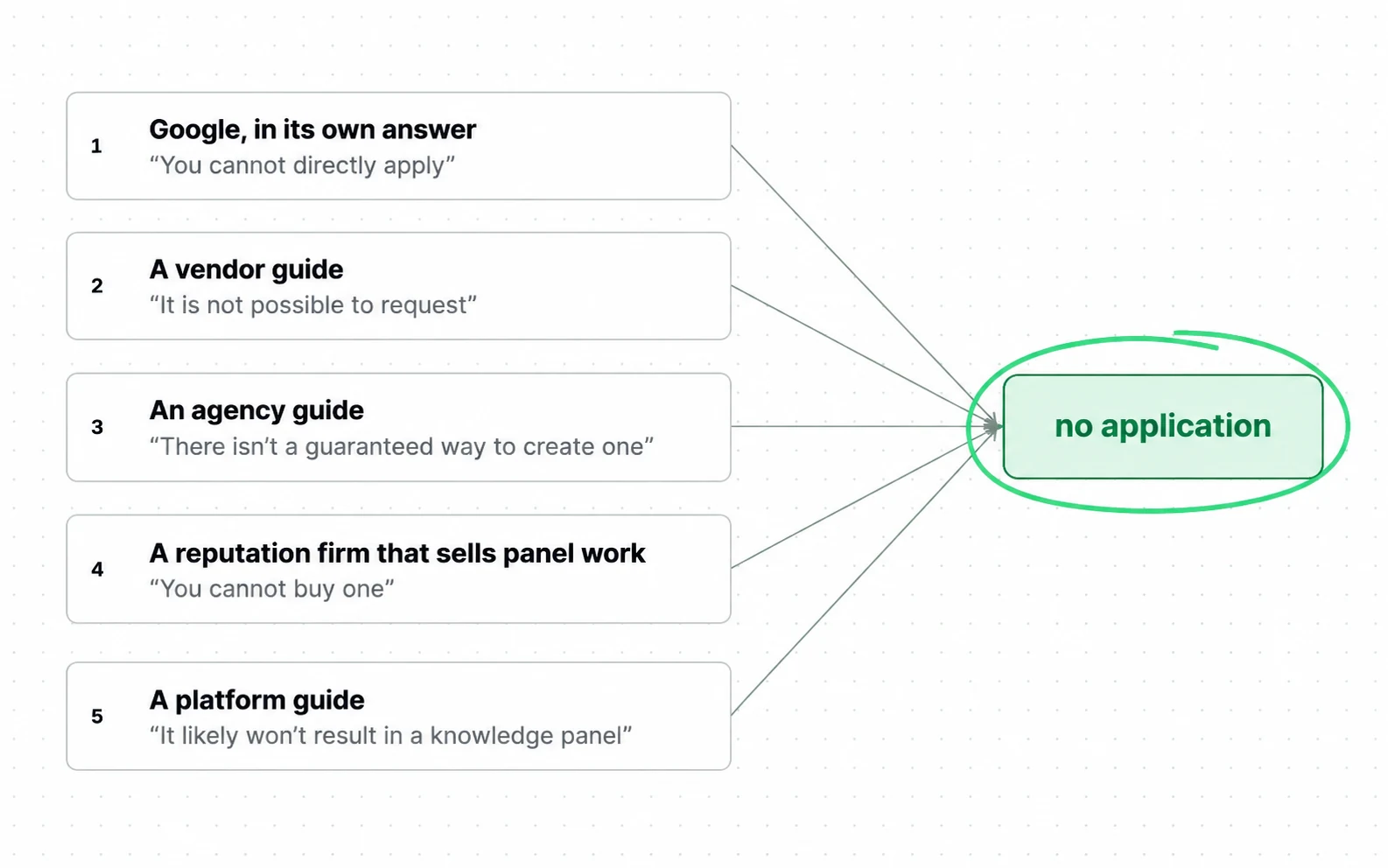
You cannot apply for a knowledge panel. Google publishes no form, no queue and no paid route to one, and no amount of money changes the decision.
Google puts the limit in the first sentence of its own summary.
A query phrased as how to get something normally produces a summary that starts with step one. This one starts by removing the premise.
What a panel is, and what claiming one reaches, is covered separately in what a Google Knowledge Panel is. Given that there is no application, the question that follows is what the published procedures describe.
Entity work behind how-to lists
If nobody can apply, a numbered list called how to get a knowledge panel is a list of something else. What those lists describe is entity work: making the facts about your organisation consistent and machine readable, so that whatever Google assembles about you is assembled from your own statements.
The job is publishing facts about yourself that a machine can read without guessing.
Google’s own explanation of how panels work says they are generated automatically, and its systems aim to show the most relevant and popular information for a topic. Nothing in that sentence is a queue you can join. What it describes is a recognition process running over whatever is already published, and that material is the only lever anyone proposes.
So every step below is an attempt to make an entity easier to recognise. Give it one page that states plainly what it is. Mark that page up so the facts are machine readable, not inferred from prose, and to make the same facts agree wherever else they already appear. Google decides whether that work produces a panel.
Wix puts the expectation in plain words: it likely will not result in a knowledge panel, and if it were this easy, all brands could have one. That sentence carries the whole distinction. That is the difference between a procedure with an output and a procedure that improves your odds at something a third party decides.
Three steps toward a Google knowledge panel
Three steps carry the work, and not one of them is a request for a panel. Write one page that states plainly what your organisation is, mark it up so the facts are machine readable, and correct those same facts wherever else they already appear. Published lists run from four steps to eight, and the extra steps are subdivisions of these three.
Here are the published lists side by side.
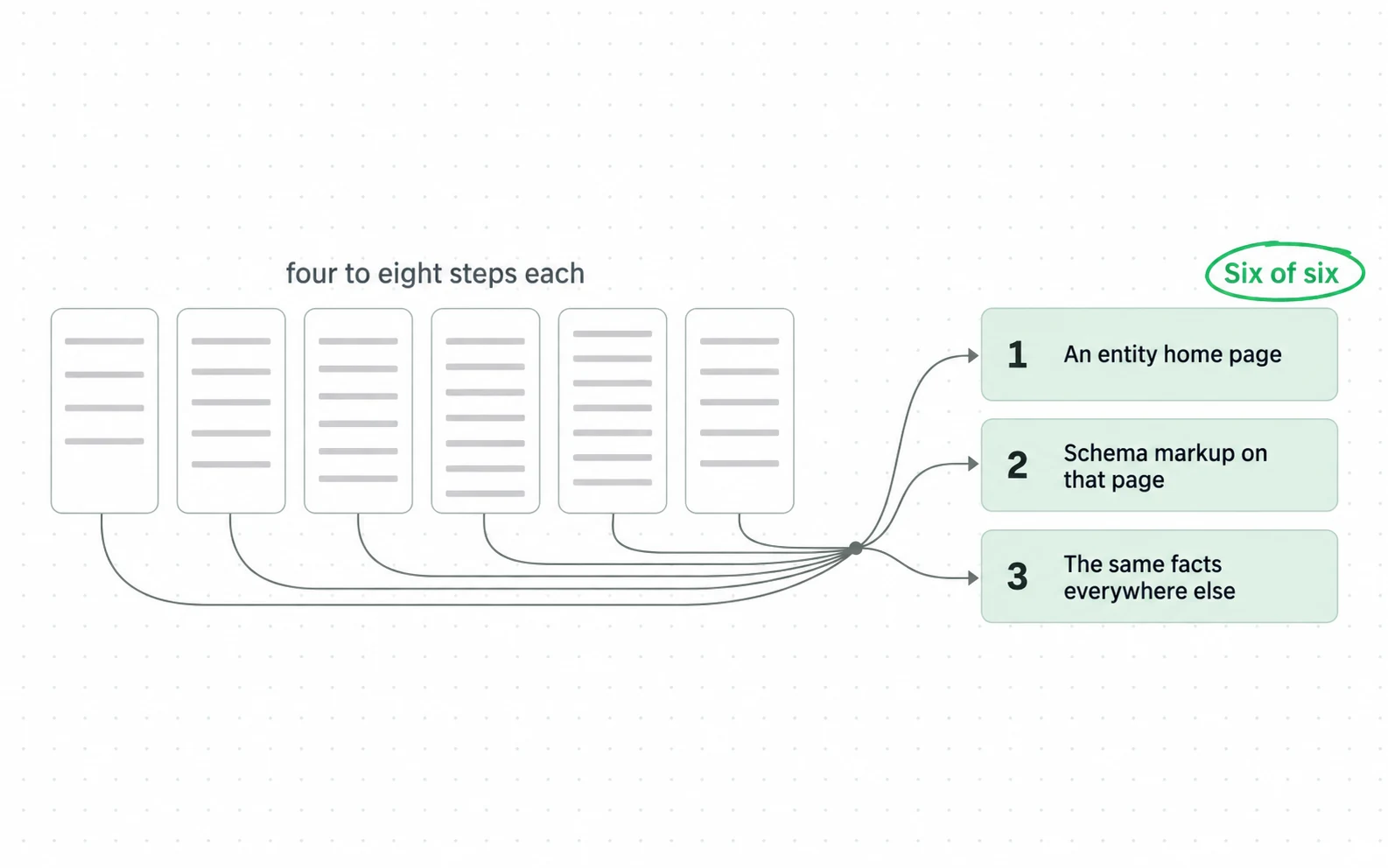
The three steps, and what each one leaves you able to check.
| Step | What you publish | How you check it |
|---|---|---|
| An entity home page | One page that states what the organisation is, what it does, when it started and who runs it | The facts sit in plain sentences on a page you control, not inferred from marketing copy |
| Structured data on that page | Organization markup carrying the same names, dates and profile links as the prose | The markup parses, and every value in it matches the sentence above it |
| The same facts everywhere else | Directory entries, profiles and press listings corrected to match | A search for the brand name turns up no contradicting founding date, spelling or leadership |
None of the three is under Google’s control, and none is under yours either until you write it. An entity home page and the schema markup on it are things you write; the third-party listings are things you correct by asking whoever runs them. Either way the material is already published, and that is all any guide can offer. The rest belongs to a system none of them can address. One of them adds a caution worth carrying: do not use a Wikipedia page as that home page, since you do not control what it says about you.
Say you want step one written for you. The schema skill writes the Organization markup with sameAs to the profiles Google can reconcile, and tells you to validate it before it goes live.
Two more steps turn up often and neither is load bearing. Wikipedia and Wikidata come below, where the disagreement is with Google. A Business Profile is not a step at all. The confusion is a category error, and it costs a reader real time, because the product it sends you to is a different product that happens to appear in the same place on the page.
The last step on most lists is to claim the panel. Claiming requires a panel that already exists, and Google’s help page adds that not all knowledge panels are claimable as of now. So the last step is conditional on the one thing the procedure could not produce.
How much does a knowledge panel cost?
If you cannot buy the decision, what does the money buy? The panel is free, and the work behind it is not. An entity page, structured data and a correction pass across everywhere your facts already appear is real labour, and no seller publishes a rate for it.
The firm selling the service answers it against its own interest.
Google charges nothing for a panel and sells nothing here. It is not possible to request one and not possible to pay for one. One ecommerce platform writes the same limit to its own merchants: you cannot request or purchase one.
The work behind it, though, costs whatever the work costs. Building an entity home page, adding structured data and correcting your facts wherever they already appear is real labour, and paying an agency to do it is an ordinary purchase. What you are not buying is the outcome. The distinction matters because the failure mode is specific and the firm above names it: someone promising a panel for a flat fee by a deadline is promising a decision that belongs to Google.
There is no published rate, and inventing a range from adjacent services would be a number with nothing behind it. What the deliverable is can be said: entity signals, sourcing and structured data, in the seller’s own words, and none of those is a panel.
Say you want the entity work on your own site handled: that sits inside the technical SEO services at Addition, an AI search agency.
Four mistakes with two found on top pages
Four mistakes cost real time here, and two of them are printed in the pages a reader is most likely to land on. A heading that promises a request form is one. A step list that ends with claiming a panel you do not have is the other. A reader who trusts a heading and stops has been misled by the page, not by themselves.
Two pages disagree with their own headings.
The first is an agency guide, and its own page is the evidence.
The second is a public relations agency page. Its own title and first step are the evidence.
We'll walk you through the steps to create one and share tips for optimizing it. … 1. Create or claim a Google Business Profile
Axia Public Relations, How to create and optimize a Google Knowledge Panel for your company, by Dana Whitfield 16 January 2025, read 7 October 2026
- Both sentences sit on the same page. The article is not wrong so much as it is titled for the search, not for the answer.
- That gap is why this question is hard to research: the pages ranking for it promise a verb the platform does not offer.
The third mistake is treating a widely repeated step as a requirement. A Wikipedia or Wikidata entry comes up almost everywhere, and Hilary Bird, writing in Search Engine Land, is the only one to call either a requirement.
The two sides are worth laying out before you spend a month on a Wikidata entry.
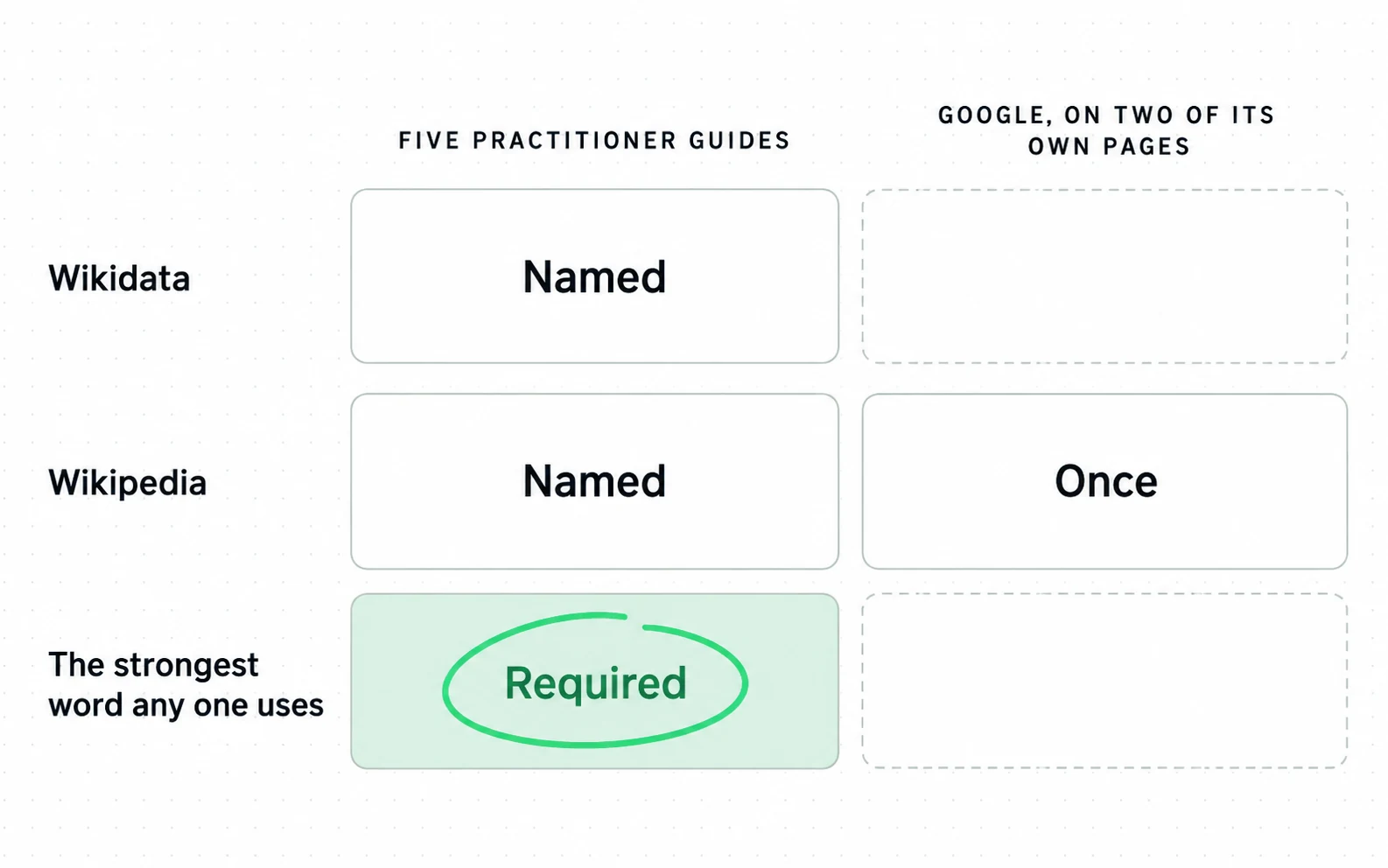
The absence is specific. Wikipedia turns up once on Google’s blog, listed among several sources. That is a mention, not an instruction. Wikidata turns up on neither page. That is not a contradiction, and it should not be read as one. One side names a specific database, whereas Google’s own pages describe their sources only in broad classes. Neither statement refutes the other, and neither side publishes a test. What it does mean is that non-negotiable is one author’s word, not a documented condition. A plan that depends entirely on getting a Wikidata entry rests on an undocumented step.
The fourth mistake is the expensive one, and it is buying a deadline. The tell is a flat fee with a date attached, and the firms selling this work name it themselves: the outcome belongs to Google, so a guarantee is the one thing that cannot honestly be sold.
Progress checks without a published timeframe
No timeframe is published anywhere for this, by Google or by anyone selling the work, so a date you are given comes from outside the published record. What you can check instead is narrower than a date, and it is under your control in a way the panel never is.
Here is what that leaves you able to check.
That absence is not evidence that no duration exists, and it does not follow from the lack of a guarantee that one cannot be observed. What it means is narrower: nobody publishing on this has printed one, so any date you are given comes from somewhere the published record does not go. The only duration published anywhere on this belongs to something else, where one vendor notes that Google evaluates submissions within several days. That is the review window for a suggested edit to a panel that already exists. It does not measure how long a new panel takes to appear.
What can be checked is narrower and more useful. Search your brand name and see whether a panel is there. It answers the only question this whole procedure was aimed at. If one appears, Google’s help article describes the claiming route and its limit, and the glossary page covers what claiming reaches. The same three checks close Tushar Pol’s list at Semrush, a company that sells software and not knowledge panel services. If one does not, the three steps are the things you can verify you have done: the entity home page exists and states the facts, the structured data validates, and the third-party listings agree with both.
Check those three, because they are verifiable regardless of the outcome. The panel is not under your control and never becomes so. Whether your own facts agree with each other is. That stays true of your pages whether or not a panel ever appears. How the wider surface is counted is covered in how to measure AI visibility. And if a panel does appear, what you can then do with it, including how to claim it, is in what a Google Knowledge Panel is.
Sources
- Google AI Overview for “how to get a google knowledge panel”: you cannot directly apply for or create one
- Google Knowledge Panel Help Get verified on Google: claim and manage a panel, add authorised representatives, submit suggestions. Contains the line, not all knowledge panels are claimable as of now
- Google Knowledge Panel Help How knowledge panels work: information drawn from a variety of sources, public sources and licensed data, with no database named
- Danny Sullivan, Google About the Knowledge Graph and knowledge panels: panels are generated automatically, and the systems aim to show the most relevant and popular information for a topic
- searchatlas Google knowledge panel guide: four steps, and the flattest statement of the limit published on this term. It is not possible to request a Google Knowledge Panel. It is not possible to pay for one either. searchatlas sells SEO software
- Princess Kang, sitecentre Google knowledge panels: eight steps, the longest list read. Step eight is titled claim or apply for your knowledge panel while the body states you cannot apply for a branded or personal panel
- Reputation Resolutions How to get a Google Knowledge Panel: six steps from a firm that sells the service, stating you cannot buy one and no legitimate service can guarantee it will appear
- Gus Pelogia, Wix How to get a Google knowledge panel: five steps, with the expectation stated plainly. It likely will not result in a knowledge panel, and if it was this easy, all brands could have one Measured 21 months ago, on a surface that has moved since.
- Axia Public Relations How to create and optimize a Google knowledge panel: a title promising creation whose first step is setting up a Google Business Profile
- Idea Digital Google knowledge panel: four steps, stating the panel is generated automatically, and naming Wikipedia and Wikidata as the most reliable sources underpinning much of its content This page carries no publication date of its own.
- Reputation X Knowledge panel guide: seven steps from a second reputation firm, stating that building source material like a Wikipedia article is one of the most important steps. It sells knowledge panel correction services
- Hilary Bird, Search Engine Land Google knowledge panel guide: three eligibility thresholds, search interest, reputable citation and unique identifiers, with Wikidata described as non-negotiable
- Tushar Pol, Semrush Google knowledge panel: steps covering an about page, Organization schema, a Wikipedia page where eligible, a Wikidata entry and consistent entity data. Semrush sells SEO software
- Shopify Knowledge panel explainer stating you cannot request or purchase one, and that small local businesses usually have a Business Profile, not a panel Measured 3 years ago, on a surface that has moved since.
- Google Search results for “how to get a google knowledge panel”
Questions people ask
Is it hard to get a Google knowledge panel?
Hard is the wrong word. It is not difficult, it is out of your hands. Google states outright that you cannot directly apply for or create one. The work is not difficult so much as unglamorous: one page you control stating who you are, structured data on it, and the same facts corrected wherever they already appear. Nobody says how long it takes. Whether it produces a panel is Google’s decision. Wix puts the expectation plainly: it probably will not, because if it were this easy every brand would have one.
Is the Google knowledge panel free?
The panel itself is free. Google charges nothing for one and sells nothing here, and two sources state the corollary directly: it is not possible to request one and not possible to pay for one either.
The work behind it costs whatever the work costs, and paying an agency to do it is an ordinary purchase. What is being sold, in one firm’s own words, is entity signals, sourcing and structured data. What cannot be sold is the outcome, and the same firm names the warning sign: be deeply skeptical of anyone promising a panel for a flat fee by a deadline.
How do I get a Google knowledge panel?
By making the entity legible and then waiting on a decision that is not yours. Three steps carry it: an entity home page you control that states the facts plainly, Organization or Person schema markup on it, and the same facts agreeing across every third-party listing that already mentions you.
Six lists, and five also name Wikipedia or Wikidata. One of them calls Wikidata non-negotiable; the other four simply list it. Google never names Wikidata on either of its own pages, and names Wikipedia once, among several sources, on its blog. The last step in most lists is claiming, which requires a panel to already exist, and Google states that not all knowledge panels are claimable as of now.

