

What is AI search optimization?
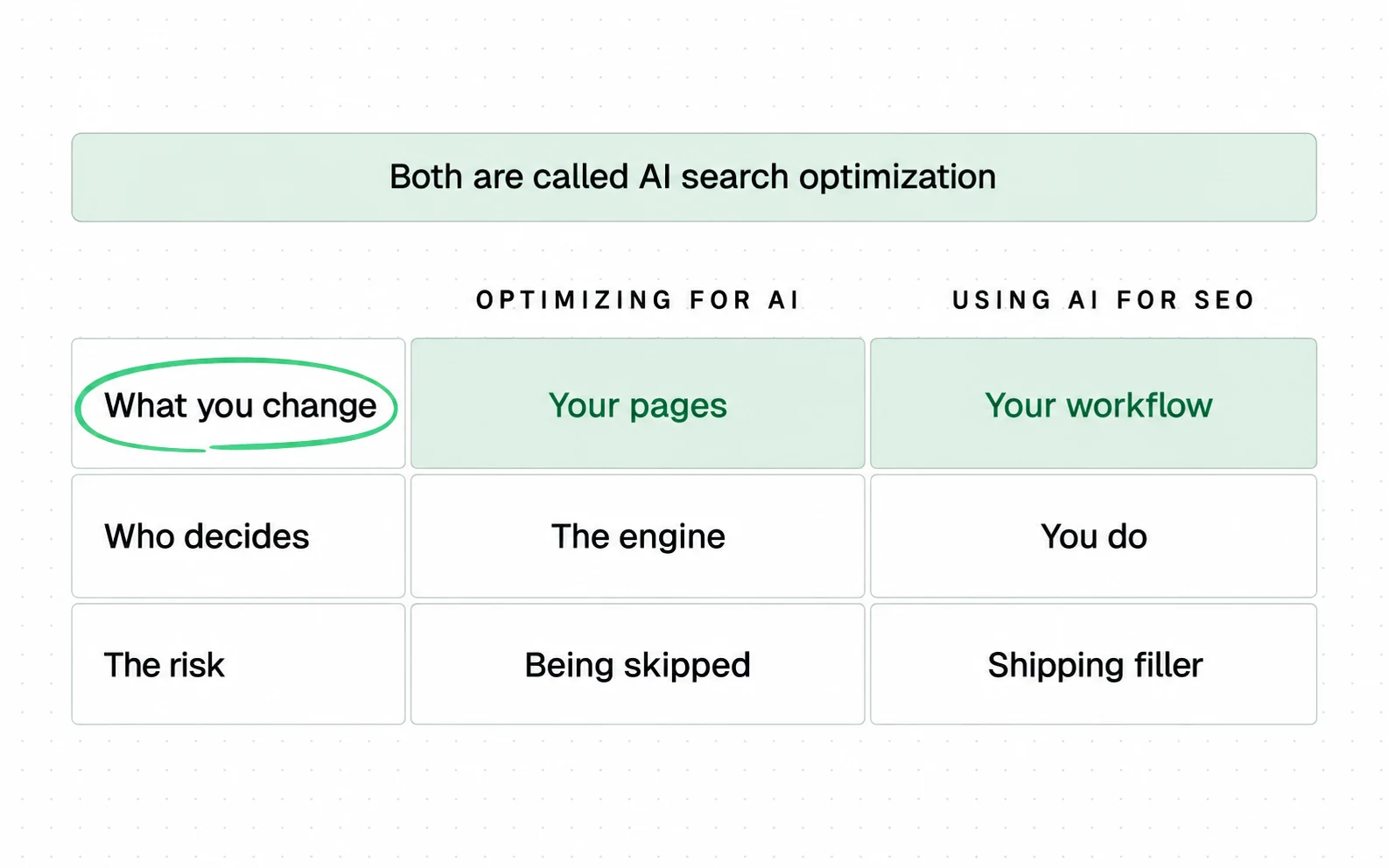
AI search optimization names two different jobs. The first is preparing your pages so that AI search engines find, quote and cite them. The second is using AI tools to do ordinary SEO work faster. The phrase does not tell you which one is on offer.
There are two main areas under the phrase, and Google names both.
Two published definitions point in opposite directions. Search Engine Land: AI SEO is the process of making your content discoverable, extractable, and trusted across AI-powered search experiences. A second: AI for SEO combines these concepts, using machine learning algorithms and data analysis to enhance SEO practices. Neither page mentions that the other reading exists.
Tasks for each of the two jobs
The two jobs diverge immediately, because one is about what you publish and the other is about how you produce it. A proposal covering both is answering two questions, and they can be judged separately even when the same team does both.
Say you want a written method for either job. The ai-seo skill covers the extractability side and gives you a monthly manual check for the measurement side.
One changes the page. The other changes the process.
| Optimizing for AI search | Using AI to do SEO | |
|---|---|---|
| The work | The ordinary technical and editorial work that makes a page indexable and quotable | Keyword research, briefs, drafts, audits |
| What it costs | Editorial and technical time | Tooling, and the time to check its output |
| What you would watch | Whether you appear in answers you did not before | Whether the same work takes less time |
| What goes wrong | The answer is assembled without you | You publish more than you can stand behind |
On the first job, the platform requirement is one sentence long. Google states two things. A page must be indexed and eligible to be shown in Search with a snippet. And there are no additional requirements to appear in AI Overviews or AI Mode, nor other special optimizations necessary. The measurement question, meaning what counts as appearing and how steady that count is, is a separate subject covered in what AI visibility is.
Findings of the two studies
Two published studies sit behind the second job, one an experiment and one a classification of pages that already existed. Read with their samples in view, each supports less than its headline number suggests. One of them also offers a comparison it cannot quite make.
Two arms, and everything differs between them at once.

Read the two rows against each other and the comparison dissolves. That is the useful part, because neither row isolates editing. Each arm still says something on its own, and the second one says what a monthly index-coverage report never will. A different study asks a different question. Semrush classified 42,000 blog pages across 20,000 keywords with GPTZero and found position one human-written 80.5 percent of the time against 10 percent for pages it classified as AI-generated. It did not test editing, so it is not a second witness for anything above. That study is a separate finding about classification, and it states its own limit: from position five the gap is relatively narrow.
Two confusions: the wrong job and a false rule
Two confusions follow from the split. The first is a buying mistake, because it is possible to agree to one job while believing you agreed to the other. The second reads as a rule when it is not one, and acting on it rules out work that is allowed.
Buying the wrong job
The phrase carries both jobs, so it does not tell you which one a proposal is offering. The question that separates them in one sentence is whether the deliverable is a change to your pages or a change to your workflow. The neighbouring terms are narrower and easier to check: answer engine optimization names the citation work specifically, and generative engine optimization covers what the published research on it tested.
Thinking Google banned the second job
It did not, and the policy repays reading, not paraphrasing, because the thing it names is a purpose, not a tool.
Scaled content abuse is when many pages are generated for the primary purpose of manipulating search rankings and not helping users. This abusive practice is typically focused on creating large amounts of unoriginal content that provides little to no value to users, no matter how it's created.
developers.google.com, spam policies for Google web search read 10 September 2026
- No matter how it is created. The policy puts the sentence in itself, which is what makes the tool the wrong thing to argue about.
- Generative AI is the first of five examples and the other four have nothing to do with it. The list is ways of doing one thing, not a list about AI.
- Every example ends the same way: without adding value, little value, no value. That repeated clause is the condition, and it is the part a paraphrase drops.
The experiment above is not evidence about this policy in either direction. It reports what happened to a set of pages. It did not test the two things the policy turns on: the purpose behind them, and whether they helped anyone. What the policy does settle is the narrower question people bring to it: a sanction applied to the tool that wrote a page is not what it describes.
Where to read next for each job
Everything above applies to both jobs at once: the policy, the studies, the buying question. Past this point they stop having anything to say to each other, so the routes split, and which one you want follows from which job you are buying.
Pick the job, then the page.
For the first job, start with AI search engine optimization, which covers Google’s own surfaces and the overlap between them. ecommerce SEO covers the work that makes a page eligible in the first place, and the AI visibility guide goes through what a score is made of. For the second job we have no page, so start with the two studies above. Read their samples before their headlines, and treat a subscription as a production decision and not than a ranking one.
Suppose you want the second job handled on your own pages: that is AEO services.
Sources
- Google Search Central AI features and your website: no additional requirements to appear in AI Overviews or AI Mode, nor other special optimizations necessary
- Google Search Central Spam policies: scaled content abuse names a purpose, and lists generative AI alongside scraping and automated translation
- Search Engine Land What Is AI SEO: the process of making your content discoverable, extractable, and trusted across AI-powered search experiences
- Salesforce AI for SEO: using machine learning algorithms and data analysis to enhance SEO practices This page carries no publication date of its own.
- Semrush Does AI content rank in search: 42,000 blog pages across 20,000 keywords classified with GPTZero
- SE Ranking How AI-Generated Content Performs: six edited AI-assisted posts against 2,000 unedited articles on 20 new domains
Questions people ask
What are the best AI search optimization tools?
The answer depends on which of the two jobs you mean, and the two have different answers. For preparing pages, the platform requirement is that a page be indexed and eligible to appear with a snippet, and no tool is required to meet it. For doing SEO work with AI, the tools are the ordinary research and drafting ones.
Before buying either, check whether the vendor’s own definition matches the job you are hiring for, because the two definitions point in opposite directions.
Is AI search optimization the same as SEO?
On Google, the first meaning is a part of SEO, not a replacement for it. Google states that appearing in its AI features needs a page indexed and eligible to show with a snippet, and that there are no additional requirements. So on that surface the underlying work is the same work. What the other answer engines require is published separately by each of them and is not covered here.
The second meaning is not a kind of SEO at all. The second meaning is a way of producing SEO work, judged on what gets published and not on what produced it.
Does Google penalize AI-generated content?
The policy names a purpose, not a tool. Google’s scaled content abuse policy covers pages generated for the primary purpose of manipulating rankings instead of helping users. It lists generative AI alongside scraping and automated translation as ways that happens.
No published study here tested the policy’s own conditions, which are the purpose behind the pages and whether they help users. What exists is one vendor’s two-arm experiment. Six AI-assisted posts that people edited put three of six into the organic top ten. Meanwhile 2,000 AI articles across 20 new domains fell from a 28 percent share of the top 100 to 3 percent. That is an outcome, and the arms differ in volume and domain age as well as in editing, so it does not identify which condition produced it.
What will AI SEO optimization be like in 2026?
Nothing here forecasts it, and the measurements available describe the recent past, not the year ahead. Semrush classified 42,000 blog pages across 20,000 keywords. Position one was human-written 80.5 percent of the time, against 10 percent for AI-generated. From position five the gap narrows.
Those rankings were collected in November 2025. Whether the pattern holds a year later is the open question, and this page has no measurement that would settle it.