

Scope of Google Alerts in Google's own words
The help article gives the boundary in one sentence, and the product interface confirms it without meaning to. Together they decide which mentions you will hear about and which you will not.
The Sources dropdown is the whole answer.
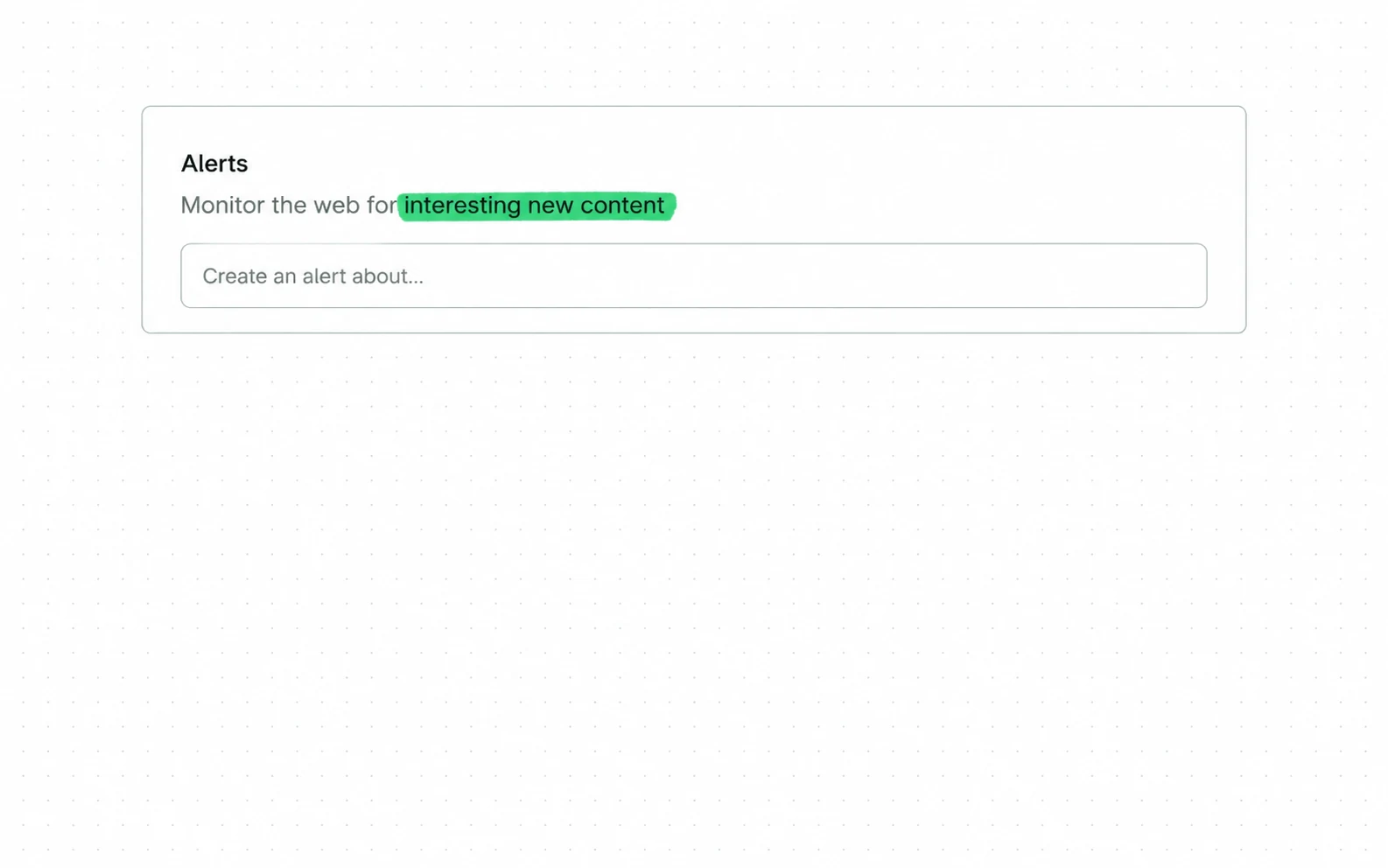
- One field. Everything the tool does begins with a query typed into it, which is why the source list underneath decides what you get back.
- The header sentence is Google’s description of the product: monitor the web for interesting new content. It does not say monitor the web.
- There is no account, no dashboard and no history view. What arrives, arrives by email, and nothing is kept here for you to search later.
Put bluntly, Google Alerts only provides mentions from pages Google has indexed. Nobody disputes it, and Google’s own wording implies it. So the useful question is not what Alerts misses by accident, but which of the places your brand gets mentioned fall inside that boundary and which do not.
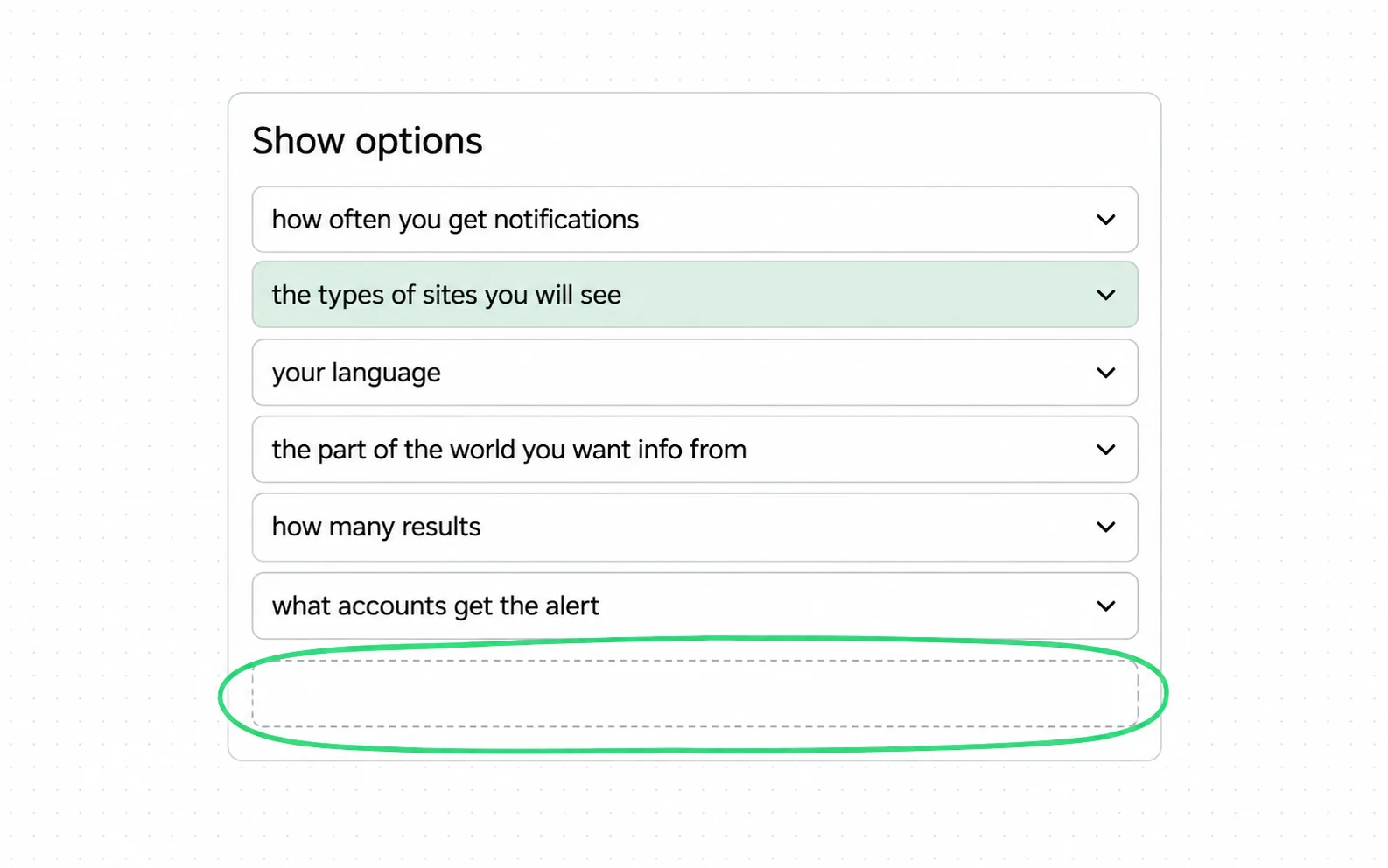
- Six settings, and Google names them all. The types of sites you will see is the one that decides what the tool can ever reach.
- The list is about filtering an index down. There is no setting that adds a surface to it.
- Nothing here mentions an assistant, an answer or a chat log, which is the boundary this page keeps returning to.
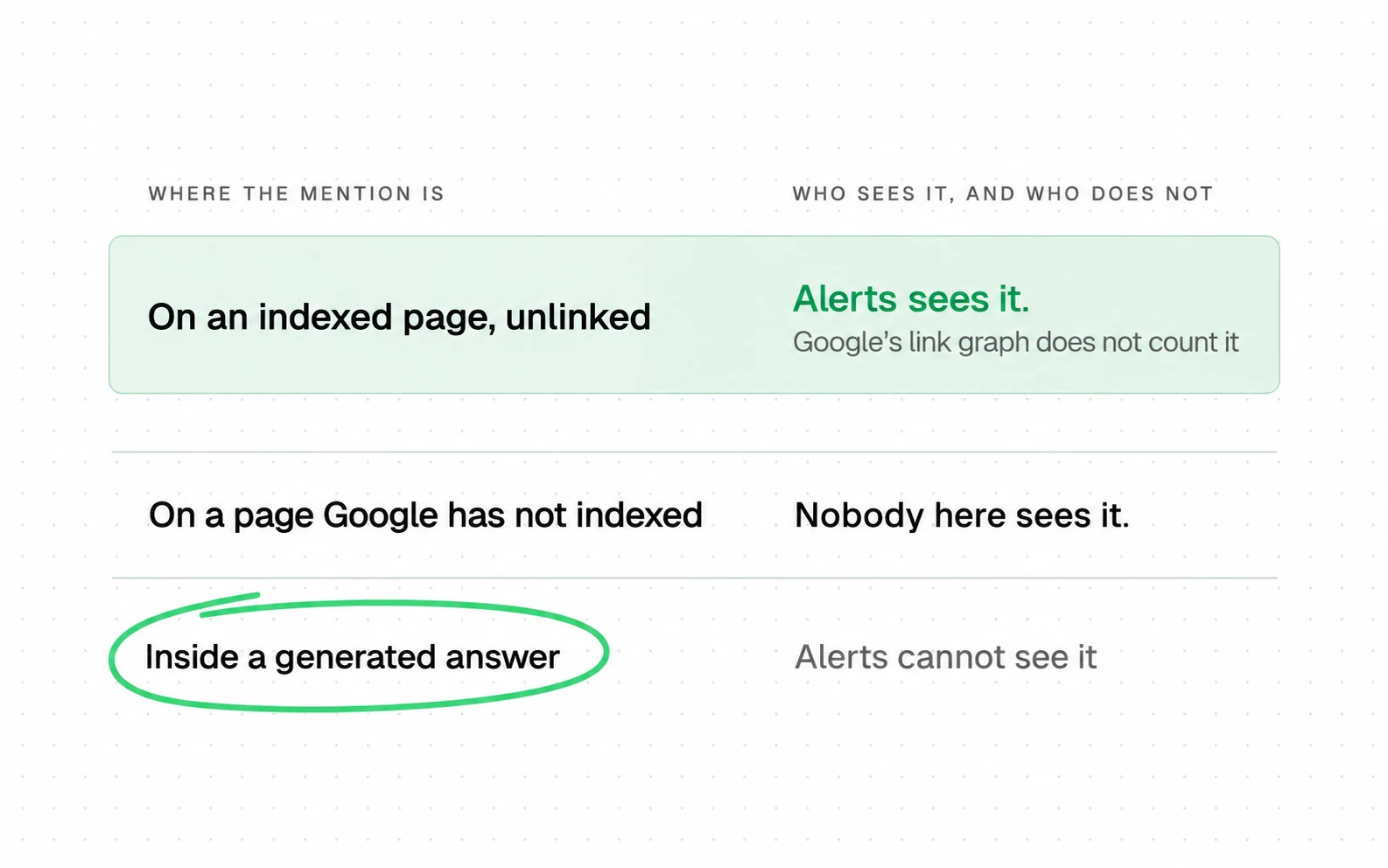
That bottom row is our reading of three documents, and none of them states it in those words. No page says Alerts cannot see inside a generated answer. What Google says is that Alerts reports new results in Google Search, and an answer is not a search result. Whether your brand is named inside one is what what AI visibility is covers, and it is counted by a different kind of product entirely.
Four options that change results
The setup takes a minute. The part worth slowing down on is the options panel. Four settings change what arrives. Two of them, frequency and the best-versus-all choice, govern how much; the other two govern what.
Six options, and two of them do the work.
| Option | What it changes | What to pick |
|---|---|---|
| How often | As it happens, at most once a day, or at most once a week | Daily for a brand term, as-it-happens only for something you would act on the same hour |
| Sources | Automatic, News, Blogs, Web, Video, Books, Discussions, Finance | Automatic unless you have a reason; narrowing it hides mentions instead of filtering them |
| How many results | Only the best results, or all results | All results for your own brand name, best results for a broad term |
| Language and region | 40 or so languages, 240 or so regions | Leave open for a brand name; narrow only for a generic phrase |
One setting deserves a warning. The frequency choice is not only about your inbox. Frequent or loosely filtered alerts can quickly overwhelm your inbox. A folder keeps them out of the way. The tool’s limited filters are why irrelevant ones pile up. How many arrive depends on what you track. That makes the setting a judgment: an alert that gets read is a monitoring system, and one that gets filtered away is not. What people use it for is more revealing than how they set it up. Set alerts for your company, product and executive names to find unlinked mentions that may become backlink opportunities. That is precisely the tactic covered in brand mentions: find the unlinked mention, ask for the link. Alerts is good at that job because an unlinked mention on an indexed news page is exactly what it can see.
What does Google Alerts miss?
Alerts has a well-known list of shortcomings, and most of it is published by companies selling an alternative. That does not make the list wrong. It does mean the number of independent sources behind each item still matters.
Some of these are corroborated. Some are one vendor.
The bigger miss is what an alert cannot reach. John Mueller at Google, quoted by Search Engine Journal, said unlinked mentions play no part in PageRank and none in reading the link graph.
And a mention inside a generated answer is a different unit again. Daniel Peris at LLM Pulse defines an AI visibility score as a position-weighted rate of brand mentions across a set prompt list, which Alerts never sees.

The pattern in that figure is worth naming outright. The two limits that describe what the tool structurally is, an index boundary and a forward-only stream, both have a source with no product to sell. The two that describe how well it performs, latency and missing sentiment, come only from companies whose product does those things. That is not evidence they are wrong. Treat the first pair as settled and the second pair as claims to test on your own brand. One limit deserves its own sentence. It changes how you use the tool, not whether you use it. An alert only notifies you of future mentions, not past ones. Alerts is a stream, not an archive. Set one up today and it tells you nothing about what was written last year. That is the gap the paid tools sell against most directly.
Does Google Alerts still work for brand mentions?
Before deciding how much of that matters, answer a prior question that comes up constantly: is Google Alerts still running? The product has a reputation for being forgotten, which makes it fair to ask before building a process on it.
Google documents it as configurable, a narrower word than maintained.
A search for its status returns the opposite impression, and that is worth naming. One summary reported that Google’s official statements indicate the service has not been updated since 2013. It rests on a personal blog post and on a company selling an alternative, and the second page does not contain the claim at all. It says the tool has no public API, which is a different assertion, and gives no source for that either. So the unmaintained-since-2013 claim is recorded here as unverified and is not used.
Paid alternatives and what they add
Those limits have a price attached, because most of them are what the paid alternatives sell against. Alerts is free, which sets up the comparison that matters: not whether a paid tool does more, but whether the more it does is the part you need.
Free covers the top row of the three-places figure.
What the free tool reaches, and what money buys on top
| Where you get mentioned | Google Alerts | What a paid monitor adds |
|---|---|---|
| A page Google has indexed | Covered, by email, free | Speed, history you can search, sentiment, filtering |
| A page Google has not indexed | Not covered | Depends on the vendor’s own crawl, which is a different index |
| Inside a generated answer | Not covered, at any price | A different product category, priced separately |
For that row, an unlinked mention on an indexed page, Alerts covers the job and the paid alternatives are buying you speed, history, sentiment and filtering. Those are three different problems, not one. History is a question about the past, which no setting in Alerts reaches. Sentiment is an analytical layer Alerts does not attempt. Speed and filtering are volume problems. Nothing here prices any of them, so the useful step is to name which of the three you have before comparing subscriptions.
For the bottom row of that same figure, mentions inside generated answers, no amount of money spent on Alerts helps. The reason is not a feature gap: the tool watches an index, and an answer is not in one. That surface is measured by a different category of product, and what those products count and charge is set out in the AI visibility guide.
Suppose that row is the one you care about: measuring it for your brand is AI visibility monitoring at Addition, an AI search agency.
Why does Google Alerts stop at Google's index?
It would be easy to read the limit as neglect. The scoping sentence suggests something simpler: the product was built to notify you about an index, and an index is a list of pages.
An answer is assembled. A page is stored.
The Sources list names eight categories: news, blogs, web, video, books, discussions and finance. Every one of them is a category of document that Google has already crawled and stored. A generated answer is produced at the moment of asking, differs between runs, and is not retrievable later as a document. There is nothing for a crawler to have indexed, which is why no setting in the panel could reach it.
The same reasoning explains a widely reported delay: an alert can arrive days after a mention was published, because the page has to enter the index first. If the alert is downstream of indexing, then a delay in the index is a delay in the alert, and a tool watching an index cannot be faster than the index. That is how the pieces fit, though no vendor puts it that way. That also explains why the measurement built for the newer surface looks so different. It does not wait for something to appear; it asks a question repeatedly and records what comes back, which is the procedure in how to measure AI visibility. One is a subscription to an index. The other is a sampling exercise.
Use cases that suit Google Alerts
Use it for what it was built for: knowing when a page mentioning you enters Google’s index. That is a real job, it is free, and for finding unlinked mentions to convert, it does the job at no cost.
Right tool, one row of the three.
Do not build a brand visibility report on it. The material it can reach is only part of what gets said about you, and none of what gets said by an answer engine. Set it up in a minute and use it for the job it does. Keep the question of whether you are named inside generated answers on a separate page of the report. That question is a separate measurement, and it needs a separate instrument.
Sources
- Google Search Help Create an alert: you can get emails when new results for a topic show up in Google Search, with options for frequency, source types, language, region, number of results and delivery account
- Google Google Alerts product interface: the Sources list offers Automatic, News, Blogs, Web, Video, Books, Discussions and Finance
- Google Workspace Admin Help Turn Google Alerts on or off for users: administrators can enable the service for an organisation, with no deprecation notice on the page
- Rank Math Google Alerts glossary: a free notification service covering articles, videos, books and forum posts, which only provides mentions from pages Google has indexed This page carries no publication date of its own.
- Sidra Condron, SpyFu Uses for Google Alerts in marketing: the first recommendation is to set alerts for company, product and executive names to find backlink opportunities Measured 16 months ago, on a surface that has moved since.
- Tuhin Banik, ThatWare Google Alerts for brand tracking: it will only notify you of future mentions, not those from the past This page carries no publication date of its own.
- The Hoyt Organization Public relations guide to Google Alerts: five uses, and one named limit, that it does not track social media posts This page carries no publication date of its own.
- Brand24 Google Alerts does not reliably track social media, alerts can arrive hours or days late, and there is no sentiment or engagement data. Brand24 sells a competing monitoring product
- BrandMentions Google Alerts only works moving forward, misses mentions and lags. BrandMentions sells a competing monitoring product with historical data This page carries no publication date of its own.
- Parallel Google Alerts has no API, no webhook delivery and no programmatic control, stated without a source. Parallel sells a monitoring API This page carries no publication date of its own.
- Roger Montti, Search Engine Journal Google’s John Mueller on brand mentions: unlinked mentions are not used for PageRank or for understanding the link graph Measured 4 years ago, on a surface that has moved since.
- Daniel Peris, LLM Pulse AI visibility score methodology: a position-weighted rate of brand mentions across a defined prompt set. LLM Pulse sells visibility tracking
- Google Search Central AI features and your website: appearances in AI features are counted inside overall search traffic within the Web search type
- Linda Zebian, Muck Rack What is AI reading: more than 25 million cited links, with 84 percent from earned media. Muck Rack sells PR software
- Google Search results for “google alerts for brand mentions”
Questions people ask
Is Google Alerts still a thing?
Google documents it as an active service. Its Workspace admin help, last updated on 26 August 2026, tells administrators how to turn Alerts on or off for an organisation and lists it under Additional Google services, with no deprecation notice and no end-of-life date.
A search for its status returns claims that it has not been updated since 2013. Those claims rest on a personal blog and on a company selling an alternative, and the second page does not contain the claim at all.
How do I set a Google Alert for a product?
Enter the product name in the box, click Show options, then set frequency and results. For a product name that is also a common word, put it in quotation marks and consider narrowing the language or region; for a distinctive name, leave both open.
Sources should usually stay on Automatic. Narrowing it to News or Blogs hides mentions instead of filtering them, and the point of the alert is to hear about the ones you did not expect.
Does Google Alerts track social media?
Not reliably, because much of what gets posted on social platforms is never indexed by Google Search. The reason follows from the scoping sentence, since much of what is posted on social platforms is not indexed by Google Search at all.
What it reaches is news, blogs, forums and other indexed pages. Separately, one study of 25 million cited links found the majority of what AI systems cite is earned media, which is largely that same kind of page. The two facts overlap; neither measures the other.
Will Google Alerts show me mentions in ChatGPT or AI Overviews?
It has no way to. Alerts reports new results that show up in Google Search, and a generated answer is not a stored page that could appear as a result. No page states this outright; it follows from the tool’s own scoping sentence.
That surface needs a different instrument. One that asks questions repeatedly and records what comes back, instead of waiting for something to be indexed. What those measurements count is covered in the AI visibility guide.