
What is ChatGPT shopping?
ChatGPT shopping gives product suggestions inside an ordinary conversation. Ask for a product or brand comparison and the answer is a short list of matching products.
For example, you might ask for a carry-on backpack that fits a 16-inch laptop and costs less than $180. ChatGPT returns a handful of bags that meet both limits.
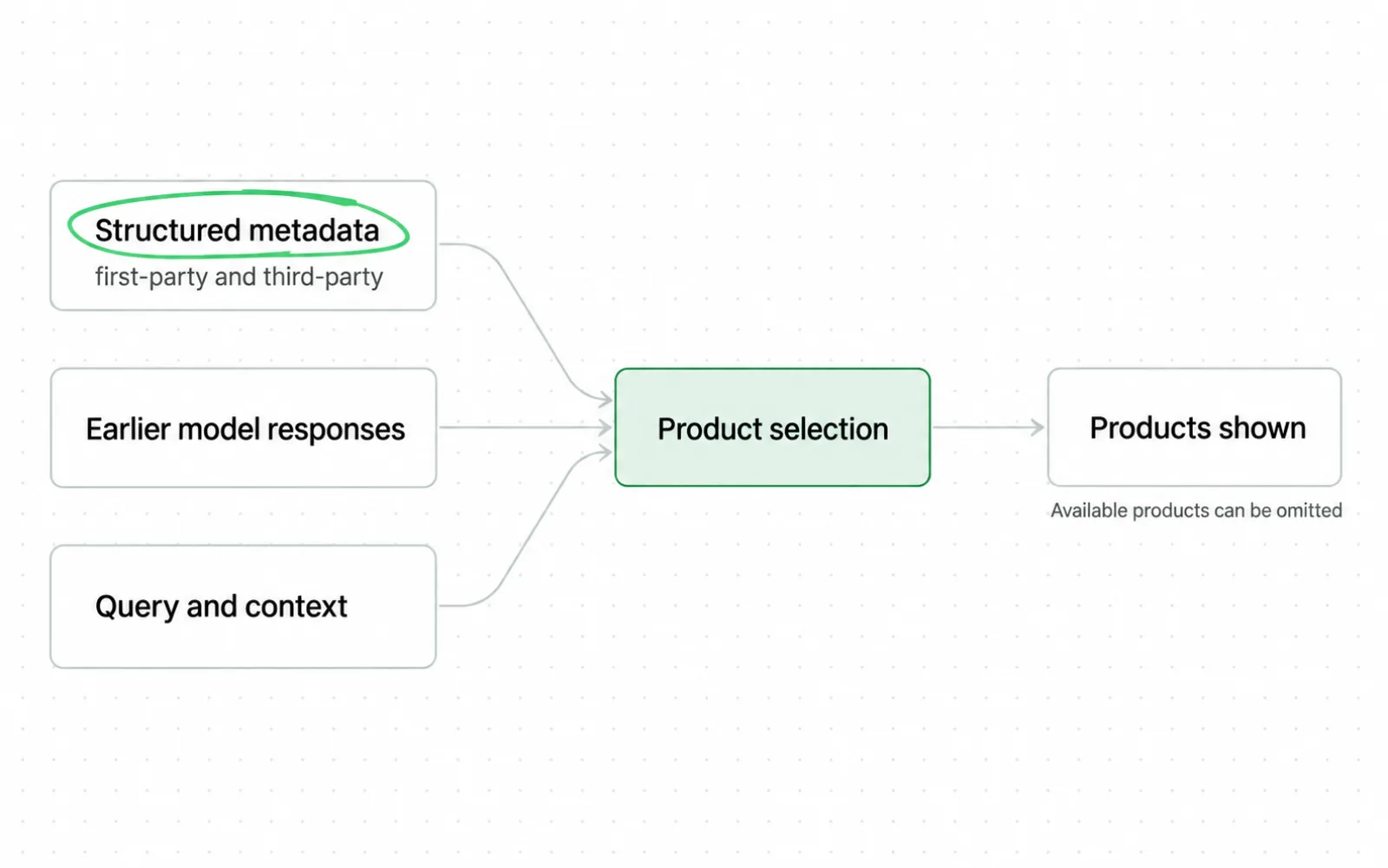
- Structured metadata from first-party and third-party providers can contribute to selection.
- Earlier model responses can contribute before ChatGPT considers new search results.
- The query and context shape the result. OpenAI also tells shoppers that available products may still be omitted.
OpenAI says ChatGPT Ads are separate from organic shopping results.
A product result can lead to your site or app for checkout. Instant Checkout appears only for eligible merchants and selected products.
Forrester's March 2026 analysis found that people use agentic commerce for product research more often than checkout.
Our guide to what AI visibility is explains how to separate product mentions from citations in your reporting.
OpenAI tells shoppers that prices and stock can be wrong, so the price on your product page is the one that counts.
How does ChatGPT choose products?
ChatGPT matches a shopper's request against product data it can read. Your platform decides whether that data comes from a feed or public product pages.
Shopify and Etsy already send catalog data to ChatGPT. Direct feed access is limited to approved partners.
For example, an eligible Shopify store can be active in ChatGPT without uploading a separate OpenAI file. If you run a custom commerce platform, you cannot count on that route being open to you.
| Merchant route | Current state | What to do next |
|---|---|---|
| Eligible Shopify store | Catalog integration is on by default | Open Agentic Storefronts and confirm your store is eligible |
| Etsy seller | The Etsy catalog is already integrated | Keep the listing facts current. Check stock, price and destination |
| Approved direct-feed partner | File upload and API updates are available | Validate Stable fields and send updates as they happen |
| Other merchant | You can apply while onboarding remains limited | Prepare the feed and preserve public product access |
The selection path has four separate decisions
- 1 Intent Does the conversation call for product options?
- 2 Product Which items fit the shopper's stated need?
- 3 Merchant Which eligible seller should appear for that item?
- 4 Destination Where does the shopper verify details and complete checkout?
Shopify says the channel is switched on by default for eligible US stores. You manage it in Agentic Storefronts, and you can turn it off.
To qualify, you must sell in the United States. Meet Shopify Catalog requirements and accept the channel terms.
For direct feeds, OpenAI accepts a full file each day. Inventory or price updates can use an API.
You can send promotions through the API, but not in the daily file.
OpenAI supports Stable fields today. Do not use Draft fields in a live feed.
Reviews and ChatGPT's previous answers affect which product it picks. Stock and price affect which merchant gets the link.
OpenAI also considers product quality and whether the seller made the product or is its primary seller.
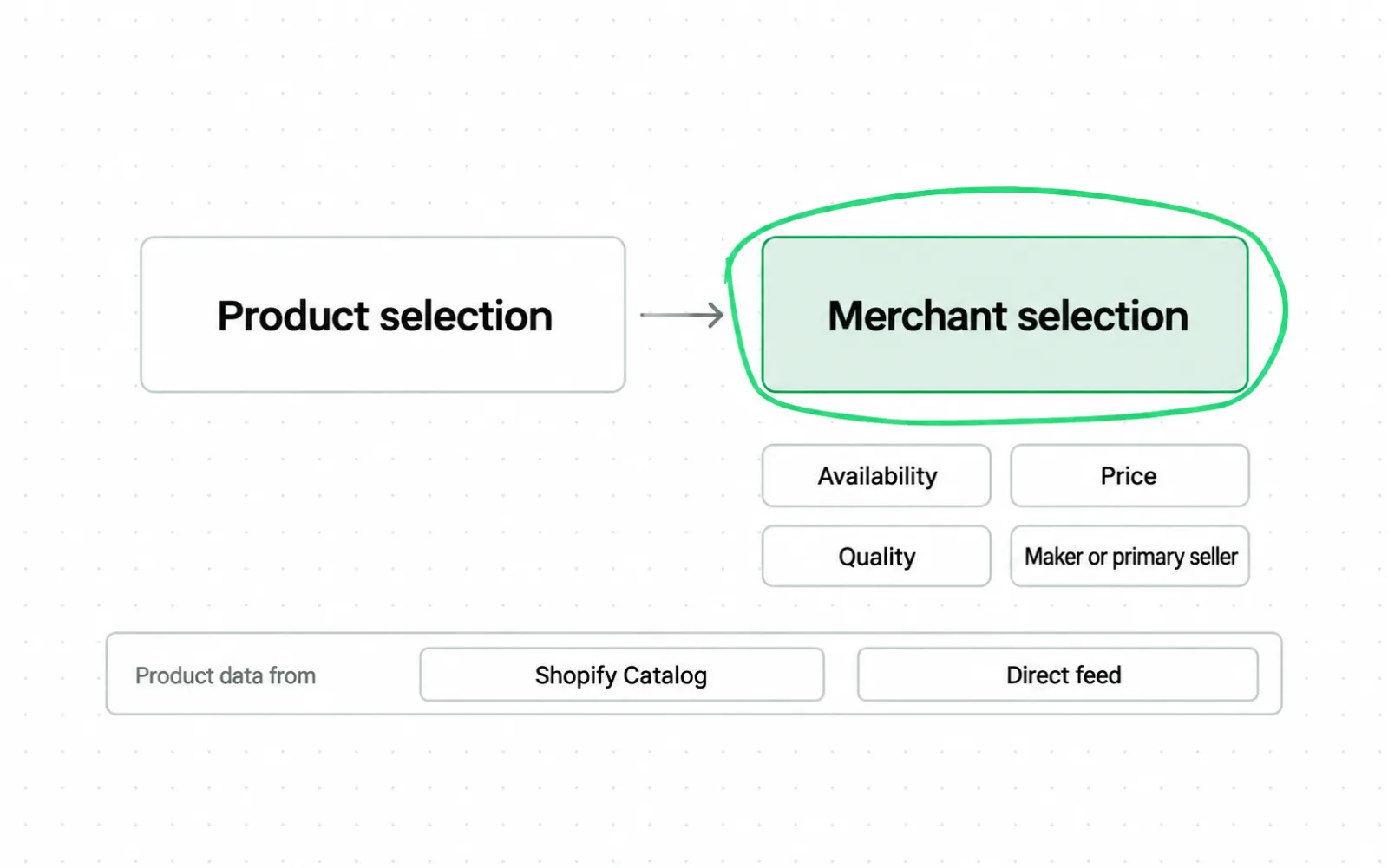
- Merchant and product metadata can come from third-party providers or merchants.
- Availability, price, quality and the maker or primary seller relationship can affect merchant ranking.
- Shopify Catalog supplies integrated product data. Merchants can also apply for direct feed access.
Say two stores carry the same shoe. ChatGPT can choose that shoe and still send the shopper to your competitor.
Our ChatGPT shopping vs Google Shopping comparison shows how to check the same product on both on the same day.
A Semrush experiment dated 20 January 2026 ran 100 shopping prompts five times each. The top ChatGPT product also appeared in the first three Google Shopping results in 75% of those prompt runs.
If price or stock differs between ChatGPT and Google Shopping, inspect both product records and the landing page before you update either feed.
OpenAI also documents OAI-SearchBot as the crawler used for search features. If you block it, your pages won't appear in ChatGPT search answers except for possible navigational links.
OpenAI says a robots.txt change takes around 24 hours to reach its systems. An llms.txt file gives crawlers optional guidance. Add it only after OAI-SearchBot can reach the page.
Prepare your products for ChatGPT shopping
OAI-SearchBot access and feed preparation can start before approval. Build every required field now, then submit the feed only after your commerce admin shows a live route or OpenAI approves it.
-
1. Identify your live route
Open your commerce admin and record whether ChatGPT discovery is active or unavailable. Outside Shopify or Etsy, submit the merchant form and keep its response.
-
2. Give every product a permanent ID
Do not reuse an ID for a different item after a catalog change.
-
3. Match every variant
Write a variant-specific title and URL. Add its own description and image. Set availability and price for that variant. A blue medium shirt should not inherit another variant's image or stock.
-
4. Check the landing page against your feed
Open the landing page as a shopper. Compare the submitted price, currency and availability with the landing page. Check the seller, shipping promise and return policy too.
-
5. Preserve crawl access
Review
robots.txtfor OAI-SearchBot and verify that product pages render without a login wall. Keep any deliberate opt-out documented. -
6. Add attribution parameters
Give the product URL a consistent campaign source and medium. Preserve those parameters through redirects and checkout.
-
7. Test representative prompts
Run category prompts, then test constraints such as size and price. Add brand comparisons. For each prompt, note whether the product appeared and which merchant was linked. Record the rank and destination in one row with the shown price and answer date.
Copy the nine fields in the example into every product record before you submit it.
One sellable variant per stable record
- `item_id` stays attached to this black variant across updates.
- The title identifies the black variant. Its image shows that variant. Availability applies to it. So do the URL and price.
- The URL carries attribution without changing the canonical product destination.
For example, do not send one parent URL for every shoe size when that URL does not open the size the shopper chose. The shopper must land on the exact variant you submitted.
Your feed URL can carry attribution parameters such as utm_medium=feed. Set the source and medium before traffic arrives.
Choose our ChatGPT product feed service when your team cannot keep variant records current.
Search Engine Land reports that Tom Wells's March 2026 analysis covered more than 43,000 products and found 83% of ChatGPT-cited products within the first 40 Google Shopping results.
Tom Wells's analysis found an 11% overlap between ChatGPT-cited products and Bing results. Compare your records with Google Shopping instead of Bing. Give Google Shopping the same record you send to ChatGPT, including each variant's price, stock level and URL.
What does ChatGPT shopping cost?
Keep the cost of updating stock data separate from checkout costs. Put paid media in a third budget so you can still see what running the feed costs.
OpenAI says product feeds are free. Merchants don't pay OpenAI fees on purchases that begin in ChatGPT and finish on their own site or app.
Shopify says ChatGPT discovery adds no channel fee beyond standard payment processing fees.
| Layer | What the platform charges now | Cost you still own |
|---|---|---|
| Organic product discovery | No payment for ranking or organic placement | Catalog; content; validation; monitoring |
| OpenAI product feed | No fee to send a feed once you are approved | Integration; updates; quality control; incident response |
| Merchant-owned checkout | No OpenAI fee on the purchase | Payment processing; platform fees; fulfillment; returns |
| ads inside ChatGPT | Paid media with its own eligibility rules and buying process | Media; creative; feed; landing page; measurement |
Assign every line to a budget before comparing costs in ChatGPT or Google Shopping. In Google Shopping, keep media spend separate from free listings.
Work out what stale stock and wrong variant prices cost you. Add the cost of redirects that strip your tracking parameters.
Avoid these ChatGPT shopping mistakes
A dropped tracking parameter can make healthy shopping traffic look broken. Check the merchant route before you change anything. Then inspect the catalog record and product page behind the bad result.
Instant Checkout launched in September 2025, but it is no longer the default. Stripe's documentation of that launch shows checkout happening inside ChatGPT.
TechCrunch and Axios reported the March 2026 shift toward checkout on a merchant's site or app.
Use the merchant-owned checkout path unless your live account shows Instant Checkout.
Our guide to how to run ads on ChatGPT covers paid setup. Keep organic product discovery in another checklist.
When running ads on ChatGPT, use campaign parameters that keep paid visits out of organic reports.
Direct feed uploads are not open to every merchant. OpenAI currently limits direct onboarding to approved partners, so an unapproved merchant should prepare the feed and apply. Until approval arrives, do not mark the feed as submitted in your internal report.
Keep each variant separate. Say your size 8 boot is in stock at $120, but your generic record lands on an out-of-stock size 10 at $135.
If you block the crawler for privacy, record which product pages lose visibility.
| Symptom | Likely mistake | Control to inspect |
|---|---|---|
| Product never appears | No live route; blocked crawler; weak product match | Eligibility; OAI-SearchBot; representative prompts |
| Wrong price or stock | Stale update or page-feed mismatch | Variant record; update time; landing page |
| Wrong seller link | You treated product choice and merchant choice as one decision | Availability; price; quality; seller relationship |
| Traffic appears as direct | Attribution parameter was lost or referrer was unavailable | Landing URL; redirects; source; medium |
| Organic report rises after ads launch | Paid and organic activity were blended | Campaign parameters and channel definitions |
One run can show a product for "lightweight waterproof hiking jacket". Another can omit it for "best raincoat". Test the same prompt set every week and compare the runs.
A Marketing Science study published 21 April 2026 covered 973 ecommerce sites and more than 50,000 ChatGPT-referral transactions from August 2024 through July 2025. The study found that last-click attribution missed earlier visits influenced by ChatGPT.
For every assisted sale you count, record the earlier visits that led to it and the date of each one.
Measure ChatGPT shopping visibility and revenue
Use the AI visibility definition to build one weekly record of where your products appear in shopping answers. A second record tracks what shoppers do after they reach your store.
Two records and four layers of evidence
| Question | Primary record | |
|---|---|---|
| Appearance | Did the product appear for the tracked prompt? | Prompt; date; location; answer; product; merchant |
| Click | Did the shopper reach the intended page? | Landing URL; source; medium; session |
| Order | Did that visit create an order? | Order ID; revenue; product; channel rule |
| Contribution | Was the order valuable after variable cost? | Margin; returns; discounts; fulfillment |
| Evidence layer | Minimum field | What it cannot tell you |
|---|---|---|
| Prompt record | Exact prompt; date; product; merchant | An answer can vary on the next run |
| Landing session | URL; source; medium; campaign | A missing referrer can hide the origin |
| Order record | Order ID; product; revenue; channel rule | Last click can miss earlier influence |
| Contribution view | Margin; returns; fulfillment cost | It leaves out sales you cannot trace to a touchpoint |
Start the visibility scoreboard with category prompts and product constraints. Add brand comparisons in the words a buyer would type.
For example, a luggage brand might track "carry-on suitcase for European trains." It might add "light hard-shell cabin bag" and a named competitor comparison. Record the exact answer date because the result can change.
Ahrefs groups prompts and mentions with citations, impressions and share of voice in its AI visibility report.
Choose our ChatGPT visibility service when your team cannot run the same prompt set every week.
If you build this in-house, count either a product link or brand name as an appearance. Write down your choice and keep it fixed.
Use the same brand names and prompt groups every week. If you change the prompts, you cannot separate a real shift from a change in your test.
Add the same UTM parameters to every feed URL you can edit, then check in Google Analytics that they survive your redirects.
Google Analytics reports source and medium in Traffic acquisition. By default it files any traffic with the medium ai-assistant into the AI Assistants channel.
For example, write chatgpt.com as the source. Choose ai-assistant or feed as the medium and map that pair to one channel.
Do not depend on referrer alone. In September 2026, Aimerce found that referrer-only detection caught 18.2% of ChatGPT pageviews across more than 1,000 Shopify stores.
Aimerce also found that 73% of the ChatGPT-attributed orders it tracked arrived with no referring site and could only be identified from the landing URL. If you use Shopify, identify AI visits from landing URLs as well as referrers.
Use Shopify Agentic Storefronts to check sales and orders by AI channel. Compare those totals with the channel's sessions and conversion rate.
Shopify says that analytics view isn't yet available for headless stores. If you run headless commerce, you have to stitch the events and orders together yourself.
A Semrush study published 5 March 2026 surveyed more than 1,000 US consumers. After an AI product mention, 40% searched Google and 36% compared options.
In that Semrush survey, 34% asked the AI a follow-up question and 28% visited the brand website.
Only revenue you can trace to a session belongs in the headline total. Give follow-up questions and comparison visits their own column.
Report AI Overviews on their own line. One shopper can see both AI Overviews and a ChatGPT shopping answer.
If you're comparing Google AI Overviews with shopping answers, use the same prompt, date and market for both.
Start the weekly review with the live route and catalog sync. Follow each appearance into its session and order, then calculate margin and list unexplained gaps.
Route a stale price to whoever owns the catalog, and a lost UTM to whoever owns the redirects.
For each pair, record the price shown and the page it linked to. Keep traffic source with the session and resulting order in the same record.
ChatGPT shopping questions from merchants
Where the order finishes depends on the merchant's account. Whether a Shopify store gets the channel depends on its eligibility. Either way, check price and stock on the product page before purchase.
Sources
- OpenAI Developers Get started with product feeds
- OpenAI Developers Product Feed Spec
- OpenAI Powering product discovery in ChatGPT
- OpenAI Merchants in ChatGPT This page carries no publication date of its own.
- OpenAI Help Center Shopping with ChatGPT Search
- OpenAI Help Center Using shopping research in ChatGPT
- OpenAI Developers Product feed best practices
- OpenAI Developers OpenAI crawlers
- Shopify Help Center Selling on ChatGPT
- Shopify Help Center Managing agentic storefronts
- Shopify AI Search Insights
- Semrush Does ChatGPT Search Google Shopping?
- Semrush AI Tools and the Modern Buyer Journey Study
- Search Engine Land AI shopping optimization needs both product feeds and pages
- Marketing Science Generative AI Referral Traffic and Ecommerce Outcomes
- Ahrefs Track AI visibility
- Forrester What It Means That The Leader In Agentic Commerce Just Pulled Back
- Aimerce The State of AI Commerce
- Google Analytics Help Traffic acquisition report
- Google Analytics Help Default channel group
- Digital Commerce 360 Shopify integration with ChatGPT changes
- Stripe OpenAI and Stripe launch Instant Checkout
- TechCrunch OpenAI shifts ChatGPT shopping strategy
- Axios OpenAI changes its shopping checkout strategy
Questions people ask
Can I buy something through ChatGPT?
Some eligible products show Instant Checkout inside ChatGPT. Otherwise, you finish the purchase on the merchant's site or app after viewing products and comparisons.
Can ChatGPT integrate with Shopify?
Yes. Shopify and OpenAI have integrated the Shopify Catalog into ChatGPT product discovery. Eligible US stores can manage the channel through Agentic Storefronts.
Is there a ChatGPT for shopping?
Shopping appears inside normal ChatGPT conversations when your request has shopping intent. It can produce buyer guides, comparisons and product links.
Is ChatGPT more trustworthy than Google?
Neither one is more trustworthy across the board. ChatGPT matches products to the request, while Google uses its own merchant system. OpenAI warns that price and stock can be wrong. Verify the seller and checkout terms.