

ChatGPT Ads self-serve: 52 countries and how access changed
OpenAI's Ads Manager availability page lists 52 countries with self-service marked available, and it separates two things that usually get merged: creating an account and getting access. You can sign up anywhere. Whether you can then run a campaign depends on the country on your account.
The advice on this is not wrong so much as undated.
Invite-only access, an application and a wait were accurate in April, when the beta opened to a limited set of US advertisers behind a fifty thousand dollar minimum. Self-serve sign-up replaced that on 5 May and the minimum is gone. Two more claims still in circulation carry the same problem, each with the date it changed.
| Still written today | What OpenAI says now | When it changed |
|---|---|---|
| Access is invite only, you apply and wait | 52 countries marked available for self-service sign-up | Self-serve opened 5 May 2026, EU and India added late August |
| The crawler docs do not say how OAI-AdsBot treats robots.txt | OpenAI crawlers respect these rules, with a published IP list at adsbot.json | Between April and September 2026 |
| Set a manual CPC bid, three to five dollars | Automated bidding is now the default choice on a new ad group | August 2026 |
When you submit an ad, OpenAI may visit the landing page to ensure it complies with our policies. We may also use content from the landing page to determine when it’s most relevant to show the ad to users.
developers.openai.com, overview of OpenAI crawlers read 10 September 2026
- Landing page content is used to decide when the ad is most relevant. The page is not only checked, it is read, and what it says feeds delivery.
- The full user-agent string and a published IP list are both here, which is what turns an allow rule into something a developer can write.
- Its data is not used to train the foundation models. Allowing this one is a narrower decision than allowing the training crawler.
On a platform moving this fast, an undated claim decays into a wrong one inside a quarter.
What has not changed is the mechanism. How the auction picks an ad, what the four crawlers do, and why the return has no published figure are taken apart in ads inside ChatGPT. What follows starts at the sign-up screen.
Targeting without a keyword list
Before the build order makes sense, one thing about the targeting has to land, because it changes what the whole setup is for. A ChatGPT ad group has no keyword list. It has context hints, which are sentences describing the situations where your product helps.
OpenAI's own example is the clearest thing on the subject. Instead of a broad hint like running shoes, it recommends cushioned everyday running shoes for beginners training for their first 5K. The instruction is to describe a person in a moment, not a product in a category.
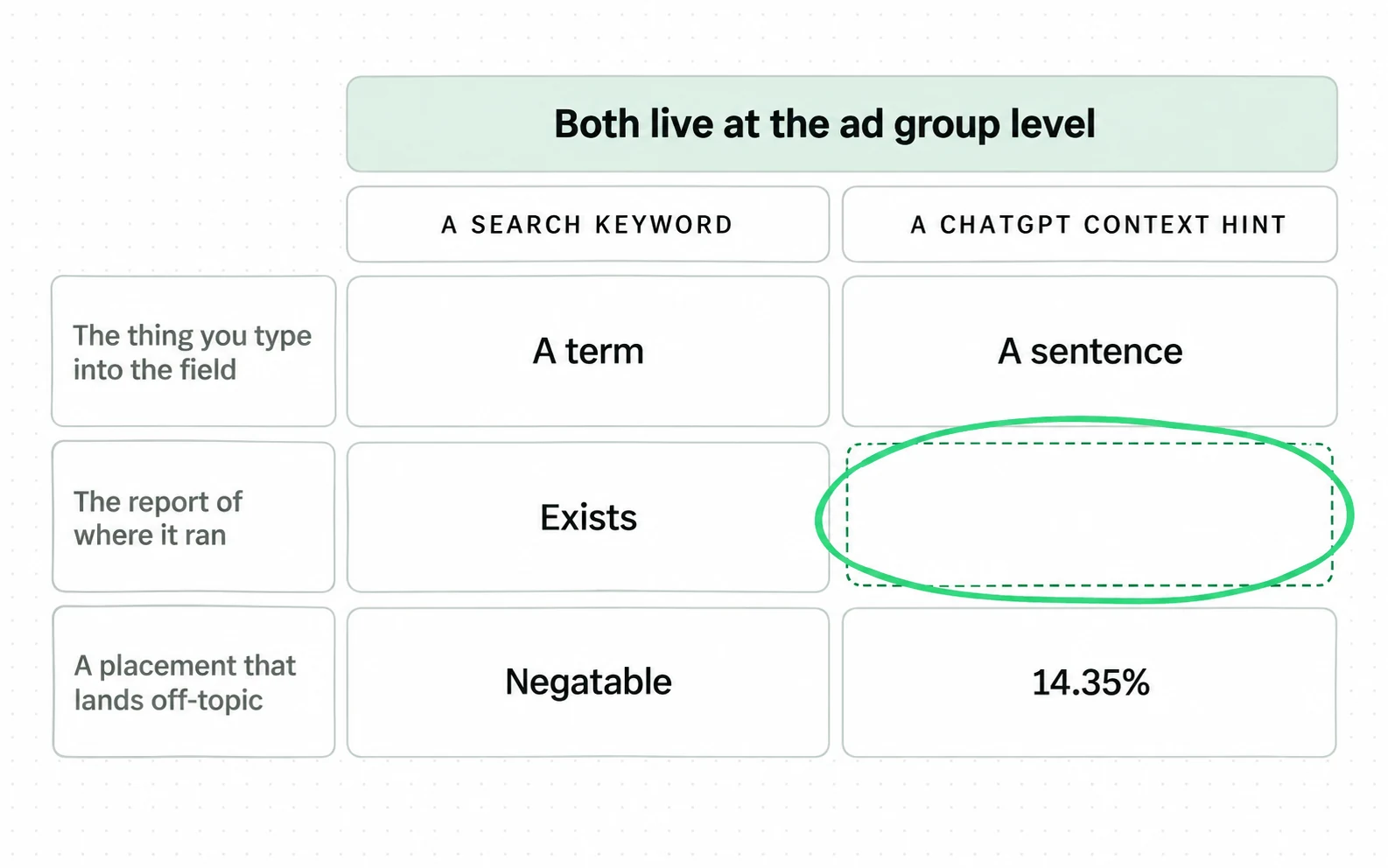
Then OpenAI writes the sentence that decides how to treat the field. Context hints are not exact-match controls, audience targeting rules, or instructions to show your ad only for specific conversations. They do not guarantee your ad will appear for particular words, topics, audiences or situations.
That is a limit on what a hint promises, not a statement that hints do nothing. How wide a hint reaches is something you can only read from your own delivery.
What the mismatch rate looks like
The consequence is measurable, and somebody has measured it. SE Ranking ran 50,006 commercially oriented prompts across 20 US niches on 23 July 2026 and found an ad on 12,974 of them, or 25.94 percent. Of the placements it collected, 14.35 percent were semantically unrelated to the conversation they appeared beside. The spread by category is wider than the average suggests: 2.6 percent in Pets, 54.2 percent in News and Politics.
A mismatch rate on its own would be survivable. The same study found no search terms report on the platform, so you never see which prompts triggered the ad.
An agency that publishes what it spends reported a run in which a keyword style list of terms outperformed the conversational phrasing OpenAI recommends. One test at one advertiser settles nothing. Treat the hint as something to test, not something to get right first time. That is awkward advice on a platform that will not tell you what happened.
Which is why the analogy people reach for breaks in one specific place.
The analogy is that this works like the Google Ads auction with sentences instead of terms. The auction half holds. The feedback loop does not carry over, and on a search account that loop is where most of the week goes. You read the report of the words people typed, then cut and add.
Why the ad is not the answer
SE Ranking also found that only 3.63 percent of advertisers were cited as a source in the answer their ad appeared beside, against 11.53 percent in Google AI Mode. What that measures is how rarely the two coincide on this platform, so an advertiser who is in the ad slot should not read that as being in the answer. Whether either position is worth more than the other is not something this study tests.
Ten steps to run ads on ChatGPT
Appearing in an answer and appearing in the ad slot are two different outcomes, and only the second is something you buy. Buying it starts with an ad group that stays out of reach until the account is finished. The setup is short but strictly ordered, and two gates look like formalities. Delivery does not start until both are done, and nothing is rejected when they are not.
The field names below are OpenAI’s own, so they match what you will see on the screen.
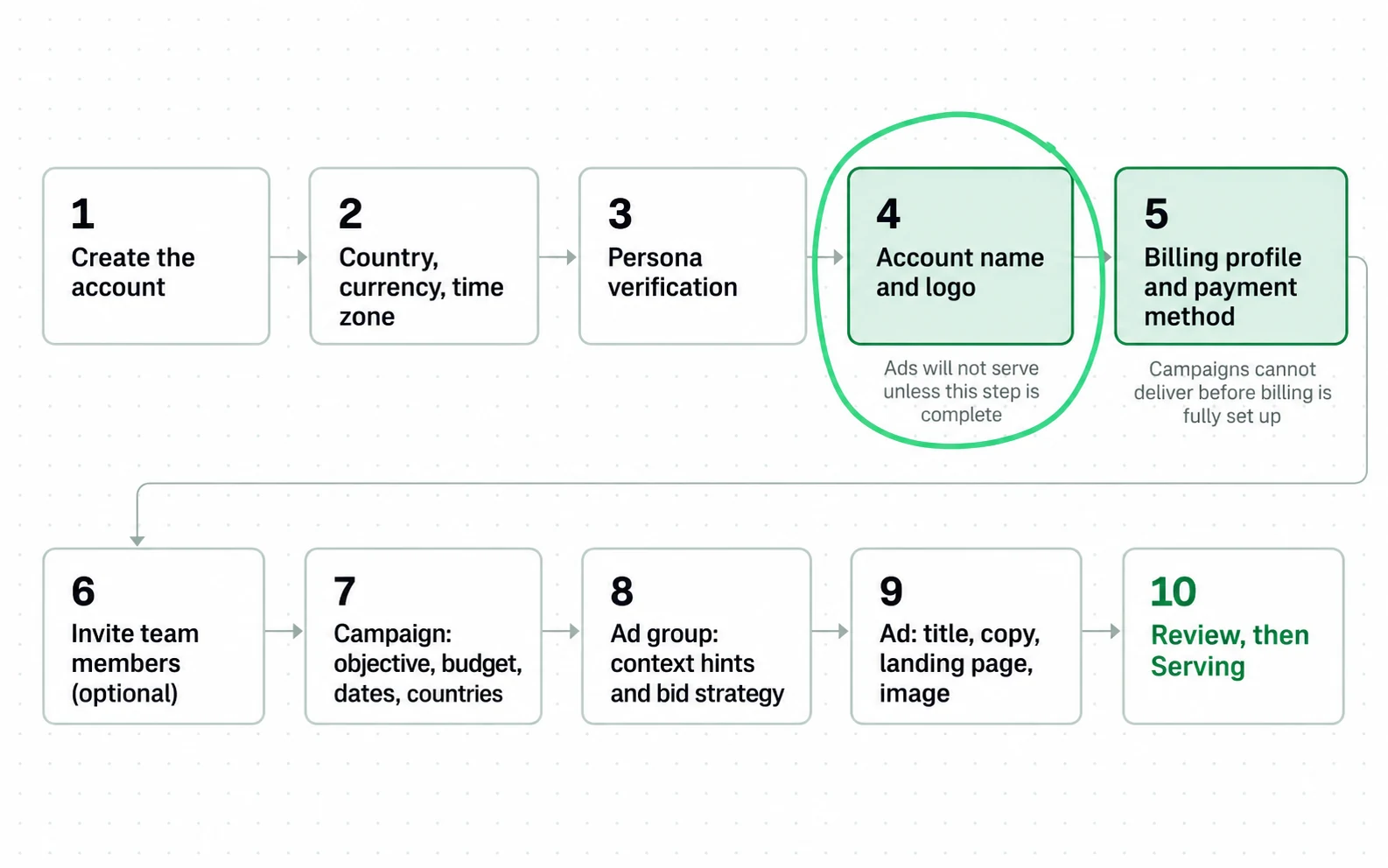
Two of these gates stop delivery without rejecting anything.
Two sentences in that flow carry more weight than their placement suggests. Account setup says ads will not serve unless the account name and logo step is complete, and it says campaigns will not deliver until all required steps are done. Neither sentence describes a rejection, only that nothing serves. There is no documented status for that state, so check both steps against the list, not against the screen.
Three settings you cannot take back
Most of an ad account is editable. Three things are not, and all three are set on screens that read like paperwork.
| Setting | Can it be changed | What OpenAI says |
|---|---|---|
| Country, currency, time zone | No | Cannot be changed later. A wrong entry means creating a new advertiser account |
| Campaign objective | Not in place | Create a new campaign with the objective you want instead of editing an existing one |
| Budget type | One way only | A campaign-total budget can be switched to a daily budget, and cannot be switched back |
| Budget amount, dates, targeting, bids, creative | Yes | Adjustable over time as you learn what performs |
The currency lock has a second effect: the budget floor is quoted per currency, so a wrong country fixes the smallest test you are allowed to run.
How to build the campaign and the ad
Once the account is live the structure is conventional. A campaign carries the objective, budget, dates and countries. Inside the United States it narrows further, to state, DMA (a US metro market area) or ZIP code. An ad group carries the context hints and the bid strategy, and the ad carries the creative. You can build it in the interface or upload the bulk CSV schema, and the schema is where the naming trouble starts.
One field, three names. Create Campaigns calls the objectives CPM (paying per thousand impressions), CPC (paying per click) and oCPC (a click bid optimised toward conversions). The Basics calls them the Reach objective and the Clicks objective. The bulk upload schema in Launch Campaigns asks for Views or Clicks, then describes the bid as a maximum CPM bid for Reach campaigns. Three pages, three labels, one field. The rule that resolves it: take the wording from the page documenting the exact step you are filling in, because that is the page the field was written against.
The ad itself has six parts. Each limit is a recommendation with a hard ceiling behind it, not a single number.
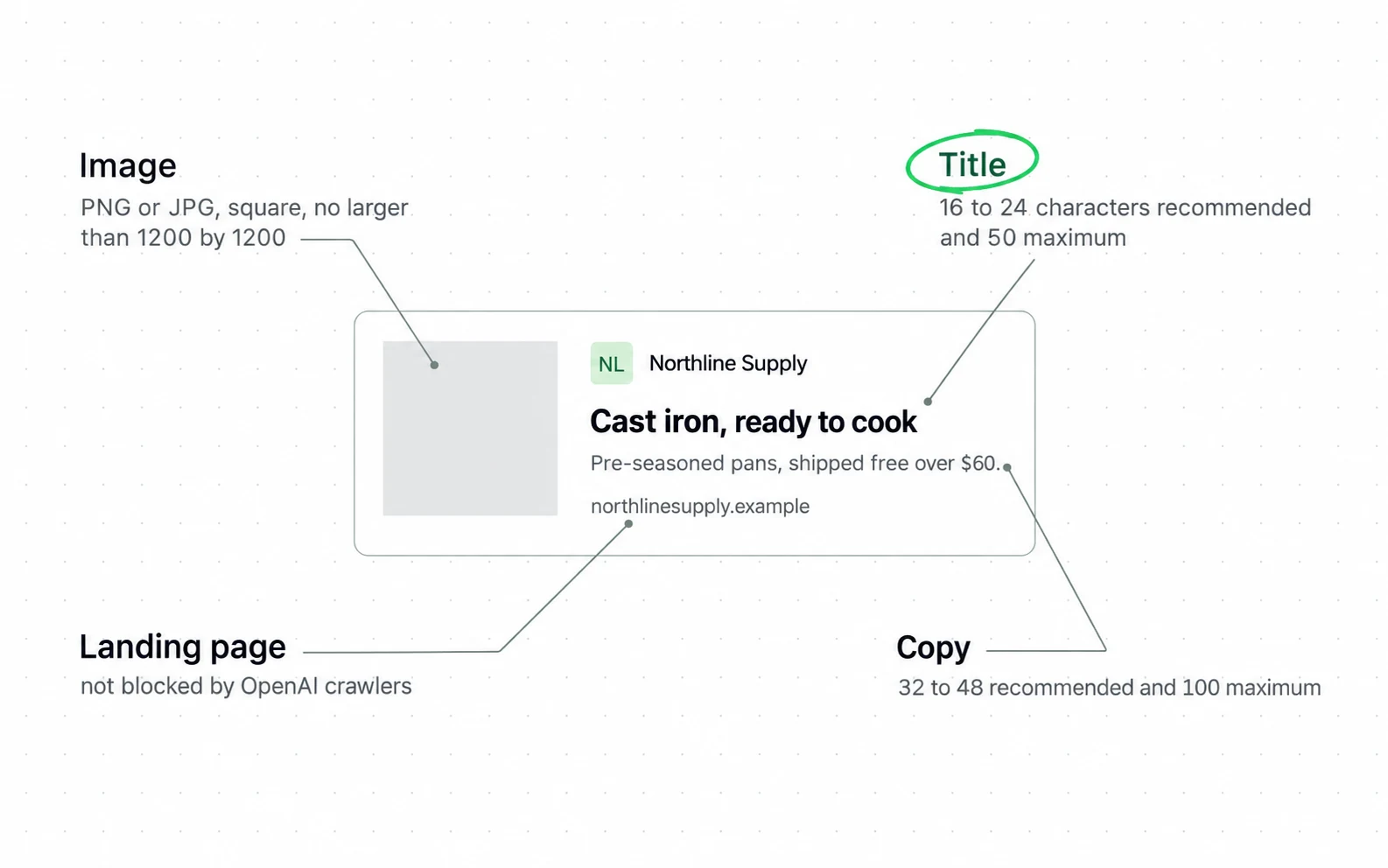
Title runs 16 to 24 characters recommended and 50 maximum. Copy runs 32 to 48 recommended and 100 maximum. The image is PNG or JPG, square, no larger than 1200 by 1200. You do not upload it; it has to be publicly reachable at its own URL. The landing page has to be valid, reachable and not blocked by OpenAI crawlers, which is one of the documented reasons a finished ad never serves.
A retail catalogue has a second route. Under Tools then Feeds you can upload a product feed by CSV, hosted URL or SFTP and build a campaign from it. Two things matter before you pick the method. Items expire after two weeks, so a one-off CSV quietly empties itself. And during the beta, feed products are eligible for ads only, not for organic conversations. If you already run Google Shopping ads, treat this as a second catalogue with its own clock, not an export of the first. ChatGPT shopping vs Google Shopping sets the two surfaces beside each other.
Daily budget as a weekly ceiling
With the build understood, the budget question changes shape. The published minimum is not a single figure, and the word daily does not mean what it means on other platforms. Both facts sit in the same help page, one paragraph apart.
OpenAI publishes a minimum campaign spend table with a separate figure for each billing currency.
| Billing currency | Minimum daily budget |
|---|---|
| United States | 25 USD |
| United Kingdom | 15 GBP |
| Europe | 15 EUR |
| India | 725 INR |
| Japan | 2,500 JPY |
| Australia, Canada, New Zealand | 25 AUD, 25 CAD, 25 NZD |
| Brazil | 40 BRL |
| Mexico | 150 MXN |
| South Korea | 25,000 KRW |
| Switzerland | 20 CHF |
OpenAI’s table puts the India minimum at 725 rupees, roughly eight dollars. The currency you are quoted in is the one the account was opened with, so the floor is decided by a field you set once at sign-up and cannot revisit.
Then the pacing rule, which is where daily stops being daily. A daily budget is an average over a seven day period. Spend on a single day will not exceed twice the amount you set, and spend across the seven days will not exceed seven times it. Underspend earlier in the window can be used later in the same window.

Both are ceilings, not forecasts: OpenAI’s wording is that spend will not exceed them, not that the budget will be spent. The seven-day figure is the one people do not expect.
What you bid on ChatGPT
The number you will see repeated is a manual three to five dollars per click, which entered circulation when CPC bidding arrived in April. That number is still documented and it is no longer the default path. Maximize results became the preselected choice on eligible new ad groups in August. OpenAI is direct about what you get from it: result volume, and no guarantee of delivery against a specific CPA (cost per acquisition), CPC, ROAS (revenue divided by ad spend) or other cost-efficiency target at this time. Manual max bid stays available, and it remains the only documented way to put a ceiling on a click.
Field reports disagree. One buyer reported a client seeing 50 percent more clicks, 108 percent higher click-through rate and 19 percent lower cost per click on the first day of switching. A Canadian agency running three campaigns in June, before the strategy existed, spent 415 dollars for 9,000 impressions and 60 clicks at about seven dollars each, none of which converted. One is a single day at one advertiser, the other a single month at another, and the platform publishes no benchmark to place either against.
So there is nothing to hold a target cost per click against. The platform publishes no benchmark, and the two field reports point in opposite directions from samples of one day and one month. Your own history is what fills that, because the only numbers describing this channel for your account are the ones your account produces. If you would rather the setup and the reading were handled for you, that is what our ChatGPT Ads management covers.
What stops a ChatGPT ad outside Ads Manager?
The campaign can be correct in every field and still never serve, because the last gate is on your own infrastructure. OpenAI reviews the landing page before the ad runs, and the review is done by a crawler that four separate layers of a normal stack are configured to block.
OpenAI is unusually direct about this one. You must allow OAI-AdsBot. Allowing OAI-SearchBot as well is recommended.
The lines that clear the first layer, and only the first
robots.txt, the two blocks OpenAI asks for
1User-agent: OAI-AdsBot
2Allow: /
2User-agent: OAI-SearchBot
2Allow: /
- 1Required. Without it the landing page cannot be validated and the ad cannot be approved, whatever else is correct.
- 2Recommended, not required, and it governs whether you appear in ChatGPT search, which is a different question from whether your ad runs.
Those two lines close one layer of four. The other three fail somewhere the marketing team does not own, which is why they are the ones that go unexplained inside the account.
| Layer | How it blocks the crawler | Where it is fixed |
|---|---|---|
| robots.txt | Disallow stops the crawl immediately. OpenAI states its crawlers respect these rules | Your own file, two blocks |
| WAF or CDN (the security or delivery layer in front of the site) | Bot mitigation returns 403 Forbidden because crawler traffic resembles automated traffic | Allowlist by user agent. OAI-AdsBot is verified and allowlisted by Cloudflare |
| Human verification | CAPTCHAs, JavaScript challenges, behavioural checks and session validation block automated access | Exempt the crawler user agents in the application layer |
| Rate limiting | 429 Too Many Requests, often triggered by a large batch upload all at once | Upload in smaller batches, review throttling rules |
App store links, deep links, documents and destinations that need a login, an app or region-specific access may not give the crawler enough to validate. A directly reachable web page is the safe answer. That puts the landing page back where it always was: it has to work for a stranger arriving cold, which is a conversion rate optimization problem before it is a media one.
One file does not belong on this list: llms.txt. That file is a proposal, and OpenAI does not check it before approving an ad.
The OAI-SearchBot line governs whether you appear in ChatGPT search. That is a visibility question, not an advertising one, and AI search engine optimization takes it apart.
Checks that catch the rest
-
Confirm the account name and logo are saved
They appear in the ad unit, and ads will not serve until the step is complete. Nothing about the campaign will tell you this is missing.
-
Confirm verification and billing both finished
Verification and account review are separate steps, and completing an identity flow does not mean the account is ready to run.
-
Check the campaign dates include today
A campaign will not serve after its end date, and a future start date produces the same silence.
-
Check the budget has not already been reached
Ads stop when the campaign budget limit is hit, which on a seven day pacing window can arrive early.
-
Fetch your own landing page as the crawler would
A successful HTTP response, robots.txt allowing the path, and no WAF, CAPTCHA, JavaScript challenge, authentication or geo rule in the way.
Policy is the last gate. OpenAI restricts categories during the test period, handles finance, health and legal case by case, and requires the experience to be consistent end to end.
Six reasons ChatGPT ad numbers differ from your analytics
Clear the policy gate and something finally serves. The first surprise after that is usually not the cost. It is that two dashboards describing the same campaign do not agree, and the gap between them is wide enough that advertisers have gone public about it.
A B2B agency reported 57 clicks in Ads Manager against fewer than 20 sessions in Google Analytics from the same campaign, and said the numbers did not match reality. Ads Manager counted more than analytics ever saw, and in another campaign the clicks arrived while analytics showed nothing at all.
The two dashboards are not measuring the same event.
On the other side of the same question, OpenAI publishes six reasons its totals and a third-party tool will differ. Three of them decide how a sale gets credited.
The attribution window decides which click gets the credit and for how long after it. Event timestamps and time zones decide when the sale happened. Deduplication decides whether two records of one sale count once or twice.
The other three are about what each system can see at all: browser consent and storage, the campaign configuration, and modelled conversions, which are estimates filled in where a sale could not be observed directly. OpenAI closes the section by saying a difference does not necessarily mean you have an error.
The two are rarely set side by side, and the reason to read them together is not that the list explains those reports. It does not: the agency reports set ad clicks against analytics sessions, while OpenAI’s six reasons are about why conversion totals differ. What they share is narrower and more useful. Both say the figure in one dashboard is not the figure in the other, and neither platform publishes a reconciliation. So two things follow. Decide before launch which of the two numbers you steer by. Then walk any conversion gap through the six causes, because a misconfigured campaign and a broken pixel look, in the totals, exactly like a definitional difference.
Digiday reached the same limit from the buying side twice. It interviewed seven ad executives in May. They described delivery improving while their doubts about measurement did not. Its earlier reporting described advertisers unable to see what competitors were doing in the channel at all. Both point at the same limit. In this channel you can measure your own account and nothing around it, so build your benchmark from your own history.
The mechanism worth understanding is the click reference. OpenAI appends a parameter called oppref to the landing page URL, the pixel stores it in a first-party cookie, and later conversion events are matched back through it. Redirects that strip query parameters break that chain, so preserving oppref through every redirect is what keeps a conversion attachable to the click that caused it.
What the platform does not give you
| What you might expect | What is documented | What this means for a test |
|---|---|---|
| A search terms report | None. Advertisers cannot see which prompts or conversations triggered an ad | Off-topic delivery cannot be found or excluded after the fact |
| A stated attribution window | The applicable attribution window is referred to, with no length attached | You cannot align the platform window to your analytics window, because one of the two numbers is missing |
| View-through measurement | No documented view-through measurement | Impression-assisted effect is outside what the platform reports |
| A performance benchmark | OpenAI states it does not yet have benchmarks across advertisers, industries or campaign types | Your own before and after is the only comparison available |
The waits are documented even where the numbers are not, and reading them in advance is what keeps an ordinary wait from being read as a failure.
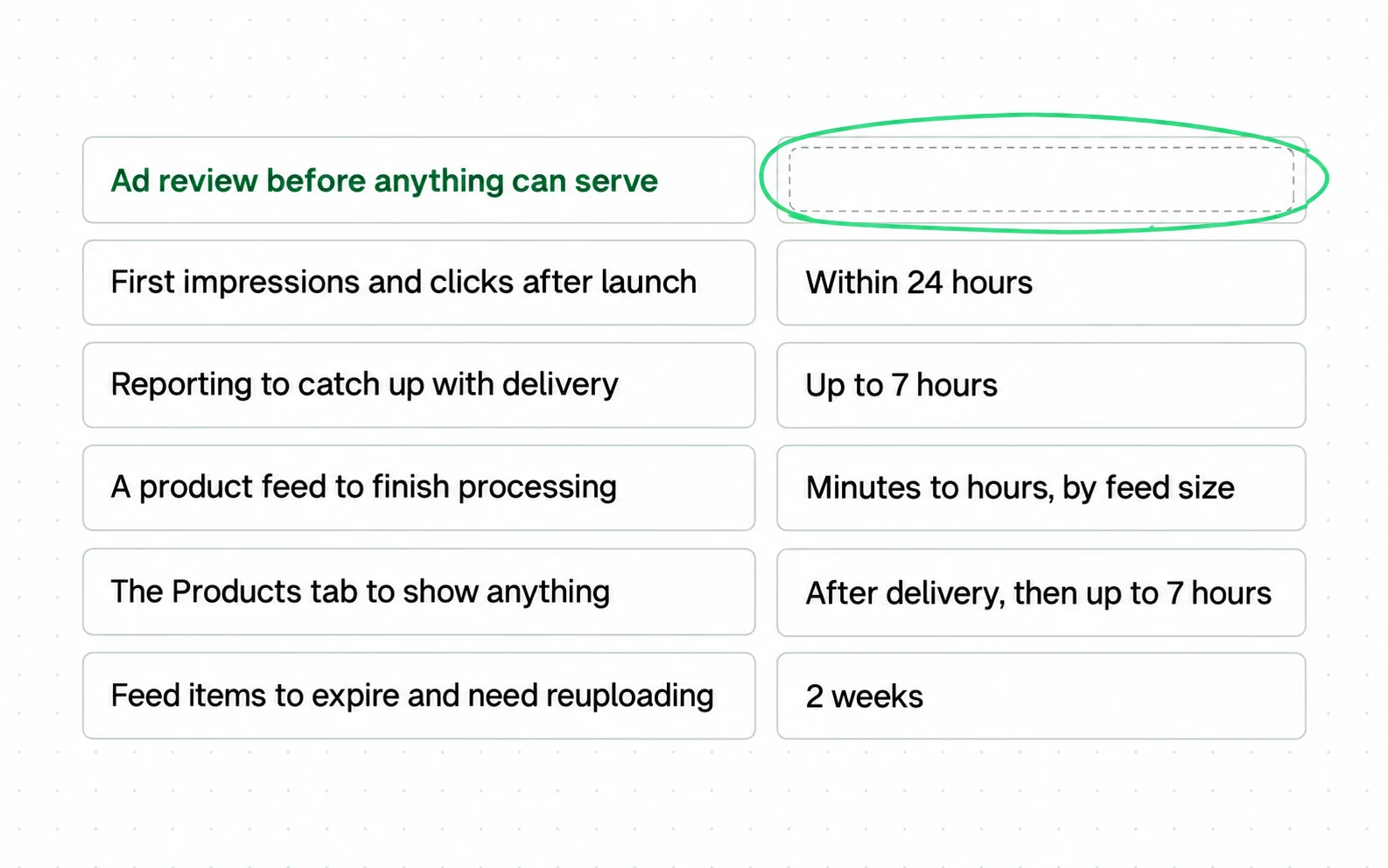
A campaign that looks dead at hour three has two documented explanations before it has a problem. Reporting can lag by up to seven hours. And the ad may still be in review, on no stated schedule.
These numbers are not comparable to a search channel line by line: the visitor arrived mid-conversation, not mid-search. What that means for the return is the argument in an ad inside ChatGPT. If you would rather the setup, the pixel and the reporting were run by someone else, that is ChatGPT advertising at Addition, a search marketing agency.
Open account setup before you name anything, and check the country, currency and time zone against the market you sell into. Those three cannot be edited afterwards, they set the currency your budget floor is quoted in, and fixing a wrong one means starting a second advertiser account from scratch.
Sources
- OpenAI Help Center Ads Manager Availability, country by country self-service table
- OpenAI Help Center Ads Manager Beta Account Setup
- OpenAI Help Center Create Campaigns for ChatGPT Ads, including the minimum campaign spend table
- OpenAI Help Center Create Ad Groups for ChatGPT Ads
- OpenAI Help Center Launch Campaigns, step by step build and bulk upload schema
- OpenAI Help Center Create Campaigns from Product Feeds
- OpenAI Help Center Advertiser Guidance for Allowing OpenAI Web Crawlers
- OpenAI Help Center Conversion Measurement
- OpenAI Help Center Maximize Results Bid Strategy
- OpenAI developer docs Overview of OpenAI Crawlers
- OpenAI New ways to buy ChatGPT ads, self-serve Ads Manager beta announcement
- OpenAI Advertising policies
- SE Ranking ChatGPT ads study, 50,006 commercial prompts across 20 US niches, collected 23 July 2026
- MediaPost ChatGPT serves ads in results on irrelevant topics, Laurie Sullivan
- TechTimes ChatGPT ads reach 1 billion, advertisers report clicks that analytics cannot find
- Search Engine Land How to run ChatGPT ads
- Search Engine Land Study: ChatGPT ads appear on 26% of commercial prompts
- eMarketer ChatGPT ads miss user intent over 14% of the time, study finds
- eMarketer ChatGPT ad revenues may fall 90% short of the 2030 target
- PPC Land ChatGPT Ads makes automated bidding the default in new ad groups
- PPC Land OpenAI opens ChatGPT Ads Manager to all US businesses
- PPC Land ChatGPT Ads Manager gets daily budgets, geo-targeting and dynamic CTAs
- Search Engine Journal OpenAI crawler docs now list OAI-AdsBot for ChatGPT Ads
- Search Engine Journal ChatGPT Ads now offer CPC bidding between $3 and $5
- StubGroup John Horn on running ChatGPT ads, agency spend
- Forbes OpenAI ChatGPT ads pass a one billion dollar annualised run rate
- directom ChatGPT ads guide describing access as invite only
- Digiday As ChatGPT ad delivery improves, the doubts it created are not easily fixed
- Adthena, via Digiday Adthena on advertisers flying blind in ChatGPT ads
Questions people ask
How to apply for ChatGPT ads?
If OpenAI lists your account country among its 52, there is no application. Ads Manager is self-serve there, and you sign up directly at ads.openai.com.
The waiting happens at identity verification instead, which is reviewed in a rolling queue after you enter your business details. If your country is not on the list you can still create an account and OpenAI will notify you when self-service opens there.
How to create ads using ChatGPT?
An ad is built inside Ads Manager, either through the guided flow or by uploading the bulk CSV schema. Each ad carries four things. A title of 16 to 24 characters recommended, 50 maximum. Copy of 32 to 48 recommended, 100 maximum. A landing page reachable by OpenAI crawlers. And a square PNG or JPG image no larger than 1200 by 1200 hosted at a public URL.
The advertiser name and logo shown on the ad come from your account settings, not the ad itself.
How much does it cost to advertise on ChatGPT?
A published minimum daily budget sets the entry cost, and it varies by billing currency. 25 USD in the United States, 15 GBP in the United Kingdom, 15 EUR in Europe, 725 INR in India, among twelve currencies listed.
A daily budget is paced across seven days, so a single day can bill up to twice the amount you set and a week up to seven times it. A 25 dollar daily budget sets a 175 dollar weekly ceiling. That is the most that can be billed, not a spend OpenAI guarantees to deliver.
Can you pay for ads on ChatGPT?
Yes. OpenAI supports CPM, CPC and conversion-optimised CPC buying, and a billing profile plus a payment method must both be set up before any campaign can deliver.
Since August 2026 an automated bid strategy called Maximize results is preselected for eligible new ad groups. Manual max bid remains available and is the only documented way to cap what a click costs.
How to promote your business on ChatGPT?
Paid placement and organic presence are two different routes. An ad is bought through Ads Manager and appears as a sponsored unit below the answer.
Product feeds are worth separating from both: during the beta, products uploaded through a feed are eligible for ads only and do not appear in organic ChatGPT conversations.
