

What is agentic commerce?
Agentic commerce lets an AI assistant research products or place orders for a shopper. The assistant reads product data, narrows the options and, where checkout is supported, places the order with your shop.
For example, you might ask an assistant for an insulated flask under $40 that holds a litre and ships to Berlin this week. The assistant returns two or three bottles that meet all three limits.
Track three outcomes separately from the start. An assistant can name your brand, send you a visitor, or complete a purchase.
Forrester's March 2026 analysis puts product research ahead of checkout in how people use these agents today.
For setup instructions specific to ChatGPT, see the ChatGPT shopping guide.
Which agentic commerce routes can you join?
Two protocols let an agent complete an order, and a third option sends the shopper to your own checkout. Your store can use both protocols alongside referral links; most stores already receive assistant referrals without setting up either protocol.
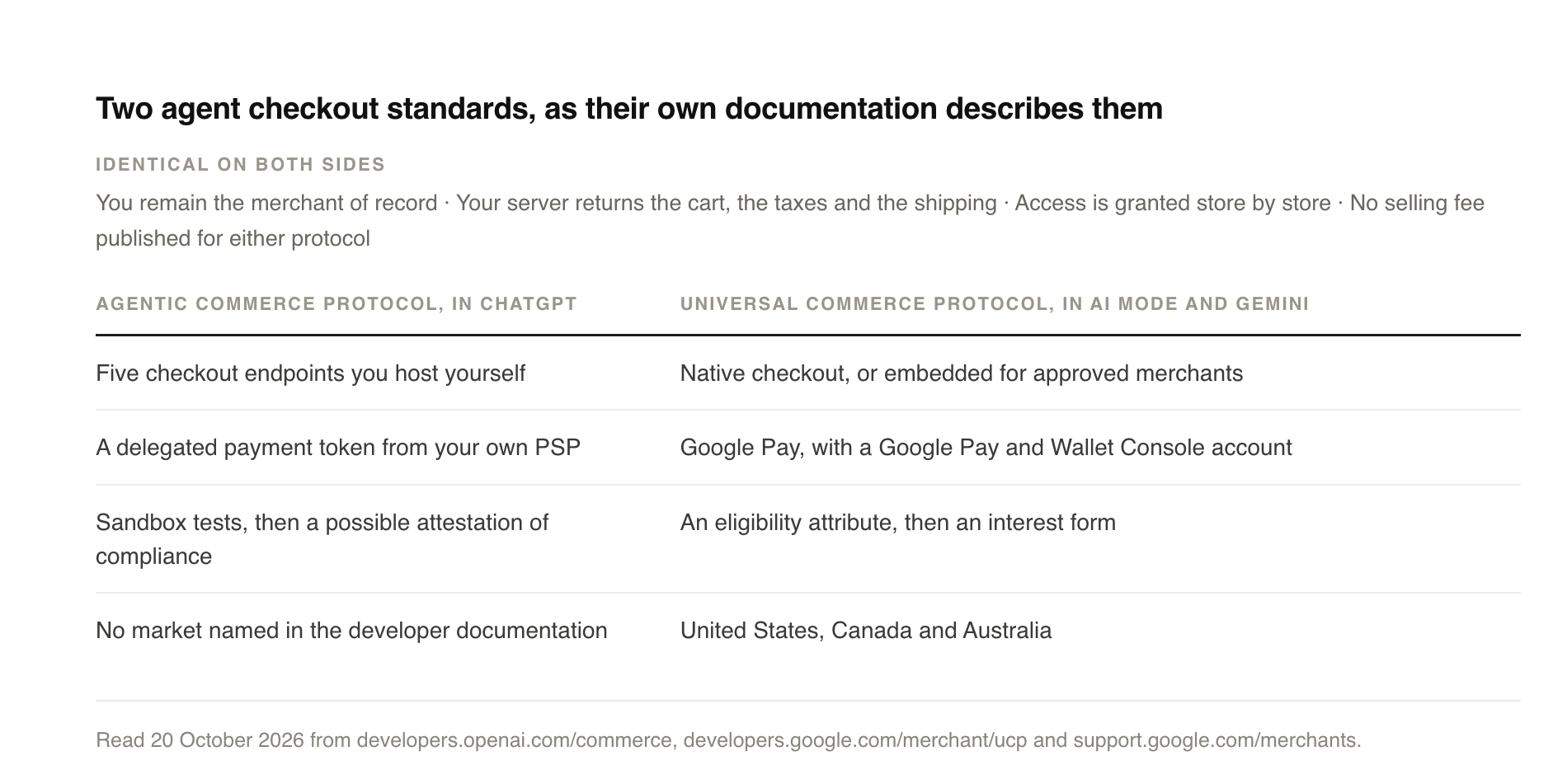
Under both standards you handle the order and the payment, and each store needs separate approval.
OpenAI, Google and Merchant Center documentation, read 20 October 2026What each standard asks a merchant to build
Google launched the Universal Commerce Protocol at the National Retail Federation show in January 2026. Shopify, Etsy and Wayfair were among its co-developers, and more than 20 other companies endorsed it.
A Buy button appears only on listings carrying the native_commerce(checkout_eligibility) attribute. Eligibility covers products sold in the United States, Canada and Australia. The feature is limited to select merchants who submit an interest form.
Stripe and OpenAI published the Agentic Commerce Protocol under the Apache 2.0 licence. Under that protocol, the agent displays the checkout and collects the shopper's payment credential. Sellers keep their existing back end and payment processing.
Shopify Catalog shares your product data by default, and you can turn that sharing off.
To decide which discovery system to prioritise, see ChatGPT shopping vs Google Shopping.
Shopify Catalog also offers discovery without a checkout protocol. It shares product data with ChatGPT, Microsoft Copilot, Meta surfaces, Google and Shop. An assistant can also link shoppers straight to your own checkout.
How does an agentic commerce checkout work?
Joining either protocol means building a checkout an agent can call. Under both protocols the agent asks your server to build a cart and shows it to the shopper. Your systems handle the order, check stock and process payment.
OpenAI's documentation states that "OpenAI is not the merchant of record in the Agentic Commerce Protocol", and Google tells UCP merchants that they remain the merchant of record.
OpenAI's Agentic Checkout Spec says merchants must implement five endpoints, and ChatGPT calls them to create or update a checkout session. Each response includes the full cart details, including tax and shipping.
The five calls an agent makes to your server
acp-checkout-endpoints.txt
1POST /checkout_sessions create a session
POST /checkout_sessions/{id} update a session
2POST /checkout_sessions/{id}/complete take payment, place order
POST /checkout_sessions/{id}/cancel cancel a session
GET /checkout_sessions/{id} retrieve a session
header Idempotency-Key safe retries
webhook order_created, order_updated keep your state in sync
- 1Endpoint names, the idempotency header and the webhook events are from OpenAI's Agentic Checkout Spec, read 20 October 2026.
- 2The spec's overview calls create, update and complete required and the other two optional, while its REST section asks for all five.
Your payment provider receives a token in place of the shopper's card number. OpenAI prepares a one-time delegated payment request that your payment service provider handles. OpenAI identifies Stripe's Shared Payment Token as the first implementation compatible with its Delegated Payment Spec.
Google offers two checkout options. Native checkout lets shoppers complete the purchase inside AI Mode and Gemini. Approved merchants can also use an iframe to embed a checkout with their own branding.
Both checkout options apply your store's existing rules to agent orders. Suppose a currency conversion produces an incorrect free-shipping threshold. Fix the calculation through your usual checkout optimization work. Until then, the agent will display the incorrect total.
Before you go live, OpenAI asks you to complete and document sandbox tests, and says it "may require your attestation of compliance (AOC) before enabling production access". Allow for an approval step after your development and sandbox testing.
How much commerce runs through agents today?
Distinguish three measures: visits referred by an assistant, orders influenced by AI, and orders an agent placed. Before using a published figure to estimate your own opportunity, check which of the three it counts.
Adobe expects AI traffic to U.S. retail sites this holiday season to rise 130% year over year, and its release defines that traffic as "measured by shoppers clicking on a link". Adobe puts the biggest uptick on Thanksgiving, up 159%, ahead of Black Friday at 95% and Cyber Monday at 88%.
For example, an agent that completes a purchase on a shopper's behalf produces no click at all.
Salesforce reported that AI and agents influenced 20% of all global orders during Cyber Week 2025, worth $67 billion. Salesforce based that estimate on activity from more than 1.5 billion shoppers across more than 89 countries. Treat that figure as an estimate: Salesforce combines first-party and third-party data with several market assumptions.
AI-influenced orders include purchases by shoppers who asked an assistant for advice and then checked out by hand. Use your store's channel report to count orders placed by agents, because Adobe's traffic forecast and Salesforce's influence estimate count other things.
Referral traffic, influenced orders and shopper intent, measured over different periods.
| Figure | What it counts | What it cannot tell you |
|---|---|---|
| Adobe, 130% expected growth | Visits to U.S. retail sites from shoppers clicking an AI link, holiday 2026 forecast | How many visits led to purchases, or how many orders agents placed |
| Salesforce, 20% of global orders | Salesforce's estimate of orders influenced by AI and agents in Cyber Week 2025, from blended data | Which orders an agent completed without a person at the checkout |
| Adobe survey, 5,000 consumers | Reported confidence and return intent after using AI to shop | Actual purchase or return behaviour |
In Adobe's survey of 5,000 consumers, 77% of respondents who had used AI for shopping reported feeling more confident. Adobe also found that 69% said they were less likely to return the item.
If your store sees 400 assistant referrals a month and no protocol orders, check the landing pages those shoppers reach.
How do agents choose products in agentic commerce?
Before an agent sends shoppers to those pages, it selects a product using the data on your page. Repeat your checks after model updates, which can change the products an agent names.
Allouah and colleagues audited agent shopping choices with randomized product positions, running 1,000 experiments for each of eight product categories. They tested Claude Sonnet 4, GPT-4.1 and Gemini 2.5 Flash in August 2025, then the successor models in December 2025.
In that audit, Claude Sonnet 4 selected a product placed in the bottom right corner 4.5% of the time. In Allouah and colleagues' audit, Claude Sonnet 4 selected the same product five times as often when the product appeared in a middle column of the top row.
GPT-4.1's favourite product position was GPT-5.1's least favourite, and the reverse held as well.
In Allouah and colleagues' audit, a model update raised one provider's selection rate for the same fitness watch from 45% to 77%. Another provider's update cut it from 25% to 6%.
A layout tuned to one model's habits can stop working after an update.
Allouah, Besbes, Figueroa, Kanoria and Kumar, [arXiv 2508.02630](https://arxiv.org/abs/2508.02630), v3How product-page changes affected agent selection
Allouah and colleagues tested three changes across three models in August 2025. The platform controls the two tags, and you control the product description.
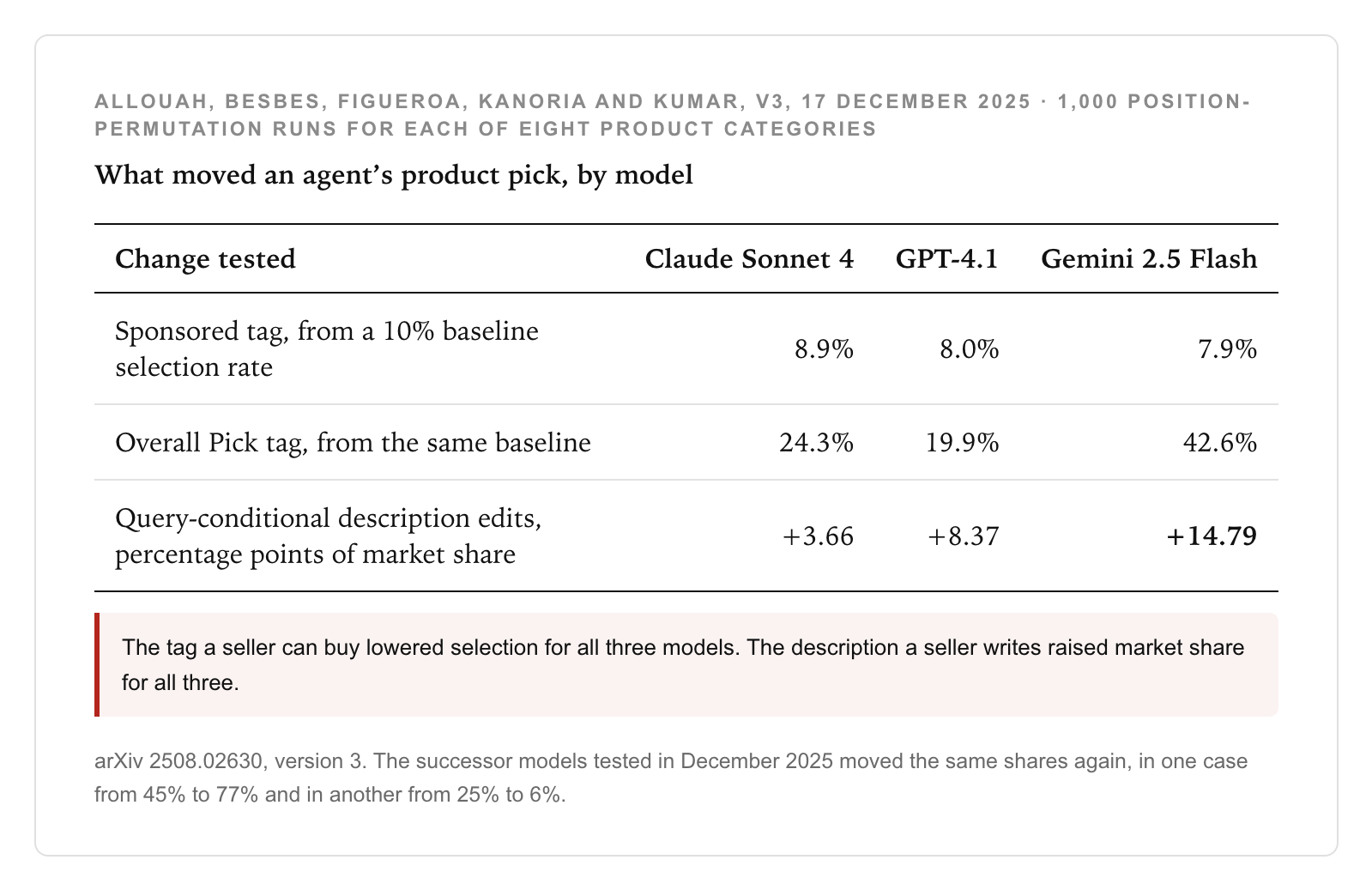
In the audit, an AI agent working for a seller rewrote product descriptions to match the shopping query. The changes significantly increased how often products were selected.
In Allouah and colleagues' audit, changing an office lamp's description increased its selection rate with GPT-5.1 by 80.4 percentage points. In Allouah and colleagues' audit, the description change increased the lamp's selection rate with Gemini 3 Pro Preview by 0.32 percentage points, a result that was not statistically significant. Test the effect of description changes before relying on them.
In a February 2026 framework paper, Cherep and colleagues at the MIT Media Lab found that varying prices, ratings and nudges shifted agent decisions predictably. They call agents "strongly biased choosers".
In January 2026, Semrush tested 100 prompts five times each and found that ChatGPT issues extra shopping queries to Google Shopping. In that test, "the top ChatGPT product was included in Google Shopping's first 3 results 75% of the time".
Optimizing your Google Shopping feed therefore affects the products an assistant shows as well as the Shopping tab.
Write product data for agentic commerce
Each route requires a product record with a published set of required fields. If you sell cookware, a missing value in that record can keep your 28cm pan out of an agent's answer entirely.
OpenAI's File Upload product specification requires nine fields for a discovery feed, and rows that break the availability rule get rejected.
The nine fields a discovery row needs
chatgpt-discovery-feed-row.csv
1item_id,title,description,url,brand,seller_name,image_url,availability,price
CW-28-SS,28cm stainless frying pan,Tri-ply base for induction hobs,https://store.example/pans/cw-28,Example Cookware,Example Cookware,https://cdn.example/cw-28.jpg,in_stock,74.00 GBP
2# availability accepts: in_stock out_of_stock pre_order backorder unknown
# omitted, empty or unrecognised availability rejects the row
# checkout only: is_eligible_checkout, seller_privacy_policy, seller_tos
- 1Field names and the availability values are from OpenAI's File Upload product spec, read 20 October 2026.
- 2The product and store in the row are fictional.
- 3OpenAI says checkout requires a separately enabled integration, so the eligibility flag alone does not finish onboarding.
OpenAI asks you to hold item_id and group_id steady when price, stock or images change. Submit the current price, and update the feed when a sale starts or ends.
Poorly maintained variant data makes an agent recommend the wrong size or a sold-out item. For example, if your 28cm pan is in stock at £74 and the 20cm pan is sold out, a single generic record sends the agent to the wrong one.
OpenAI does not require advertising fields for product discovery. Paid placement in ChatGPT Ads runs on its own eligibility flag.
As part of your ecommerce SEO maintenance, use one source record for each product to supply your category pages, product pages and agent feeds. Check it whenever price or availability changes.
Decide which commerce agents reach your store
A product record only reaches an agent that is allowed to read it. Platforms control access through settings or bot rules. Shopify enables access by default.
By default, all available channels have access to your products through Shopify Catalog.
Shopify Help Center, Managing agentic storefronts read 20 October 2026
The "Allow Shopify to manage for me" setting is enabled by default. It activates every channel, turns on direct checkout where it's supported, and enrols you in new agentic storefronts as they appear.
Shopify says it can take up to 7 days to stop sharing your product data after you turn the setting off, so allow for that delay when planning a sale.
On your own infrastructure, identify an agent before you decide whether to block it. On 14 October 2025, Cloudflare announced an authentication layer built on Web Bot Auth that lets bots and agents prove their identity using HTTP message signatures and public key cryptography.
Visa co-developed the Trusted Agent Protocol with Cloudflare for its Visa Intelligent Commerce platform. Mastercard is folding Web Bot Auth into Mastercard Agent Pay, and American Express will use it in its own programme.
User agent strings and IP addresses are used to identify agent traffic. Both can be spoofed, so blanket blocks exclude legitimate shopping agents while spoofed ones get through.
Four access settings and who owns each one
| Your decision | The part you do not decide | |
|---|---|---|
| Shopify Catalog sharing | Leave on, or switch off and wait up to seven days | Which channels Shopify adds next while auto-enrol is on |
| Per-channel direct checkout | Allow or block it channel by channel | Whether your store is eligible |
| Bot rules at your edge | Allow verified agents, challenge unsigned traffic | Whether an agent chooses to sign its requests |
| Protocol onboarding | Prepare the feed and apply | Approval, and the attestation that may precede it |
For example, a security rule that blocks an assistant's fetcher keeps your products out of its answers even when your feed is perfect. Check your logs for the published agent names to see whether access rules are the cause.
Disabling a channel does not remove your products from every agent answer. Shopify warns that products can still appear through other methods such as web crawling, and points to a product-level setting for hiding an item completely.
Measure agentic commerce sessions and orders
Use your platform's channel report to count orders placed by agents separately from orders placed by referred shoppers. Record these figures before your next sales season so you can compare results afterwards.
Shopify's agentic channel reporting gives you four fields per channel: sales, orders, online store sessions, and online store conversion. The sessions figure counts visits to your online store from an AI channel, and conversion divides the sessions that completed checkout by all sessions.
Shopify combines referral sales and direct-checkout sales in one figure, so record the two separately yourself.
If you run the protocol endpoints, use the order_created and order_updated webhooks to keep your own record of agent orders.
For example, report 40 assistant sessions, two agent orders and nine orders from referred shoppers as three separate figures.
Tag assistant referral visits with a consistent source and medium, as you would any other traffic source. That pairing lets you compare assistant visits with search and paid visits in one table.
Track brand mentions separately, because an assistant can mention your brand without sending a visit. See AI visibility for a tracking method.
Run your checks monthly, and repeat them after each model update.
What does agentic commerce cost a merchant?
Budget for platform charges separately from engineering, because only the platform charges are published today. Get an estimate from whoever will build the endpoints, since that cost depends on the stack your store already runs.
Shopify charges no selling fees for its ChatGPT channel. You pay your standard payment processing fees, as you would on your own checkout.
Fee information from Shopify, Google and OpenAI as of 20 October 2026.
| Cost | Published charge | Your team's responsibility |
|---|---|---|
| Shopify ChatGPT channel | No selling fees, standard payment processing applies | Catalog accuracy and the settings you choose |
| UCP-powered checkout | Google's Merchant Center page does not specify one | A Google Pay and Wallet Console account, plus the technical implementation |
| Agentic Commerce Protocol | OpenAI's developer documentation does not specify one | Five endpoints, webhook handling, sandbox tests, possible attestation |
| Feed maintenance | Not a platform charge | Price and availability updates whenever either changes |
Merchant Center says you need a Google Pay and Wallet Console account for UCP-powered checkout, and that you don't need to add the Google Pay button to your own checkout.
For example, a store with an error-free Merchant Center feed and a Shopify checkout can use referral links and catalog listings this month without paying platform fees. The same store must budget for development and obtain approval before accepting agent orders through its own checkout endpoints.
Budget for feed maintenance as an ongoing expense. A record created in October can still show a sale price after the sale ends in November.
Avoid these agentic commerce mistakes
Beyond the budget, avoid these three mistakes. Keep market estimates separate from your store's results, confirm checkout eligibility before building the integration, and test how paid labels affect agent selection.
First, don't report "AI influenced" figures as agent orders. Salesforce's 20% figure is an estimate of orders influenced by AI and agents, calculated from blended data sources.
Second, don't assume an assistant keeps recommending your product after a model update.
Third, before paying for a sponsored label, test whether agents recommend your product less often with the label. In Allouah and colleagues' audit, a sponsored tag reduced product selection rates for every 2025 model tested, while platform endorsement increased them.
Before renewing a sponsored placement, compare the agent's recommendations with the answers you saved before the placement began.
Start your agentic commerce prep this week
Run your customers' shopping questions through an assistant and save the answers. Put one person in charge of reviewing your product feed and agent settings and recording the date of each decision. That work can begin before any protocol approval.
-
Audit one product record end to end
Check the nine required discovery fields, the availability value and the price against your live page. Correct any error in the source product record.
-
Open your platform's agentic settings
Decide which channels keep catalog access and which keep direct checkout. Write the decision down with the date.
-
Check your bot rules for verified agents
Look for the published agent names in your logs, then allow the signed ones and challenge unsigned traffic.
-
Run ten buyer questions and save every product named
Use the words your customers use, with one real constraint such as a size, a budget or a delivery date.
-
Record the three outcomes separately
Record brand mentions, assistant visits and agent orders in separate columns. Repeat the checks after the next model update.
Your feed can also be built and maintained by our ChatGPT product feed service. Addition's search marketing agency team also tracks your catalog's performance in search results.
Sources
- Google for Developers Universal Commerce Protocol (UCP) Guide: surfaces, native and embedded checkout, REST and MCP binding, merchant of record
- Google Merchant Center Help About the Universal Commerce Protocol (UCP) and UCP-powered checkout feature on Google
- Google New tech and tools for retailers to succeed in an agentic shopping era
- OpenAI Agentic Commerce Protocol: key concepts
- OpenAI Agentic Checkout Spec: five checkout endpoints, idempotency header, order and session statuses, webhook events
- OpenAI File Upload product spec: nine required discovery fields, availability enum, checkout-only conditional fields
- OpenAI In production: sandbox test documentation and attestation of compliance
- Agentic Commerce Protocol An open standard for programmatic commerce flows between buyers, AI agents, and businesses, Apache 2.0 This page carries no publication date of its own.
- Shopify Help Center Managing agentic storefronts: default Catalog access, named channels, seven-day window, four reporting fields
- Shopify Help Center Selling on ChatGPT: no selling fees, US sales requirement, active by default, checkout in the ChatGPT in-app browser
- Cloudflare Cloudflare Collaborates with Leading Payments Companies to Secure and Enable Agentic Commerce Dated 2025 with no month given, so its exact age is not knowable from the source.
- arXiv What Is Your AI Agent Buying? Evaluation, Biases, Model Dependence, and Emerging Implications for Agentic E-Commerce, v3, 1,000 position experiments per category across eight categories and six models Dated 2025 with no month given, so its exact age is not knowable from the source.
- arXiv A Framework for Studying AI Agent Behavior: Evidence from Consumer Choice Experiments, v2
- Adobe U.S. Holiday Shopping Season to Hit Record $275.1 Billion Online, Rising 6.7% YoY, with a 5,000-consumer survey
- Salesforce AI and Agents Propel Cyber Week to Record $336.6B in Global Spend, more than 1.5 billion shoppers across more than 89 countries Dated 2025 with no month given, so its exact age is not knowable from the source.
- Semrush We Found Out What ChatGPT Searches on Google Shopping: fan-out queries of 100 prompts, five runs each
- Forrester What It Means That The Leader In Agentic Commerce Just Pulled Back
Questions people ask
What is agentic commerce?
Agentic commerce lets an AI assistant find and compare products for a shopper and, on some surfaces, place the order. You remain the merchant of record under these protocols, responsible for orders, payments and returns.
Can an AI agent buy from my store today?
An agent can place an order only after your store is approved and connected. OpenAI's protocol needs five checkout endpoints, sandbox tests and possibly a compliance attestation. To use Google's Buy button, your store needs the Merchant Center eligibility attribute and approval after submitting the interest form. An assistant can refer a shopper to your existing checkout without any integration.
How do I prepare for AI shopping agents?
Start with your product record, which supplies the data agents use across all these routes. Complete OpenAI's nine required discovery fields from your live page, then decide which agents get catalog access.
Does blocking AI bots keep my products out of agent answers?
Blocking a bot prevents it from reading your product pages. Blocks based on user agent strings and IP addresses are unreliable, because both can be spoofed. Cloudflare, Visa, Mastercard and American Express are developing ways for agents to prove their identity with digital signatures. Check which agent names your rules catch before you assume the feed is at fault.
How do I measure agent sales?
Use your platform's per-channel report for orders and sessions, and keep your own split between referral sales and direct-checkout sales. If you run the protocol endpoints, use the order webhooks to track agent orders.