

What does a B2B marketing strategy have to exclude?
The word promises a decision, and a decision means something gets dropped. Nothing gets dropped in the guidance published under this term. Forrester names channels only to reject them as strategies, and the usual answer is still a channel list in no order.
The plainest version of the rule is thirty years old and not about marketing at all. Michael Porter wrote in Harvard Business Review in 1996 that the essence of strategy is choosing what not to do. Your plan has to survive that sentence.
Google’s AI Overview on the subject opens with a definition sourced to a thread in r/smallbusiness, and Forrester turns up only in its framework bullets.
The analyst framework runs to five points, and two of them are written as refusals. The framework is Forrester's, and that is why it carries weight in a room.
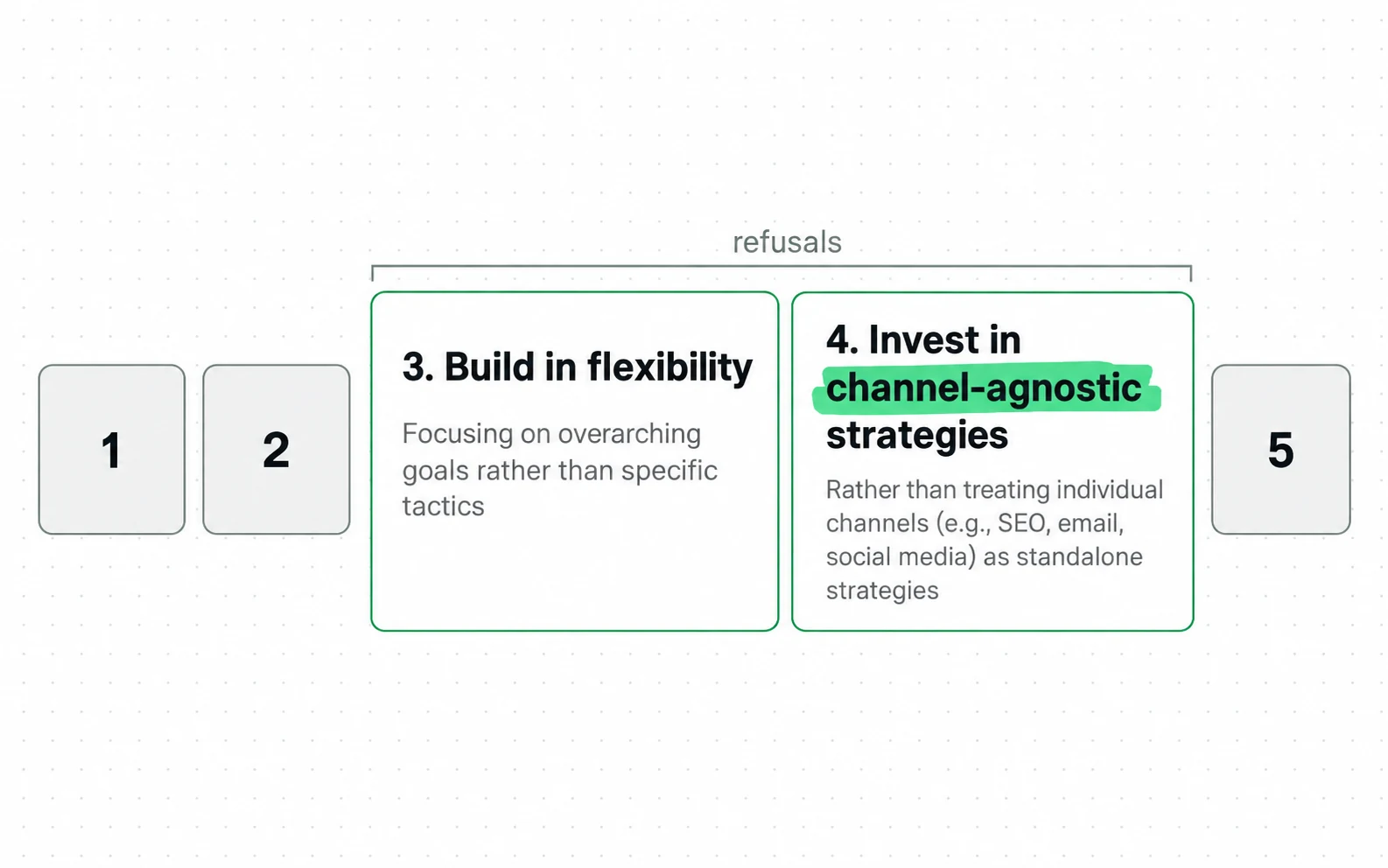
- Point three asks for overarching goals instead of specific tactics, which removes the level a small team plans at.
- Point four names SEO, email and social media, and does so only to reject each one as a strategy on its own.
- Both are defensible for an enterprise with a full function. Neither tells one marketer what to open on Monday.
That refusal is deliberate and it is also the whole gap. A channel-agnostic method assumes someone downstream will pick the channels. In a firm with one marketer there is no downstream.
Forrester, the US Chamber and Salesforce, against the four questions a founder has to answer.
| Page | Names an order | Names a budget | Names something to skip |
|---|---|---|---|
| Forrester, five point method | No | No | Names channels only to reject them as strategies |
| US Chamber, seven tactics | No | No | No |
| Salesforce, definition and funnel | No | No | No |
A list of seven things to do, with no order and no budget, is a menu. The reader arrives with one marketer and a number, and leaves with seven open tabs.
Publishers are not being lazy here. Order and budget depend on facts about your firm, and a page written for every reader cannot know them. So it writes the part that generalises and stops.
Which means the work these pages skip is the work. Choosing among seven channels for a specific firm with a specific number is what a strategy is, and it is the only part that cannot be published in advance.
Choose the buying group your B2B strategy serves
The exclusion has to be made against a real buyer, and in B2B the buyer is a group whose membership changes with the product. Two worked examples on one page show the change, and that same page then gives one approach for all of them.
Here is that passage, and the sentence directly under it matters as much as the examples.
The makeup of this committee depends on the product or service being purchased. … Your B2B marketing approach will look different based on industry, company size, and other factors.
Salesforce, B2B marketing guide read 7 September 2026
- Office furniture pulls in facilities and operations. Marketing software pulls in marketing, sales, technology and finance.
- The next sentence says the right approach differs by industry and by company size.
- The page then presents one approach, and that is the gap this guide is about.
Forrester puts the average group at thirteen stakeholders across departments, and publishes three survey figures about how those people now behave.

Eighty one percent dissatisfaction is a statement about the winner. A plan built only to win the deal is optimising the half of the problem that the buyer is already unhappy with.
Thirteen people, from a population where four in five came away unhappy with the vendor they picked, in a group whose membership you cannot predict from your own product category. That is who the exclusion has to be made for.
It also reframes reach. A finance member and an operations member are unlikely to read the same things. A single channel is a bet that they do, and the three pages here leave that bet untested.
The other two rows describe where those people look. About two thirds came up after 1980, and three in ten of the younger ones bring in ten or more outside voices. A good deal of the deciding happens somewhere you do not publish.
Two channels will not cover thirteen people either, and how many they would cover is not published anywhere. What two channels can do is meet whoever starts the search, and that is the part of the group in play before anyone contacts you.
One fact about the group you are selling to sits outside every strategy page here. The Ehrenberg-Bass Institute reports John Dawes finding that companies change providers roughly every five years, so about five percent of buyers are in the market in a given quarter.
Read against thirteen stakeholders, that is the case for choosing channels people encounter before they are buying. The institute names Dawes and the study and prints no sample, so it is a prior and not a measurement of your market.
B2B marketing channels: how many fit in thirty hours
The seven channels on the US Chamber list are email, search, LinkedIn, video, customer relationship management, content and account-based marketing. A single marketer cannot run seven. Trying anyway takes one line of arithmetic, and that line is the argument.
Seven is not the longest list you will be handed. Twelve channels appear on one advertising platform's own B2B page, and a longer menu is not a stronger strategy.
The Content Marketing Institute asked 1,015 B2B marketers between June and August 2025 how far their personalisation reaches. Fifty-nine percent described it as basic, in one or two channels with minimal integration.
That is where your seven-channel plan lands in practice. The same survey puts resource constraints, meaning time, people and budget, among the top three challenges at 39 percent.
The year before, the same survey asked 980 B2B marketers how big the team is. Of those with dedicated content staff, 54 percent said two to five people. That is the headcount your seven-channel list is written for.
That spend figure is worth following one step back. A market forecaster published it in August 2024: 38.67 billion for that year, rising to 48.15 billion by 2026. The restatement moves the base year to 2025 and leaves the number alone.
Give the whole week to the list and divide it evenly.

What the division proves is the division. Whether four hours a week is enough for a channel is a judgment, ours, and it comes from running these channels. Nothing published here settles it.
Which two
This part is our judgment and no source publishes it. It rests on one figure the US Chamber quotes from Gartner: buyers spend 27 percent of the purchase journey researching independently online, with nobody from your company present.
- Start with the work that runs while you are absent, because 27 percent of the journey happens that way. Search and published material are the two we reach for, because both are readable without us present. No source ranks them against the alternatives. B2B content marketing sets out what that work costs and how often it has to appear.
- Add one channel that reaches the group you already know. Email is the only one of the seven with any published return figure attached to it, and that figure arrives without a denominator. Treat it as a reason to look, not a number to plan against.
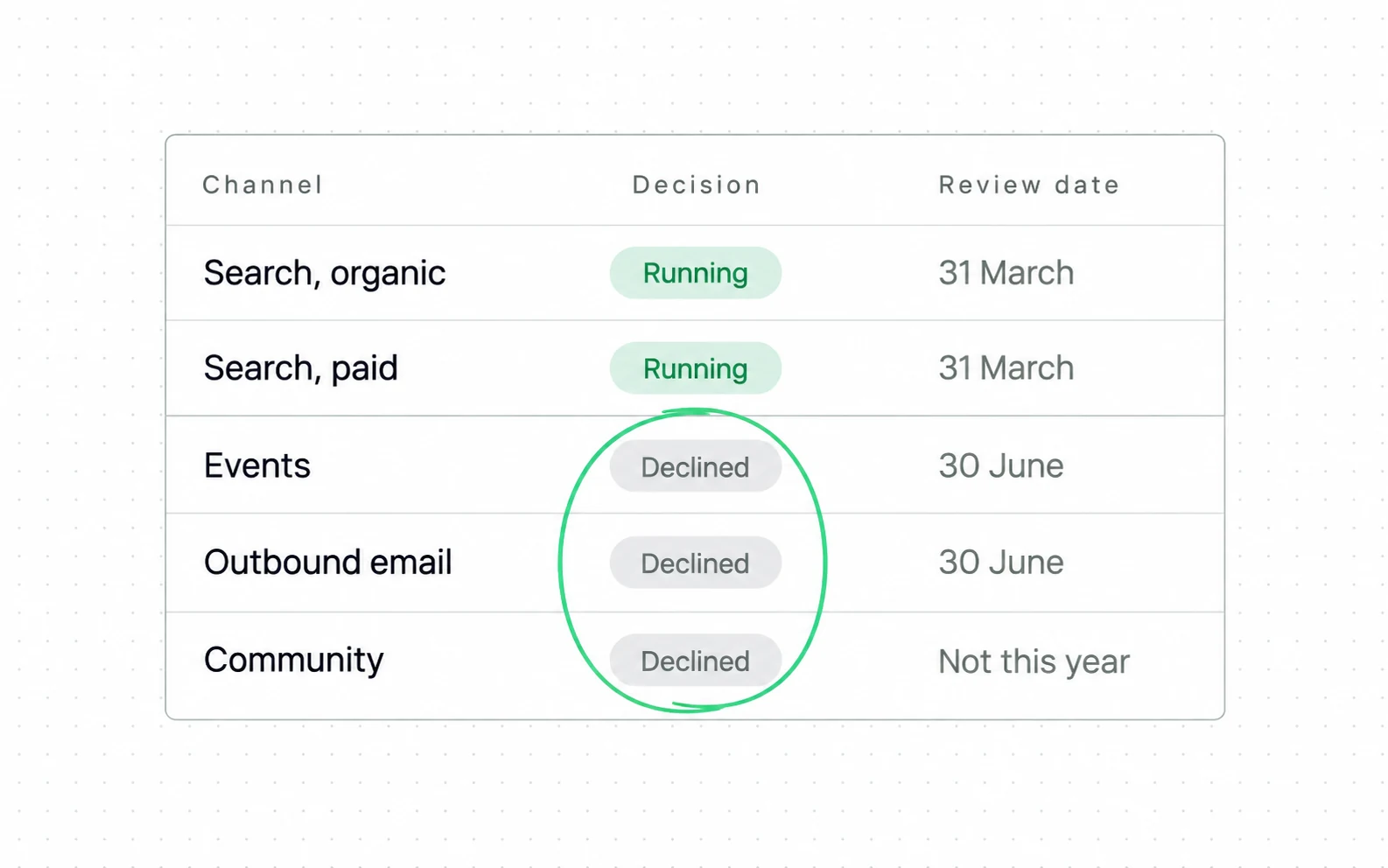
- Decline the rest in writing, with a date to revisit. An undeclared decline comes back as guilt every Monday.
- Revisit when a constraint changes, not when a quarter ends. More people, a longer sales cycle, or a list big enough to make account-based marketing meet its entry condition.
Say you want an agent to run the same exercise for your brand. The Digital Marketing Pro plugin runs a twelve-part engagement and writes your choices down, and that is the part people skip.
Argue with the order if you like, and with the number. Whatever you decide, some of your channels have to be declined in writing, because your thirty hours do not stretch.
One test tells you whether your choice is real. For instance, if you cannot name what you gave up, you have not chosen, and the seven are still running quietly in the background as guilt.
Why nearly half of B2B startups run no systematic marketing
Declining five channels sounds severe until you see how many B2B startups decline all seven. The strongest exclusion decision anywhere here sits in the first paragraph of one page, and it is not advice. The sentence reports what B2B founders already do, and none of the three builds on it.
The US Chamber page opens with it, cites a journal, and then moves on to the seven tactics.
The study behind that sentence is Gary Lilien and Ofer Mintz in Industrial Marketing Management, 2024. They read 693 startups on the Equidam platform between July 2016 and April 2018, and checked the result against a separate panel of 377.
Forty-five percent reported no systematic marketing, meaning no ongoing process of collecting customer data and using it. Some of your competitors have made that decision already, and the study ties it to their valuation. If you are choosing two channels, you are ahead of them.
According to a study published in the journal Industrial Marketing Management, nearly half of business-to-business (B2B) startups intentionally decide not to do any marketing. This decision had far-reaching effects, impacting the startups' valuation and growth potential.
CO by US Chamber of Commerce, 17 July 2026 read 7 September 2026
- Nearly half of B2B startups intentionally decide not to do any marketing, according to a study in Industrial Marketing Management.
- The study reports the decision affects valuation and growth, so this is a finding about consequences and not an endorsement.
- The headline over that sentence says tactics, and the seven that follow it are channels, not choices.
Nearly half is a phrase, not a percentage, and the wording here comes from the Penn State summary of a paper in Industrial Marketing Management. The finding treats marketing as a decision with a real alternative.
The alternative is real for a specific kind of firm. Say you have three customers, a two week sales cycle and more referrals than you can service. You are not underinvesting in marketing, and your constraint is delivery.
The cost of the seven channel menu falls hardest on exactly that firm, because a menu makes every skipped item feel like a failure. A stated exclusion with a revisit date costs nothing and removes that.
Say you keep the two channels your firm can staff and drop the rest of the menu. That is where B2B SEO agency work starts at Addition, a search marketing agency.
Four common B2B marketing strategy mistakes
If deciding nothing is the failure, it helps to know what deciding nothing looks like on the page. Four habits show up in these three pages and in one figure they quote, and each survives because the word strategy is doing work the document does not. They are cheap to spot once you know that a plan with no exclusion in it is a list.
Four habits and what each one hides.
| Habit | What it hides |
|---|---|
| Publishing a channel list under the word strategy | That no channel was chosen over another, so the reader still has to choose |
| Naming goals instead of tactics | That the level where the money gets spent was skipped entirely |
| Quoting a return figure with no denominator | That 36 dollars per dollar counts different senders, lists and offers |
| Writing one approach after saying approaches differ | That the differences named in the same paragraph never reach the advice |
The fourth is the easiest to miss, because the contradiction sits inside a single page. One paragraph says approaches differ by industry and company size, and the rest of the page gives one approach.
The second is the analyst version of the same thing. Goals without tactics is a defensible position for a firm that has a planning function, and it is empty for a firm that has one person.
How to measure two chosen channels honestly
Two channels chosen and five declined gives you something a menu never does: a set small enough to measure honestly. The measurement question changes as well: not whether each channel works, but whether the two you kept are moving the same number.
Write your exclusion down with the reason and the date. For example, a decision that lives only in your head gets relitigated every time a competitor posts something.
For the size of the whole envelope, The CMO Survey put marketing at 7.7 percent of company revenue in September 2024. It asked 260 US marketing leaders, 97 percent of them VP-level or above, and it does not break that figure out for B2B.
Then give each of the two a number that is theirs alone, and check the denominator before you compare it with anything published. Our entry on B2B lead generation sets out why the public cost benchmarks disagree, and the answer is almost always the denominator.
Give the pre pipeline work a longer window than the pipeline work. B2B demand generation collects the published evidence on how much of the journey happens before anyone identifies themselves, and that stretch is invisible in a monthly report.
Line the two numbers up against the stages you already use. Those stages sit in the B2B marketing funnel, and a number with no stage behind it is a number nobody can act on.
Sources
- Forrester The B2B marketing strategy page, a five point method that names no channel
- CO by US Chamber of Commerce 7 smart B2B marketing tactics that work, 17 July 2026, opening with a journal study on firms that market nothing
- Industrial Marketing Management Study reporting that nearly half of B2B startups intentionally decide not to do any marketing, quoted by the US Chamber
- Salesforce What is B2B marketing, with the buying committee composition worked through two products
- Gartner Finding that business buyers spend 27 percent of the purchase journey researching independently online, quoted by the US Chamber
- HubSpot Estimate of 36 dollars returned for every dollar spent on email marketing, quoted by the US Chamber
- Google AI Overview Overview for the query b2b marketing strategy, as it stood on 27 August 2026; overviews are regenerated per search and the live one may differ
- Michael E. Porter, Harvard Business Review What Is Strategy?, November to December 1996: the essence of strategy is choosing what not to do, and strategy renders choices about what not to do as important as choices about what to do
- Penn State Smeal College of Business, on Gary Lilien and Ofer Mintz Nearly half of B2B startups choose not to market themselves: Industrial Marketing Management, 2024, on 693 B2B and B2C startups from the Equidam platform between July 2016 and April 2018, with a validation study of 377 startups from an entrepreneur panel
- Content Marketing Institute B2B Content Marketing Benchmarks, Budgets and Trends 2025, 980 B2B respondents, fielded 25 June to 16 August 2024
- Content Marketing Institute B2B Content and Marketing Trends: Insights for 2026, 1,015 B2B marketers out of 1,229 global responses, fielded 24 June to 14 August 2025, published 8 October 2025
- The CMO Survey, Duke Fuqua School of Business Fall 2024 edition, 260 marketing leaders at for-profit US companies, 97 percent VP-level or above, fielded 4 to 25 September 2024
- Amazon Ads What is B2B marketing: definition, examples, trends
- eMarketer By 2026, worldwide B2B digital ad spend is set to nearly triple its pre-pandemic level, forecast dated August 2024
- Ehrenberg-Bass Institute for Marketing Science 95% of B2B buyers are not in the market for your products, on Professor John Dawes’ work for the LinkedIn B2B Institute
Questions people ask
What are the four types of B2B?
A settled four type taxonomy does not exist, so no list follows.
A taxonomy of buyer types describes who buys. It does not tell you what to do first, and that is the question this page is about.
What are the four C's of B2B marketing?
The four C’s are not a defined framework in B2B marketing, so no definition follows.
A framework repeated from memory would put an unsourced list in front of you. The decision it is meant to help with is worked through above.
What is the 3-3-3 rule in marketing?
The 3-3-3 rule has no traceable source either, so no definition follows.
A rule that cannot be traced to a source stating it cannot be checked, and an unfalsifiable rule is a slogan.
What is the Rule of 7 in B2B marketing?
An advertising heuristic says a buyer needs around seven exposures before acting. Our entry on the B2B marketing funnel traces the closest measured version of it and the researcher who calls his own figure a heuristic.
For strategy the useful part is not the number. The useful part is that exposure has to happen while nobody from your company is present, and the first two choices below are for exactly that.

