

What demand gen campaigns are
Demand Gen is a Google Ads campaign type; demand generation is a marketing strategy. They share a name and little else, and reading one as the other is how a plan ends up without a budget figure in it.
According to Google Ads Help, Demand Gen encourages people to engage with an ad and take action on YouTube, including Shorts, as well as Discover, Gmail, Maps and the Google Display Network.
B2B demand generation involves identifying consumer needs, promoting the product and generating leads.
| What you are doing | Which one you need |
|---|---|
| Launching a campaign in a Google Ads account | The campaign type |
| Planning awareness and interest before anyone buys | The strategy |
| Setting a daily budget or a bid strategy | The campaign type |
How Demand Gen differs from Performance Max
Demand Gen and Performance Max both bid automatically, and both can serve on YouTube and Discover. The difference is what each one lets you decide about creative, audiences and placements.
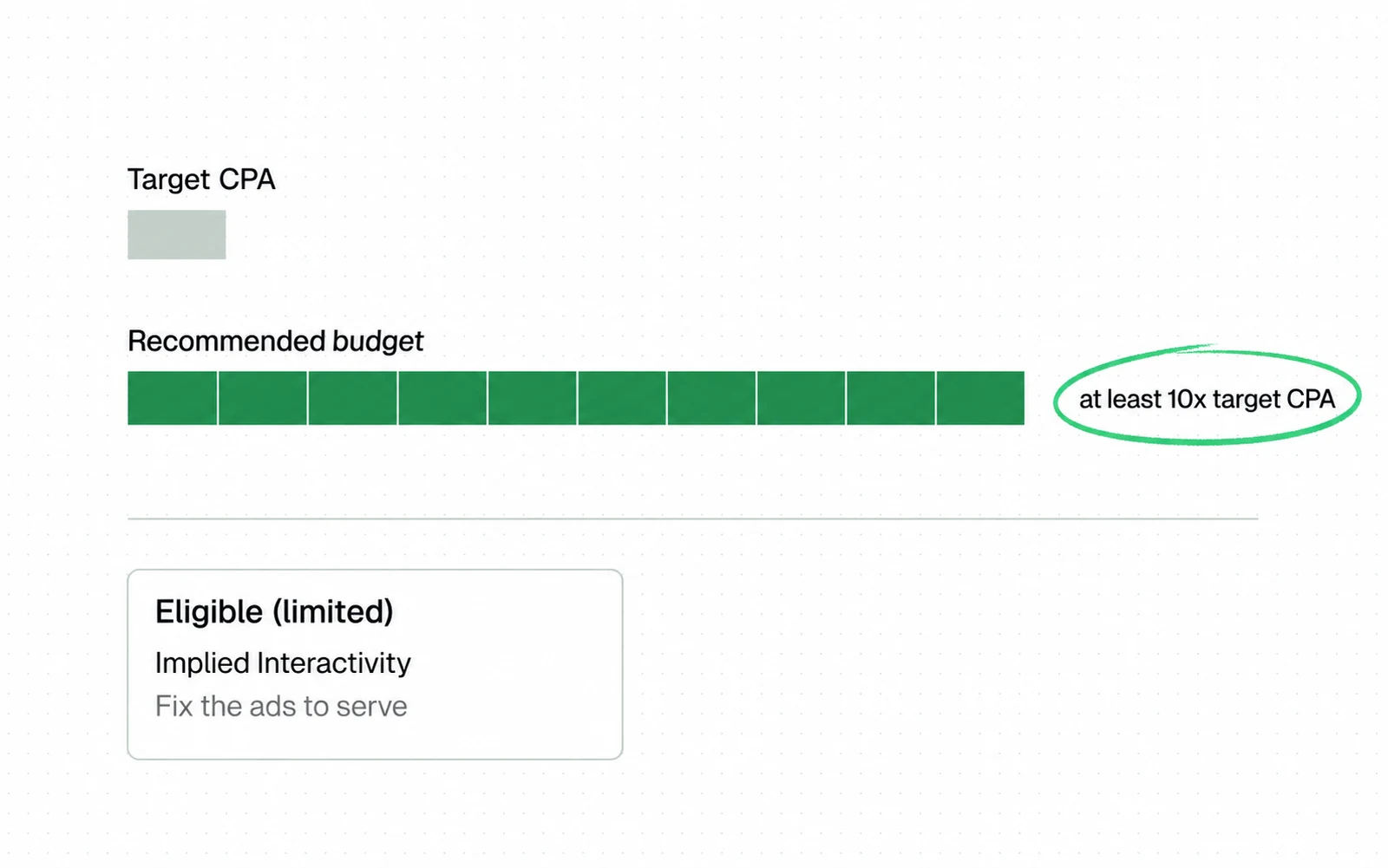
- The recommendation is a multiple of the target, so it moves with the campaign it is set for.
- The same section names one state that stops ads serving: Eligible (limited) due to Implied Interactivity. Google lists it as an ad fix.
Google says Performance Max finds more customers likely to convert across all of its channels. Demand Gen gives more control over creative testing, audience targeting and specific placements on YouTube and Discover.
Google says Performance Max combines your assets to create images and videos, uses Smart Bidding, and automatically allocates your budget to the inventory and placements that perform best.
Who controls creative, placements and bidding
| Demand Gen | Performance Max | |
|---|---|---|
| Placement choice | yours | account exclusions only |
| Creative assembly | yours | automated |
| Audience targeting | yours | signals, age and device |
| Bidding | automated | automated |
| Surfaces | five named | all channels |
Both campaign types bid automatically. Compare the creative and placement rows when choosing between them.
Dennis Moons, who runs both campaign types, says Performance Max targets people close to buying, although it is marketed for every stage of the buying process. He puts Demand Gen at the top of the funnel, where people are still looking.
Pick Demand Gen when you want to test creative on placements you choose. Pick Performance Max if you want Google to choose the placements and assemble the creative.
Neither choice changes what a click costs, because the same auction prices both, and how Google Ads works sets out that pricing.
Demand Gen reaches YouTube feeds including Shorts, Discover, Gmail, Maps and the Display Network. It runs on more channels than a video campaign and fewer than Performance Max.
If you leave all five surfaces enabled, one bid strategy runs across a YouTube feed, a Gmail inbox and the Display Network together.
Google is retiring standalone Display campaigns and moving their inventory into Demand Gen. Search Engine Journal reported the plan in May 2026.
The migration tool opened in June 2026 for eligible advertisers who want to move campaigns themselves.
Google has not announced dates for the next two steps: requiring new Display campaigns to be built in Demand Gen, and migrating the existing ones automatically. Search Engine Journal reported in May that new campaigns would move later in 2026, with automatic migration continuing through 2027.
If you are running Display today, plan for that budget to sit inside Demand Gen.
Demand Gen vs Performance Max in one account
Most accounts running Demand Gen are already running Performance Max, and both can be eligible for the same impression. Google Ads Help says the ordinary auction decides which one serves.
The campaign with the higher Ad Rank serves, and neither campaign type gets priority over the other.
Search has one exception to that rule. A Search keyword that exactly matches the query is preferred over Performance Max.
| If the job is | Run | Why it fits |
|---|---|---|
| Reaching customers likely to convert across Search, Shopping, Maps and YouTube with a single budget | Performance Max | Google says it finds customers likely to convert across all of its channels |
| Testing creative, choosing the audience and picking YouTube or Discover placements | Demand Gen | Google says Demand Gen gives more control over creative, audiences and placements |
| Keeping a Display Network budget running | Demand Gen | Display campaigns are moving into it |
| Showing a product feed to people who are still researching | Either campaign type | Both campaign types can serve a product feed |
Both campaign types can show ads from a product feed. Smarter Ecommerce, a software vendor, reported in July 2026 that 35 percent of Demand Gen campaigns use a product feed, up from 16 percent in 2024.
Smarter Ecommerce interprets that increase as a sign that Demand Gen is being used for work Performance Max already handles.
Google says the overlap happens when the two campaigns share conversion goals, bidding targets and other settings. Give them different conversion goals to prevent that overlap.
Set four Demand Gen campaign settings
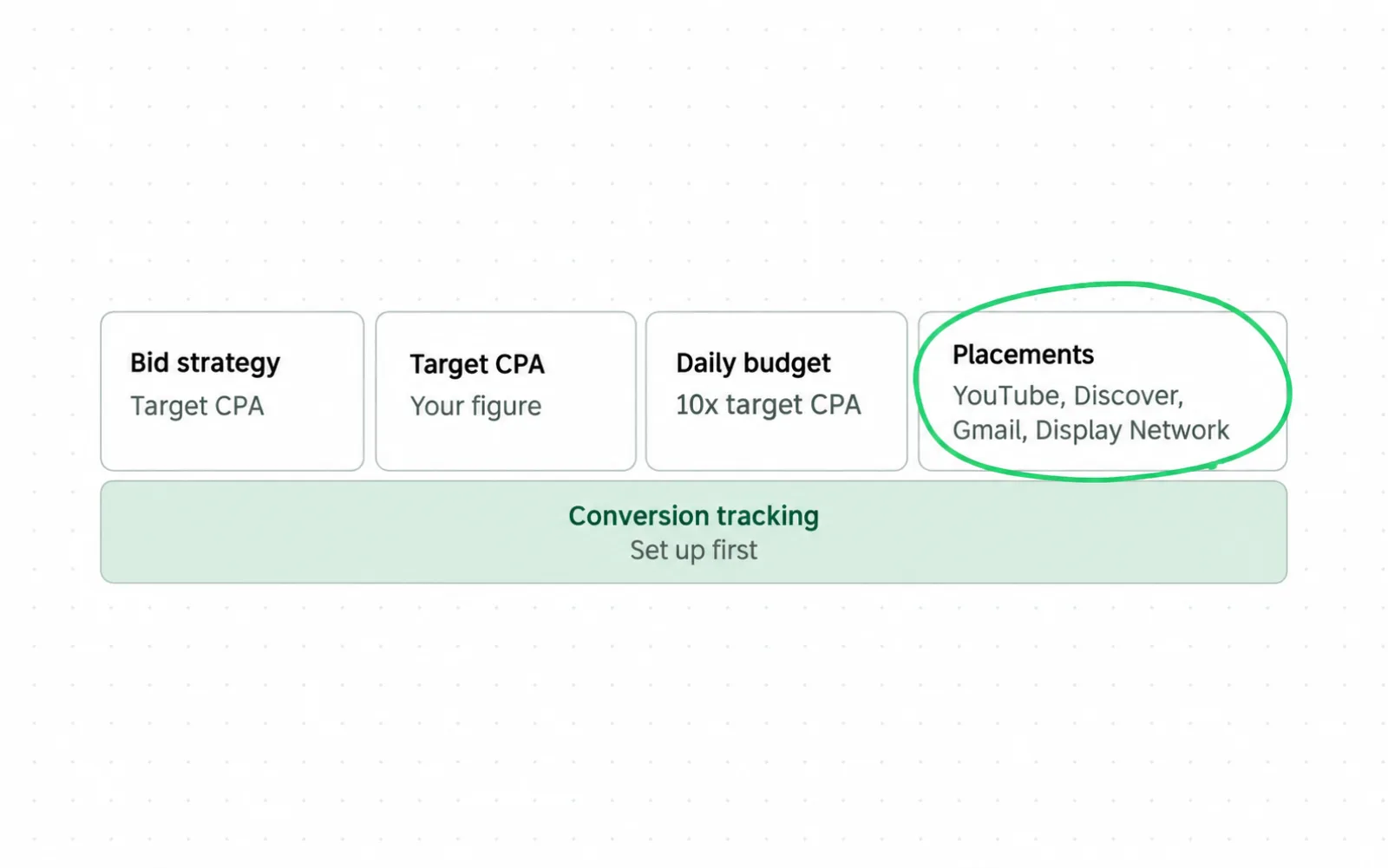
On the Demand Gen setup screen, set the objective, the target CPA, the daily budget and the placements, in that order. Then set the audience and the creative, which both have numbers Google publishes for them.
Google’s Lookalike segment documentation defines narrow, balanced and broad reach as 2.5, 5 and 10 percent of the audience in the target location. It also says the old minimum seed list of 100 users no longer applies.
Google says these tiers no longer limit who can see your ads. From March 2026 the reach level and the seed list act as signals, and the system may serve outside the threshold you picked.
Search Engine Land reported the change in February 2026; Google’s Lookalike documentation confirms it as well.
For a custom segment, Google asks for 10 to 15 keywords that signal interest or purchase intent.
Google requires images in four aspect ratios, with a minimum size of 300 by 300 pixels, and videos at least five seconds long.
Run the same four decisions on another ad platform with The ads skill, which carries the budget and learning period rules for each one.
-
Set the objective first
Demand Gen offers Maximize Clicks, conversion bidding and value based bidding. The list you see changes with the objective you pick.
-
Set the target CPA before the budget
Use the target CPA to calculate the daily budget in the next step.
-
Calculate the daily budget
Google recommends a daily budget of at least ten times the target CPA. For example, at a fifty dollar target that is five hundred dollars a day.
-
Choose your placements
Go through the five surfaces and switch off the ones you do not want. All five stay on by default.
-
Check conversion tracking before launch
Set up conversion tracking so automated bidding can optimize for conversions.
How to set a Demand Gen daily budget
Conversion tracking supplies the data for automated bidding, and the daily budget determines how quickly those conversions accumulate. Google Ads Help recommends at least ten times your target CPA while the campaign is learning, so a fifty dollar target means five hundred dollars a day.
Daily budgets calculated from the same target CPA
Use the hundred dollar minimum when twenty times the target CPA comes out under a hundred dollars.
From 1 April 2026 the Google Ads API refuses a Demand Gen campaign budgeted under five dollars a day, returning a BUDGET_BELOW_DAILY_MINIMUM error.
That five dollar minimum decides whether the API accepts the budget, and it is separate from Google’s guidance for the learning period.
If you raise the target CPA from fifty dollars to five hundred, recalculate any daily budget based on a multiple of that target. A fixed daily budget stays unchanged.
Google asks for at least fifty conversions before you move a Demand Gen campaign to target CPA or target ROAS bidding.
If the campaign meets its target CPA, its daily conversions equal the daily budget divided by that target. Use that estimate to see how quickly your budget gets you to fifty.
Days to reach fifty conversions at a fifty dollar target
The bottom row shows a daily budget equal to the target CPA. At that budget, reaching fifty conversions takes fifty days.
That calculation is the first thing our Demand Gen management does for a new account.
Thresholds a Demand Gen campaign has to clear.
| Threshold | Source | What it decides |
|---|---|---|
| Ten to twenty times target CPA, daily | Google Ads Help and Store Growers | Budget available during the learning period |
| Two to four weeks | Store Growers | When to assess performance |
| Fifty conversions in thirty days | Store Growers | Whether target ROAS bidding is usable |
Four demand gen campaign mistakes to check first
Check for four mistakes before launch: budgeting below the recommended multiple, judging performance on last click attribution, leaving every placement enabled, and using Google’s own uplift figure to justify the spend.
| Habit | Consequence |
|---|---|
| Using the lower budget multiple and judging performance in week one | The campaign is still in its learning period when you assess it |
| Judging a top of funnel campaign on last click attribution | The report excludes assisted conversions |
| Leaving every placement on | You leave placement selection to the system |
| Quoting the platform’s own uplift figure | Your budget relies on a comparison Google chose |
Each of the three figures has a different problem with its baseline.
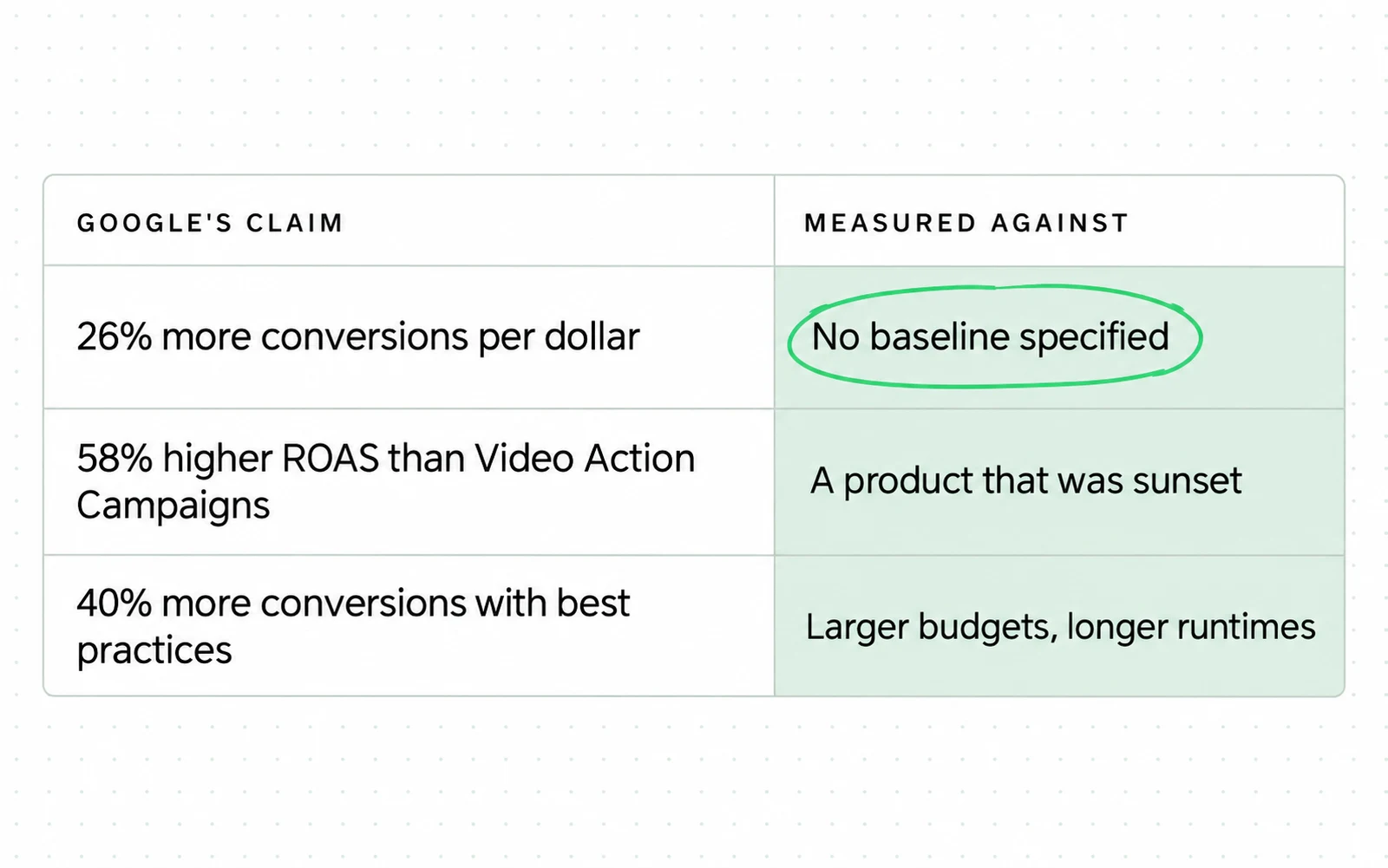
- The first claim names no baseline, so it cannot be checked against anything.
- The second compares the campaign type against a product Google has retired.
- The third describes larger budgets and longer runtimes, which improve any campaign.
Compare your account’s performance with the previous period to assess the effect of your creative and placement choices.
A test like that costs the learning period and the recommended daily budget. Use its results to assess whether your account achieves Google’s reported uplift of 26 percent.
In the account TNT Growth analysed, Demand Gen and Search reached similar costs per acquisition.
| Measure | Demand Gen | Search |
|---|---|---|
| Spend analysed | $67,000 | $1.3M |
| Cost per click | $0.09 | $7.33 |
| Conversion rate | 0.01% | 0.83% |
| Click through cost per acquisition | $880 | $878 |
| View through conversions | 180 | Not reported |
View through conversions are reported for Demand Gen only, 180 of them. Include them when you compare Demand Gen with Search in that account.
Include assisted conversions when measuring Demand Gen
A campaign that generates the first click looks unsuccessful in a report that credits only the last click, which is what the view through row above shows. Include assisted conversions, and use a reporting window long enough to capture them.
Report assisted conversions alongside last click conversions, and state the view through window you used. Set that reporting up before you assess the campaign.
A Search campaign running beside it reaches people at a different stage, so comparing the two favours Search. The same caution applies when you compare Demand Gen with Performance Max, which targets people closest to making a purchase.
Before you attribute a fall in impressions to your campaign, check whether impressions have fallen across Google Ads. Optmyzr tracked 21,425 Google Ads accounts across five quarters to Q1 2026 and counted 5.65 billion fewer impressions served, an 11 percent fall in auction volume.
Over the same five quarters Optmyzr measured click-through rate rising from 1.83 to 2.22 percent. A fall in impressions alone does not tell you whether the auction or your campaign caused it.
Conversion data determines eligibility for target ROAS bidding and trains the automated bidding model.
Google recommends starting with a target ROAS around 20 percent below your last 30-day ROAS, then adjusting bids up or down in steps of 10 percent.
For the first month, report the daily conversion count beside the cost figures. Use it to track progress toward the fifty conversion threshold while the campaign is still learning.
Sources
- Google Ads Help About Demand Gen campaigns: surfaces, bid strategies, the budget rule and the move of Display campaigns into Demand Gen, with the migration tool from June 2026 and no date yet for the rest, no update date shown
- Google Ads Demand Gen: Engage Customers and Drive Results, the marketing page for the same product
- Store Growers Google Demand Gen Campaigns: The Complete Guide, by Dennis Moons, 27 February 2026
- Google Ads Help About Performance Max campaigns
- Google Ads Help Performance Max reporting and controls update: search terms reporting for all campaigns, campaign-level negative keywords, age and device targeting fully available, gender controls in beta, channel performance report in beta, 7 August 2025
- Google Ads Help How to use brand suitability features in Performance Max: campaigns respect account-level and manager-level placement exclusions, brand exclusions per campaign, no update date shown
- Google Ads Help How Performance Max interacts with other campaigns in your account: Demand Gen and Performance Max interact on normal auction dynamics and the campaign with the highest Ad Rank serves; the one exception is a Search keyword that exactly matches the query, no update date shown
- Luís Rijo, PPC Land Demand Gen feed use hits 35 percent as PMax advertisers face Q4 overlap: Smarter Ecommerce data posted 27 July 2026, 35 percent of Demand Gen campaigns using a product feed in 2026 against 26 percent in 2025 and 16 percent in 2024, no sample or method stated, 28 July 2026
- Amazon Ads What is Demand Generation in Marketing? Definition and guide, no date shown
- Turtl 13 types of demand generation campaigns for success
- Verde Media A small business owner's guide to Google's Demand Gen campaigns
- Google Ads Help Use Lookalike segments to grow your audience: narrow, balanced and broad previously set at 2.5, 5 and 10 percent of the target location, and the statement that the 100-user minimum seed list requirement is no longer true
- Google Ads Help Demand Gen campaign asset specs and best practices: images from 300 by 300 pixels in 1:1, 1.91:1, 4:5 and 9:16, maximum 5 MB; video minimum 5 seconds; logo 1:1 from 144 by 144 pixels
- Google Ads Help Demand Gen Frequently Asked Questions: at least 50 conversions before moving to target CPA or target ROAS, an opening target ROAS about 20 percent below the trailing 30-day figure, bid steps of plus or minus 10 percent, and 10 to 15 keywords for a custom segment
- Google Ads Help Video Action Campaigns are being upgraded to Demand Gen: new VACs blocked from April 2025, automatic upgrades from July 2025, final upgrade April 2026; Google reports advertisers adding image assets seeing 20 percent more conversions at the same cost per action, on January to February 2024 data
- Optmyzr Google Ads benchmark report Q1 2026: 21,425 Google Ads accounts tracked across five consecutive quarters from Q1 2025, reporting 5.65 billion fewer impressions served, an 11 percent fall, with click-through rate rising from 1.83 to 2.22 percent
- Store Growers Demand Gen Benchmarks: What to Expect for Ecommerce in 2026, by Dennis Moons, updated 27 February 2026
- TNT Growth Google Demand Gen Campaign Benchmarks versus Search, by Adam Treboutat, 6 August 2026, stated as operator data from one account
- Affect Group Google Demand Gen Benchmarks: CTR and CPC planning ranges, 4 June 2026, no sample size given
- Anu Adegbola, Search Engine Land Google Ads API enforces daily minimum budget for Demand Gen campaigns: five dollars a day from 1 April 2026, BUDGET_BELOW_DAILY_MINIMUM in API v21 and above, 3 March 2026
- Anu Adegbola, Search Engine Land Google shifts Lookalike to AI signals in Demand Gen: the narrow, balanced and broad tiers stop being targeting limits from March 2026, with an opt-out form for the old behaviour, 17 February 2026
- Brooke Osmundson, Search Engine Journal Google Is Retiring Standalone Display Campaigns In Favor Of Demand Gen: migration tool from June 2026, new standalone Display campaigns closing later in 2026, automatic migration through 2027, 26 May 2026
Questions people ask
What is a Google Demand Gen campaign?
A Google Ads campaign type that serves on YouTube including Shorts, Discover, Gmail, Maps and the Google Display Network. Google says it encourages people to engage with an ad and take action on those channels.
It supports Maximize Clicks, conversion bidding and value based bidding, and requires conversion tracking.
What is a demand generation campaign?
Demand generation is a marketing approach that builds awareness and interest before people are ready to buy. It involves identifying consumer needs, promoting the product and generating leads.
Google’s Demand Gen is an advertising campaign type inside Google Ads.
What are the key differences between PMax and Demand Gen campaigns?
Performance Max finds customers likely to convert across all of Google's channels. Demand Gen gives more control over creative testing, audience targeting and specific placements on YouTube and Discover.
Performance Max also runs across Search and Shopping, while Demand Gen stays on YouTube, Discover, Gmail, Maps and the Display Network.
What budget does a Demand Gen campaign need?
Google Ads Help says at least ten times your target CPA as a daily budget, so a fifty dollar target means five hundred dollars a day.
The Google Ads API also refuses any Demand Gen budget under five dollars a day.