

Set the boundary before you fund the priority
You need to decide where demand generation ends and lead generation begins. Write that boundary down first. Then ask whether your market needs more awareness or a better way to capture existing interest.
If your market does not know you, demand generation comes first, because there is little existing intent to capture. If it knows you and your forms are quiet, your gap is capture.
Base the funding choice on current awareness and available intent. B2B demand generation explains which signals can support that choice.
Use the table to match the market condition to the work it needs now.
Find the condition that best describes your market today.
| If this is true of your market | Fund first | Why it fits |
|---|---|---|
| Buyers in your category have not heard of you | Demand generation | Demand work builds recognition before you ask buyers to convert |
| Buyers know your name and your forms stay quiet | Lead generation | Existing awareness shifts the constraint to the capture path |
| You need pipeline before demand work can mature | Lead generation | Lead generation can work with the intent that already exists |
| Interest arrives and the follow up loses it | Neither, fix the handoff | Fix the loss before sending more interest into the same path |
Definitions still matter for reporting. A team and its board need the same boundary before they can judge targets. Our B2B demand generation guide explains the signals behind the category.
Five choices that shape the operating model
Your team has five practical choices to make after it defines the boundary. Together, they determine who owns the work, how you divide the budget and which results you report.
Treat these as design choices for one operating model.
| Design choice | Decision | Practical effect |
|---|---|---|
| Combined ownership | One team owns awareness and contact capture | One budget and shared targets |
| Split ownership | Demand generation owns awareness; lead generation owns contact capture | Separate owners need a written handoff |
| Target dependency | Lead targets reflect the interest created upstream | Capture targets depend on available demand |
| Workflow order | Interest comes first and contact capture follows | Stage metrics can share one funnel |
| Reporting structure | Each function keeps its own goals while supporting the other | Budgets and reporting remain distinct |
Ownership creates the largest operational difference. A combined team can share targets, while split teams need a clear handoff.
- This model places awareness and contact capture under one owner.
- It works best when the team shares targets and reporting rules.
- This model gives each function its own target and reporting line.
- The handoff must state when interest becomes a captured lead.
Demand generation on its own terms
Whichever operating model you choose, demand generation reaches people who are not looking yet. The work makes your company familiar before those buyers enter the market. Some teams extend it from initial awareness through customer retention.
A business also uses demand generation to become known in a market that has never heard of it.
For example, a new category may need education before buyers know which problem to search for.
Demand-generation metrics are less direct than pipeline measures. Teams often track website traffic, content engagement, brand awareness, social mentions and share of voice. These signals can inform a sales forecast, but they do not translate into one directly.
That makes demand generation hard to fund because its early signals show up long before pipeline does. Set a review horizon for each stage of the B2B marketing funnel.
Lead generation on its own terms
Pipeline targets make lead generation easier to fund because the work is easy to count. When a quarter goes badly, the lead count is often the first number people push.
Lead generation identifies interested prospective customers and captures their contact information. Some teams only count someone as a lead once that person is ready to buy.
A useful lead definition includes current need and budget to purchase your product or service. That requirement also raises the cost of B2B lead generation.
Adding budget to the definition shrinks the group. A campaign measured against everyone who might be interested is different from one measured against buyers who can purchase today, even when both run the same ads.
Lead generation is measured by lead volume, MQLs, SQLs, conversion rates, cost per lead and quality scores. Volume metrics show how much you captured. Quality scores help you judge whether those contacts were useful.
The trap is that a countable number attracts targets. Once your form fill has a target on it, the cheapest way to hit that target is to lower what counts as a lead.
That is why teams argue about lead scoring and the difference between an MQL and an SQL.
Where demand capture sits
Lead-scoring disputes usually begin with a simpler question: where does awareness end and capture begin? Teams draw that boundary in different places. Define the handoff before assigning ownership or budget.
| Where demand capture is placed | In their words | |
|---|---|---|
| ZoomInfo, defining demand generation | Inside demand generation | "Demand generation encompasses two distinct motions: demand creation and demand capture" |
| ZoomInfo, drawing the comparison | Opposite demand generation | "The distinction maps to demand creation versus demand capture" |
| Leadfeeder | Inside demand generation, as step two | "The first step generates demand. The second step is demand capture" |
| fullfunnel.io | A third term of its own | Section heading: "Demand generation vs lead generation vs demand capturing" |
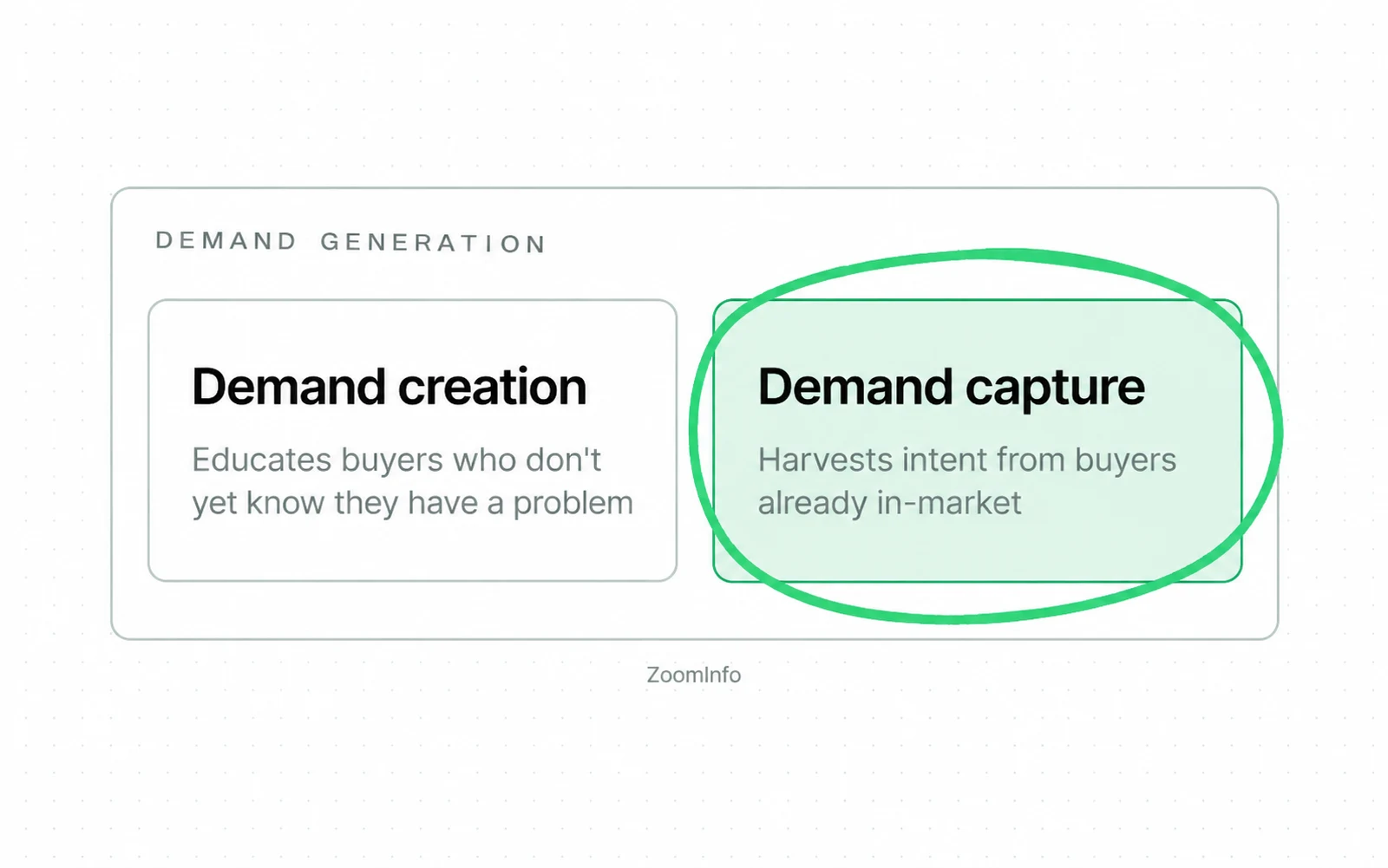
- Demand creation educates buyers before they show active intent.
- Demand capture begins when the team acts on an observable intent signal.
Define the observable intent signal that moves someone from demand creation into capture. Without that threshold, ownership changes with each campaign.
So when someone says your team should be doing more capture, ask which of these they mean before you agree. The word alone does not tell you whose budget it comes from, or where in the B2B marketing funnel the work lands.
How long demand generation takes to show results
Your budget needs one timeline for pipeline impact and another for relationship development. Give each timeline its own signal and review date, or you will judge both kinds of work against the wrong deadline.
Use a separate review date for each endpoint.
| Planning line | Review signal | How to use it |
|---|---|---|
| Early demand | More buyers engage with the category and brand | Use it to check whether awareness is growing |
| Relationship development | Known buyers return and engage again | Use it to check whether interest is becoming sustained |
| Pipeline impact | Qualified opportunities begin to reflect the work | Use it to judge whether demand is reaching sales |
| Lead capture | Existing interest turns into usable contacts | Review it separately from long-term demand work |
Pipeline impact and relationship development reach different endpoints. Label the endpoint before you attach a deadline to the budget.
Say which endpoint you mean when you ask for the budget.
When to delay demand generation
Delay demand generation when the immediate constraint is conversion, time or a broken capture path. Check all three before you move the budget, because more awareness will not repair any of them.
The first is a market that already knows you and still does not convert. Awareness spending there buys you more of a thing you already have.
Check whether branded searches and direct visits already bring qualified buyers to your site before you buy more awareness.
The second is a runway shorter than the wait. If the business needs pipeline before demand work can mature, put the immediate target on lead generation.
A long horizon does not guarantee payback. Fund it only when the business can wait for the signal it is designed to produce.
The third is a capture path that leaks. If the form, follow-up or lead nurturing sequence loses incoming interest, fix those steps before spending more to create interest.
In all three, lead generation or conversion work addresses the immediate constraint more directly. Price the chosen work against the target it must move.
Whichever you fund, write down how your team divides awareness, capture and handoff. Otherwise the reporting argument returns later.
For example, if search on your own site is part of the plan, that is what our B2B SEO service does.
Sources
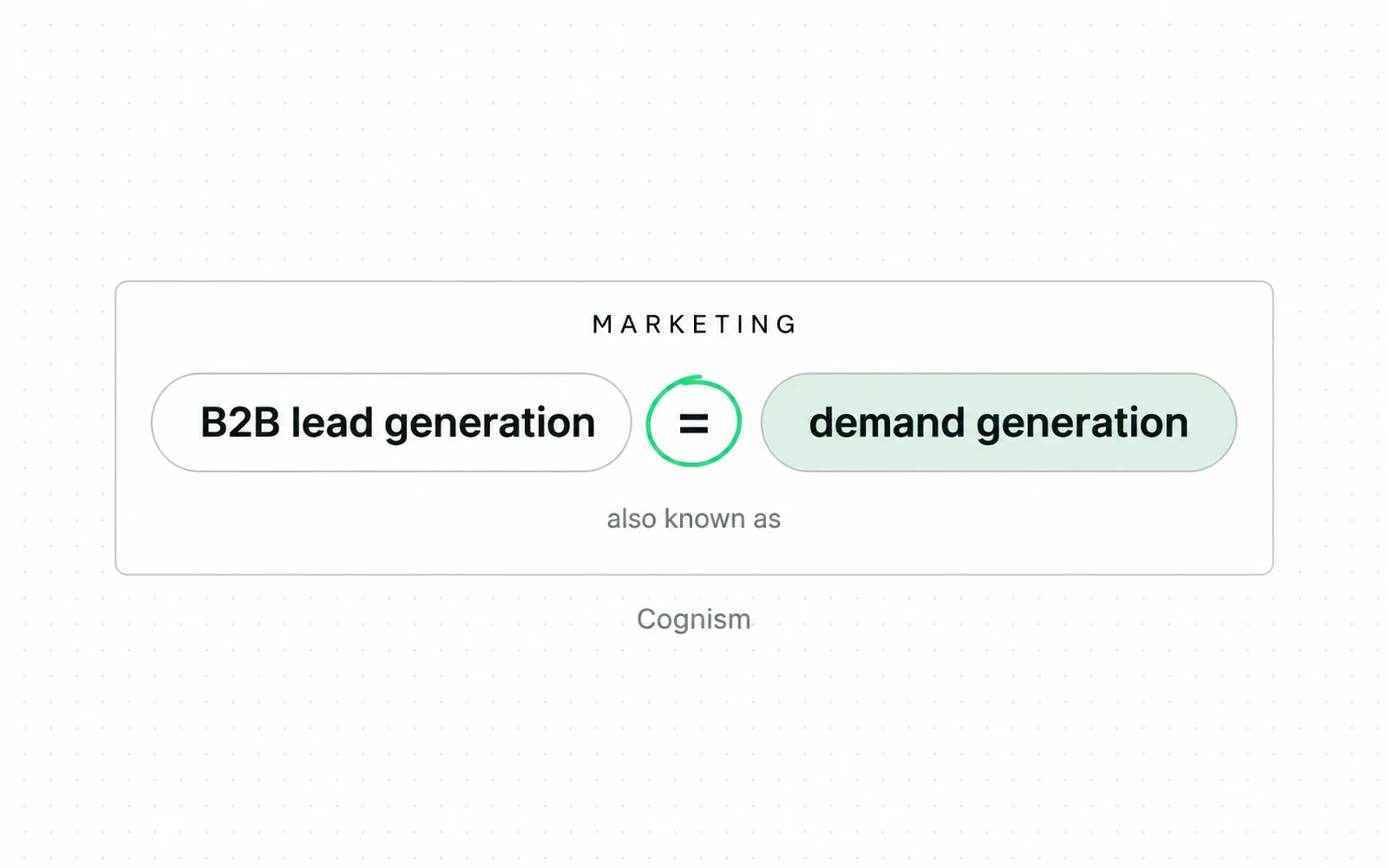
- Cognism What is B2B Lead Generation, which says the process is also known as demand generation
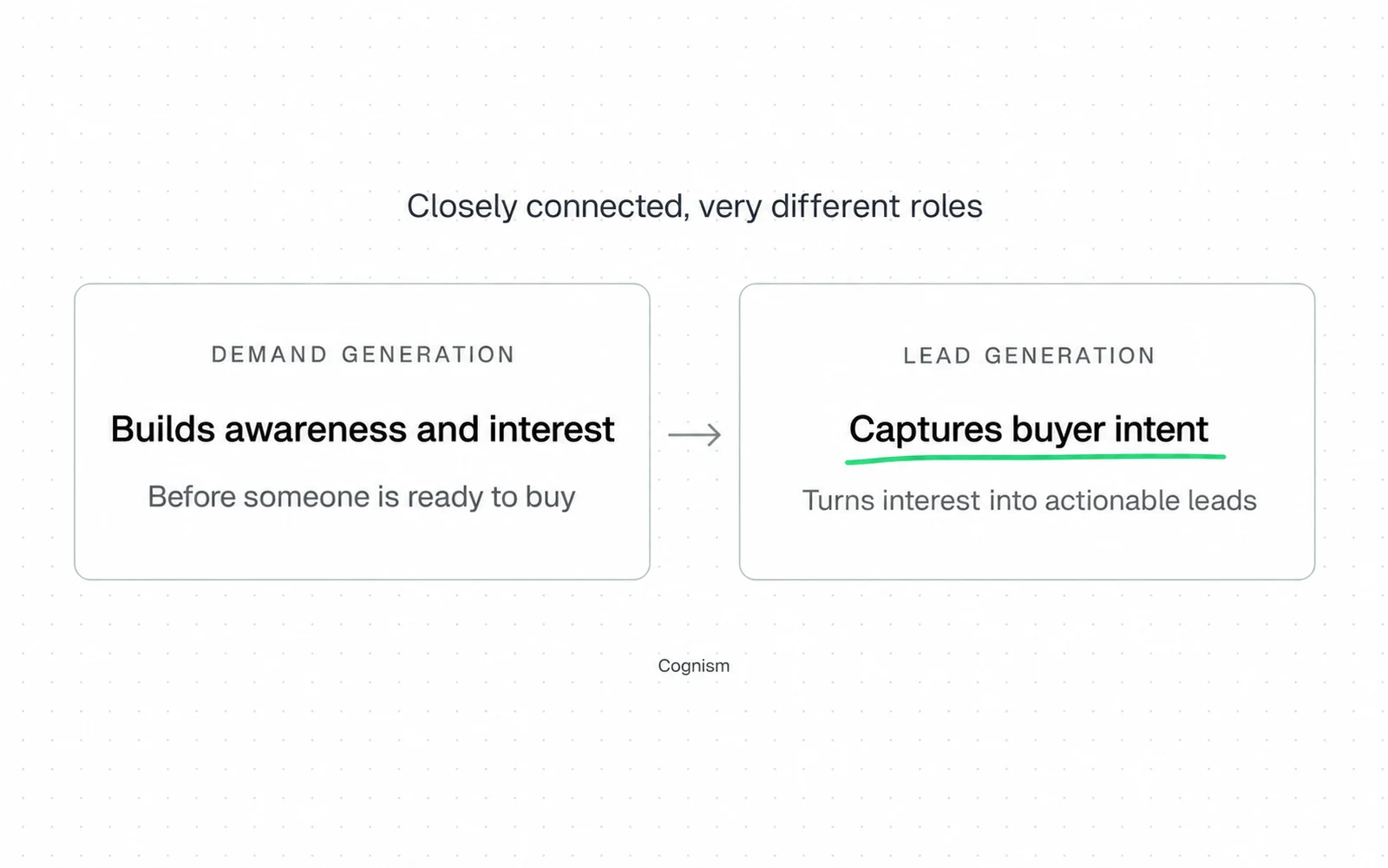
- Cognism Lead Generation vs Demand Generation, which says the two play very different roles
- INFUSE What Is Demand Generation, which makes lead generation the outcome of demand generation
- Salesforce Demand Generation vs. Lead Generation, which frames them as two consecutive stages
- ZoomInfo Demand Generation vs. Lead Generation 2026 Guide, which puts demand capture on both sides of its own comparison
- HubSpot Demand generation vs. lead generation, which calls them two distinct practices often used interchangeably
- Leadfeeder Demand Generation vs. Lead Generation, which makes demand capture the second step of demand generation
- monday.com B2B demand generation strategies, with a side by side table and a stated time horizon
- Informa TechTarget The Complete Guide to B2B Demand Generation, whose comparison adds budget to the lead generation definition
- fullfunnel.io B2B demand generation guide, which runs the comparison across three terms instead of two
- MarketOne What is B2B demand generation, which calls the people demand generation goes after leads
Questions people ask
What is the difference between demand generation and lead generation?
Demand generation creates interest before someone is ready to buy. Lead generation captures contact details from someone already interested.
Because teams draw the boundary differently, agree on ownership and targets before reporting results.
Is lead generation part of demand generation?
It depends on the operating model your team adopts. Lead generation can sit inside demand generation when the function covers both creation and capture.
Teams that reserve demand generation for creation treat lead generation as the next stage.
Which one should I prioritise?
If your market has little awareness, prioritise demand generation. If awareness is strong but forms remain quiet, prioritise lead capture in the short term.
The definition does not change what you should fund next quarter.
Why is lead generation so hard?
Lead generation is difficult because the target group must have a current need, sufficient intent and budget.
That group is smaller than the audience your demand work reaches. Measure capture against the smaller group, or the job looks harder than it is.