

What does an ideal customer profile describe?
A profile names companies, not people. The confusion between the two is the failure the whole idea exists to prevent, and the cost of it is specific: a perfectly qualified contact sitting inside a company that was never going to buy.
Three layers, three owners: the profile filters companies, the persona describes a role inside one, the score ranks an individual record against both.
Three layers, and the question each one answers.
| Layer | What it is about | The question it answers |
|---|---|---|
| Ideal customer profile | A company | Can this company buy from us at all |
| Buyer persona | A role inside that company | Who in it cares, and about what |
| Lead score | One person record | Which of them to call first |
Three company facts decide the first row and none of them shows on a person record: too small to afford you, locked into a competitor, or years away from having the problem.
None of this is new. Deciding which customers to serve is fundamental to strategy, and so is deciding not to serve others.
That second half is the part a profile is for. If yours does not rule anybody out, you have written a description of your market.
The count runs one to many in the other direction: many buyer personas, one profile.
The unsettled part is where the profile comes from, and the two answers on this page disagree about it completely.
Mixing them produces a specific and expensive result: a well scored contact at a company that was never going to buy. The score was right about the person and nobody had asked about the company.
The software you keep the profile in blurs the same line. HubSpot ships an ideal customer profile tier property with three grades, tier one a great fit and tier three acceptable but low priority.
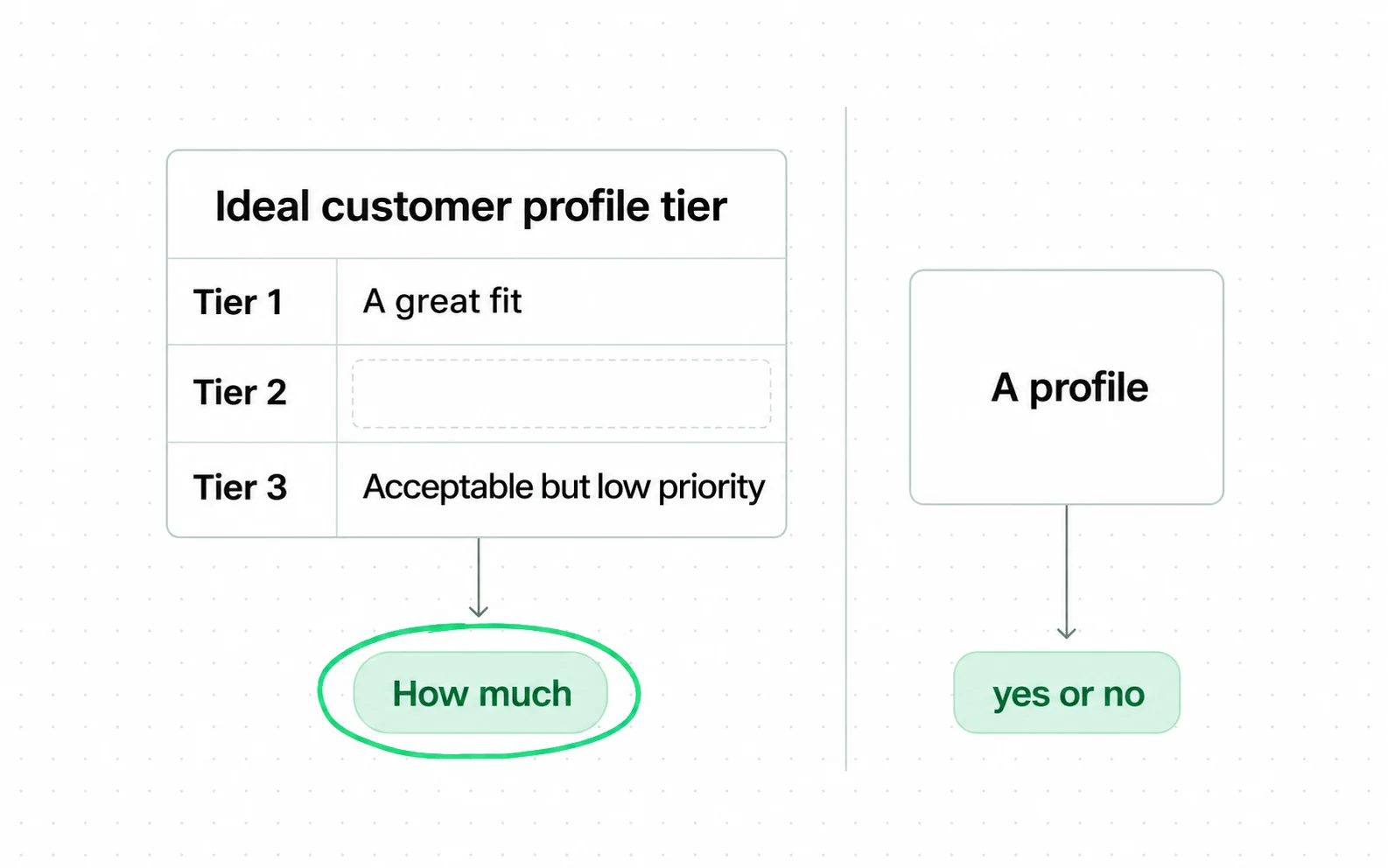
A filter answers yes or no and a tier answers how much, so the field that stores your profile is already a score. Nothing warns you about that, and it is the same collapse one layer down.
Two methods matched to customer count
Two methods produce a profile. Derivation reads your existing accounts for what they share and writes it down as a filter; discovery states a guess, sells against it and corrects it with what closes. The first has an input requirement: enough existing accounts for a shared pattern to be more than a coincidence.
Derivation is the familiar one, and it is usually sold on its benefits. Its inputs go unmentioned.
Now the other method. Lenny Rachitsky interviewed twenty-five named founders and operators, from Gong and Figma to Notion and Databricks, and published what they had in common.
Most founders initially got their ICP wrong. Everyone landed on at least three attributes to describe their ICP. Data from outbound sales is the best signal for what’s working, versus leads from investors and friends.
Lenny Rachitsky, 29 August 2023 read 7 September 2026
- Most founders got the first version wrong, so a first version is a starting position and not an answer.
- The signal that corrected it came from outbound selling. Leads arriving through investors and friends did not carry it.
- Everyone landed on at least three attributes. That floor was observed across the group; nobody imposed it.
Read those two together and the disagreement is not about definitions. The evidence runs in opposite directions: one derives the profile from customers you already have, the other produces the customers to derive it from.
Mathilde Collin, who runs Front, is quoted in the same piece calling the failure to think about this early one of her biggest mistakes. She names the omission itself as the cost, not a wrong answer.
Fair question: are the two methods in conflict at all, or does one describe the early stage and the other the later one? That reading holds.
What does not hold is presenting the later method as the only method. A company with eight customers is then handed an exercise its own numbers will struggle to fill.
Minimum input for derivation
Derivation is the method with an input requirement, and the requirement is the part that usually goes unmentioned. A profile lands on at least three attributes. Count the segments three attributes create and the requirement becomes arithmetic, holding only on its own two assumptions.
Three attributes, each with two possible values, divide the world into eight kinds of company.

Say you have eight customers and three attributes. Spread evenly that is one account per cell, and real lists never spread evenly, so the useful question is whether yours clusters.
If most of them sit in one cell, you have something to look at and a sample too small to be sure of. If they scatter, what you have describes your customers; it does not filter for new ones.
Which method your numbers allow
- Count your closed accounts, then run the arithmetic above on your own list and look at how they land. The fewer accounts your largest segment holds, the less there is to derive from and the more the founder method is what you have.
- Write the guess down anyway, in three attributes, specific enough that any company can be checked against it in a minute.
- Sell against it deliberately. Outbound data is what carries the signal; leads arriving through investors and friends do not.
- Watch for four signs: conversion rate up, enthusiasm up, urgency up, and the nod.
- Rewrite the guess when the evidence contradicts it, and expect to. Most first versions turn out to be wrong.
Once you do have volume, derivation has something to work with, and its advantage is that it reads evidence instead of memory.
No defensible crossover number exists, and this page will not invent one. Check instead whether your largest segment holds enough accounts to be more than a coincidence, using the same arithmetic on your own list.
Ideal customer profile examples from five companies
The word attribute sounds like a field on a form, and the real examples are nothing like that. Eleven companies published their first profile in exactly three conditions each, and the conditions are specific enough to check.
Gong: Software company selling in English | selling via video conferencing | selling software that costs $1,000-$100,000. Linear: 2-5-person startup | using GitHub and Google Auth | at a founder-driven product company. Figma: Mid-stage software company | with in-house designers | that place a premium on design. Ramp: Series A/B | finance teams who want less waste and more predictability | spending $250k-$2m/month. Snyk: Early-stage tech startup | security-conscious web developer | within the Node.js community.
Lenny Rachitsky, 29 August 2023 read 7 September 2026
- Linear names a company size, a specific pair of tools, and a leadership pattern. Not one of the three is an industry.
- Ramp names a funding stage, a job the buyer wants done, and a monthly spend band.
- Gong is the only row with a price range in it, and Snyk is the only one that names a developer community.
These are not the firmographic filters a data vendor sells. Google Auth is a technographic signal, a founder-driven product company is a judgment, and less waste with more predictability is a job someone is trying to get done.
That mix is the practical difference between the two methods. Derivation returns whatever attributes your data happens to hold, and those categories are firmographic, technographic and behavioural.
Discovery returns whatever separated the deals that closed from the ones that did not, and that is often something no vendor has a column for.
Look at what these rows name: a tool, a spend band, a community. Sector is the easiest attribute to fill in, and not one of the rows above uses it. Two companies in one industry can differ more than two companies across industries.
For instance, turning your finished profile into terms and pages is B2B SEO agency work at Addition, a search marketing agency.
Common profile mistakes
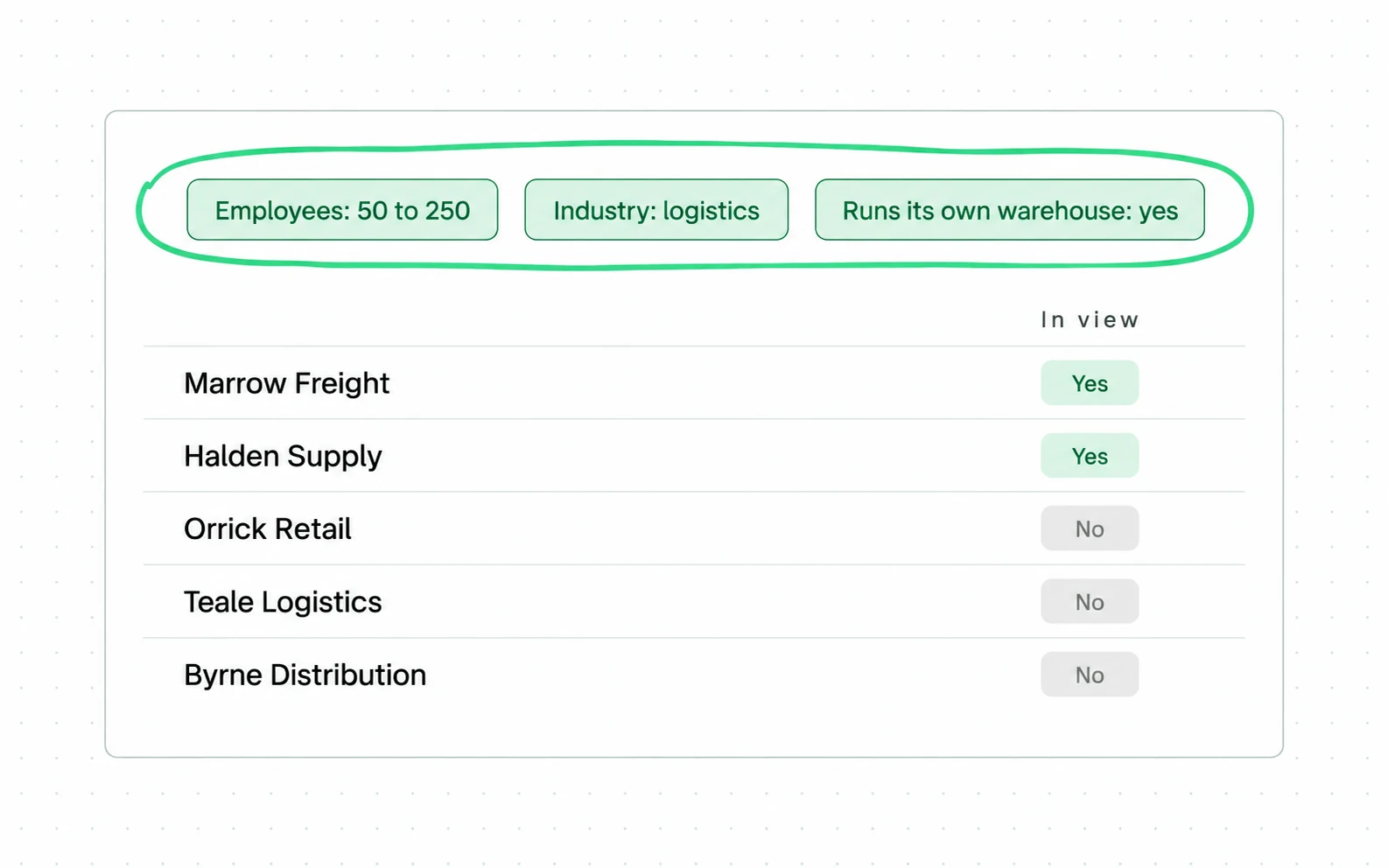
Four failures come up again and again, and not one of them is a mistake about the definition. Each is a step skipped somewhere between having a profile and using it, and each one is cheap to check.
Four habits and what each one hides.
| Habit | What it hides |
|---|---|
| Deriving a profile from a handful of accounts | That three attributes cut the world into eight segments, and a handful of customers cannot fill them |
| Filling in the fields a data vendor provides | That the attribute which separates your wins may have no column |
| Scoring people without filtering companies first | That a perfect contact at an unqualified company still cannot buy |
| Treating the first profile as settled | That Lenny Rachitsky's founder interviews found most first versions were wrong |
The third is the one with a number attached elsewhere on this site. Once the profile becomes a named list of companies, account-based marketing sets out the condition under which working that list is worth the effort.
The second is subtler. A profile assembled only from the columns a data provider supplies is bounded by that provider, and a founder-driven product company is not a column anyone sells.
Skipping the whole thing is commoner than any of the four. Gary Lilien and Ofer Mintz found 45 percent of B2B startups doing no systematic marketing at all. They read 693 companies from the Equidam platform, with a separate panel of 377 behind the result.
Systematic marketing in their definition is an ongoing process of collecting customer data and using it. A profile you never revise is closer to that 45 percent than to the four habits above.
Having one and using one are also different things. The Content Marketing Institute asked 1,015 B2B marketers in mid-2025 how far their personalisation reaches, and 59 percent called it basic, in one or two channels.
The fourth is the one the founder interviews speak to directly. A profile treated as settled quietly becomes a reason to reject evidence, and a deal that closes outside it gets filed as an exception instead of read as a correction.
A fifth objection comes from outside this set and it disputes the whole exercise. Jenni Romaniuk at the Ehrenberg-Bass Institute calls narrow targeting counter-productive to B2B growth, and recommends targeting all buyers in the category.
Her evidence is 16 US business insurance products, where customer overlap between brands ran from 14 to 24 percent. The reading behind it is the duplication of purchase law: brands share customers in proportion to competitor size, whatever their positioning says.
That does not make a profile useless to you. It narrows what a profile is for. Use it to decide who you serve well and what you build, not to decide who is allowed to see your advertising.
The same three conditions are also the input to B2B keyword research, where they decide which search terms are worth writing for.
Measure the profile against closed deals
All four are failures to check the profile against something. A profile is a claim about which companies buy, so the test is whether the companies it names do, and that test needs the profile written down before the quarter.
Tag every opportunity as in profile or out of profile at the moment it is created. For example, if you write your profile after the quarter, you write it knowing which deals closed, and the test stops being a test.
Then compare win rates between the two groups over the same period. If your in profile group does not win more often, separate two explanations before anything else: the profile may be wrong, or your team may not be applying it.
Watch the four qualitative signs as well as the rate. Conversion up, enthusiasm up, urgency up and the nod all arrive before a number does. A win rate needs enough deals behind it before it says anything.
When the profile is stable enough to score against, lead scoring turns the company level filter into a number on individual records. B2B lead generation sets out what reaching those companies costs.
That test has a timing problem under it. 6sense surveyed nearly 4,000 B2B buyers for its 2025 Buyer Experience Report and found they choose from their Day One Shortlist 95 percent of the time.
First contact with a seller now falls around 61 percent of the way through the journey. A profile that decides who reaches that shortlist is doing its work months before your win-rate column moves.
An account can match the profile and still buy nothing this quarter. John Dawes at the Ehrenberg-Bass Institute puts roughly 95 percent of business buyers out of market in any given quarter.
That figure is division, not measurement: a five-year average purchase cycle spread over quarters, and Dawes calls it a heuristic. A quiet in-profile list is a timing question before it is a profile question.
One more comparison is cheap and rarely run: the accounts that closed outside the profile. If several of them share something, that something belongs in the next version, and your profile was too narrow instead of wrong.
Sources
- Lenny Rachitsky How to identify your ideal customer profile, 29 August 2023, drawing on interviews with twenty-five named founders and operators
- ZoomInfo What is an ideal customer profile, ICP guide for B2B, updated 1 July 2026
- Salesforce guide Ideal customer profiles, benefits and how to create, 14 May 2026
- Salesforce State of Sales Finding that 86 percent of business buyers are more likely to buy when their goals are understood, quoted on the Salesforce page
- Mathilde Collin, Front Quoted in the founder corpus: not thinking about the profile early was one of her biggest mistakes
- Google AI Overview Overview for the query ideal customer profile, as it stood on 27 August 2026; overviews are regenerated per search and the live one may differ
- Cognism How to create an ideal customer profile with template, 29 September 2025, updated 16 April 2026
- HubSpot Set up account-based marketing in HubSpot, knowledge base, updated 20 June 2026
- Qualtrics Ideal customer profile article
- HubSpot blog Ideal customer profile post
- Miro ICP marketing page
- Crunchbase Ideal customer profile blog post
- 6sense The B2B Buyer Experience Report 2025, a survey of nearly 4,000 buyers across North America, APAC and EMEA, each qualified by a minimum spend of 25,000 dollars in the past two years, plus a companion survey of 766 more
- Michael E. Porter, Harvard Business Review What Is Strategy?, November to December 1996, on deciding which target group of customers, varieties and needs to serve, and on deciding not to serve others
- Jenni Romaniuk, Ehrenberg-Bass Institute Narrow targeting is counter-productive to B2B growth: research on 16 US business insurance products, with customer overlap between brands running from 14 to 24 percent, published via Marketing Week
- Penn State Smeal College of Business, on Gary Lilien and Ofer Mintz Nearly half of B2B startups choose not to market themselves: Industrial Marketing Management, 2024, on 693 startups from the Equidam platform between July 2016 and April 2018, with a validation study of 377 from an entrepreneur panel
- Salesforce State of Sales, seventh edition: 4,050 sales professionals in 22 countries, fielded August to September 2025, average seller spending 40 percent of their time selling
- Content Marketing Institute B2B Content and Marketing Trends: Insights for 2026, 1,015 B2B marketers, fielded 24 June to 14 August 2025
- John Dawes, Ehrenberg-Bass Institute The 95:5 rule, 2021, an arithmetic estimate the author explicitly calls a heuristic, not a precise rule
Questions people ask
How do you define an ideal customer profile?
Two ways, and which one you can use depends on how many customers you have. Derive it by looking for attributes your best accounts share, or state it as a guess and correct it against what closes.
In Lenny Rachitsky's interviews with twenty-five named founders and operators, most first versions turned out to be wrong, so treat yours as a starting position and not a finding.
What is an ICP example?
Linear started with two to five person startups, using GitHub and Google Auth, at a founder-driven product company. Three conditions, and eleven companies in Lenny Rachitsky's founder-interview corpus published theirs the same way.
Notice what those are. They are not industry and revenue band; they are conditions specific enough that you could check any single company against them in a minute.
What is a customer profile example?
A customer profile usually means the person, and an ideal customer profile means the company. Sales Director Sam at a mid-sized manufacturer is a persona; a mid-sized manufacturer with in-house engineers is a profile.
Our entry on marketing qualified lead covers the person level threshold, and that is where the two get mixed up most often.
What are the 7 qualities of a good customer?
Seven is a number the question brings, not one the practice settled on, so no list follows.
What decides it at the company level is fit: budget, timing, and a problem you solve. A numbered list of virtues is easier to remember and harder to check.

