

Why does volume fail as a B2B keyword research filter?
Keyword research in most markets starts by sorting a list by monthly searches and working down it. In B2B that sort puts the wrong terms on top, and knowing so leaves you with a list and no order.
The problem takes one paragraph to state. Search volume data can become almost meaningless when the audience is narrow enough.
Andrew Holland writing for Search Engine Land treats volume as one input, weighed against internal resource and the cost of ranking. He stops before any arithmetic that would settle a single term.
Prioritising volume over relevance gets named as a mistake, and the answer offered is conversion potential. Naming the mistake is not the same as pricing the term, and neither page does the second part.
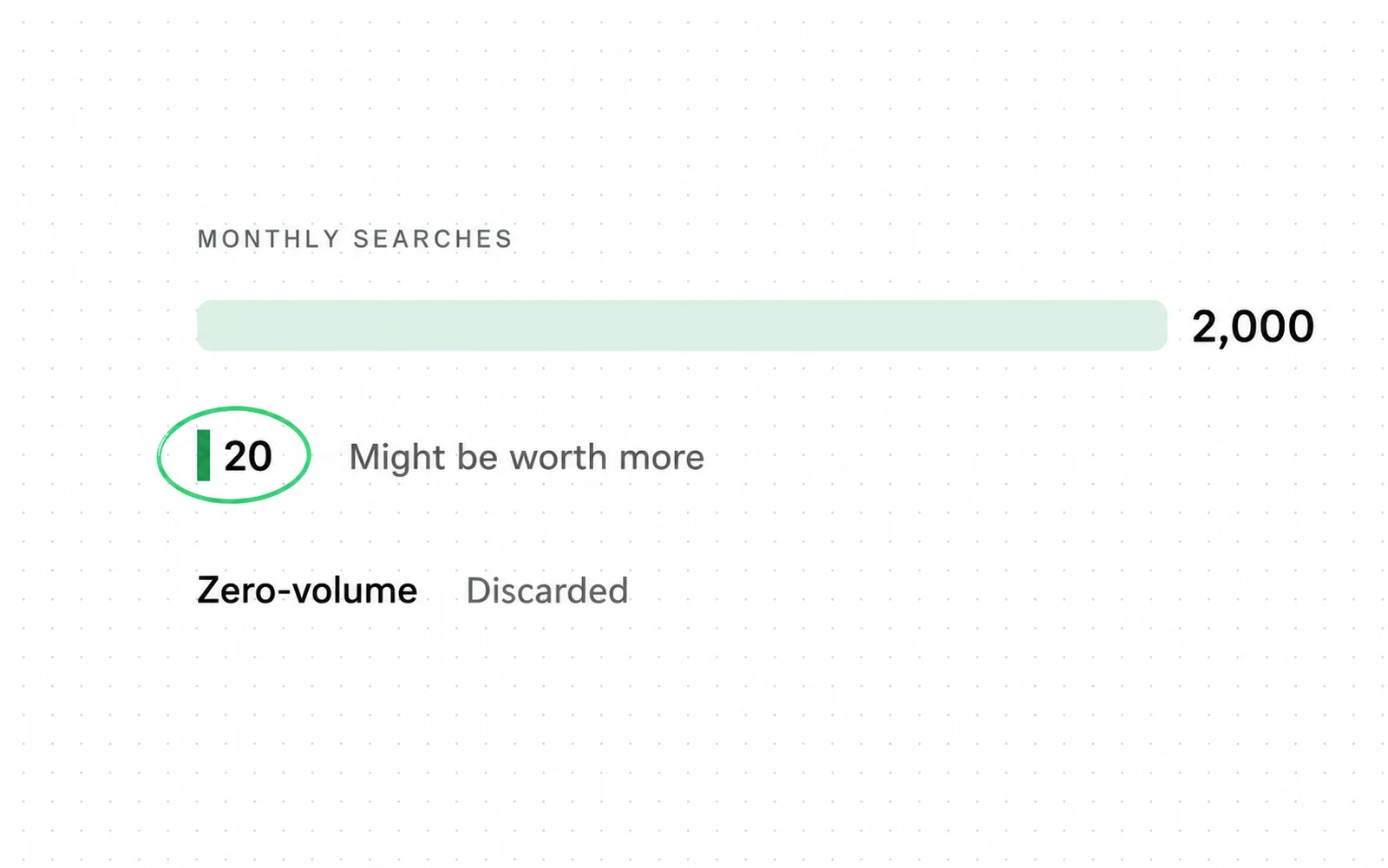
- Twenty against two thousand is the comparison, and the smaller number is the one being defended.
- The last clause is the operational consequence: the standard method removes those terms before anyone looks at them.
Even very low volume terms can be valuable, and chasing high volume terms in B2B is a vanity metric.
Both are right, and both stop at the same point. One offers account level engagement and conversion quality. The other offers profile fit, buying intent, commercial value and ranking ability.
Every one of those is a judgment. Put two candidate terms side by side and none of them tells you which to write first.
Quant-only analysis falls short in technical B2B spaces, and that is where the standard method stops.
The single exception offers a proxy in place of volume. Cost per click gets read as evidence that a term converts for somebody, so you get a number you can sort on and it is somebody else’s economics.
Some methods keep volume as a selection input and balance it against competition. That is the ecommerce keyword research method applied unchanged.
The column you sort by is itself an estimate. Google Ads Help calls average monthly searches a twelve-month average and says your figures are rounded, hard enough that two locations do not add up to their total.
SparkToro and Datos measured the shape of that column across 331,697,810 searches on about 130,000 US devices between January 2023 and September 2024. The top 10,000 terms carried 46 percent of all demand, and your terms are not among them.
In the same panel, 612,981 keywords searched exactly once in September 2024 were 59 percent of unique queries and 2.2 percent of volume. That is the tail a volume sort removes before you see it.
John Dawes at the Ehrenberg-Bass Institute puts the other half of it. Firms change providers about once every five years, so about 5 percent of your buyers are in the market in a quarter.
Dawes calls that a heuristic and not a precise rule, and the caveat matters more in a niche than in a mass market.
Price one term instead of ranking a list
A term is worth what it produces in a year. That is four multiplications, and every input is a number a B2B company either has or can find.
Take a term at twenty searches a month, the small side of the comparison. That is 240 searches a year.
Apply your click share for the position you can realistically hold, your enquiry rate for that page, and your close rate for enquiries from that source. What comes out is a customer count.
One small term across a year
Your click share sits in your analytics, your enquiry rate on the page, and your close rate in your CRM. Put those three in before reading the last row.
Just under one customer a year, from a term a keyword tool would put near the bottom of a sorted list. The last multiplication is the one that changes the decision.
What that term is worth at three contract values
The same term, the same traffic, three businesses. Contract value is the input the keyword tool never sees and the only one that moves the answer by an order of magnitude.
Run the same chain on a term at two thousand searches a month whose audience is one step wider, and the enquiry rate is the number that collapses. That comparison gets described often and computed rarely.
Nothing here needs a tool licence. The click share comes from your own analytics, the enquiry rate from the page, the close rate from your CRM, and the contract value from your last twenty invoices.
The arithmetic is also the reason a small term can justify a page that a volume sort would never approve. One customer a year at a quarter of a million pays for a lot of writing.
Where the enquiry becomes a lead worth counting is the subject of cost per lead, and the definition it has to pass is in MQL vs SQL.
Get B2B keyword demand from your own Search Console
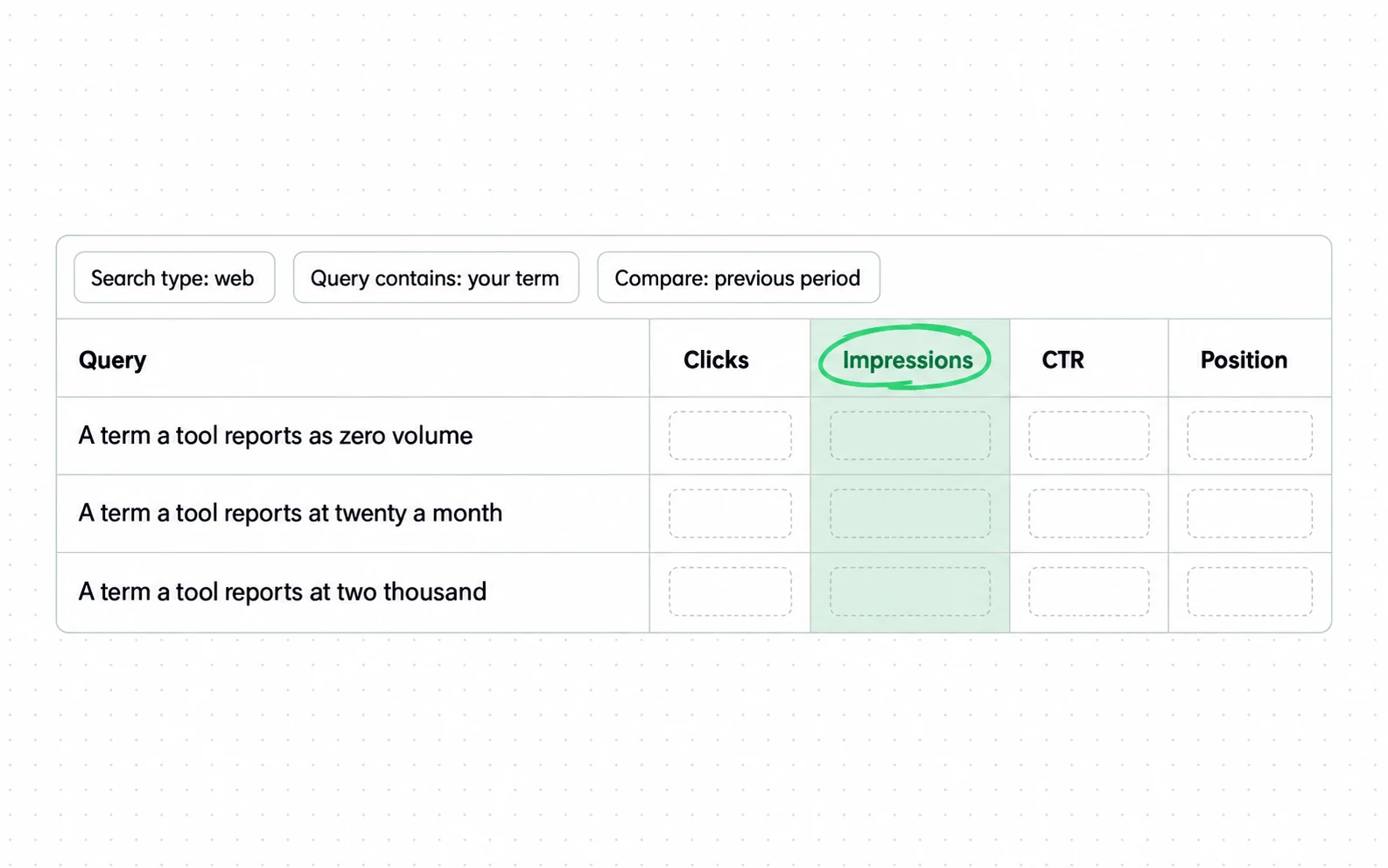
The estimate a tool prints is modelled from clickstream and it is least reliable exactly where B2B lives, at the low end. Your own impressions are measured, not modelled, and they cost nothing.
-
Write the profile first
Three conditions specific enough to sort a company list. The test is in ideal customer profile, and terms are chosen against it, not against a volume column.
-
Collect the words your buyers use
Sales call notes, support tickets, the subject lines of enquiry emails. These produce terms no tool suggests, because the tool starts from what is already searched at scale.
-
Read your own impressions
Search Console, Performance, Queries. Filter to the term. Impressions are your measured demand for it, on your market and your device mix.
-
Price each candidate
Run the four multiplications above with your own rates. Sort by the last column, not by the first.
-
Keep the zero volume terms in a separate list
They cannot be sorted by an estimate that does not exist. Judge them on profile fit and revisit them once a page ranks and impressions appear.
Ahrefs compared Search Console impressions with Keyword Planner volume for 72,635 keywords in November 2021. Keyword Planner came in higher than the measured impressions 91.45 percent of the time, and drastically higher in 54.28 percent.
Ahrefs sells the tool it was comparing, so read the ranking as an interested party. The direction of the error is the part you can check yourself in Search Console.
Difficulty is the field worth keeping. It answers whether you can hold a position at all, and it is the one column a tool measures from something other than the audience size.
Everything else in the table below is either yours already or absent from the tool entirely.
Suppose you have chosen the terms. The seo-content-brief skill turns one of them into a brief against the pages that rank, with your real sitemap as its source of internal links.
The tools stay useful for what they measure well. What they report and what the decision needs are different fields, and the difference is worth seeing side by side.
What a keyword tool reports and what pricing a term needs
| Keyword tool | Pricing a term | |
|---|---|---|
| Monthly search estimate | yes | starting point |
| Difficulty score | yes | yes |
| Your click share at that position | no | required |
| Your enquiry rate on that page | no | required |
| Your contract value | no | decides it |
The difficulty row is the same on both sides, and it is the only field the tool supplies that survives into the decision unchanged.
How much time does B2B keyword research take?
The reason the volume sort survives is that it is fast. Sorting by a column is instant, and the alternative sounds like a research project. The published numbers show where the hours go.
One reported competitor analysis in software test automation produced over nine thousand candidate keywords, and clustering reduced a list by more than sixty five percent.
He also quotes consultants on how long the work takes: thirty to forty hours in one case, ten to fifteen in another, and the better part of a week in a third.
Where the hours in a keyword project go
The last bar is small on this scale on purpose. Nine hours is the floor, and the published quotes run from ten to forty, so the judging is not where most of the time goes.
Pricing twenty candidate terms with the four multiplications takes an afternoon, and it produces a ranked list somebody can defend in a meeting.
The nine thousand candidate approach produces a longer list and the same unanswered question about which term to write first.
Which of your terms to write first, priced before you write: that is B2B SEO agency work at our search marketing agency.
Four B2B keyword research mistakes to check before you commission
Four mistakes turn up again and again, and each one costs whatever you spent before you noticed. The cost lands late because a keyword decision only shows its result once the page has been live long enough to rank.
Four habits and what each one hides.
| Habit | What it hides |
|---|---|
| Sorting the list by monthly searches | That the audience behind the top rows is not yours |
| Discarding the zero volume terms | The terms with the shortest distance to a contract |
| Taking the tool estimate as the demand | A measured impression count sitting in your own account |
| Ranking terms without contract value | The only input that moves the answer by an order of magnitude |
The third one has a quiet version worth naming. A tool reporting zero is reporting that its model has no signal, and a term your buyers use twice a week produces no signal at all.
Your own impressions are the correction, and they only appear once a page exists to collect them. That ordering is why the zero volume list is kept, not deleted.
The first habit has a version that survives good intentions. A team agrees volume is the wrong filter, then sorts by difficulty score instead, and the difficulty score is derived from the same audience the volume estimate described.
Both columns come from the tool. Neither of them knows what a customer is worth to you, and that is the number the decision turns on.
Measure B2B keywords by enquiries per term
A keyword programme judged on sessions will always recommend the high volume terms, because sessions are what those terms produce. The measurement has to sit closer to the contract than that.
Count enquiries by landing page, and read the page against the term it was written for. A page with eighty visits and two enquiries beats a page with four thousand visits and one.
Keep the contract values beside it. The same two enquiries mean different things at twelve thousand a year and at a quarter of a million.
Datos, a Semrush company, measured US Google searches from September 2022 to May 2024 on a clickstream panel of tens of millions of users. Around 600 of every 1,000 ended without a click going anywhere.
Pew Research Center watched 68,879 Google searches from 900 US adults in March 2025. People who saw an AI summary clicked a result in 8 percent of visits, against 15 percent when they did not.
Both numbers say the same thing about your reporting. A term’s volume is not traffic, and traffic is not an enquiry.
Give a new page two quarters before judging it. A B2B term with a handful of searches a month produces a handful of impressions a month, and a single month of that data is noise.
When you do judge it, compare it against the price of the page, not against another page. A page that cost six hundred pounds and produced one enquiry has already answered the question.
What to report, how often, and what it answers.
| Number | Window | What it answers |
|---|---|---|
| Enquiries per landing page | Monthly | Whether the term was worth writing |
| Impressions for the target term | Monthly | What the tool estimate was hiding |
| Average contract value by source term | Quarterly | Which terms bring the customers worth having |
| Zero volume terms now showing impressions | Quarterly | Which of the held back list to write next |
What the enquiries cost to produce is the subject of cost per lead, and where the terms sit inside a wider plan is in B2B marketing strategy.
The plan those terms are published into, and what two years of it commits you to, is B2B SEO strategy.
One reporting habit is worth adding on the first day. Record the term each page was written for, in a field somebody can filter on, because six months later nobody remembers.
Sources
- Konstruct Digital The Only B2B Keyword Research Guide You'll Need in 2026, by Brady Bateman, 14 January 2026
- Hallam B2B keyword research: how to find and prioritise keywords that drive pipeline, by Paulina Wisniewska, 21 August 2026
- Mike Sonders B2B keyword research is broken, 27 January 2025 and updated 14 March 2025, by an author who sells a tool for the problem
- Neil Patel How to do B2B keyword research using Ubersuggest
- Design at Work How to conduct B2B keyword research like a pro
- Altitude Marketing B2B keyword research: 5 steps to target the right organic keywords
- Ahrefs GSC vs GKP: comparing search volumes for 72,635 random keywords in the 1K to 10K range, Google Search Console impressions against Google Keyword Planner volume for the same month, 3 November 2021
- SparkToro and Datos We analyzed 331,697,810 searches for 320,775 unique query terms across roughly 130,000 US devices over 21 months, January 2023 to September 2024
- SparkToro and Datos 2024 zero-click search study, clickstream panel of tens of millions of users, September 2022 to May 2024
- Pew Research Center Google users are less likely to click on links when an AI summary appears, 68,879 unique Google searches from 900 US adults in March 2025, published 22 July 2025
- John Dawes, Ehrenberg-Bass Institute The 95:5 rule: firms change major providers around once every five years, so roughly 20 percent are in the market over a year and about 5 percent in a quarter; the author states the figure is a heuristic and not a precise rule
- Google About Keyword Planner forecasts, Google Ads Help
- Search Engine Land Keyword research for SEO: the ultimate guide, by Andrew Holland, 30 September 2024
- SeeResponse Mastering keyword research for B2B: uncovering high-impact terms for your niche
- Google Search Console Performance report, the queries view this page sends you to
Questions people ask
What is B2B keyword research?
Choosing the search terms your buyers use, in a market where those terms carry very little measurable volume. The method is the same as any other keyword research until the sorting step.
At that step the standard approach puts the wrong terms on top, because it is sorting by an audience size that does not describe your buyers.
Why is search volume unreliable for B2B keywords?
Volume estimates are modelled, and the model has least signal where the searches are fewest. A keyword with 20 monthly searches might be worth more than one with 2,000.
Your own impressions in Search Console are measured, not modelled, and they are free.
How do you choose between two B2B keywords?
Price them. Annual searches multiplied by your click share, your enquiry rate and your close rate gives a customer count, and that count multiplied by your contract value gives an annual figure.
Contract value is the input that separates two terms a keyword tool would rank the other way round.
Should you target zero volume keywords in B2B?
Keep them on a separate list instead of deleting them. They cannot be sorted by an estimate that does not exist, so they are judged on profile fit instead.
Once a page ranks for one, impressions appear in your own account and the term becomes measurable.

