

Is there a separate ranking algorithm for B2B SEO?
The first thing a B2B SEO strategy has to get right is what it is not. There is no separate set of B2B ranking rules to find, and hunting for one costs you the first quarter.
Brian Dean states it directly, and then contradicts the reassurance in the same breath.
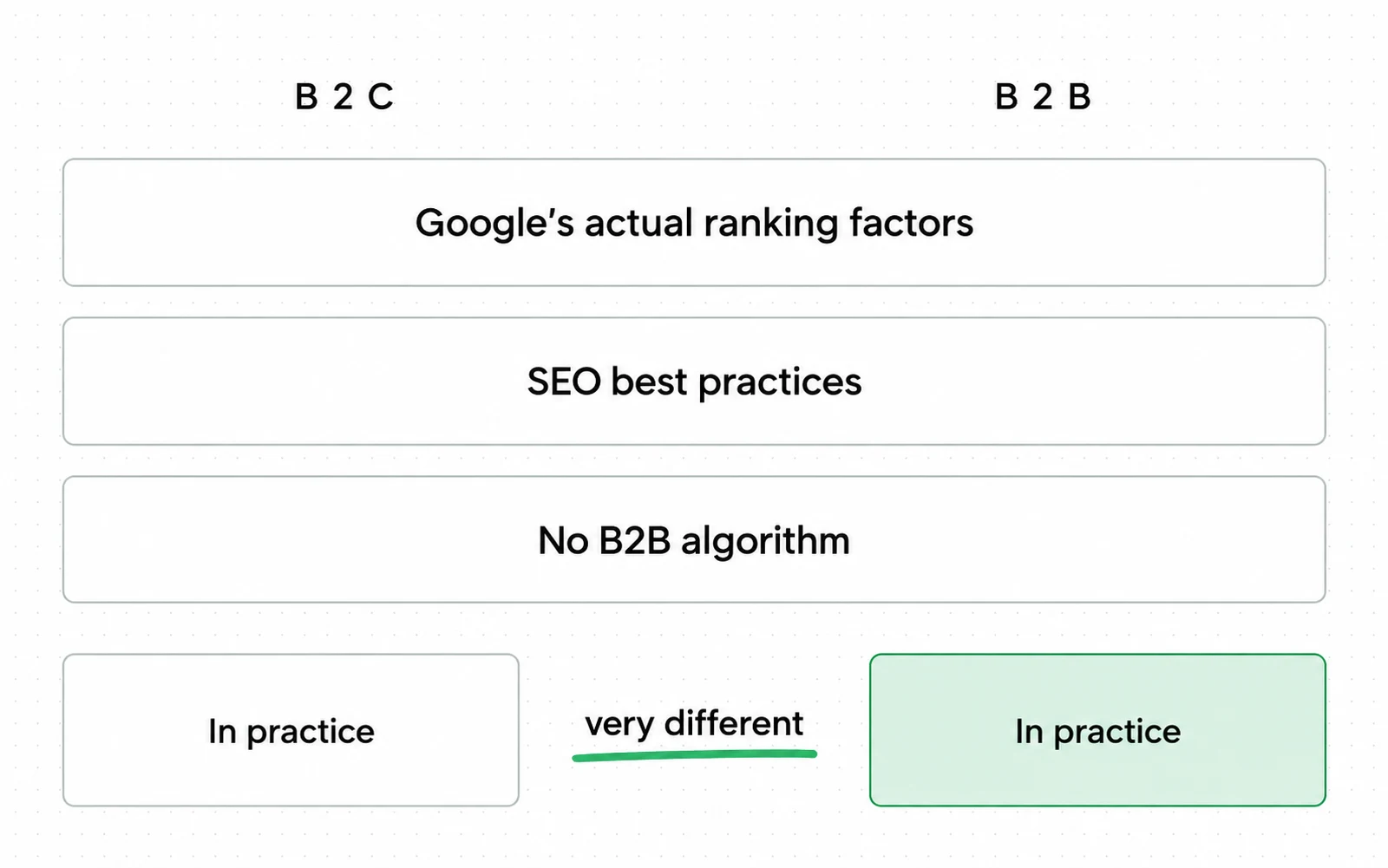
- The first three lines close off the technical difference. There is no separate algorithm to learn.
- The fourth line reopens the question somewhere else, and that somewhere is the economics.
What changes is who is searching and how many of them there are. Dean describes the target as a small group of decision makers at a company, against the broad demographics a consumer term reaches.
The consequences are arithmetic. Smaller audience means smaller terms, more people involved means more pages, and a form instead of a cart means the payback arrives later.
What is identical and what is not
| B2B | Consumer | |
|---|---|---|
| Ranking factors | same | same |
| Technical requirements | same | same |
| Term size | tens | thousands |
| People deciding | a group | one |
| The conversion | a form | a purchase |
The two rows marked the same are the ones most strategy documents spend their length on. The three below them are the ones that change what you do.
That last row is the one with the longest tail. A purchase ends the transaction; a form starts a conversation that runs for months, and every page in the plan is being judged on something that has not happened yet.
A published figure puts an average B2B deal at 62 touchpoints. Your plan is being judged on the last of them and paid for at the first.
Semrush names four grounds on which B2B differs and every one is about the market: funnel length, stakeholder count, term size, conversion rate. Not one of them is a ranking factor.
The software follows the same pattern. The products sold to you as B2B SEO tools are the ones a consumer site uses, and the few that look different are built for agencies and not for you.
It also explains why B2B SEO advice reads as vague so often. The outcome the work is aimed at sits outside the window most reporting covers.
Search volume changes what a page is for
A consumer term brings a crowd and a B2B term brings a handful. That single fact reorders the plan, because a page written for ten searches a month has to do a different job from one written for ten thousand.
Dean gives real examples. A cloud point of sale system term at 590 searches a month. A best payroll program term at 140. Others at 50 and at 10.
SparkToro and Datos measured how lopsided that is across 331,697,810 searches on roughly 130,000 US devices. The top 10,000 terms carried 46 percent of demand, and 612,981 keywords searched once carried 2.2 percent.
Your terms live in the second group. A plan built for the first one will keep telling you the pages are underperforming.

At ten searches a month a page cannot be justified by traffic. The page is justified by the contract behind one of those searches, and that calculation is in B2B keyword research.
The same arithmetic decides how many pages the plan needs. The published recommendation runs to four to six topical pillars and a focus on the fifty to two hundred most valuable terms.
That range is wide because it is doing two jobs. Fifty terms is a plan a small team can finish, and two hundred is a plan that needs a publishing operation behind it.
The term size also changes what a page has to contain. The average length of a page in the top ten is recorded at 1,447 words, and a page written for ten searches a month competes against that same bar.
A small term does not license a small page. It licenses a page that answers one question completely, for the few people who will ever ask it.
Site structure before the content calendar
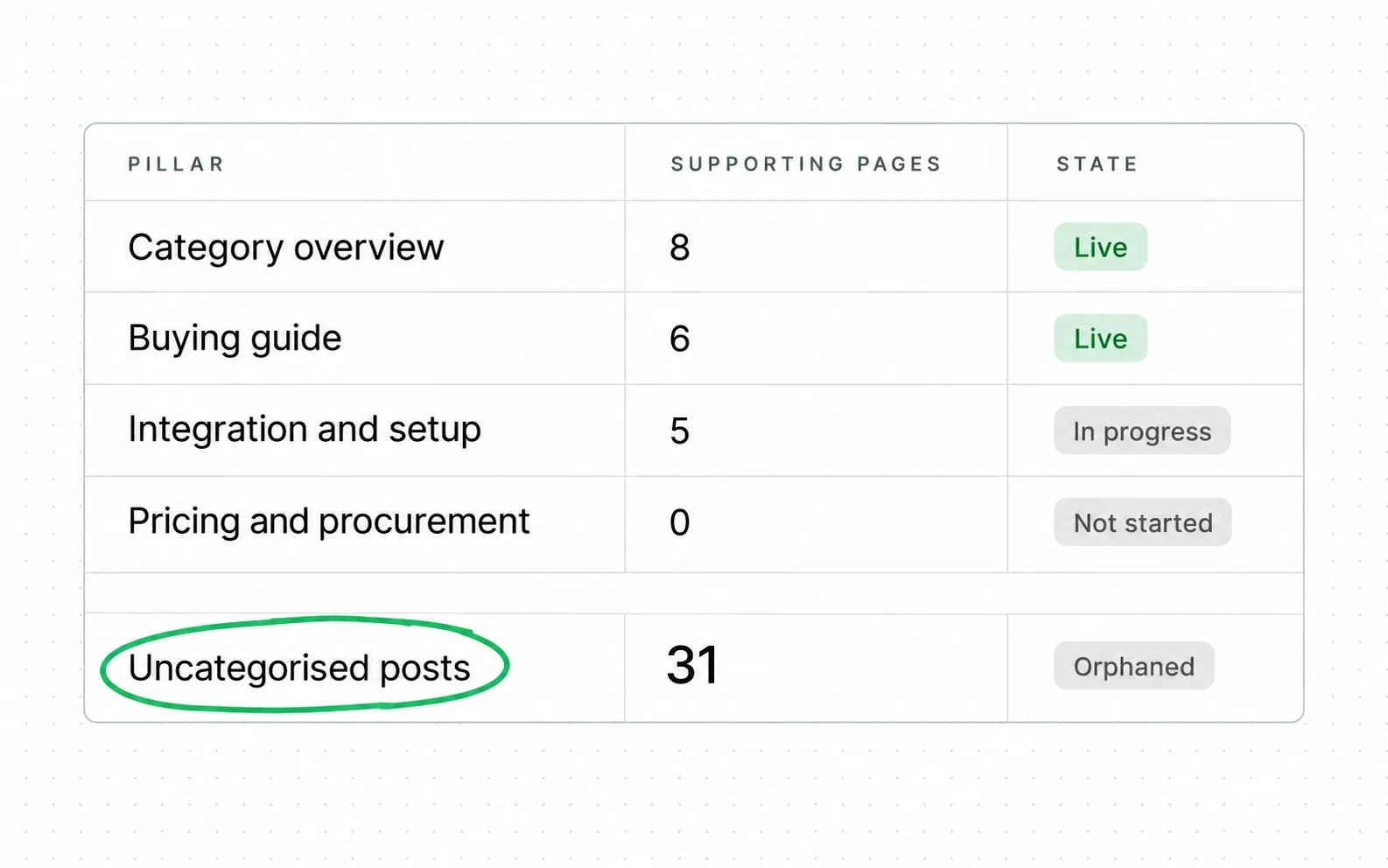
A B2B site that has been publishing for a while usually has more pages than plan. The first job is not writing. It is finding out what the existing pages are for, because a strategy that ignores them is a second site running beside the first.
-
List the pages you already have
Group them by the pillar they belong to. Anything that fits none of them goes on an orphan list, and on most B2B sites that list runs to dozens of pages.
-
Choose four to six pillars
The published range sits there. Fewer than four and the site has no shape, more than six and no pillar gets enough supporting pages to matter.
-
Price the terms before assigning them
Sort candidates by what one customer is worth, not by monthly searches. The method is in B2B keyword research.
-
Decide the orphans
Each one gets folded into a pillar, redirected, or left alone with a note saying why. Leaving them undecided is what makes the next audit take a week.
-
Set the cadence you can hold for two years
The published timeline below assumes a rate that does not stop. A plan that runs hot for a quarter and stops is a plan that never reaches the point of measurement.
Who the pillars are written for is settled before any of this, and the test for that is in ideal customer profile.
Google publishes a threshold for when the orphan list starts to cost you crawling. It names 1 million pages changing weekly, or 10,000 pages changing daily, and calls both rough estimates, not exact thresholds.
Almost no B2B site is that size, so the orphan problem here is about what your pages say, not about crawl budget. Say so out loud before somebody sells you a crawl budget audit.
Say your structure suggests a templated set of pages. The programmatic-seo skill asks you three questions first: what pattern, what data you own, and who ranks for it today.
The audit step is the one teams skip, and it is the cheapest of the five. An afternoon spent grouping existing pages tells you whether the plan is a new site or a repair.
It also decides where the first pages go. Adding a supporting page to a pillar that already has six is a different bet from starting the pillar that has none.
How long does B2B SEO take? Published timelines compared
Repair or new pillar, the next question is when any of it pays, and the published timelines do not agree with each other. One of them publishes a schedule, and it is the only one saying what you have to do instead of when to expect something.
That schedule puts benefits after roughly six months of consistently posting twice a week, with the best results in the second and third years.
Ahrefs put a measured number beside that expectation. Across 1 million random URLs its crawler first saw in September 2023, 1.74 percent of newly published pages reached the top 10 within a year.
The same study read 1.3 million random US keywords. It found the average number one page five years old, and 72.9 percent of the top 10 older than three years.
What that schedule costs in published pages
Fifty two published pages before the moment the schedule names. The source calls that moment benefits appearing. It says nothing about what arrives sooner.
Set that against the pillar count and the shape of the commitment appears. Five pillars and 208 pages is roughly forty pages per pillar over two years.
Against fifty to two hundred target terms, the same two years is between one and four pages per term. That is the resolution the plan is really working at.
The same source publishes a conversion benchmark to hold the traffic to: a visitor to lead rate of at least 2.5 percent. That threshold is one agency's and no sample is given, so treat it as a starting line, not a standard.
The other two timelines are shorter and describe an expectation, not a cadence. One puts meaningful movement at four to six months; the other puts payback at six to nine.
That second timeline also prints the hardest figure here: 1.74 percent of newly published pages reach the top ten inside a year. Read against a two-year schedule of 208 pages, that is the case for the cadence, not against it.
The rest raise the timeline and answer it with commitment. One says SEO will not deliver overnight results and attaches no number, one answers its own FAQ heading with long-term commitment, and one carries neither a rate nor a timeline.
None of the agency guides above puts a money figure on any of this, so the cost has to be built from your own rate for a page multiplied by the cadence above.
If you would like that cadence run against your own funnel instead of costed, that is B2B SEO agency work at Addition, a search marketing agency.
Four B2B SEO strategy mistakes to check before sign-off
Check these four costly issues before approving a B2B SEO plan for the next quarter. Each shows up as a wasted quarter, never as an obvious mistake.
Four habits and what each one hides.
| Habit | What it hides |
|---|---|
| Looking for B2B specific ranking tactics | That the mechanism is identical and the economics are not |
| Planning terms by monthly searches | The contract behind a term with ten searches |
| Starting to publish before auditing the archive | A second site of orphaned pages competing with the new one |
| Judging the programme at three months | That the only published schedule names month six |
The last one is the expensive habit. A programme cancelled at month four has paid four months of cost and stopped short of the published schedule.
If the funding cannot survive two quarters without a signal, that is a real constraint and it belongs in the decision before any terms are chosen.
The second habit has a version that survives good intentions. A team accepts that volume is the wrong sort, then picks the largest terms among the small ones, which is the same sort with a smaller range.
The correction is the same either way. Sort by what a customer from that term is worth, and let the volume column sit where it belongs.
Measuring B2B SEO by enquiries per page
A B2B programme reporting sessions will look flat for two quarters and then look fine, and neither reading tells you whether it is working. The numbers that answer that sit closer to the form.
Report enquiries by pillar. A pillar producing enquiries while its sessions stay small is doing exactly what a B2B pillar should do.
Pew Research Center recorded 68,879 Google searches from 900 US adults in March 2025. A result was clicked in 8 percent of visits where an AI summary appeared, and 15 percent where none did.
That gap lands on your sessions line before it lands anywhere else. Impressions can hold or rise while sessions fall, so a sessions-only report will read a summary rollout as your pages getting worse.
Hold the traffic to a conversion rate. A published starting line of 2.5 percent of visitors to leads is on the table and carries no sample, so a page well under it is the next one you open.
What to report, how often, and what it answers.
| Number | Window | What it answers |
|---|---|---|
| Enquiries by pillar | Monthly | Which part of the structure is earning |
| Visitor to lead rate by page | Monthly | Whether the page or the term is the problem |
| Pages published against plan | Monthly | Whether the schedule the timeline assumes is being held |
| Terms with first impressions | Quarterly | Which of the small terms have started to register |
What an enquiry costs once it arrives is the subject of cost per lead, and the threshold it has to pass is in MQL vs SQL.
If your product has a free tier the page ends in a signup. SaaS SEO strategy measures how far that sits from a form.
Keep the orphan count in the same report. It falls as the audit decisions land, and a flat orphan count means the structure work stopped while the publishing carried on.
Sources
- Backlinko A Complete B2B SEO Strategy, by Brian Dean, updated 23 December 2025
- First Page Sage B2B SEO Strategy: 2026 Guide, by Evan Bailyn, updated 1 May 2025
- The Growth Syndicate A complete B2B SEO strategy for 2026
- Intelegencia A B2B SEO strategy guide framed around lead generation, 2026
- Huemor B2B SEO strategy: a complete step-by-step guide
- Semrush B2B SEO: a complete strategy, 27 June 2023
- Ironpaper SEO for B2B
- Sprout Social B2B SEO: how to turn search intent into revenue with a social-first approach, 4 February 2026
- Delta V Digital B2B SEO strategy: the framework we use with every client
- Ahrefs How long does it take to rank? 1 million random URLs first seen by the Ahrefs crawler in September 2023, plus 1.3 million random US keywords for page age, published 2025
- SparkToro and Datos We analyzed 331,697,810 searches for 320,775 unique query terms across roughly 130,000 US devices, January 2023 to September 2024
- Google Search Central Large site owner’s guide to managing your crawl budget: 1 million+ pages changing weekly, or 10,000+ pages changing daily, described as rough estimates and not exact thresholds
- Pew Research Center Google users are less likely to click on links when an AI summary appears: 68,879 unique Google searches from 900 US adults, March 2025, published 22 July 2025
- Ahrefs GSC vs GKP: 72,635 random keywords in the 1K to 10K range, Search Console impressions against Keyword Planner volume for the same month, 3 November 2021
- Google Search Console Performance report, where the small term impressions appear
Questions people ask
What is a B2B SEO strategy?
A plan for ranking on the terms a small group of decision makers search, on a site where the conversion is a form. The ranking mechanism is the same as any other market.
What changes is that the terms are small, the buying group is several people, and the return arrives after the pages have been live for a while.
Is B2B SEO different from B2C SEO?
Not technically. No B2B algorithm exists, and the same best practices apply.
In practice it is very different, because the terms carry a fraction of the volume and the page has to earn a form submission from a committee, not a purchase from a person.
How long does B2B SEO take to work?
The only published schedule in the ranking set says benefits appear after roughly six months of posting twice a week, with the best results in the second and third years.
That is one agency's figure with no sample behind it, and it is fifty two published pages before the moment it names.
Is SEO worth it for B2B?
That question is asking for an amount, and the amount is not published anywhere. The amount is computable from your own numbers.
Price one term: annual searches, your click share, your enquiry rate, your close rate, your contract value. Compare that against two years of publishing at two pages a week.

