

A SaaS SEO plan names its conversion first
Define the conversion event before choosing keywords. First Page Sage measured organic trial-to-paid rates of 18.2 percent without a card and 48.8 percent with one.
Do not combine demo requests and trial signups into one conversion metric. A trial signup happens on the site, while a demo request starts a sales process that may involve several people.
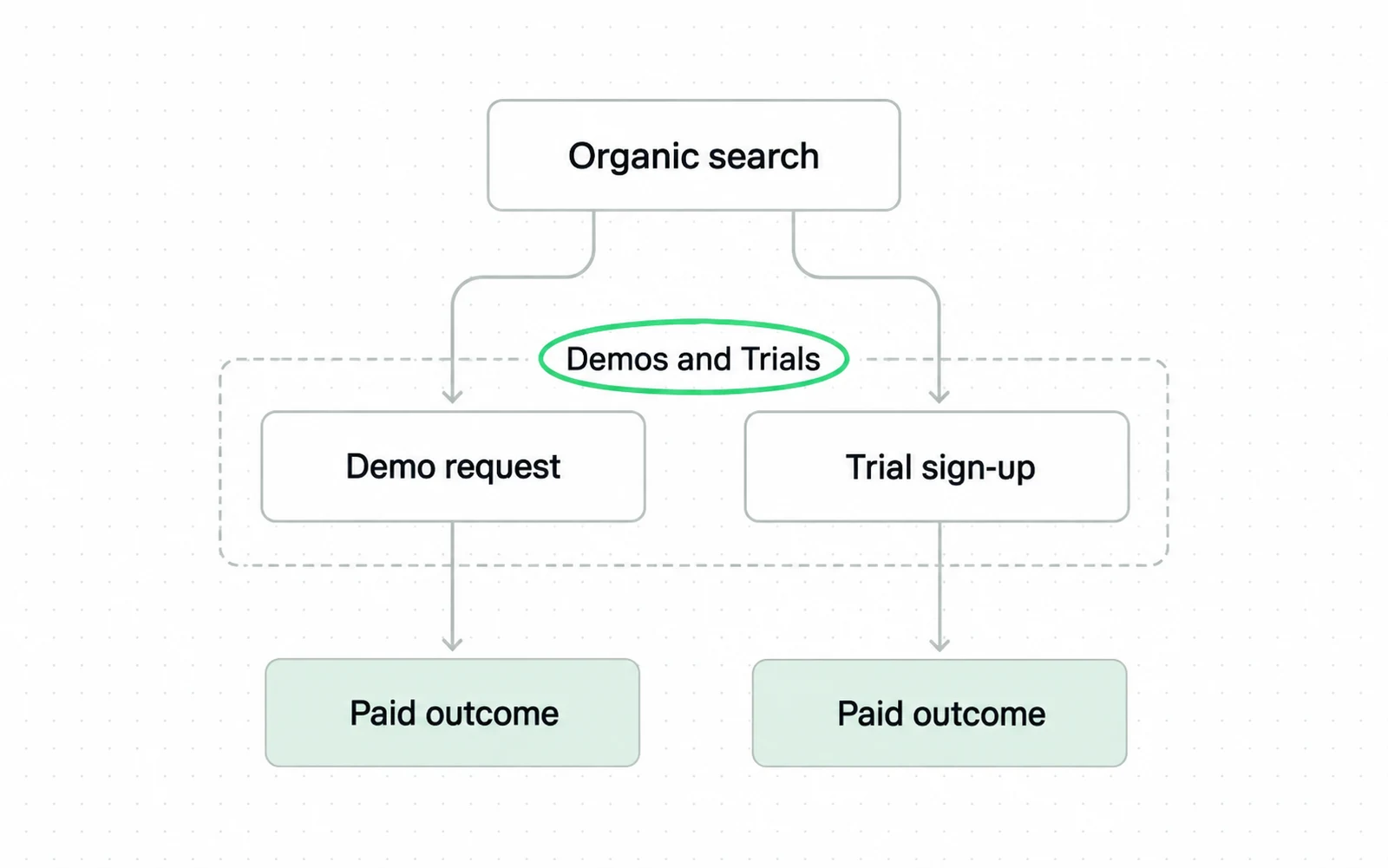
- Two events with different paths to revenue are reported as one measure.
- Track each event from organic traffic separately, then connect it with its own paid outcome.
A conversion percentage cannot set a target until the event is named. The same rate can describe a download, signup, trial or demo request, and those events do not produce revenue on the same path.
Price the plan from the event you can observe. Follow that event through to revenue before deciding what a customer from search is worth.
Pick one primary event and keep the remaining events as separate secondary measures.
Tie the payback window to that event. Use the signup date for a self-serve product and the completed sale for a demo-led product.
When finance changes retention or account value, update the forecast instead of changing the SEO target. The event stays fixed while its value changes.
A purchase gives ecommerce a clear endpoint. A software site can offer several conversion points, so the plan has to pick the one it will value and optimise for.
Split the rate by trial type
Your chosen conversion event sets the benchmark. Record whether the trial requires payment details before selecting a trial-to-paid rate. That choice determines which cohort applies.
Start with the signup flow a visitor sees. A rate from a no-card trial does not describe a card-required trial.

First Page Sage found little difference between organic and paid traffic within each trial type. The card requirement produced the larger gap.
Growing organic trial signups and changing the trial form are different projects. Leave trial design out of the SEO target but include it when you value each signup.
For a forecast, use the First Page Sage cohort that matches your signup flow. Replace the benchmark once your own trial-to-paid sample is large enough for planning.
First Page Sage attributes part of the gap to the payment details already collected by an opt-out trial. Continuing payment is passive, so the higher rate reflects inertia as well as fit.
Conversion medians hide an eightfold spread
ChartMogul and ProductLed measured 200 B2B software products. Their January 2026 data splits free-to-paid conversion by model and shows why an overall average can mislead.
Card requirements and free-tier structure create separate cohorts. Read the row for your model before using any overall conversion figure.
| Model | Fiftieth percentile | Seventy-fifth percentile |
|---|---|---|
| Free trial, card required | 25 to 35 percent | 50 to 60 percent |
| Freemium, ungated signup | 7 to 9 percent | 8 to 12 percent |
| Free trial, no card | 4 to 6 percent | 10 to 15 percent |
| Reverse trial | 4 to 6 percent | 8 to 12 percent |
| Freemium, standard | 3 to 5 percent | 8 to 12 percent |
These rows describe different signup models, so they are not interchangeable. ChartMogul and ProductLed's 8 percent overall median is less useful than the band for your own flow.
Use First Page Sage's 18.2 percent and ChartMogul and ProductLed's 4 to 6 percent no-card band as separate planning scenarios.
A signup may still be too early to represent buying intent. Add a qualification threshold when product use is the stronger signal.
Our product qualified lead guide explains how to set that threshold and keep it separate from the signup rate.
Check that a benchmark's sample and event match your plan. Save its card requirement and percentile with the rate. Keep the edition month there too, so the next report uses the same release.
Name the event in your analytics today
The right model band is useful only after your analytics names the event. Review the active events in five steps, then make the primary event explicit in the plan.
When analytics groups active events into one total, the organic rate combines actions with different paths to revenue. The settings screen below shows where that mix begins.
Keep signup, trial, lead and purchase events on separate rows.

-
List what is switched on
Open the conversions list in your analytics and write down every event currently marked as a conversion.
-
Remove what is not a step toward paying
A guide download and a newsletter signup come off here. They stay in the report as secondary counts, just not in the conversion column.
-
Choose the one closest to revenue
Of what is left, take the event nearest to a payment that still happens often enough to show movement inside a month. For a product with a free tier that is usually the signup or the trial.
-
Write the event name into the template
Replace a generic conversion label with the exact analytics event name.
-
Record which band you compare against
Note the published band for your own model and whether your trial asks for a card.
If programmatic pages are part of the plan, review their programmatic SEO data and intent before scaling them. Track the primary event for that page set separately until its traffic mix is understood.
For a product that requires a sales conversation the answer at step three is the demo request instead, and the threshold that request has to pass is a separate decision covered in MQL vs SQL.
For a sales-led product, the demo request is the web event and the completed sale is the revenue outcome. Keep both visible so marketing and sales can reconcile the handoff.
Price one organic signup
A paid subscription gives the primary event a dollar value. Trial design, account revenue and retention set that value before ranking position enters the calculation.
Take 100 organic signups in one month, average revenue of $80 a month per account and a customer who stays two years. The only difference between the two bars below is whether the signup form asked for a card.
What one month of organic signups returns over two years
Replace the signup count, revenue per account and retention with your own figures. The two conversion rates come from First Page Sage.
On those figures, the difference is about $58,000 from a single month of identical traffic. Trial design belongs in the forecast because it changes the value assigned to every organic signup.
The range widens when the model changes. Using ChartMogul and ProductLed's bands, the same signups return about $6,000 at the 3 percent freemium floor. At 35 percent, the top of the median band for card-required trials, they return about $67,000.
If trial design changes the budget decision, show both versions in the forecast.
Run the arithmetic before committing to a publishing schedule. If projected revenue is low, fund fewer pages and compare their total cost with the expected return.
Revenue per account is already in your billing, and retention comes from your SaaS churn rate. Our SaaS metrics guide defines both. Check that finance and marketing use the same definitions.
The card question belongs to the team that sets pricing, while SEO brings qualified visitors to the signup.
Use the same signup-value calculation when you compare an internal plan with our SaaS SEO service.
Avoid four expensive mistakes
The value calculation fails when a report uses the wrong model, event or timeline. Check each assumption before you use the rate in a forecast or budget.
The first mistake is comparing your rate with a band from a different signup model.
The second is aiming the plan at the wrong event. A plan aimed at a self-serve signup and one aimed at a demo request differ at almost every decision, even though they look the same on a content calendar.
Two plans that look the same on a calendar
| Aimed at a signup | Aimed at a demo | |
|---|---|---|
| Ranking mechanism | same | same |
| Technical requirements | same | same |
| Terms worth writing for | problem and how to | category and comparison |
| What the page ends in | a product action | a form |
| Who decides | one user | a buying group |
| When to judge it | weeks | quarters |
The first two rows are shared. The remaining decisions depend on the conversion event and determine how the work can pay back.
The third mistake is judging both plans on the same timeline. In a signup-led plan, a visitor can convert during the visit that brought them. A demo-led plan needs time for a buying group to decide.
Semrush's 2023 study followed 28,000 new domains and asked whether each gained a top-ten ranking for at least one keyword. Semrush found 19 percent reached that mark by month 6 and held it through month 13.
Ahrefs' 2025 study found 1.74 percent of 1 million pages reached the top ten within a year. Across 1.3 million keywords, Ahrefs found 72.9 percent of top-ten pages were over three years old. Plan for a long ranking window.
The fourth is letting several events arrive in one column. Every figure in the report becomes a mixture, the mixture changes as traffic shifts between pages, and the trend line then moves for reasons that cannot be reconstructed afterwards.
Recalculate the rate whenever the analytics event settings change.
Our B2B keyword research guide covers which comparison and alternative terms deserve a page. B2B SEO strategy covers how many pages the plan commits you to.
If your primary event is a self-serve signup, the page should let visitors start using the product. Our SaaS landing page guide shows the layout.
Report the event beside the rate
Put the signup or form event name beside every conversion figure in the monthly report. This keeps the rate comparable with its benchmark and with your previous results.
A colleague should be able to reproduce the comparison from the report alone.
Pew Research Center observed 68,879 Google searches by 900 US adults in March 2025. Pew Research Center found an 8 percent click rate when an AI summary appeared and 15 percent without one. Allow for that loss before applying the site's conversion rate.
SparkToro and Datos clickstream data for September 2022 to May 2024 shows that around 600 of every 1,000 US searches ended without a click. Your rankings can hold while your sessions fall.
| Line | Why it is there |
|---|---|
| Organic sessions | Traffic reaching the site from organic search |
| Named conversion event and its count | The event, spelled out, beside the number |
| Rate for that event alone | What can be compared against a published band |
| Model band you are comparing against | Stops cross-model comparison at the source |
| Secondary events, counted separately | Downloads and newsletter signups stay visible without inflating the rate |
For what each enquiry costs, see our cost per lead guide. Our SaaS marketing funnel guide shows where the signup sits in the wider journey.
If the plan aims at a product action, product-led growth explains the mechanics of that model.
Sources
- Olga Andrienko, Semrush How Long Does It Take to Rank Higher on Google, 2 March 2023: 28,000 new domains followed from July 2021 to July 2022, of which 7.65 percent held a top 100 ranking for all thirteen months and 19 percent were in the top ten by month six and stayed there
- First Page Sage SaaS Free Trial Conversion Rate Benchmarks, by Evan Bailyn, 86 SaaS companies, Q1 2022 to Q3 2025, updated 5 September 2025
- ChartMogul and ProductLed The SaaS Conversion Report, 200 B2B software products, January 2026
- SimpleTiger SaaS SEO in 2026: A Playbook for the AI Search Era, by Bella Ranta, published 14 July 2026
- Grow and Convert SaaS SEO: How to Build a Growth-Focused Search Strategy, by Cameron Brown, updated 16 February 2026
- Optimist SaaS SEO Strategy, by Tyler Hakes, published 23 April 2026
- SEOptimer SaaS SEO: A Step-by-Step Guide for Software Companies, by Ruben Rogers, published 21 November 2025
- Kalungi SaaS SEO: The Actionable Guide, by Fadi George, published 5 January 2026
- Userpilot SaaS Average Conversion Rate: Benchmarks
- Flowlu SaaS SEO in 2026: the only guide you will need to rank higher
- SEOProfy SaaS SEO: the ultimate guide with practical strategies for 2026, updated 29 May 2026
- NoGood All SaaS marketing blog articles, a category listing
- Pew Research Center Google users are less likely to click on links when an AI summary appears: 68,879 unique Google searches from 900 US adults, March 2025, published 22 July 2025
- SparkToro and Datos 2024 zero-click search study, clickstream panel of tens of millions of users, September 2022 to May 2024
- Ahrefs How Long Does It Take to Rank in Google?, a study of 1 million random crawled URLs plus 2 million URLs created in October 2023, with page-age analysis across 1.3 million random US keywords
Questions people ask
What is a SaaS SEO strategy?
A plan for ranking on the terms your buyers search, aimed at one named conversion event on your own site.
Name the conversion event before pricing the plan. A free signup, a card-backed trial and a demo request convert to paid at very different rates.
What conversion rate should a SaaS site expect from organic search?
Trial type changes the rate. First Page Sage measured organic trial to paid at 18.2 percent when the trial asks for no card and 48.8 percent when it does, across 86 SaaS companies.
ChartMogul and ProductLed found another wide split across 200 products, and few products sat near the overall eight percent median.
How long does SaaS SEO take to pay back?
Payback depends on which event you count. A self-serve signup is visible on the site, while revenue from a demo request appears only after the sales process.
Use a shorter measurement window for signup movement and a longer one for demo revenue.
Is SaaS SEO different from other SEO?
The technical requirements and ranking factors are the same as for any other site.
A software site can offer several conversion points across the site. Choosing the primary event can move the value of a ranking more than a keyword decision does.