

Which B2B SEO tool fits an in-house team or an agency?
Before comparing anything, settle which buyer you are. A company running its own search work and an agency running it for business clients are sold the same phrase and different software, and the difference is priced.
Ahrefs, Semrush and Screaming Frog cover the work itself: finding your terms, watching your positions, crawling your site. Nothing in any of them is specific to selling to businesses.
The second product is different software with the same label on it. Its headline feature is a report a client will read and a seat a colleague logs into. If you are a team of one working on your own site, you need neither of them.
The B2B SEO Tool Designed to Scale Your Agency. Manage all your clients, automate white-label reports, and deliver results with a powerful, simple, and affordable SEO platform.
TrueRanker, B2B SEO tool page read 10 September 2026
- The headline names the buyer directly. B2B here describes the vendor’s customers, not the market its customers sell into.
- The subhead is the feature list in one line: manage all your clients, automate white-label reports.
- A company doing its own SEO has no clients to manage and no report to white-label, so most of what is priced here is priced for somebody else.
Read the label the other way and it stays true. A tool built for a business-to-business market would carry a feature a consumer brand has no use for. The published feature lists here are the ones sold to retail.
What changes for a B2B company is downstream of every one of them, and the last section is about that.
Reading B2B SEO tool pricing pages for the intended buyer
Feature grids in this category run long and mostly agree. The quickest read is the pricing page, because vendors put the buyer in the plan name.
One rank-tracking product prices three plans and labels each one with its audience in the card itself.
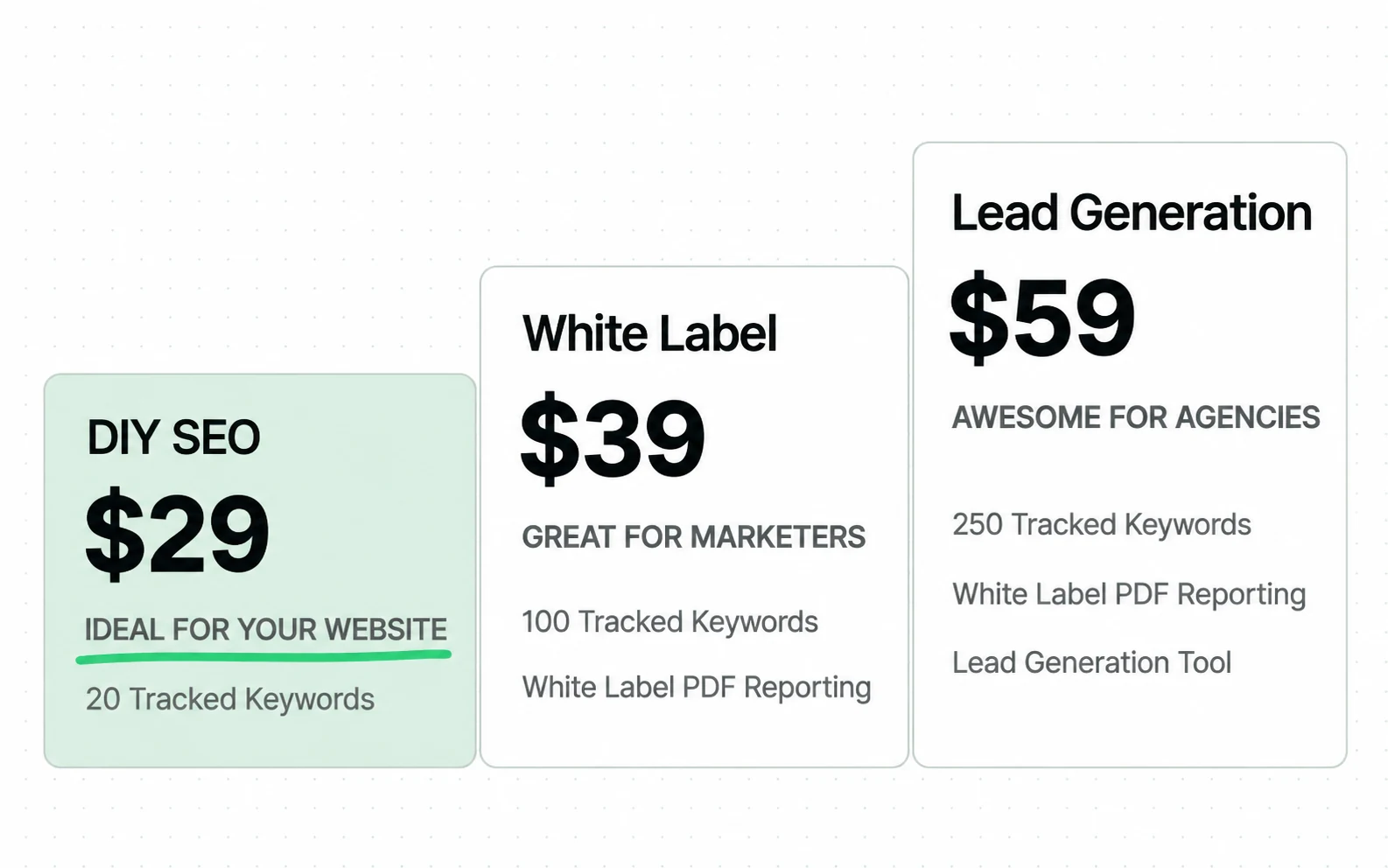
- The 29 dollar plan says ideal for your website. It is the only one of the three written for a company working on its own site.
- Everything above it is agency equipment: white-label PDF reporting at 39 dollars, a lead generation tool at 59, and user seats appearing only from the middle plan.
- The volume limits rise with the same steps, from 20 tracked keywords to 250, so an in-house buyer who wants more keywords has to buy the agency features to get them.
That last line is the trap in the category. The two things are bundled. Say you want more tracked keywords: you pay for client reporting you will never open. A small agency that wants the reporting gets keyword volume it does not need.
The general suites are priced the same way and the numbers are larger. Ahrefs starts at 129 dollars a month for 750 tracked keywords and charges 40 to 80 dollars a month for each extra user. Semrush starts at 117.33 dollars a month billed annually for 500 daily tracked keywords and adds users at 45 dollars a month each.
The largest suite in the category prices its extras the same way, and its add-on menu is plainer than any feature grid.
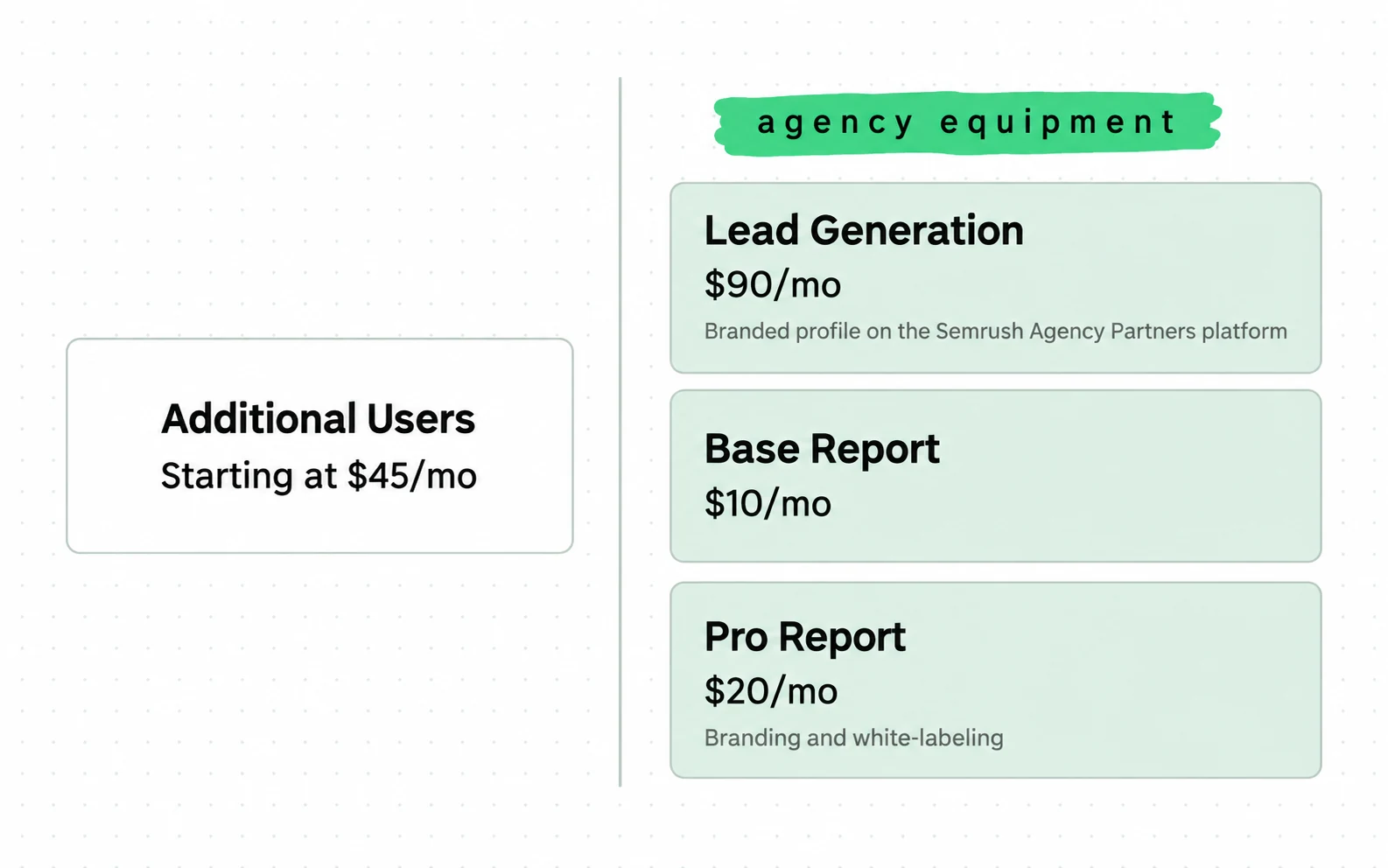
- The card labelled Lead Generation does not measure a lead. It buys a branded profile on the vendor’s own agency directory and a verified badge, so the leads it generates are leads for an agency.
- White-labeling appears as a report add-on at 20 dollars a month. The smaller rank trackers charge a whole plan step for it.
- Additional users start at 45 dollars a month each, so a buying committee of five costs more in seats than the base plan costs in data.
Read the four cards as a description of the buyer and the pattern from the smaller product repeats at ten times the price. What sits above the base subscription is mostly equipment for selling the work to somebody else.
Match the job to the B2B SEO tool
Split the work into jobs and the shopping list gets shorter, because most of these products are bought for one job and priced for four.
Four jobs, and the products sold for each
| The job | Sold for it | What you are paying for |
|---|---|---|
| Find terms a small audience really searches | Ahrefs, Semrush | Keyword data, and tracked-keyword limits that set the price |
| Crawl the site and find what is broken | Screaming Frog | A crawler licensed by the year, free to 500 URLs |
| See what your own pages already earn | Search Console | Clicks, impressions and average position, at no cost |
| Show a client what happened | SEOptimer, TrueRanker | White-label reports and seats, priced per plan |
| See which companies visited | Leadfeeder | Company identification, counted per month |
The free rows are worth taking seriously before any subscription. A crawler that stops at 500 URLs covers your whole site if it runs to a few hundred pages. The paid licence is 199 pounds a year, not a month.
Search Console is the other one. It reports clicks, impressions and average position for your own site. Its own documentation adds a caveat. A query can appear in your report and still not show your site when you run the same search. Results depend on the time, place, device and recent history of the person searching.
Between them the free rows cover the crawl and your own search data, so the shopping list you are left with is shorter than the lists suggest.
Poor fits for each B2B SEO tool
That shopping list is not a recommendation. Every product on it fails somebody, and the failure is predictable from the vendor’s own pricing page. A side-by-side test on outcomes would settle more than any feature grid, and the category has not produced one.
Ahrefs and Semrush
Ahrefs and Semrush are wrong for you if you have one site, a handful of terms and nobody to share the account with. The entry plans carry 750 and 500 tracked keywords. Your term list needs a fraction of that, and the price is set by the number.
They are right when several of you need the same data and somebody has to defend a decision with a backlink profile or a competitor comparison.
Screaming Frog
Screaming Frog is wrong as a monitoring tool. It runs when you run it, it reports nothing on a schedule, and nobody is alerted when a template change removes a canonical tag.
Buy it first. The free version already crawls 500 URLs, and most technical problems on a B2B site are template problems visible in the first hundred.
SEOptimer and TrueRanker
SEOptimer and TrueRanker are wrong for you if you own the site you are working on. Their upper plans are priced on client management, branded PDFs and seats, and none of that changes anything about your rankings.
They are right if you have several clients, your deliverable is a document somebody else reads, and the alternative is rebuilding it by hand every month.
Visitor identification
Leadfeeder is wrong as a substitute for search work. It tells you which companies arrived. It does not tell you which terms are worth writing for, and it never sees a company that stays away.
Reach for it once your traffic exists and its quality is an open question. That is the common state of a B2B site with rising sessions and a quiet inbox.
What do B2B SEO tools not count?
Everything above counts sessions, positions and pages. A B2B company is paid when an organisation buys, and an organisation is not a session. For example, eleven people can visit from one company across four months, and every product on this page reports eleven visitors and no company.
Google Analytics is the usual answer to how you would know, and it counts something else. Its own metric definitions give total users as the number of unique users who triggered any event in the date range. No metric on that page describes an organisation.
The requirement and the failure to meet it sit two paragraphs apart on one page, first in a pull quote and then in plain text.
B2B SEO tools must track micro-conversions across months-long buyer journeys, not just final conversions. … The most significant problem is the inability to connect organic performance to revenue outcomes. Most analytics and SEO tools display traffic metrics and rankings but can’t reveal that visitors searching for “enterprise project management software comparison” convert at 12% while those looking for “free project management tools” convert at 0.3%.
Entlify, B2B SEO tools guide read 10 September 2026
- The pull quote sets the standard: track micro-conversions across months-long buyer journeys, not just final conversions.
- The paragraph underneath calls the inability to connect organic performance to revenue the most significant problem, and attributes it to most analytics and SEO tools.
- The two conversion figures in that paragraph, 12 percent and 0.3 percent, carry no study, sample or source anywhere on the page.
One product class does count organisations, and it is filed under lead generation, not under search. It reads the network address a visit arrives from and matches it to a company.
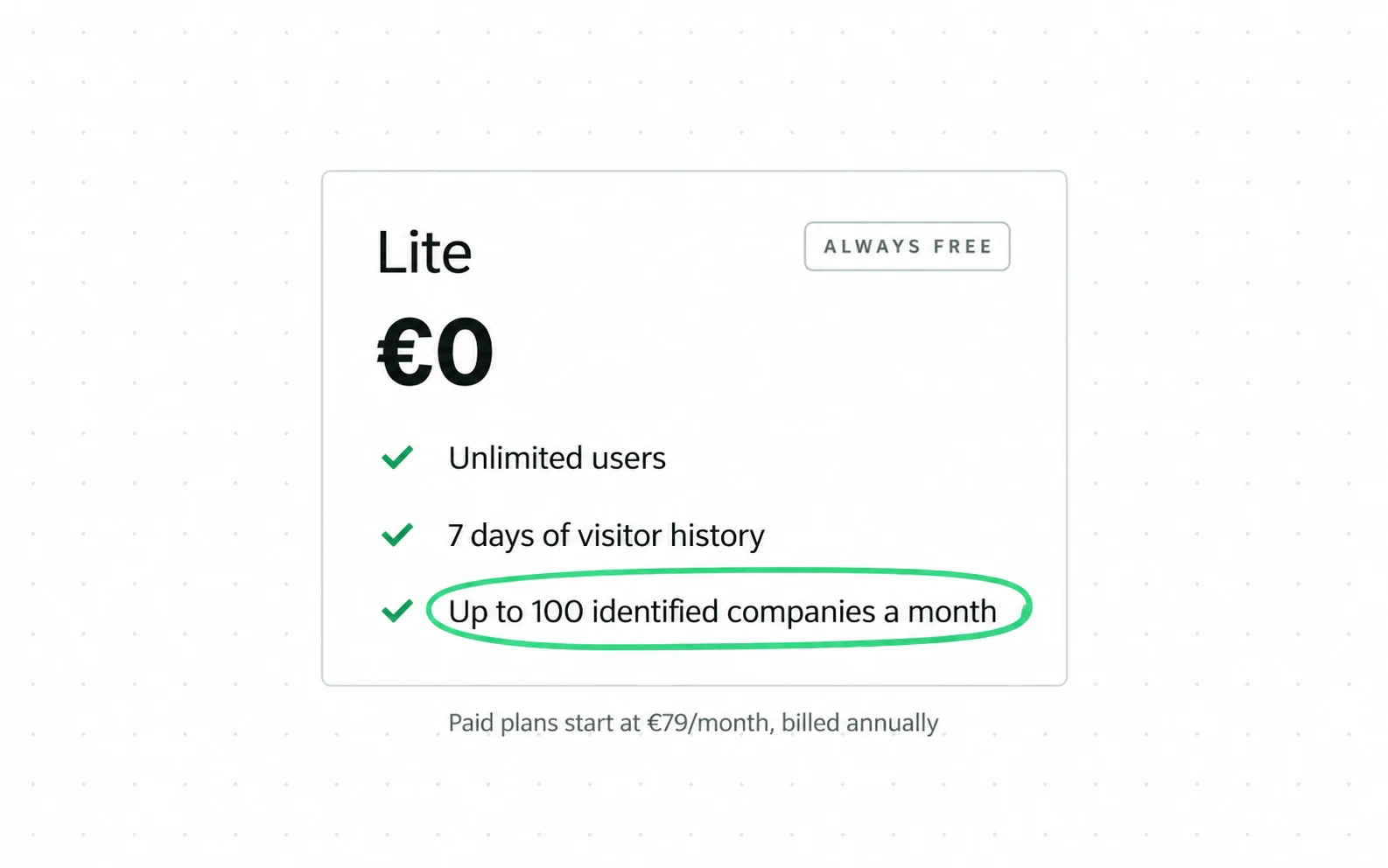
- The unit on the card is an identified company per month, and the free plan caps it at 100.
- Visitor history on the free plan is seven days. Most B2B sales cycles run for months.
- The vendor describes the product as revealing the companies visiting your site even if they never fill a form, so the identification is at company level and not person level.
This is worth being exact about, because it is easy to oversell. Identification is company level and probabilistic. It tells you that somebody at a named organisation read three pages. Who they are, whether they can sign anything, and whether the rest of the room ever saw your site all stay unknown.
It also stops at your own front door. Suppose a company shortlists you on a peer recommendation and never opens your site. It stays invisible, and in any given quarter that is most of your market.
The piece nobody sells is the one that makes all of it readable, and it is one field. Store the landing page, or the term, against the account record when a deal is created. Then your terms carry a pipeline number, and the whole subscription above starts answering a question you really have.
Four fields your CRM ships with, and the two that close the loop
The account record, with one line added
account_name
created_date
stage
deal_value
1first_landing_page
2first_search_term
- 1The first four lines exist in every CRM the day it is installed, and a keyword has nothing there to join to.
- 2The landing page is the join. It is written once, when the record is created, and it survives every tool change afterwards.
- 3The term is optional and cheaper to keep than to reconstruct. Without one of these two lines, every number on this page is about traffic and not about revenue.
Say you want the crawl and audit half of this category for free. The seo-audit skill crawls your site, scores it and writes the action plan without a subscription.
Without that field your reporting is about the wrong unit. Positions climb, sessions rise, and nothing on your screen can say which of them paid for the contract. Deciding what a form fill is worth before buying any of this is the subject of B2B lead generation.
Say the field goes in and the terms still do not exist. That is a research problem and not a tooling one. That research is where the B2B SEO agency work starts at Addition, a search marketing agency.
Check who wrote the roundup
Roundups in this category are mostly written by companies that sell one of the products inside them, and the ordering tends to follow. Knowing that before you read one changes how the order looks, and the check takes about ten seconds.
The check takes ten seconds and works on any list. Find the publisher, look for its own product among the entries, then look at where it sits. Usually it sits first.
That is not a reason to dismiss the list. A vendor is the primary source for what its own product does, and a poor one for how it compares. Read the feature descriptions as facts and the ordering as marketing.
The same test applies to the free checkers some agencies publish under this phrase. Ariad Partners puts five of them on its own site, including an AI search visibility score and a bulk keyword generator. It describes them as built for B2B and SaaS buyers. They are a real service and also a form, and both things are true at once.
Sources
- TrueRanker B2B SEO tool page: white-label reports, client management, sub-accounts, 14-day trial, no price published
- SEOptimer Pricing: DIY SEO 29 dollars, White Label 39, Lead Generation 59, with crawls, tracked keywords and seats per plan
- Ahrefs Pricing: Lite 129 dollars a month with 750 tracked keywords, Standard 249 with 2,000, Advanced 449 with 5,000, extra users 40 to 80 dollars a month
- Semrush Pricing: SEO plan 117.33 dollars a month billed annually with 500 daily tracked keywords, extra users from 45 dollars, and an add-on menu whose Lead Generation card at 90 dollars buys a branded profile on the vendor’s agency directory
- Screaming Frog SEO Spider pricing: free version limited to 500 URLs, licence 199 pounds per year with no crawl limit
- Leadfeeder Pricing: Lite free forever with up to 100 identified companies a month and 7 days of history, Discover from 79 euros, Activate from 369, Scale from 599
- Ariad Partners Five free tools including an AI search visibility score, a title tag CTR grader and a bulk keyword generator
- Google Analytics Help GA4 metric definitions: total users given as the number of unique users who triggered any event in the date range
- Google Search Console Help Performance report: clicks, impressions and average position defined, with the caveat that results depend on time, place, device and recent history
- Google Search Central Managing crawl budget for large sites
- Google Search Central SEO starter guide: some changes take effect in a few hours, others several months
- Onely B2B SEO guide, 26 February 2026: recommends no tools, and cites 84-day sales cycles, 11-person buying committees and lower-volume keywords to five third parties
- Contently SEO tools for B2B content marketing, 3 October 2024: nine products including BrightLocal, a local search tool, described as crucial for B2B marketers
- Entlify B2B SEO tools guide: pull quote requiring micro-conversion tracking across months-long journeys, then seven general products named
Questions people ask
What is B2B in SEO?
It describes the market, not the method. The ranking mechanism is the same one every site is subject to. What changes is the audience: a small number of people at specific companies, searching terms with low volume and high value.
What that means for tools is simple. No B2B setting exists to switch on, and a product marketed as a B2B SEO tool is either a general tool or agency software.
What are the 5 best SEO tools?
Five jobs answer it better than five products. A crawler, a keyword source and your own search console. Then a way to score a draft, and something that tells you which companies arrived.
The crawler and the console cost nothing. Screaming Frog crawls 500 URLs free. Search Console reports your own clicks, impressions and average position at no cost, and no paid product holds that data about your site.
Does SEO work for B2B?
People asking it usually mean payback, not ranking. A form is not a purchase, so the return arrives after a sales process that runs for months, and none of the tools above measures that stretch.
What decides it is whether your buyers search at all, and what an enquiry is worth once it arrives. Both are questions about your own numbers, and a subscription answers neither.
What is the rule of 7 in B2B?
A marketing heuristic says somebody needs around seven exposures to a brand before acting. No published study with a stated sample sits behind the number, and it is repeated far more often than it is sourced.
Treat it as a reason to expect repetition, not a target to plan against, and note that exposures are not counted by anything in this category.

