

Which SaaS SEO tools do which job?
Say somebody hands you a budget and the words SaaS SEO tools. The first useful move is to ignore the label, because the products behind it are the general ones, and pick by the job you have this month.
Five jobs came out of reading these products, and no single one of them covers all five.
Say two of those jobs are urgent and three are not. The budget question answers itself once they are separated, because the products are priced per job and a suite charges you for all five whether you opened them or not.
The job you have, and the tools sold for it
| The job | Tools sold for it | What you pay for |
|---|---|---|
| Find terms you can win | LowFruits, Ahrefs, Semrush | Keyword data, and a way to filter it down |
| Crawl the site and find breakage | Screaming Frog | A crawler, priced per year, not per month |
| Score a draft before it ships | Surfer, Clearscope | A number against pages that already rank |
| Watch rankings over time | Ahrefs, Semrush | Tracked keywords, counted per plan |
| Watch AI answers | Ahrefs, Semrush, and the trackers | Tracked prompts, counted per plan |
The fifth row is newer than the rest and the two suites now fold it into plans you may already hold, which AI visibility tools sets out in more detail.
Two of those jobs cost nothing and come before any purchase. A crawl of a forty-page marketing site is free at that size. A read of your own Search Console is free and shows which pages already earn impressions. That is the shortest route to knowing what to write next.
Three published numbers that separate plans
Feature grids in this category are long and mostly identical. Three numbers do the separating, and each vendor publishes the ones its own product is priced on: tracked keywords, crawl credits, and now tracked prompts.
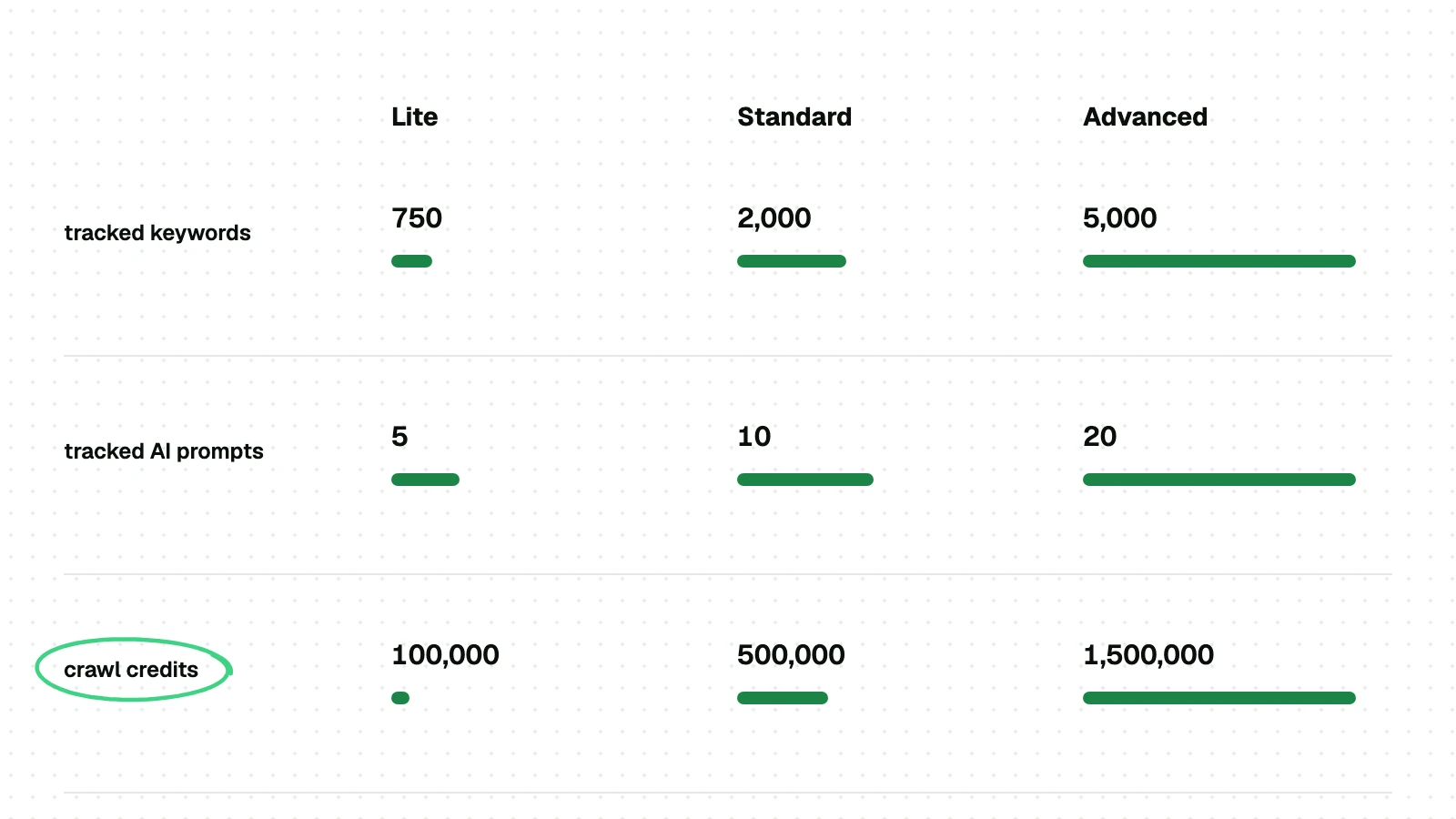
- Tracked keywords climb 750, 2,000, 5,000. That is the number to hold against the size of your own keyword list before choosing a tier.
- Tracked AI prompts appear on every tier now, at 5, 10 and 20. A separate prompt tracker starts to look expensive next to that.
- Crawl credits are the third dial, at 100,000, 500,000 and 1.5 million. A large documentation site burns those faster than a marketing site does.
Say your product has three hundred pages of documentation and forty marketing pages. Your crawl number matters and your tracked-keyword number does not, and the plan a general SEO list recommends will usually be sized the other way round.
The mismatch is common enough to state plainly. Documentation sites are large and low-intent; marketing sites are small and high-intent. A plan sized for the second will not crawl the first, and a plan sized for the first is mostly unused keyword capacity.
The cheapest end of this category is priced in credits instead of seats, which changes how you size it.
A credit is spent when you ask the tool to do something, not when a person logs in. So a small team running one keyword project a month pays a fraction of a per-seat suite. A team running the same query daily pays more than it budgeted for.

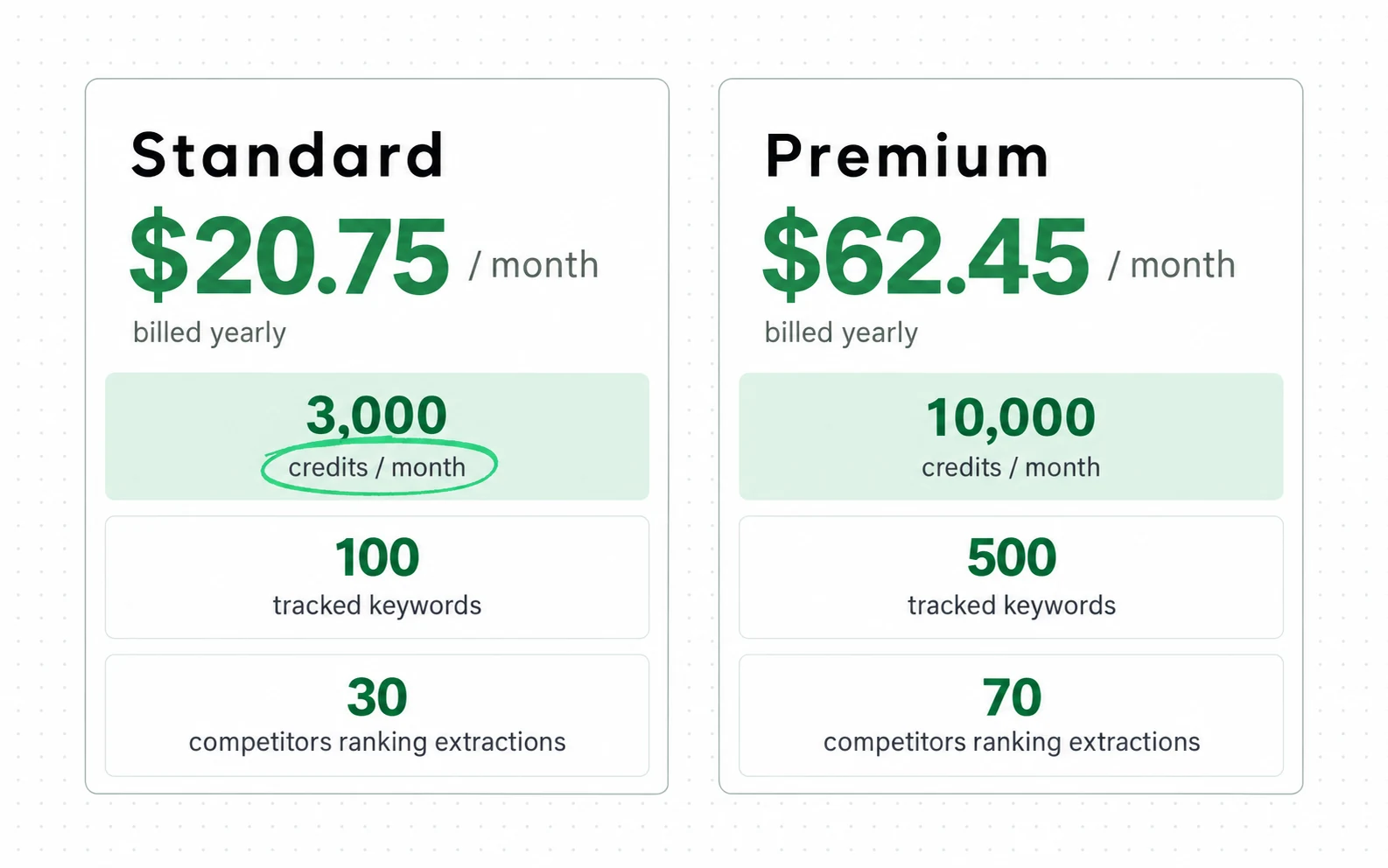
- Credits per month is the unit here, and it is what a keyword extraction costs, not what a person costs.
- A hundred tracked keywords on the cheaper plan against 750 on Ahrefs Lite. That gap is the trade you are making at about a sixth of the price, comparing LowFruits billed yearly with Ahrefs billed monthly.
- The competitor extraction rows are the reason to look at this at all: 30 and 70 per month, which is a specific job, not a general suite.
Free crawler coverage for technical work
One product in this category gives away most of what a small SaaS team needs. You buy the paid version for a specific reason, not for access.
The same is true of the newest question you will be asked. Mangools runs its AI Search Grader over three models without payment, counting visibility as the share of prompts where your brand appears in the top 20.
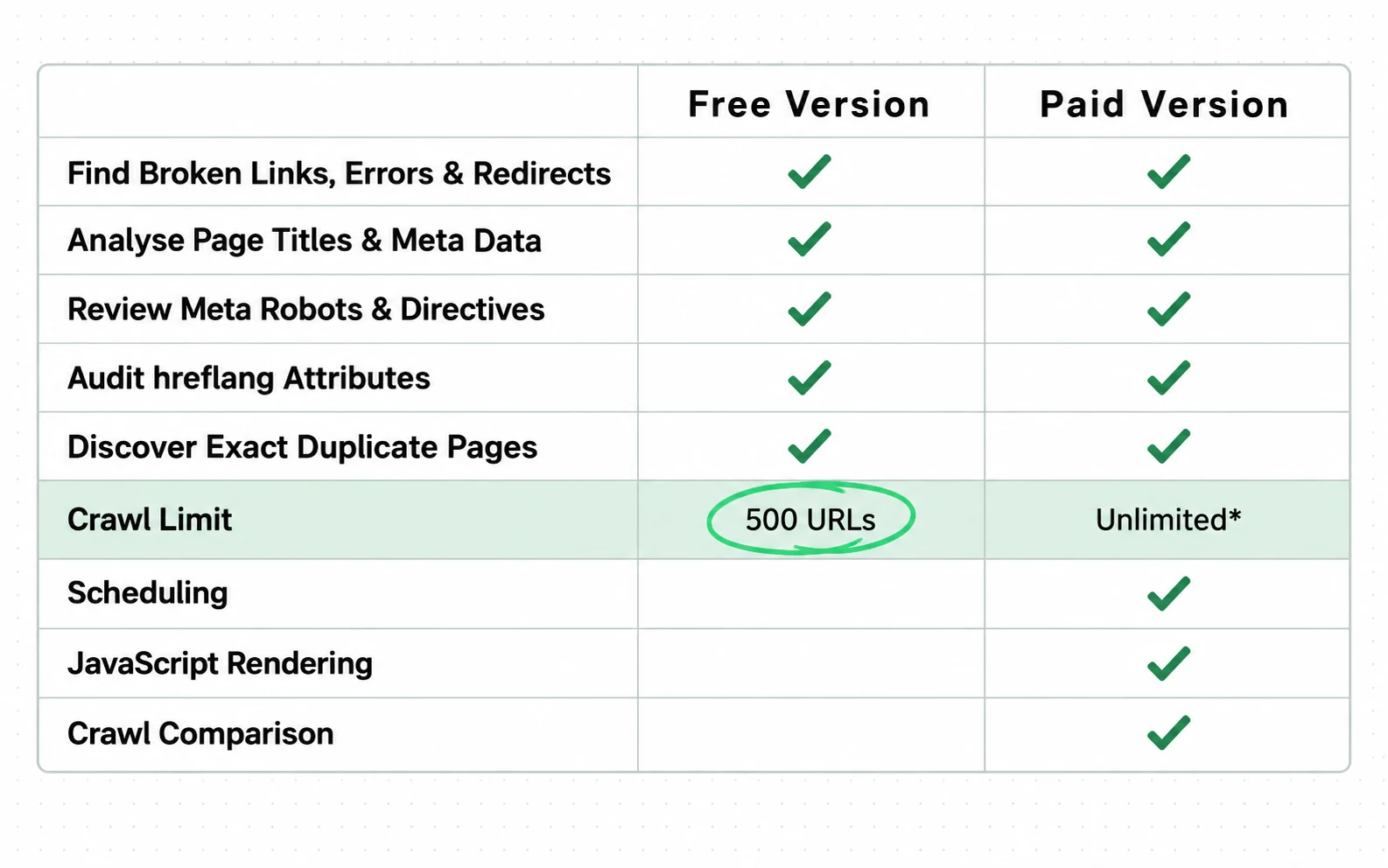
- Broken links, titles, meta robots, hreflang and duplicate pages are all in the free column. That is most of a technical audit.
- The limit is 500 URLs, which is the number that decides this for you. A forty-page marketing site fits; a documentation site does not.
- The paid rows are the tell: scheduling, JavaScript rendering, crawl comparison. You buy the licence for repetition and for a JavaScript app, not for the checks themselves.
If your marketing site is under five hundred pages and does not render its content in JavaScript, the free crawler covers the technical job and the money goes somewhere else. That is a real answer to the question those threads keep asking, and it is the answer a subscription cannot give you.
The same reasoning applies to the writing tools. If one person writes everything and reads the drafts before they ship, a content score is a second opinion you already have. Two writers and a reviewer changes that, because a published number is easier to agree on than a preference.
Who should skip each tool?
Every product here fails somebody, and the failure is predictable from what the vendor publishes. This comes from pricing and feature pages, not from running them side by side, which nobody has published either.
Ahrefs
Best fit when rankings and backlinks are the reporting line, and when prompt tracking would otherwise be a second subscription. Five tracked prompts on the entry plan is thin, and twenty on the top one is still fewer than a dedicated tracker sells at a third of the price.
Skip it if you have one product and forty pages. You are paying for a keyword universe you will not use.
LowFruits
Best fit for finding terms a small site can win. That is the bottleneck for most early SaaS companies. Credits make it cheap to answer one question well.
Skip it as your only tool. No crawler, and no rank history to speak of. It sits beside something else instead of replacing it.
Screaming Frog
Best fit for the technical job, and free under 500 URLs. A yearly licence, not a monthly subscription, which changes how it looks on a budget.
Skip the paid version until you have hit the free limit or need JavaScript rendering. Both are checkable.
Surfer and Clearscope
Best fit when several people write and the drafts need a shared bar. Both publish their plan limits plainly.
Skip either if one person writes everything. A score against pages that already rank tells a solo writer what they already decided, and best AI SEO tools sets out what neither publishes about the score itself.
Semrush
Best fit when one subscription has to cover keywords, rankings and prompt tracking at once, and when somebody else will inherit the account. Semrush is the most widely documented product in this list. That matters when the person who set it up leaves.
Skip it if you already hold Ahrefs. The overlap is most of the product, and buyers treat the two as alternatives, not as a pair.
What SaaS SEO tools cannot count
Everything above is about pages and rankings. A SaaS company is not paid for either, and the gap between what these tools count and what you are measured on is the whole reason this term exists separately.
The newest column you are being sold has the thinnest evidence under it. C-SEO Bench, by Puerto, Gubri, Green, Oh and Yun, tested published optimisation methods over two tasks and three domains each and found three of fifty-four combinations improved.
Coverage is a real trade for you, not a feature line. Orbit Media Studios read 13,184 citations across 1,765 answers and found all four models naming the same domain for the same question in 30 of 1,792 combinations.
Your conversion is a trial, a demo or a signup, and these products document nothing that records one. What each publishes ends at the session, and what happens after it lives in your own analytics and your own database.
So the line between a keyword and a customer is something you build, not something you buy. One field on the signup form, or one parameter carried through to the account record. That piece is what makes every number above readable.
Say a term brings forty sessions a month and two of them start trials. No tool on this page can tell you that. Your analytics can, if somebody stored the landing page against the account when it was created. That is a single field, not a project.
Without it, the whole category reports on the wrong unit. You will see rankings climbing and no way to say which of them paid for the subscription. Most SaaS teams are in that position when they ask which tool to buy next.
Say you sell to other businesses and not to consumers: the problem is the same and your unit is different. What you count there is a company, and that is where B2B SEO tools part company with this list.
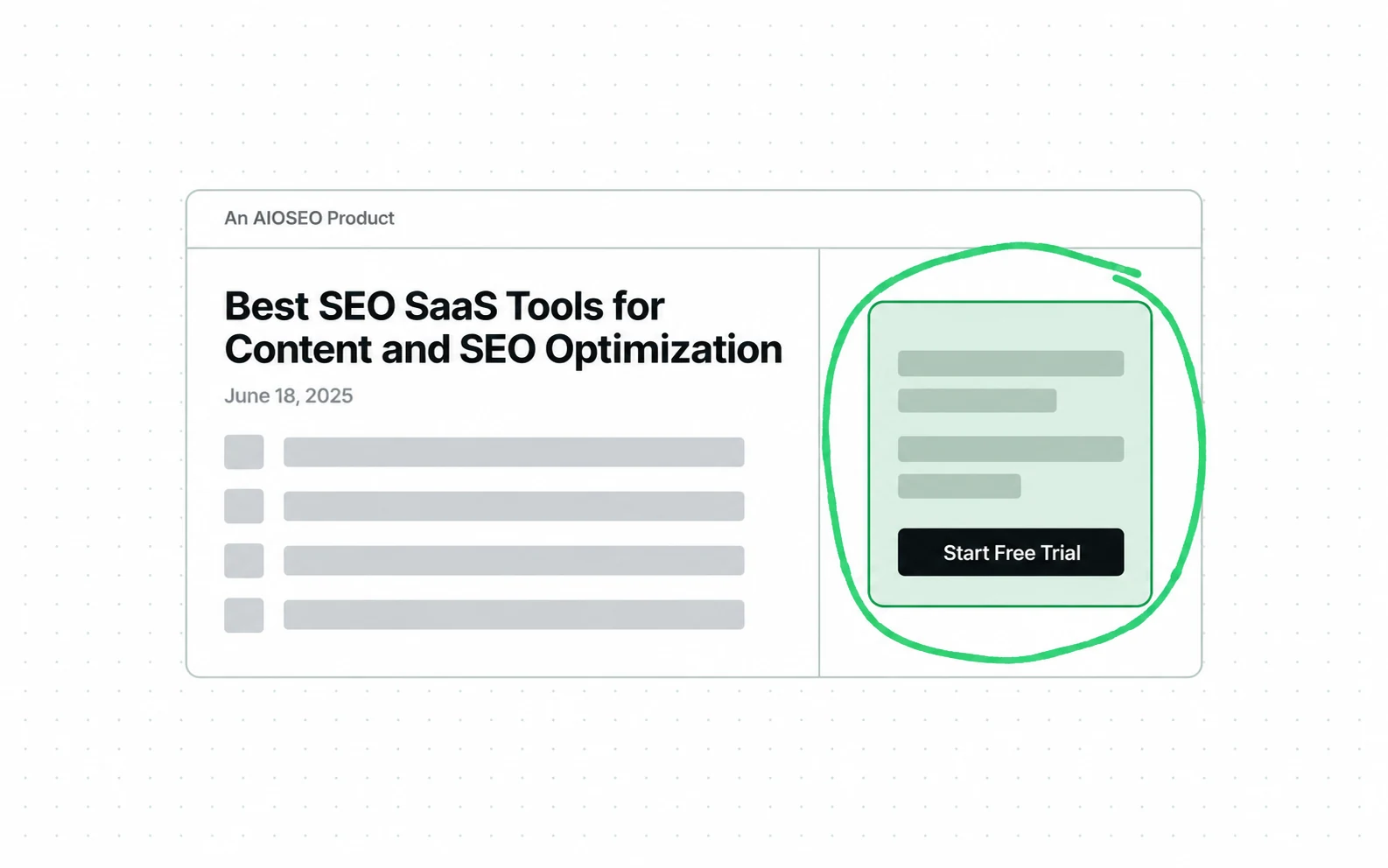
- The article is published by a company selling a tool in the category, and the promotional box sits beside the list.
- That is not a reason to dismiss the list. The bias is a reason to read the ordering as marketing and the product facts as facts.
- One check settles it on any list like this: look for the publisher’s own product, then look at where it sits.
For example, you can cover the technical rows on that list with the seo-technical skill. It reads your fetched HTML alone and reports crawlability, indexability, rendering and the AI crawler table.
Ask any list one question before you buy from it: does the writer sell one of these. You will find the answer on the page, usually in the header, and it changes how you read the order without telling you the tools are bad.
Suppose the answer sends you off the list: the work itself is what our SaaS SEO agency team does at Addition, a search marketing agency.
Sources
- Ahrefs Pricing: Lite $129 a month with 750 tracked keywords, 100,000 crawl credits and 5 tracked AI prompts; Standard $249 with 2,000 and 10; Advanced $449 with 5,000 and 20
- LowFruits Pricing: Standard $20.75 a month with 3,000 credits and 100 tracked keywords; Premium $62.45 with 10,000 credits and 500 tracked keywords
- Screaming Frog Pricing: the SEO Spider is free to crawl up to 500 URLs, with a licence required for scheduling, JavaScript rendering, crawl comparison and custom robots.txt
- Surfer Pricing: Standard $99 a month with 25 AI prompts tracked, Pro $182 with 50, and two plans at 100
- Clearscope Pricing: Essentials $129 a month with 50 tracked prompts and 50 pages; Business $399 with 300 of each
- Semrush Pricing: plans from $117 a month, with AI visibility prompt tracking included at 50 and 100 prompts on the tiers where it appears
- SEOBoost Best SEO SaaS Tools for Content and SEO Optimization, June 2025: a ranking list published by a company selling a tool in the category
- Google Search Central Crawl budget guidance: crawl capacity and crawl demand together decide how much of a site Googlebot fetches
- Google Search Central Search Console documentation: impressions, clicks, click-through rate and average position, free and without a plan limit
- Google Search Central JavaScript SEO basics: Google can process content in JavaScript when it is not blocked, and working on a JavaScript site is more complex than on other sites
- Google Search Central Optimizing for generative AI features: SEO best practices continue to be relevant because the AI features are rooted in the core Search ranking systems
- Puerto, Gubri, Green, Oh and Yun C-SEO Bench, NeurIPS Datasets and Benchmarks 2025: published optimisation methods tested across two tasks and three domains each, with three of fifty-four combinations positive
- Orbit Media Studios 13,184 citations across 1,765 answers, four models, three brands: all four cited the same domain for the same question in 30 of 1,792 combinations
- Mangools AI Search Grader: three AI models covered without payment, visibility defined as the share of prompts where a brand appears in the top 20
Questions people ask
What are the best free SEO tools for SaaS?
Screaming Frog is free up to 500 URLs and covers most of a technical audit: broken links, titles, meta robots, hreflang and duplicate pages. Google Search Console is free with no limit and is the only source of your own impression and click data.
Between them you can answer the technical questions and the performance questions without a subscription. What you cannot do free is track a large keyword set over time.
Do SaaS companies need different SEO tools?
No. The products named are the general ones, sold to ecommerce and publishing under the same names.
What differs is the unit. Your conversion is a trial or a demo, not an order, and no SEO tool records one. The connection between a keyword and a signup is something you build in your own analytics.
How much should a SaaS company spend on SEO tools?
The published entry prices run from about $21 a month for a keyword tool to $129 for a full suite. The crawler is licensed yearly, not monthly.
Size it by two numbers you already know: how many pages you have, and how many keywords you would track. A forty-page site on a $449 plan is paying for a keyword universe it will never open.
Is Ahrefs or Semrush better for SaaS?
No published test compares them on outcomes, so the comparison that survives is what each publishes about its own plans: tracked keywords, crawl credits and tracked prompts.
Pick on the number that binds for you. If you have a large documentation site, crawl credits decide it. If you have a long keyword list, tracked keywords do.

