

What is AI SEO?
Say you are asked to sort out AI SEO for a store. Before anything else, settle which of two jobs you were handed, because the tools, the budget and the measurement are different for each and nothing about the phrase tells you.
The first job is production. You use AI to write, update and maintain pages faster than a person could on their own, and the outcome you want is ordinary: rankings, traffic, orders. Nothing about the mechanism is new here. The machine is on your side of the desk.
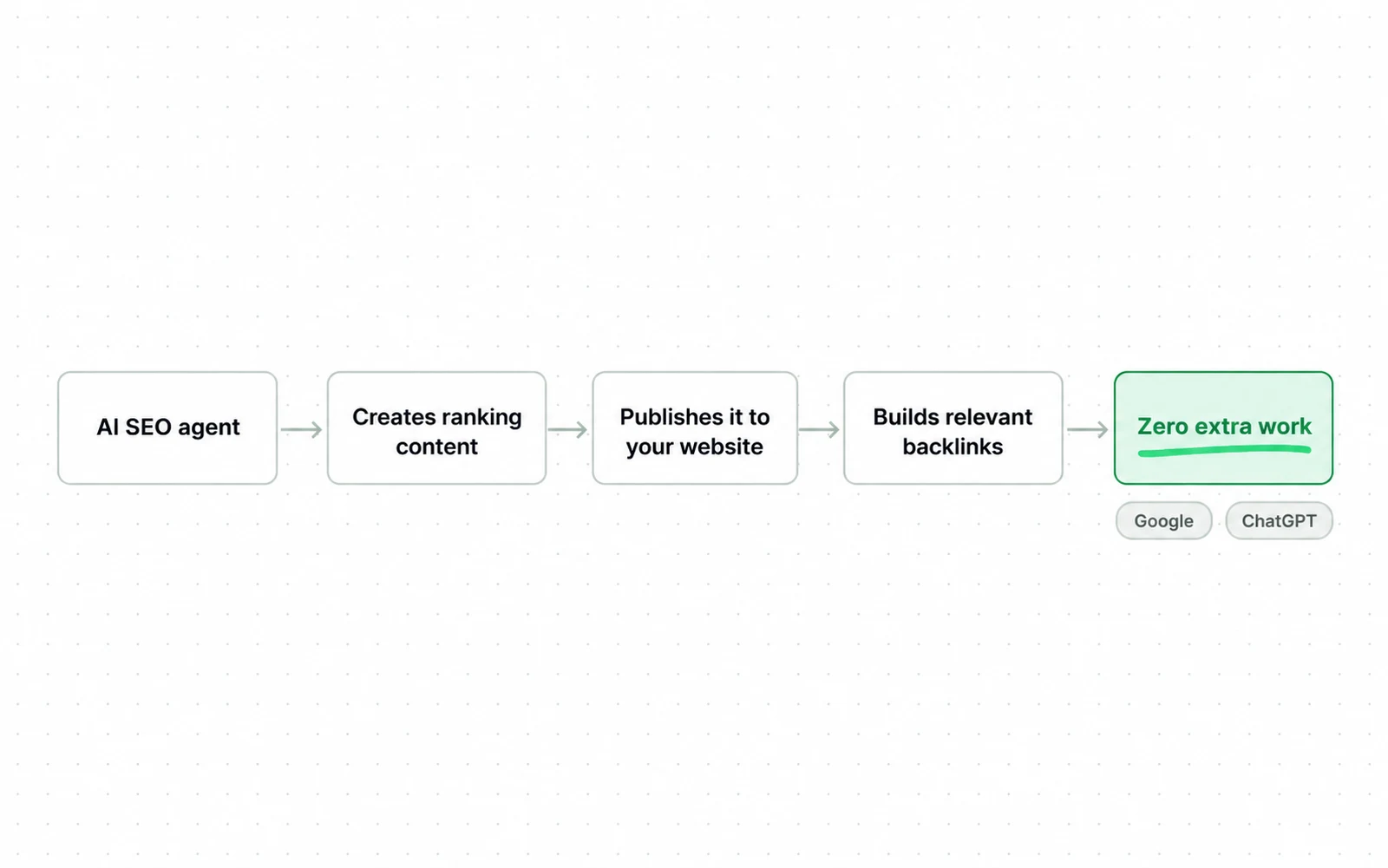
- The verbs are the job: creates content, publishes it, builds links. The product does the work a person would otherwise do.
- Zero extra work is the promise, and it is a productivity promise. Nothing here is about how an assistant chooses what to cite.
- Combining search visibility and assistant visibility in one promise is where the two jobs start blurring for a buyer.
The second job is visibility inside answers. You want an assistant to name your brand when somebody asks it a question in your category. The outcome is a mention or a citation, and it may arrive without a click.
The blur is not anybody’s fault. A single vendor page can sell both, and an assistant can be the tool you write with and the surface you want to appear on.
The phrase covers that overlap without marking it. So your first question is which outcome somebody is expecting, not which tool is best.
These are not two halves of one project. One is bought from a writing tool, the other from a tracker or from ordinary search work, and AI visibility sets out what the second one is made of.
Which job you were handed
| AI doing your SEO | Being found by AI | |
|---|---|---|
| What you buy | A writing or auditing tool | Search work, or a tracker to watch it |
| What moves | How many pages you can ship | Whether an answer names you |
| Where it shows up | Rankings and traffic | Mentions and citations, often without a click |
| Who sells it | Surfer, Clearscope, Semrush | Profound, Otterly, Semrush |
Which index do Google's AI features retrieve from?
The visibility job sounds like it needs a separate discipline. Google published a guide in 2026 saying it does not, and the mechanism it names is the reason.
Google states that its generative AI features are rooted in the core Search ranking and quality systems, and names two techniques. Retrieval-augmented generation retrieves pages from the Search index and generates an answer from them. Query fan-out issues several related queries at once and gathers more results.
Both are retrieval. Neither is a separate index you can be admitted to. The technical half of the work is the technical half you already know.
One consequence follows immediately and it saves money. Google documents the retrieval step for its own AI features, and it reads the same index your ordinary search results come from. On Google’s surfaces, a page that is not indexed and snippet-eligible cannot be retrieved by Google’s AI features. Do not generalise that mechanism to every assistant, and treat it as true only where it is documented. The work that fixes the second problem is the work that fixes the first, and it is priced like ordinary search work because that is what it is.
The way Google Search finds and processes your pages remains the core of how our AI systems access your data. … To be eligible to be shown in generative AI features on Google Search, a page must be indexed and eligible to be shown in Google Search with a snippet, fulfilling the Search technical requirements.
Google Search Central read 5 September 2026
- Indexed, and eligible to be shown with a snippet. Ordinary search work already opens that part. The same section names a second condition: the site must be included in Search generative AI features in Search Console.
- The line about semantic HTML is the one to read twice: focus on human readability and do not worry about perfect code.
- Crawlable content is named as the requirement, not any new file or markup, which rules out a category of advice sold under this term.
OpenAI publishes the same shape of answer in its own documentation. OpenAI names the crawler that decides whether your pages can appear in ChatGPT search answers, and LLM SEO works through that rule alongside the other assistants.
How to buy AI SEO without paying for two jobs
This is a triage procedure, not a strategy. It settles which of the two purchases you are looking at, and that decision comes before any tool choice below it.
Say you want the extractability check behind the first job run on your page. The ai-seo skill runs its ten-row table on a URL you name. Its crawler list conflates OpenAI’s training and search bots, and its item page tells you so.
-
Write down the outcome somebody expects
More pages published this quarter is the first job. Being named when a buyer asks an assistant is the second. If two people give you two different answers, you have found the actual problem before spending anything.
-
Ask the assistants your own questions, signed out
Ten minutes, no subscription. Type what a buyer would type, in your category, and write down which brands come back. This tells you whether the second job is even live for you, and it costs nothing.
-
Open your robots.txt
Look for the crawler names that decide search eligibility on each assistant. Blocking one of them is a decision, and a decision made by accident is the most expensive line in this whole guide.
-
Check whether your pages are indexed at all
Google’s guide names two conditions: indexed and snippet-eligible, and included in Search generative AI features in Search Console. A section that fails the first never reaches Google’s AI features. Each assistant sets its own condition.
Only after those four does a purchase make sense. If the answer was the first job, you are shopping for a writing tool and best AI SEO tools compares four of them on what each publishes. If it was the second, you are shopping for measurement, and AI visibility tools sets out what those watch.
AI SEO pricing for the two jobs
Both jobs are sold monthly, and the entry prices are closer than the products are. That is part of why they get confused. What you get for the money is not comparable.
In the comparison below, the cheapest visibility plan starts at $29 a month for 15 prompts, and the provider behind it tops out at $489. The prompt count is what your money is buying, and 15 of them will not cover a catalogue.

One product on the chart belongs on both sides, because its plans carry a content tool and prompt tracking together. Check that before buying a second subscription for the half you already hold.
Check one more thing before buying: whether a free option answers your question. Asking the assistants your own category questions, signed out, produces a real reading for nothing. That does not replace a tracker over time, and it tells you whether there is anything to track.
The larger cost in the second job is not the tool. Your budget goes to the ordinary search work the retrieval step depends on, and that is a normal SEO line with a different reason attached.
Say you want that line run against your own catalogue: that is ecommerce SEO services at Addition, a search marketing agency.
Common mistakes when buying AI SEO
Every one of these is somebody buying the right product for the wrong job. The cost is not usually the subscription. The cost is a quarter spent on the wrong measurement.
Buying a writing tool and expecting the visibility number to move. A content editor scores a draft against pages that already rank. Nothing in that loop watches an assistant, so the number you were hired to move is not in the product.
Buying a tracker and expecting the pages to improve. A tracker reports whether you were named. It does not write anything, and the half of the pitch that promises improvement is the half tracking alone cannot deliver.
Say you sell garden furniture and somebody asks an assistant which teak bench lasts longest outdoors. A tracker tells you whether your brand was named in that answer. It will not write the page that would make you worth naming.
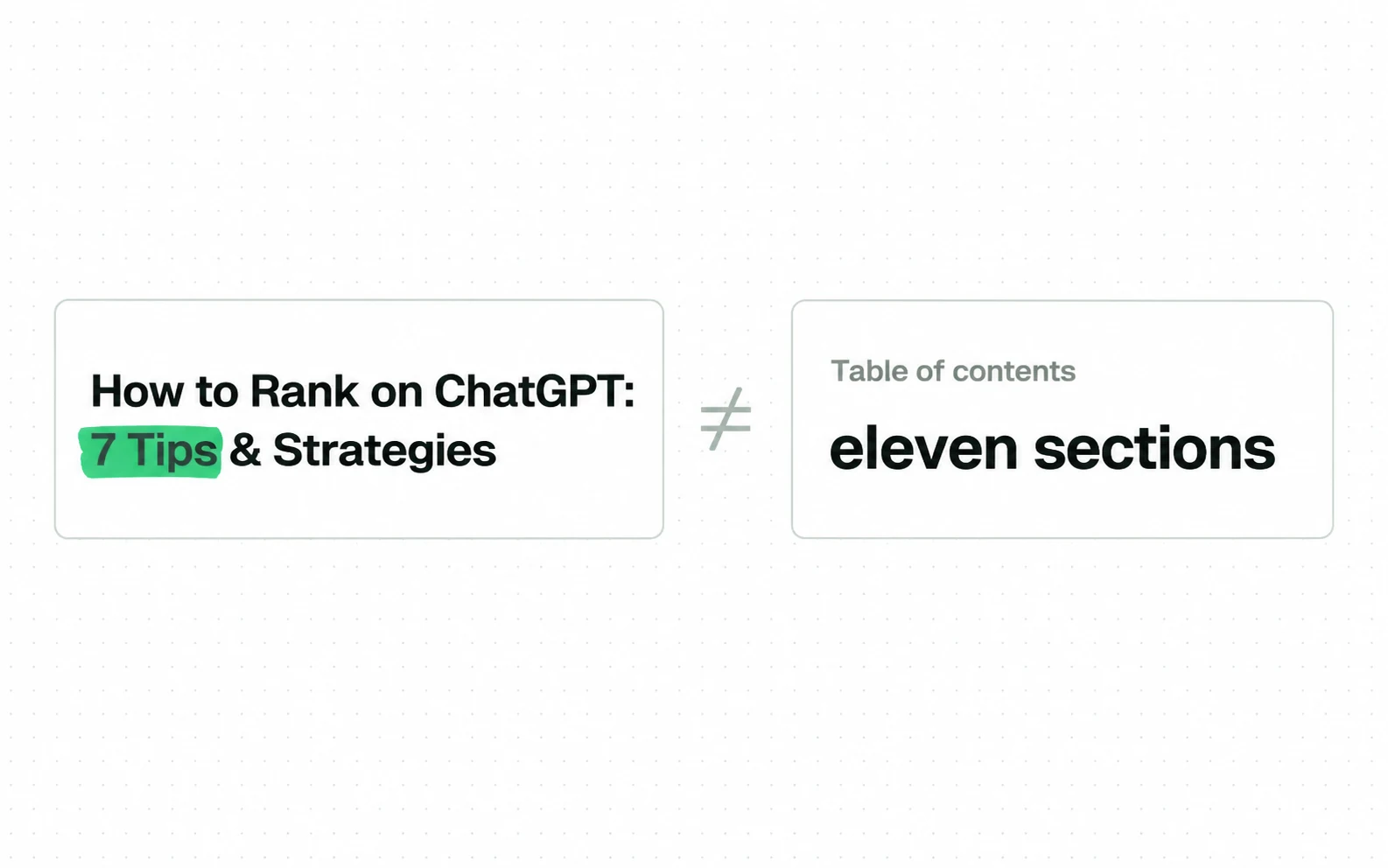
- Seven tips in the title and eleven sections in the contents. The mismatch is the tell that the number was chosen for the headline.
- The word rank does the damage. Nothing in an assistant ranks pages the way a results list does, so the verb sets the wrong expectation before the reader starts.
- The goal is real and the mechanism is never named, which is the failure mode this whole term produces.
Treating the assistants as one surface. They publish different crawlers and different rules, so a change that makes you eligible on one says nothing about the others.
Orbit Media Studios put a size on that in 2025. Across 13,184 citations drawn from 1,765 answers for three brands, all four models cited the same domain for the same question in 30 of 1,792 combinations.
Measuring the wrong half. A store that hires for the second job and reports on sessions will look like it achieved nothing. An answer that names a brand and sends no click leaves no trace in that number. The work may have been fine and the report was reading the wrong column.
Blocking the crawler that decides eligibility while allowing the one that does not. This is the cheapest mistake to check and the most expensive to leave in place. It removes you from a surface entirely; it does not lower your position on it.
What can you measure in each AI SEO job?
The first job is measurable with the reports you already have. The second is where the counting gets hard, because part of it is not visible to you at all.
For production work, the numbers are ordinary: pages shipped, pages indexed, rankings, sessions, orders. Nothing in this guide changes how you read them.
One caution applies to both columns. Your page can be fetched by an assistant, quoted in an answer, and produce a visit weeks later that your analytics credits to a direct session.
Neither report is wrong. Server logs and analytics count different events at different moments, and nothing you change reconciles them.
For visibility work, Search Console reports traffic from Google’s AI features inside overall Search under the Web search type. So a click that came from an AI Overview is in your total, and an appearance without a click stays folded into the overall Web totals. How to measure AI visibility sets out what you can do by hand.
Independent testing of the visibility job you would be buying is thin. A 2025 benchmark ran published optimisation methods over two tasks and three domains each, and three of fifty-four combinations improved. Its authors are Puerto, Gubri, Green, Oh and Yun.
Where each job becomes countable
- 1 Pages shipped First job. Your own count, available immediately.
- 2 Indexed and snippet-eligible Shared. Search Console reports it, and the second job depends on it.
- 3 Named in an answer Second job. Visible only by asking, or by paying a tracker to ask.
- 4 Click from an AI feature Second job. Folded into Search totals, not broken out.
- 5 Order Shared, and neither job can attribute it cleanly.
A brand tracking its own name will see movement on the third rung long before anything reaches the fifth. Treat those as two reports, not one funnel, because neither carries the other’s unit.
One more thing is worth setting up before either report: your own logs. Google and OpenAI both publish the crawler that fetches pages for their answers, and a fetch is a line in your server log with a user agent you can verify. That is the cheapest evidence in this category and it answers a question no dashboard does: whether the machine has read the page at all.
Sources
- Google Search Central Optimizing your website for generative AI features on Google Search: states the features are rooted in the core Search ranking systems, and names retrieval-augmented generation and query fan-out as the techniques
- Google Search Central Same guide, technical section: a page must be indexed and eligible to be shown in Google Search with a snippet; existing technical SEO best practices continue to be worthwhile; a site must also be included in Search generative AI features in Search Console
- Google Search Central AI features and your website: there are no additional requirements to appear in AI Overviews or AI Mode, nor other special optimizations necessary
- Google Search Central Creating helpful, reliable, people-first content: the self-assessment questions Google publishes for judging content quality
- SEO.AI Product homepage: an AI SEO agent that creates ranking content, publishes it to your website and builds relevant backlinks, headlined more traffic from Google and ChatGPT with zero extra work
- Power Digital Marketing How to Rank on ChatGPT: 7 Tips and Strategies, January 2026: eleven contents entries under a seven-item title
- Otterly.AI Pricing: entry plan at $29 a month with 15 search prompts, rising to $489
- Writesonic Pricing: Starter at $79 a month, Basic $199, Growth $399, with tracked prompts and engines listed per plan
- Profound Pricing: Starter at $99 a month, ChatGPT tracking only, 50 prompts, daily prompt frequency
- Surfer Pricing: Standard at $99 a month with 25 AI prompts tracked, Pro at $182 with 50, and two plans at 100
- Clearscope Pricing: Essentials at $129 a month with 50 tracked prompts and 50 pages, Business at $399 with 300 of each
- Semrush Pricing: plans from $117 a month carrying both content tooling and AI visibility prompt tracking
- Puerto, Gubri, Green, Oh and Yun C-SEO Bench, NeurIPS Datasets and Benchmarks 2025: tests published optimisation methods across two tasks and three domains each, with three of fifty-four combinations positive
- Orbit Media Studios 13,184 citations across 1,765 answers, four models, three brands: all four models cited the same domain for the same question in 30 of 1,792 query and domain combinations
- Google Search Central Search Console documentation: traffic from AI features is reported inside overall Search traffic under the Web search type
- OpenAI Overview of OpenAI Crawlers: OAI-SearchBot surfaces websites in ChatGPT search results, and sites opted out of it will not be shown in ChatGPT search answers
Questions people ask
Is SEO dead now with AI?
Google’s own guidance points the other way and gives the mechanism. Its generative AI features are rooted in the core Search ranking systems, and they retrieve pages from the Search index to build an answer.
What changes is where the answer is read. A page can be used in an answer without receiving a click, so the traffic number and the visibility number stop moving together.
Which AI is best for SEO?
That question belongs to the first job, and no such comparison appears among the sources on this page: whether the pages these tools help produce perform better than pages written without them.
Each plan does publish what it includes: tracked prompts, pages and drafts. Compare those and treat the rest as untested.
Can I use AI to do my SEO?
Yes, and Google says so directly. Its guidance asks that AI-assisted content meet the same standards as anything else on Search, and points to its spam policies for content produced primarily to manipulate rankings.
The line is purpose, not authorship. Content made to help a reader is fine however it was produced; content made at scale to game rankings is the thing the policy names.
How do I know which kind of AI SEO I need?
Ask what outcome somebody is expecting. More pages published is the production job. Being named when a buyer asks an assistant is the visibility job.
If you get two different answers, do the free check first: ask the assistants your category questions from a signed-out window and see whether your brand comes back at all. That result decides the budget better than any tool page will.

