

Four jobs AI SEO tools handle
Start with the output you need this week. A draft score, a site plan, generated copy and an AI visibility report solve different problems, so the right tool for one job is often the wrong purchase for the other three.
For a draft due today, rule out a site-planning tool even if its other features appeal to you.
AI SEO tools grouped by the job they do
| The job you have | Tools sold for it | What you get |
|---|---|---|
| Score a draft before publishing | Surfer, Clearscope | A score for one page, based on pages already ranking for the target keyword |
| Plan a whole site | MarketMuse | Topic clusters and gaps across your content inventory, not a score for one draft |
| Write the draft | Frase, Writesonic | Briefs and generated copy. A poor fit if your team writes the copy and only needs a tool to score it |
| Manage SEO through one suite | Semrush, SE Ranking | Keywords, rank tracking and AI answer tracking. A poor fit if you do not need the rest of the suite |
Shortlist only tools sold for the same job.
How to test AI SEO tools on the same job
Give each tool on your shortlist the same page, keyword and goal. Run every tool in the same week, because search results shift from week to week.
Build one repeatable trial
The evidence a buyer needs from a tool trialSave the page, output and method so a teammate can repeat the trial
Our sample trial log for one page and one keyword.

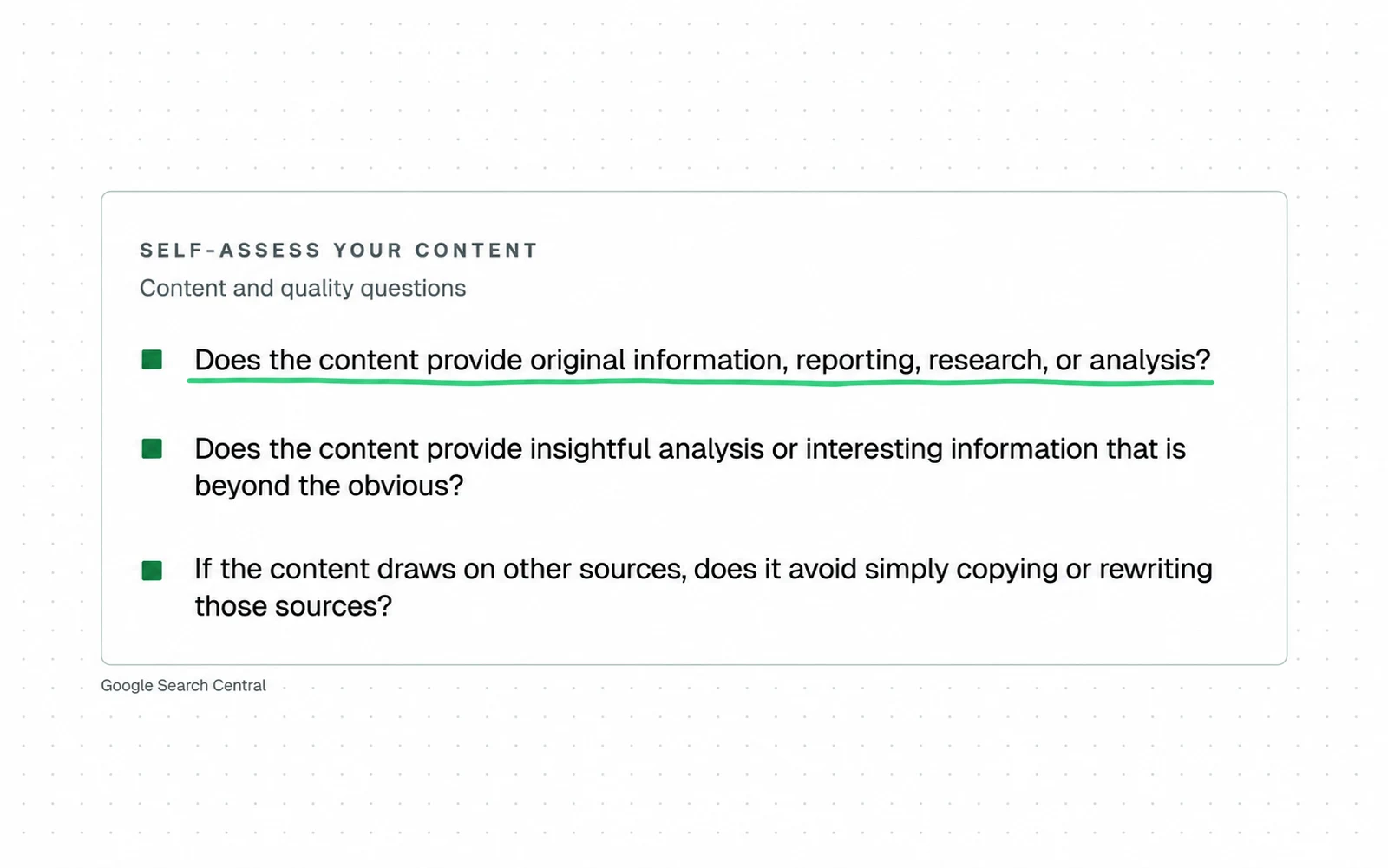
- Google frames these questions as a self-assessment. Use them to check the evidence behind a tool recommendation.
- For a buyer, the useful questions are whether the content adds original analysis and whether it avoids simply rewriting other sources.
- You cannot verify a tool comparison when only one product has a visible test.
-
Choose one real page
Use work your team already needs. Keep the original page and target keyword as the baseline.
-
Define a useful result
Before opening a tool, write down the changes you want it to make. Include the output you expect and the mistakes that would make it unusable.
-
Run the same brief
Give every tool the same page, keyword and instructions. Save each output for the review.
-
Record the correction cost
Count the edits needed to make the output usable. Time them too. If fixing an output takes longer than writing that section yourself, it fails.
Decide what counts as a failure before the first run. For instance, a draft that keeps a service you no longer sell fails the trial, however good its score looks.
What each tool costs and predicts
Price is the one part of a trial you can check before the first run. Surfer, Semrush, Clearscope and MarketMuse do not state what their scores predict.
Price and score details from each vendor
| Surfer | Semrush | Clearscope | MarketMuse | |
|---|---|---|---|---|
| Listed price for the feature | Standard $99/mo, Pro $182/mo | Content optimization from Pro+, $248.17/mo billed annually | Essentials $129/mo, Business $399/mo | Not published |
| States the scoring scale | Yes, a score out of 100 | Not published | Not published | Not published |
| What the vendor says the score predicts | None published | None published | None published | None published |
Ask each vendor what outcome its score predicts before you compare scoring systems.
For example, ask whether a higher score means the page should rank higher, receive more citations or simply cover the topic more fully.
Who each one is wrong for
Say your team writes its own drafts and only needs a score for each one. Surfer and Clearscope are then the two to trial. The notes below give a test for ruling out each tool.
Surfer
Surfer provides a score out of 100 that it says rests on more than 500 ranking factors. Surfer suits teams that write their own drafts and want a single score to guide revisions.
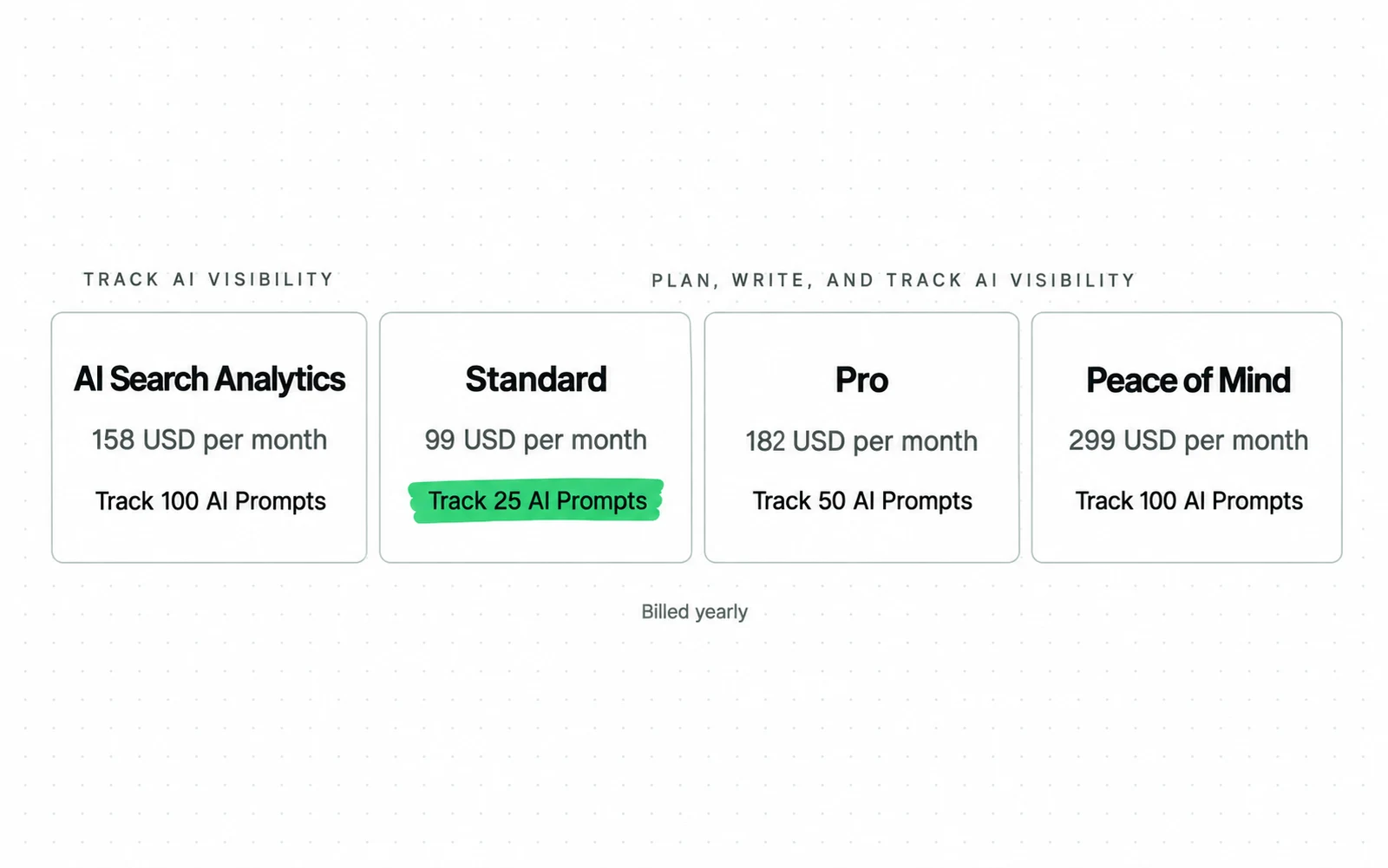
- The prompt counts are published and they climb with the plan: 25 on Standard, 50 on Pro, 100 on the two ends.
- There are four plans. The cheapest is not the first one shown. AI Search Analytics at 158 sits above Standard at 99 because it is a different product line, not a bigger one.
- Count the prompts you will track each month. If that count fits the smaller plan's allowance, buy the smaller plan.
Semrush
Semrush starts at $117.33 a month when billed annually. Content optimization starts with Pro+ at $248.17.
Skip it if you would use only the content tools and none of the rest of the suite.
Semrush charges extra for its AI visibility product. See our AI visibility tools comparison for pricing.
Clearscope
Clearscope scores drafts like Surfer does. Count the pages your team edits in a month. Clearscope fits if that count stays under the plan's page limit.
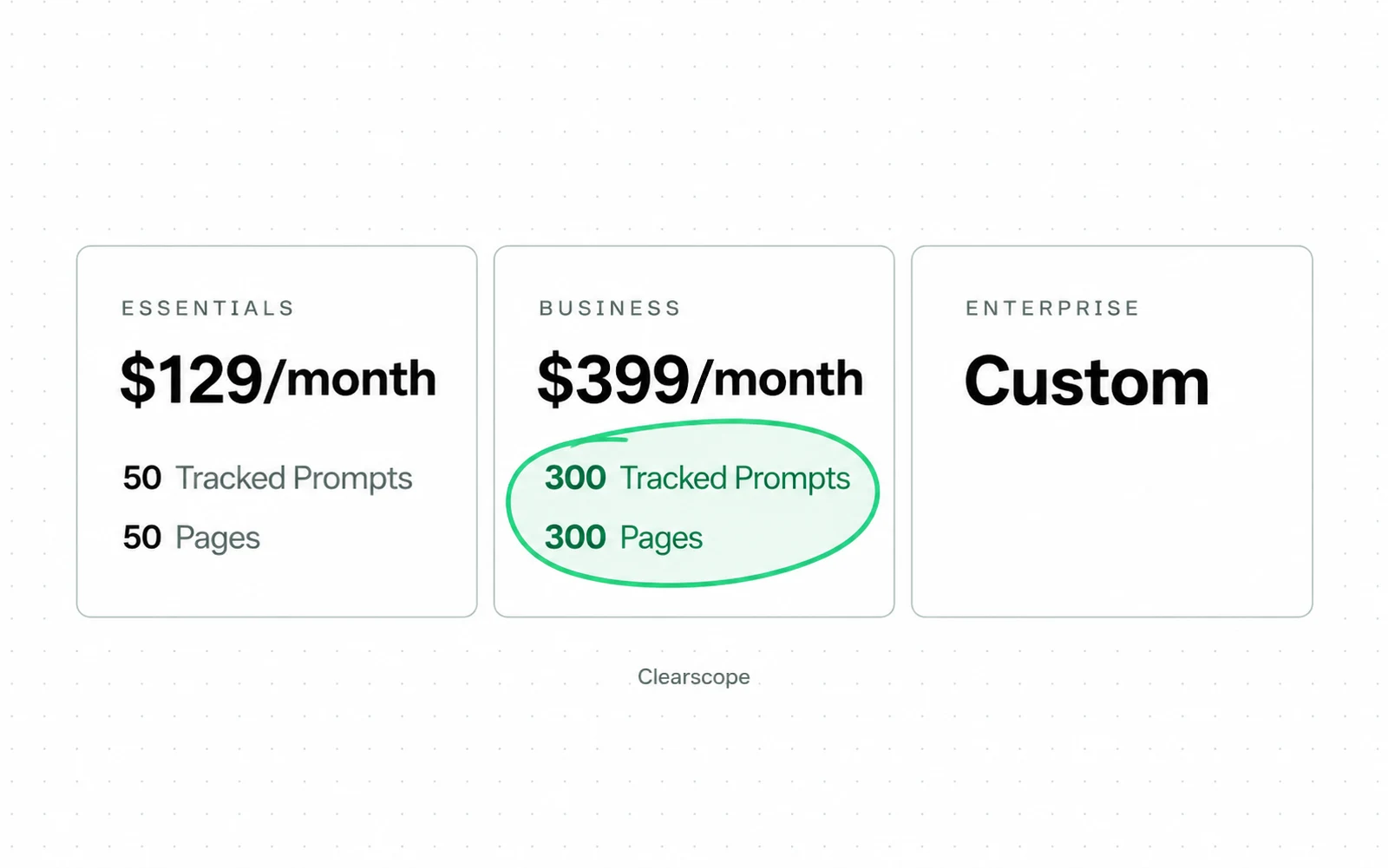
- Tracked prompts and pages are published: 50 and 50 on Essentials, 300 and 300 on Business.
- Clearscope calls the pricing simple and transparent. The plan limits support that claim. Both numbers a buyer needs to size the plan are available.
- Ask for a sample report on one of your own pages before you commit to a plan.
MarketMuse
Say you manage hundreds of pages and cannot tell which topics they already cover. MarketMuse maps the topics covered across your site.
It fits when your team can act on a site-wide content plan. Skip MarketMuse if your immediate need is to score drafts.
What these tools cannot tell you
SEO.AI promises to write your drafts and says how fast it will do it, but never says what those drafts will do for your traffic. Test the output on one page before handing over publishing access.
seo.ai product page, read 4 September 2026What SEO.AI promises and what its evidence shows
Ask for a trial page and set a period for assessing its rankings before giving SEO.AI publishing access.

MarketMuse quotes one customer reporting four to ten times more traffic. Do not plan around that range. Record your own traffic for the month before the trial starts and compare against it.
What to test before you buy
If you need to diagnose problems with one page, run an AI SEO audit of its technical and content signals before you buy a dashboard.
Puerto, Gubri, Green, Oh and Yun found that retrieval-focused optimisation methods performed better than conversational ones. Check whether a tool's edits make your text easier for a search system to retrieve and quote.
For example, check whether each answer to a question your buyers ask now sits in its own short paragraph under a clear heading.
Google says it treats automation as spam when the point of the automation is to manipulate rankings. Have a person approve every page a tool publishes for you.
Make the tool trial a buying decision
Use your trial results to choose a tool and a plan. Save the five trial records below for every tool you test. Compare them side by side before you pay.
Five records to keep from every tool trial
| Check | What to look for | Why it matters | Your action |
|---|---|---|---|
| Input | The same page, keyword and brief | Results from different tasks do not show how the products compare | Save the original files |
| Output | The draft, score or plan produced | You need something concrete to compare | Export or capture the result |
| Corrections | Edits needed before use | Review time changes the real cost | Count the edits needed before the output is usable |
| Failures | Wrong facts or unusable advice | One severe error can outweigh speed | Record severity and cause |
| Subscription commitment | Plan, billing term and required add-ons | Monthly labels can hide annual spend | Calculate the full commitment |
Make the result repeatable
When a vendor changes its plans or scoring, rerun the same brief. Compare the new output with the one you saved.
If your trial shows the real need is tracking brand appearances in AI answers, start with our AI visibility tools comparison.
If you prefer to outsource the work, our AI visibility service tracks your brand's appearances in AI answers and reports changes each month.
Sources
- Google Search Central Creating helpful, reliable, people-first content: the product review criterion, that a reader benefits from understanding the number of products that were tested, what the test results were, and how the tests were conducted; plus the first-hand expertise question and the line that automation used for the primary purpose of manipulating rankings violates the spam policies
- Google Search Central Google Search reviews system: the scope of the system, covering first-party standalone content written to provide a recommendation, an opinion or an analysis
- United States Federal Trade Commission The FTC’s Endorsement Guides, what people are asking: if there is a connection between an endorser and the marketer that a significant minority of consumers would not expect and it would affect how they evaluate the endorsement, that connection should be disclosed clearly and conspicuously
- Puerto, Gubri, Green, Oh and Yun, arXiv C-SEO Bench, does conversational SEO work: two search tasks with three domains each and a multi-actor protocol, finding most conversational SEO methods largely ineffective and frequently harmful to ranking, while traditional retrieval-focused SEO is significantly more effective. NeurIPS Datasets and Benchmarks 2025
- OneLittleWeb Seventeen best AI SEO tools: Semrush first, published evaluation criteria, more than forty tools tested over three years on live client campaigns and cross-checked against Search Console and Analytics, with an affiliate disclosure and no per-tool test results
- freddiechatt I tried 18 AI SEO tools: eighteen listed, four with a specific first-person account naming the page or site each was run on, no shared protocol and no duration, with an affiliate disclosure
- Whatagraph We tested the 14 best AI SEO tools: fourteen listed with Whatagraph seventh, five carrying a first-person account of use and nine given as feature descriptions. The author is a Whatagraph employee and the article states it takes no commission on the tools featured
- Rankability Fifteen best SEO content optimization tools: Rankability first, roughly 25 to 40 products reviewed, and the most specific method statement here, one sample keyword through each tool compared on headings, entities, questions, intent alignment and revision effort. No disclosure of commercial interest
- Willson Liu, AthenaHQ AI SEO tools comparison: five tools with AthenaHQ first, no testing method described, comparison built on feature matrices and vendor claims, byline reading Operations at AthenaHQ
- Clearscope Clearscope vs MarketMuse vs Surfer: a comparison of its own product against two competitors, carrying the plainest interest statement here, that Clearscope is our product, and resting on ratings from G2, Capterra and GetApp, not on a test
- Surfer Content Editor: the content score given as a gauge indicating a score of 82 out of 100 and said to rest on 500+ ranking factors analyzed, with no sentence on the page stating what the score does or does not predict
- SEO.AI SEO.AI product page: an agent that creates ranking content, publishes it and builds backlinks
- MarketMuse Product page: software that tells you what content to write and how much, describing itself as analysing your entire content inventory and pinpointing high-value topic clusters. No price and no score unit on the page; a customer claim of four to ten times more traffic appears without a sample
- Maher El Ouahabi, EchoWi Who writes AI visibility tool comparisons: 27 comparison articles read across several tool queries, 22 of them published by a company selling a tool in its own list, with the publisher’s own disclosure attached
- Semrush Plans and pricing: SEO at $117.33/mo billed annually instead of $139 monthly, Starter at $165.17, Pro+ at $248.17 and Advanced at $455.67, with content optimization listed from Pro+ upward
- Semrush AI Visibility Toolkit pricing: $99 a month per domain billed annually, a separate product from the plans above
Questions people ask
Which AI is best for SEO content?
The best choice depends on whether you need draft scoring, site planning or content generation.
Surfer and Clearscope score drafts against pages already ranking. MarketMuse plans site coverage. Frase and Writesonic generate drafts.
Which AI agent is best for SEO?
An agent publishes content on its own. A scoring tool only evaluates the drafts you write.
SEO.AI, for example, promises content that ranks, backlinks and ongoing work, but does not state what results you should expect. Test it on one page and review every change. Keep final approval before you extend it to more pages.
Can AI do SEO optimization?
Google says automation, including AI generation, violates its spam policies when the primary purpose is manipulating search rankings.
Google also asks whether content demonstrates expertise gained from using a product or service. So use AI on pages where someone on your team has used the product and can add what they found.
Which AI SEO agency is the best?
Compare agencies by case studies of work like yours, reporting methods, prices and the team assigned to your account. For each case study, ask what the client's situation was at the start, what the agency did and what results it measured.