

Three AI visibility tools compared
Profound, Peec AI and Semrush each fit a different starting point, so rule out the mismatched options first. Our AI visibility definition explains what these tools sample.
For example, a ChatGPT-only plan cannot cover buyers who use Gemini. A manual check then tells you whether the remaining tracker captured the live answers.
Profound, Peec AI and Semrush compared
| Tool | What it does | Who it suits |
|---|---|---|
| Profound | Runs prompts across AI engines and reports which brands and domains get named | Teams ready to go beyond the entry plan, which tracks ChatGPT only |
| Peec AI | Tracks brand mentions across ChatGPT, Perplexity and Gemini | Teams that need those three engines and can assess the commercial terms with sales |
| Semrush AI Visibility | Adds AI answer tracking to an SEO suite, with the terms printed next to the price | Teams already paying for Semrush, and anyone who wants the terms in writing first |
| Others you will meet | AthenaHQ, Otterly.AI, ZipTie, Scrunch AI, Ahrefs, Writesonic, AirOps | Narrower coverage or a narrower buyer; worth a look once the three above are ruled out |
What each plan costs and covers
Write down the engines your buyers use and the prompts you need before opening a pricing page. A tool that misses either set cannot give you the reading you want.
No comparative performance test tells you which of these three is more accurate. Run the same small prompt set by hand before a trial, then check whether the tool captures the answers you saw.
Treat published plan terms as a filter, not as proof that a tracker captures live answers accurately.
AI summaries change both clicks and brand exposure, so a visibility reading answers something rankings alone cannot.

Across 68,879 Google searches by 900 US adults in March 2025, Pew Research Center found fewer traditional-result clicks when an AI summary appeared. That drop is a reason to track AI answers separately from rankings.
What coverage and sampling decide
An AI visibility tracker is useful only when it covers the engines your buyers use and reruns prompts often enough to show change. Feature lists rarely reveal either condition.
Set those two requirements before comparing extras such as sentiment labels or dashboard design.
Why those two and not the feature grid
Coverage changes what your number means because models return different sources. Orbit Media Studios found only 1.7 percent citation overlap among four models when it ran 72 weekly prompts for three business brands. Its study covered 13,184 citations across 1,765 answers, and week-to-week retention also varied by model.

Coverage of one model cannot stand in for another, and weekly results move as citation sets change. Our guide to AI share of voice explains the headline number most tools show.
These three watch answer engines. None of them writes for you. Tools that do the writing are a separate purchase, compared in best AI SEO tools.
Ask each vendor whether it sends live queries and captures the response a real user would see. Collection method changes what a reading represents. That matters more than a long feature list when you compare measurement quality.
-
Run the same prompts by hand
Compare a small manual reading with the trial output. Missing answers reveal a collection or coverage gap before you commit.
-
Inspect how competitors are chosen
A fixed or user-entered competitor set changes the score. Make sure the comparison includes the brands your buyers consider.
-
Verify the current price with the vendor
Check the price on the vendor’s own page before you buy. Confirm whether billing is monthly or annual.
-
Check what the account retains
Confirm how long captured answers and citations remain available for review.
Compare the plans side by side
The table puts each plan’s price next to its engines, prompts and refresh rate. Start with the engine row, then compare limits and cost among the plans that remain.
What each vendor publishes about its own plan
| Profound | Semrush AI Visibility | Peec AI | |
|---|---|---|---|
| Published entry price | $99/month, billed yearly | $99/month per domain, billed annually | Not published |
| Next tier | $399/month, billed yearly | Not published as a tier on that page | Not published |
| Engines at the entry price | ChatGPT only | ChatGPT, Google AI, Gemini, Perplexity | ChatGPT, Perplexity, Gemini |
| Prompts at the entry price | 50 prompts tracked | 25 custom prompts | Not published |
| Refresh stated | Not published | Daily, weekly and monthly updates | Not published |
Treat an unpublished cell as a question for sales, not as a promise that the feature is included.
If more than one plan survives the engine check, use prompt capacity and refresh rate to estimate whether each can cover your tracking set.
Who each of the three is wrong for
Those price, engine and prompt differences make each tool a poor fit for somebody. Start with the condition that would make a plan unusable for your team.
Profound
Profound is the wrong choice if you need more than ChatGPT on its Starter plan.
Peec AI
Peec AI leaves its price unpublished. It names ChatGPT, Perplexity and Gemini but does not publish a complete engine list. If Google AI Overviews matter to you, ask whether they are included before you buy.
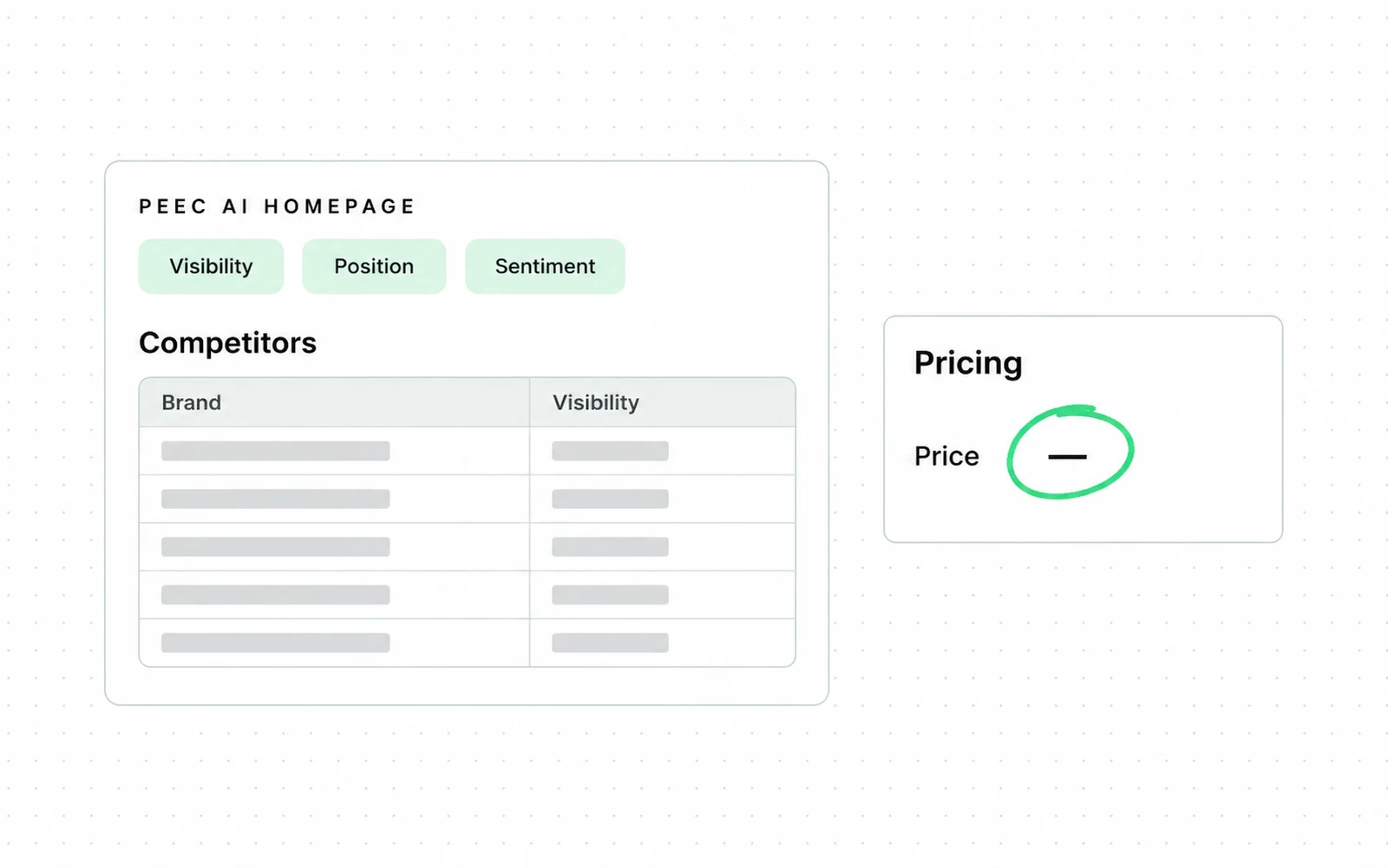
- The three metrics are named on the page: visibility, position and sentiment. That is the shape of the reading you are buying.
- The competitor table arrives with the product. Every tool in this category measures your brand against a comparison set.
- A pricing link sits in the navigation and no figure appears anywhere on the page. That is the whole reason this tool cannot be placed in the table above.
Semrush AI Visibility
Semrush is the easiest of the three to judge before you buy because its pricing page shows the engines, prompt allowance and update options together. Skip it if 25 prompts is too small for your catalogue.
What these tools still cannot do
No tool can show you every prompt and every answer. Sampling choices determine which part of the market you see, so inspect the engine and competitor sets before trusting a score.
Competitor selection can be manual. SE Ranking asks you to enter up to five competitors, so ask Profound, Peec AI and Semrush how their own comparison sets are built.
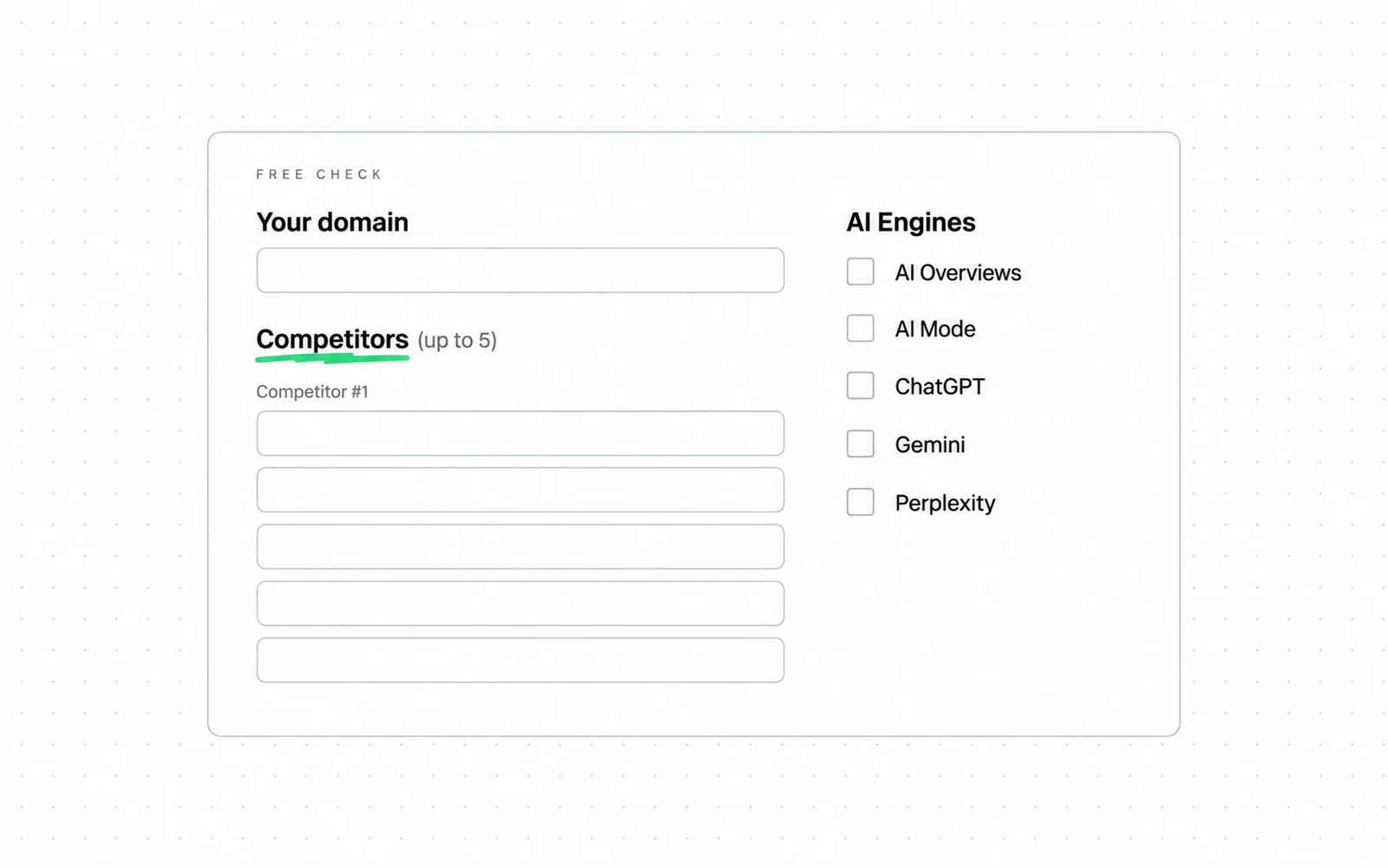
- SE Ranking names Google AI Overviews, AI Mode, ChatGPT and Gemini.
- The competitor field is the part that matters for sampling. You enter up to five, so you chose the comparison set and the tool did not discover it.
- A free check sits above the paid plan, which means the first reading costs nothing and you can see the shape of the output before you price anything.
Paul DeMott writes in Search Engine Land that buyers should treat current tracking data as directional. Complete visibility is not possible yet, so be wary of a vendor or consultant that promises it.
Citations across ten models
Using 761,495 citation pairs from 11,200 queries and 112,000 responses, CITETRACE found that provider choice explained 88 to 96 percent of citation-quality variance across ten models from five providers.
CITETRACE also separates two common failures. A citation can distort its source, or it can come from a domain that does not fit the claim.

Provider choice can change a visibility score. Ask which provider and model version the vendor queries, then check how it verifies captured answers. For page-side checks only, run an SEO-GEO audit of crawler access and citability for each URL without ongoing tracking.
What to verify before you pay
A vendor plan can look suitable on price and still fail on collection method, exports or contract terms. Verify the working parts during a trial and the commercial terms before you pay.
Eight checks to run before you buy
| Check | Why it matters | What to verify | Decision |
|---|---|---|---|
| Engine coverage | Missing engines leave gaps | Every engine in your brief | Reject a plan that misses one |
| Prompt allowance | A small cap narrows the sample | Your full prompt set and headroom | Price the required tier |
| Refresh schedule | Cadence changes the reading | Daily, weekly or monthly runs | Match it to your decision cycle |
| Collection method | Interfaces and APIs can differ | How prompts are sent and captured | Prefer a method you can inspect |
| Competitor set | The comparison group changes share | Who chooses and updates the set | Use brands buyers consider |
| History and exports | Trends require more than one reading | Retention window and raw exports | Confirm data can leave the tool |
| Billing term | Annual billing changes real cost | Renewal date and cancellation terms | Calculate the committed spend |
| Accuracy check | Captured answers can be incomplete | Manual checks against live answers | Set an acceptable error rate |
Run the trial against your own prompt set
Start with ten prompts you already care about. Run them by hand, save the answers and compare them with the trial account. Record missed answers, missing citations and brands assigned to the wrong competitor group.
Repeat the check after the next scheduled refresh. You are looking for a stable collection process and a clear explanation when the dashboard differs from the live answer.
Do not let a polished share-of-voice chart replace the raw checks. If the tool will not show the captured answer or let you export it, you cannot investigate a sudden change.
For the wider picture, see the AI visibility guide. To count what you can without a tool, see measuring AI visibility. For a one-off reading instead of ongoing tracking, see the AI visibility audit.
If you would rather have someone run the measurement and act on the findings, see our AI visibility service.
Sources
- Pew Research Center Google users are less likely to click on links when an AI summary appears: 900 US adults, 68,879 Google searches, 12,593 of which produced an AI summary. Clicks fell from 15 percent of visits to 8 percent
- Orbit Media Studios LLM citation study: 13,184 citations across 1,765 answers, 72 prompts, three brands, four models, weekly for about three months. Models cited the same domain as each other 1.7 percent of the time; week-to-week citation retention ran 30 percent for Claude to 65 percent for Perplexity
- Seo, Jeong, Kim, Jang and Lee, arXiv CITETRACE, Verified Misguidance: 11,200 queries, 112,000 responses, ten models, five providers, 761,495 evaluable citation pairs. 30.6 percent of citations distort their sources, 27.1 percent come from domain-inappropriate sources, provider-level differences explain 88 to 96 percent of citation-quality variance, and at the response level up to 96 percent of users encounter at least one structurally misleading citation
- Paul DeMott, Search Engine Land LLM optimization in 2026: be wary of any vendor or consultant promising complete visibility, and treat current tracking data as directional, not definitive
- Maher El Ouahabi, EchoWi Who writes AI visibility tool comparisons: 27 comparison articles read across several tool queries, 22 of them published by a company selling a tool in its own list. On best geo tools, one of fourteen came from someone with nothing to sell. The article carries its own disclosure, that EchoWi publishes a tool comparison and sells in the category
- Danny Goodwin, Search Engine Land Google may be cracking down on self-promotional best-of listicles: analysis by Lily Ray of Amsive showing 30 to 50 percent visibility drops after the December 2025 core update. The body states Google has neither confirmed nor announced any update targeting them
- Zapier The best AI visibility tools: eight tools, Profound first, with a stated method covering more than twenty tools tested, account sign-ups and product documentation. Prices are printed with the annual discount spread across twelve months This page carries no publication date of its own.
- Marketer Milk Best AI monitoring tools: ten tools, an affiliate-link disclosure, and Profound priced at a Lite plan of $499 a month that its vendor page no longer lists
- Profound Pricing page: Starter $99 a month and Growth $399 a month, both billed yearly with two months free, plus a custom Enterprise tier. No surfaces and no prompt allowance are named
- Profound blog Eighteen best AI visibility tools for marketing agencies: the longest list read, with Profound in first place and stated evaluation criteria but no prices
- Semrush AI Visibility Toolkit pricing: $99 a month per domain billed annually, 25 custom prompts with daily AI rankings, and mentions from ChatGPT, Google AI, Gemini and Perplexity
- Semrush blog The eight best AI visibility tools: Semrush first of eight, with a stated evaluation approach and no disclosure that Semrush sells in the category
- Backlinko Five AI visibility tools to track your brand across LLMs: Semrush first, and an ownership statement reading that Backlinko is owned by Semrush and its content is written by employees or paid contractors of Semrush Inc
- Frase The ten best AI visibility tools: Frase first of ten, six evaluation criteria listed, and no sentence describing how the ten were selected or tested
- Analyze AI Leading AI visibility optimization tools: Analyze AI first of eight, with a stated method of more than ninety days of testing across live brand projects, and Profound priced at $99 and $399
- Brainlabs The ten best tools for tracking AI visibility: Brainlabs sixth of ten, no stated method and no prices This page carries no publication date of its own.
- SE Ranking AI Visibility Tracker: two different surface lists on the same page, a stated collection method of direct interface monitoring, and an FAQ line reading that there is no benchmark yet as AI search is too new for the industry
- Peec AI Product site naming three surfaces, ChatGPT, Perplexity and Gemini. Prices are drawn by script on the pricing page and did not resolve on load
Questions people ask
How to see AI visibility?
You can check AI visibility by hand or use a tracker. By hand, run the prompts a buyer would use and record which brands appear. A tool repeats that work on a schedule across several models.
One manual reading shows what appeared that day. A tracker earns its fee by showing whether the result persists.
What are AI Visibility Services?
Tools and services are both sold as AI visibility, but they do different jobs. A tool runs prompts and records which brands or domains appear.
A service acts on that evidence by improving the relevant pages, third-party coverage and entity information. Buying a tracker does not make those changes for you.
How to get AI visibility?
A tracking tool measures whether your brand appeared. Improving that visibility is a separate job.
The generative engine optimization guide and the brand mentions guide explain the work involved.
What are the 5 main AI tools?
If you mean AI visibility tools, no standard top five exists. Start with the criteria that change the reading: engine coverage, prompt allowance, refresh frequency and collection method.
This comparison focuses on Profound, Peec AI and Semrush. Match each one against your required engines and prompt set before you choose.