

Which should you fund first: CRO or more traffic?
If your store cannot reach the sample a conversion test needs, you cannot verify a conversion gain at all. A traffic buy has a price you can read in advance. That is a difference in what you can know, not proof that one earns more. If you can reach the sample, conversion is the one you can settle with evidence from your own store.
The threshold narrows it, and the rest is your own numbers.
Everyone selling conversion work says traffic is overrated, and everyone selling traffic says the opposite. Both are describing the same equation from different ends. Revenue is sessions times conversion rate times order value, and any of the three raises the total. One published case prints three such figures in a single table, and they do not multiply into each other.
-
Is something on the site plainly broken
If yes, fix it now. This is neither lever, it is maintenance, and it needs no test and no budget argument.
-
Can you reach the sample a test needs
If no, a conversion gain cannot be verified, so weigh an unverifiable improvement against sessions at a price you can see.
-
Are you already buying sessions
If yes, a rate gain lowers what each order costs you, because the same media spend produces more of them, which is the strongest case the conversion lever has.
What separates them is that of the three levers, one can be bought and one has to be demonstrated. Media is priced before you spend, and what a paid click costs in the Google Ads auction is knowable in advance in a way that no conversion gain is. A conversion gain has to be established by measurement, and how an A/B test is run sets out why that measurement needs enough visitors to be decidable, which is exactly what a small store does not have.
Criteria compared one by one
The first row decides it, and the rest of the table only matters if the first one leaves both options open. If it rules one out, the remaining criteria are a discussion you do not need to have.
| Criterion | Conversion work | More traffic |
|---|---|---|
| A gain has to be established | Yes, if you want it measured | No, the price is visible before you buy |
| Applies to | Every session, including the ones you already bought | Only the sessions you add |
| Persists when you stop paying | The change stays on the site | Paid stops, organic keeps arriving |
| Cost visible in advance | The work, plus a tool if you need to buy one | An auction price you can look up |
| Most attempts fail | Yes, published success rates are low | A different question: the risk is what the clicks are worth |
| Affects the other lever | A better site can lift paid results too | Changing where traffic comes from can change the rate |
One input to the fourth row changed on a date we can name. Google Optimize, the free first-party testing tool, closed on 30 September 2023 and Google named no first-party replacement. This is not a survey of what free alternatives exist now, and not a claim that testing costs money everywhere. The point is to check the tooling line instead of assuming it. The detail is in our guide to A/B testing.
Arguments for CRO
Take the conversion lever first. The case for it is the multiplication. A rate improvement applies to traffic you have already bought, so it raises the return on media you are spending anyway, and it keeps applying next month.
The case against it is that most attempts do not work.
What each budget buys, line by line
| Conversion work | More traffic | |
|---|---|---|
| What the money buys | Attempts | Sessions |
| Price known before you spend | No | Yes |
| Most of it returns nothing | Yes | No |
| When you find out | Weeks, after a test | Same day |
| Still there next month if you stop | Yes | Paid no, organic yes |
| Feeds the same multiplication | Yes | Yes |
The last row is equal, and it is the one the argument turns on.
Baymard Institute, read 2 September 2026Whether the conversion lever has anything in it that needs no sample
Addition’s own panel. The five values are Baymard’s, from its cart abandonment page (last updated 22 September 2025); the row labels, the callout and the element and field definitions are ours. This is the exception that keeps the threshold rule honest. Baymard does not publish its exact counting rule on the free page, so a store’s own count is a rough comparison, not a score. Even rough, a checkout showing twice the ideal number is somewhere to look, and looking is not an experiment.

That is not pessimism, it is the published record. The success rates from large experimentation programmes, and the sample arithmetic behind them, are set out in our guide to conversion rate optimization. The short version: most tested ideas fail, even at organisations with dedicated teams. So run conversion work as a portfolio, not a project.
That has a consequence for the comparison. A traffic budget buys sessions at a price quoted in advance. A conversion budget buys attempts, most of which return nothing, and the return arrives as a rate that then compounds. They are different shapes of investment, not different sizes of the same one.
| A budget of the same size buys | On conversion | On traffic |
|---|---|---|
| What arrives | Attempts, most of which fail | Sessions, at a price quoted before you buy |
| When it arrives | After the test finishes | Paid, quickly. Organic, over months |
| What is left next month | The change, if it won | Nothing, unless it was organic |
There is one place where the conversion lever is unambiguous and needs no test at all: something on your site is broken or missing. A checkout that shows the total only at the last step, or a form the browser cannot fill, is not a hypothesis. Those changes are covered in checkout optimization, and they should not be waiting behind a testing programme.
Arguments for buying more traffic
The case for traffic is legibility. You can look up what a click costs before you buy it, and if the arithmetic works you can decide to spend more. Nothing about conversion work is priced that far in advance.
The case against it is that you pay again next month.
IRP Commerce, July 2026The scale the multiplication runs at
Addition’s own panel. The three order values are IRP Commerce’s July 2026 figures, read 2 September 2026; the callout is ours. This matters for the comparison because the value of one extra session is your conversion rate times your order value. A store with a £700 basket and a store with a £110 basket are answering a different question with the same words.

The traffic option is really two options with different cost shapes, and choosing between them is a separate decision covered in SEO or paid search. Paid stops the day you stop paying. Organic takes months and then keeps arriving. The risk sits at the front, not the back.
| Cost shape | Paid traffic | Organic traffic |
|---|---|---|
| When you pay | Per click, continuously | Up front, in work |
| When it stops | The day you stop paying | It does not, quickly |
| Where the risk sits | Ongoing, and visible | At the front, before you know it ranks |
What both share is that they add sessions to the top of the same multiplication. Neither of them improves what happens to a session once it arrives, which is why a store with a broken checkout gets a smaller return on every pound of traffic it buys.
Three cases that overturn the verdict
Three cases where the verdict above does not hold. The first is serious enough that it undermines the arithmetic this whole comparison is built on, and it is the one neither side of this argument tends to raise.
The two variables are not independent.
Sessions times conversion rate reads like a clean multiplication in which you can raise either factor separately. But adding traffic changes who is arriving, and there is no reason a different audience should convert at the same rate. One published argument makes the general form of this point: traffic source is one of the reasons two stores cannot be compared on a rate. If the rate moves when the mix moves, the revenue you get is not the revenue the multiplication promised, in either direction.
Contentsquare published a case of exactly that in its 2026 benchmark. Conversion rate fell 5.1 percent year over year while frustration signals fell 4.3 percent, so the rate dropped while the experience improved.
No published measurement of how much the rate moves for a given increase in traffic appears in our sources, and none is offered here. That is a limit on the model, not a detail. The equation describes a period that has already happened. It does not predict what a change will do.

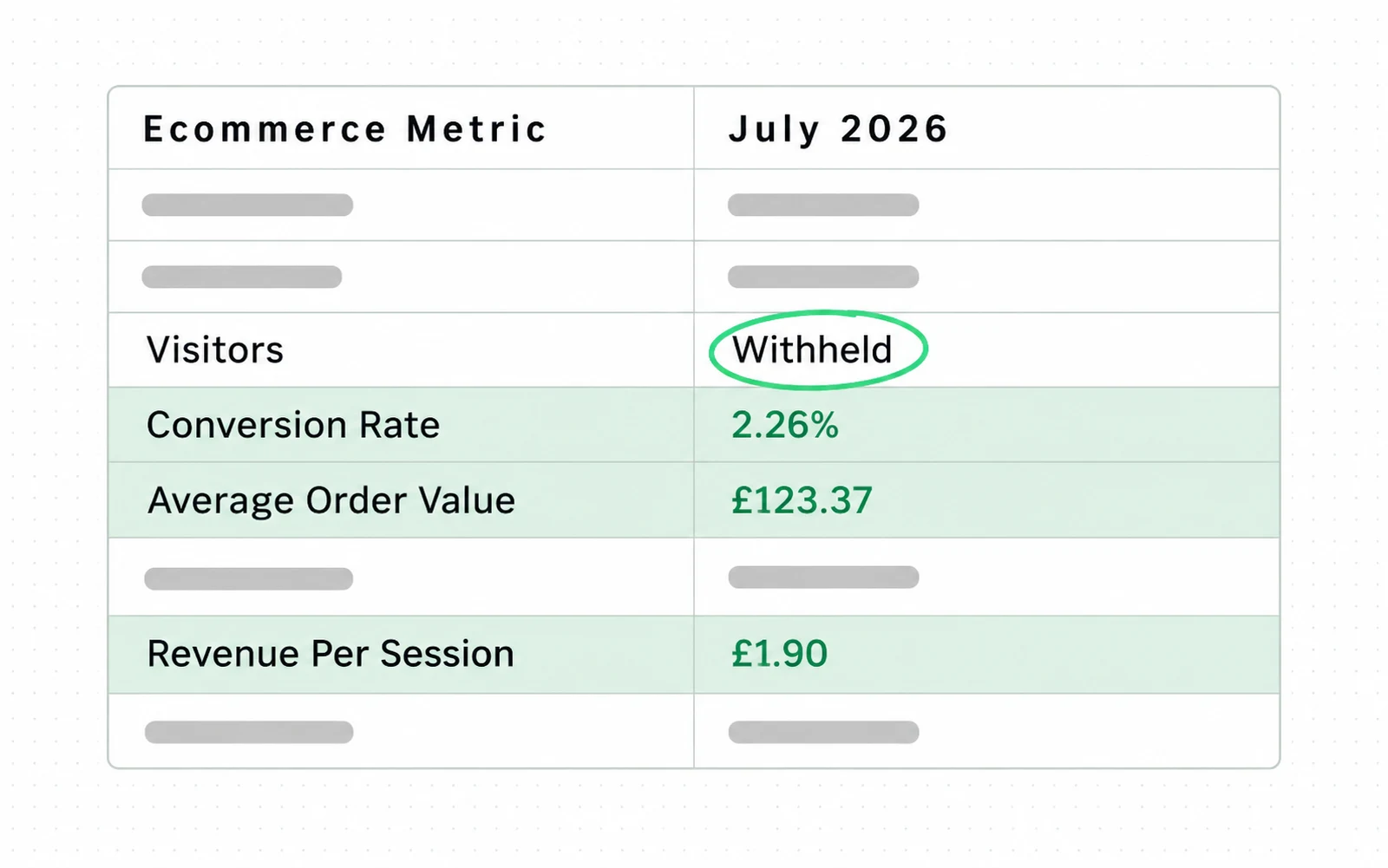
- Conversion rate, average order value and revenue per session are rows four, five and seven of the same table.
- Two rows read Withheld, and visitors is one of them. So the session count that would let anyone rebuild the chain is not on the page at all.
The threshold argument is not ours alone. Another published page argues it from its own campaign figures and from named public benchmarks. What you get here instead is published sample arithmetic, cited page by page.
Two narrower cases
Second, the threshold argument assumes you intend to test. A store with little traffic can still fix what is plainly broken, and should, without waiting to reach a sample size. The threshold rules out measurement, not improvement.
Third, some businesses have a ceiling on demand, not on conversion.
If you sell to a small, well-defined market and you already reach most of it, more traffic is not available at any price. The conversion lever is the only one you have, whatever your sample size allows.
Three exits from the decision, and only the middle one is open to every store on any day:
- Your traffic mix is about to change. Neither lever in isolation, because the rate may move for reasons that have nothing to do with your site.
- Something is plainly broken. Fix it regardless of traffic level. This one needs no test and no threshold.
- You already reach most of your market. Conversion, whatever your sample size allows, because there are no more sessions to buy.
The one thing worth doing today: multiply your own sessions, conversion rate and order value for last month, and compare the answer to your actual revenue. If they disagree, find out why before you spend against the model, and start with your denominator: your session count multiplied by a user-based rate, or two of your tools counting different scopes.
Suppose you want to find out why your rate is where it is, from exit surveys and tickets instead of guesses. That is the first framework in the cro-methodology skill.
Suppose the rate is the smaller number: moving it on your own pages is our landing page optimization service.
Sources
- IRP Commerce Ecommerce market data July 2026: conversion rate 2.26 percent, average order value £123.37, revenue per session £1.90, sector order values including £737.47 for Baby and Child and £106.77 for Food and Drink
- Google Google Optimize and Optimize 360 are no longer available as of 30 September 2023
- Kohavi, Deng and Vermeer A/B testing intuition busters, KDD 2022: idea success rates at large experimentation programmes, and the sample arithmetic
- Baymard Institute Checkout benchmark: ideal flow 12 to 14 form elements against 23.48 in the average US checkout
- Google Analytics Data API schema: sessionKeyEventRate and userKeyEventRate as separate metrics with different denominators
- Contentsquare 2026 digital experience benchmark: conversion rate fell 5.1 percent year over year while frustration signals fell 4.3 percent
- The Good Why ecommerce benchmarks mislead: traffic source, business model and calculation method differ between stores
- Salesforce Conversion rate optimization overview, sixth organic result
- Zenweb CRO versus more traffic: the first organic result, which makes the same threshold argument and sources its figures to its own campaigns or named public benchmarks
- TechBayLeaf CRO versus traffic: why visitors alone do not guarantee sales, third organic result
Questions people ask
Is CRO the same as SEO?
No. SEO brings sessions to the site and conversion work changes what happens to a session once it arrives. They multiply and do not compete, and ecommerce SEO is the discipline on the traffic side. The definitional question, what a conversion rate is, is answered separately.
What does CRO mean in analytics?
Whichever sense is meant, the number underneath it is ambiguous until you say what it divides by. Google Analytics exposes session-denominated and user-denominated rates as two separate metrics, so one phrase can describe two different figures, and a report showing one of them rarely says which.
Should I fix conversion before buying more traffic?
Fix what is plainly broken first, always, because that needs no test and no sample. After that the answer depends on whether you have the traffic to measure a change. If you do not, measured conversion work is not available to you, though fixing what is plainly broken still is, and the rest of the conversion lever opens up once the traffic arrives.
How much traffic do I need before A/B testing is worth it?
It depends on your baseline conversion rate and the size of change you want to detect, and the arithmetic is worked through in our CRO guide. The order of magnitude on a typical ecommerce rate is tens of thousands of visitors per variant, which is why most small stores are not choosing between a tested conversion change and traffic at all.