

Which should you choose: Google Ads or Meta Ads?
Choose by how your product is bought, not by reported return. If people search for what you sell, the search auction is where the intent already is. If they do not know it exists, no keyword will find them. A catalogue holding both kinds of product needs both channels. The split is a judgement, and no dashboard produces it.
The two dashboards report a return, and they are not counting the same thing.
Three descriptions, and the third explains why this is rarely settled once for a whole account. One catalogue can hold products of both kinds, so the answer is per product, not per channel.
- People search for it by name or category. Start with the search auction, where the intent already is.
- People do not know it exists. Start with the feed-based platform, because the demand has to be made.
- Both are true of different products. Both, split by product, not by budget.
This question is badly served, and where people go for it shows that. Practitioners answer it to each other in a Reddit thread in r/googleads. Google’s AI Overview leans on that thread and not on anything a vendor published.
Most of what is written about it compares reported returns from two dashboards that are not counting the same thing. That is the one comparison that cannot settle it.
Settle the how-it-is-bought question before anything else, because the two return figures you would otherwise compare are not counting the same thing.
Differences that exist before measurement
Six differences that change the answer. Two of them are about the auction, two about the customer, and two about the counting, which is the pair that gets left out.
| Google Ads | Meta Ads | |
|---|---|---|
| What starts the impression, on the search side | A search someone typed | A profile the system matched |
| Buyer state | Looking for something | Not looking for anything |
| What you give it | Keywords, or a product feed | Creative and an audience signal |
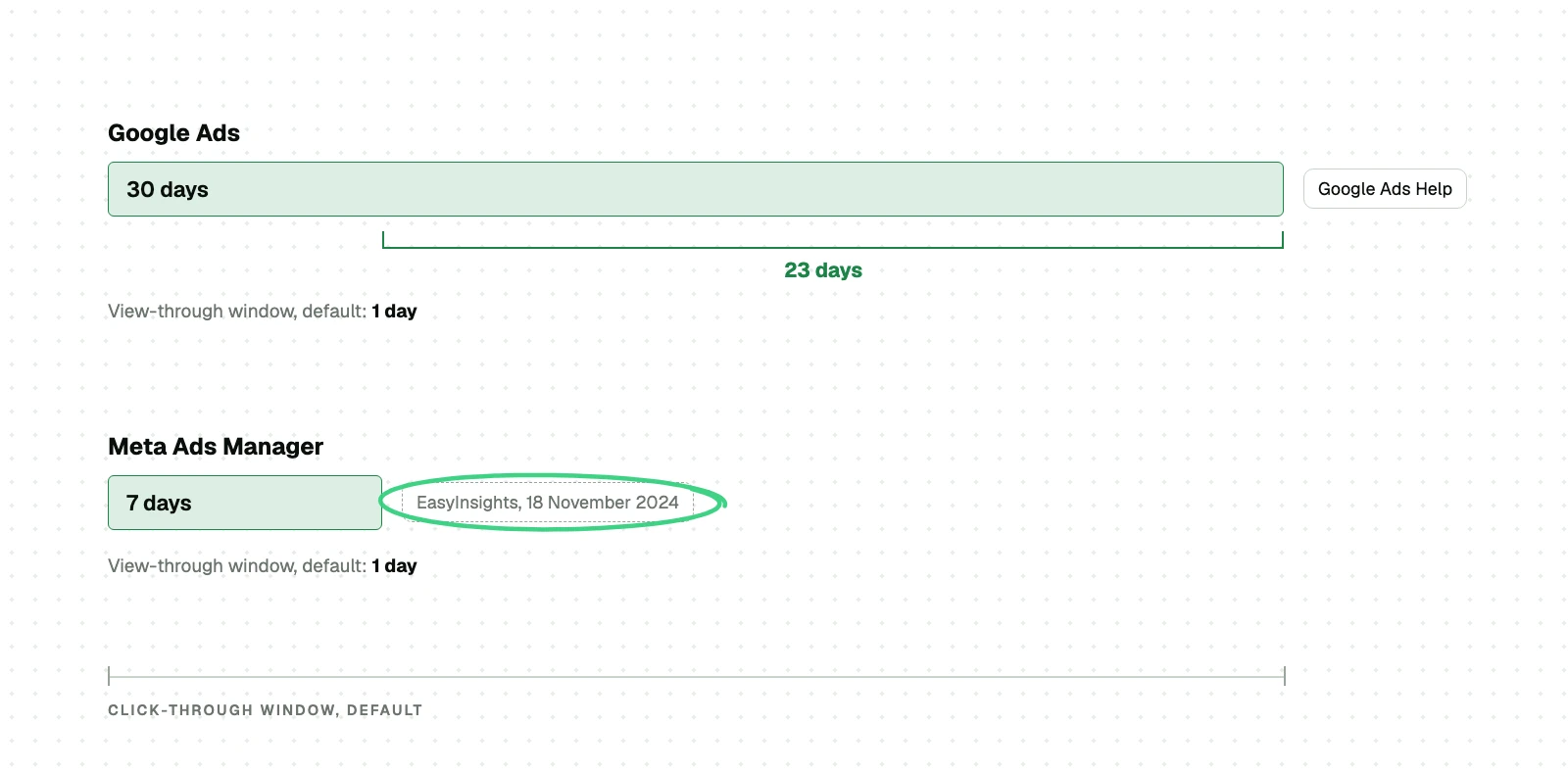
| Standard click window | 30 days by default, from Google’s own help | 1 or 7 days, from Meta’s own help |
| What creative does | Qualifies the click | Creates the click |
| A common first constraint | No search volume for the product | Creative supply |
Google Search ads in this comparison
This comparison is usually about the search side of Google Ads, not the whole platform, which also runs Display, YouTube and Demand Gen. On the search side the demand already exists and you are bidding for position in front of it, which is why the ceiling there is the number of people looking.
You cannot buy more searches than exist.
What a click costs is not a rate card. Google names six inputs to Ad Rank, of which your bid is one, and how Google Ads works is where that gets set out. For a store the format that matters most is the product listing, and it runs on your feed, not on keywords. Google Shopping ads covers that side, and Performance Max is the campaign type that increasingly runs it.
In the categories one published analysis measured, the share of clicks going to paid results rose. In the Similarweb data Aleyda Solis published in February 2026, comparing January 2025 with January 2026 across the top 5,000 US queries per category, the paid share roughly doubled in both categories measured. The sizes are below. Search Engine Land covered the same analysis and added the advertiser side, in paid clicks, not spend. Amazon up 35 percent, Walmart sixfold, Gap up 137 percent. Those are the buyers of the share that moved, which matters before treating the shift as something a small store can simply join.

| Question about the search auction | What decides it |
|---|---|
| Can you appear at all | Whether anyone searches for what you sell |
| What a click costs | Six inputs, of which your bid is one |
| Whether Target ROAS is available | 15 conversions in 30 days on Search and Shopping |
| How much of the page you are bidding into | A rising paid share on product queries |
One constraint is published, and you can check it before budgeting. Target ROAS needs at least 15 conversions in the past 30 days on Search and Shopping, so a small budget in an expensive auction may not reach that strategy. Others carry their own requirements.
Meta Ads in this comparison
Where Google sells the intent someone already has, Meta sells attention that was pointed somewhere else. Most people seeing the ad were not looking for your product, which is the weakness and the point at once: the addressable audience is not limited to people already searching.
Creative is the targeting.
| What you change to improve it | Google Ads | Meta Ads |
|---|---|---|
| First lever | The feed or the keyword list | The creative |
| Second lever | Bids and campaign structure | The audience signal |
| What repetition does | Little, the query is new each time | Wears the same assets on the same audience |
| What a new asset buys you | A better match | A new chance at the same person |
Where the work sits on this side
The practical consequence is that the work sits in a different place. On the search side you improve a feed or a keyword list; here you improve what the ad says and shows, because the creative is what decides whether an uninterested person becomes an interested one. Our read is that creative supply binds before the bid does, because the same audience sees the same assets repeatedly. That is a claim to test, and nobody has published it. It shows up in whether performance recovers when new assets ship. If it does not, the constraint was somewhere else.
The counting is the part that trips up your comparisons. Meta publishes its standard windows itself.
A click is counted for 1 day or 7 days and a view for 1 day. Any other click on the ad, such as a like or a five-second video play, counts for 1 day under a third heading Meta calls engage-through.
Click-through: Counts events that occurred within 1 day or 7 days after a link click on your ad. View-through: Counts events that occurred within 1 day after an impression of your ad. Engage-through: Counts events that occurred within 1 day after a non-link click action on your ad.
Meta Business Help Centre, About attribution models and attribution settings read 7 October 2026
- Seven days is the longest standard click window on this list. Google’s default is thirty.
- The page gives the options, not which one a given account is set to. That part still has to be read in the account.
Search Engine Land put the current defaults side by side in July 2026: Meta defaults to a seven-day click window plus a one-day view. If your account still runs 28-day click, a guide dated November 2024 records that it remains available in some cases.
The same article widens the gap instead of closing it. If your Google account runs data-driven attribution, it looks back up to 90 days.
That is a modelling lookback and not your 30-day conversion window, and it is longer than both of the numbers above.
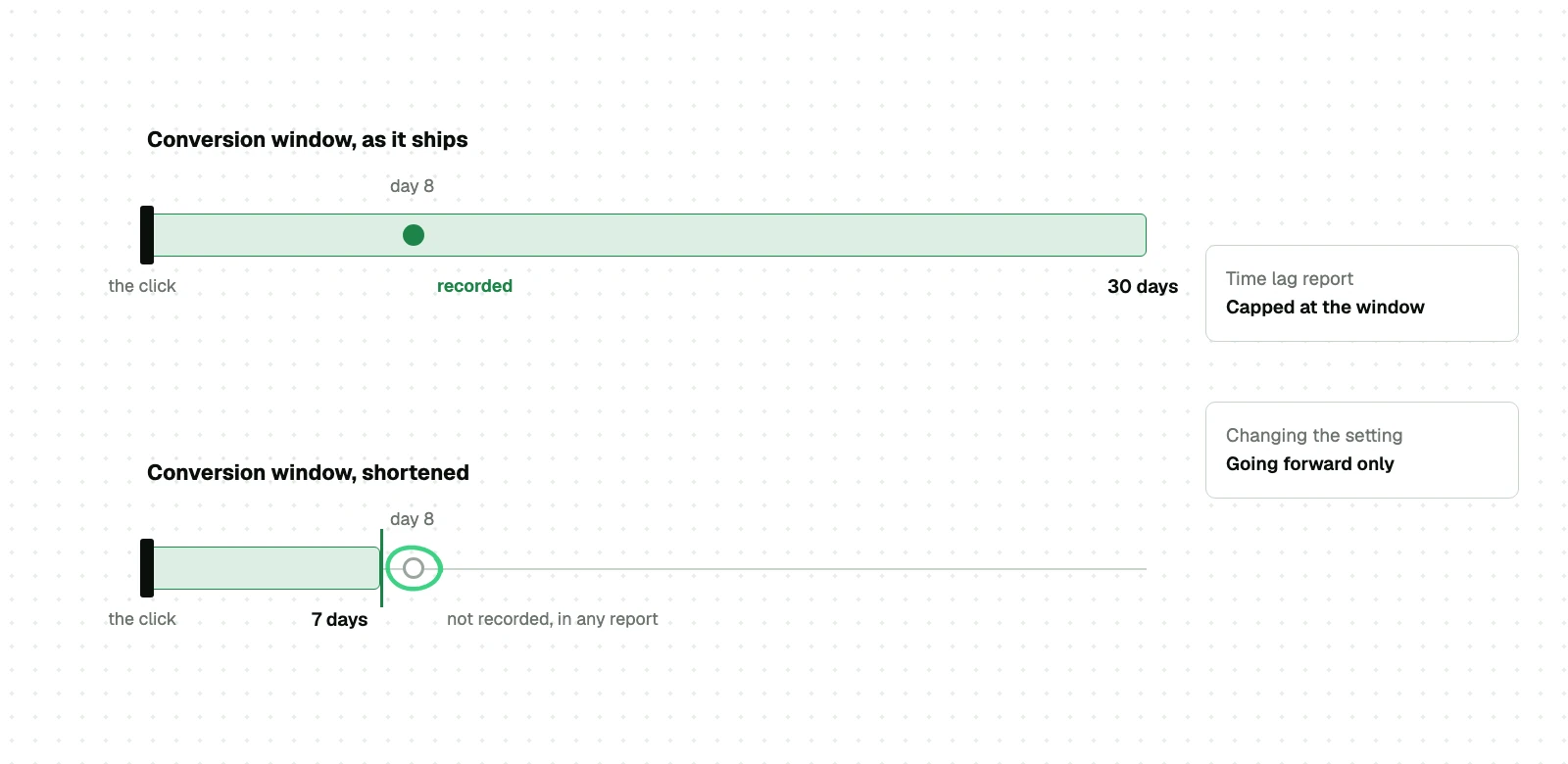
The two platforms also observe different interactions. Meta credits views and engagements as well as clicks, so the effect on the reported number is not a simple subtraction.

Which is the same problem what a good ROAS is sets out inside one platform, appearing here across two. Your own store data at least applies one rule to both, and that rule is not neutral: Shopify’s marketing reports default to last click with a 30-day lookback, giving all credit to the last channel touched, including direct visits. It sees both channels and systematically favours whichever came last. And what it counts as a conversion is your own setting before any of that, which is the question behind what a conversion rate is.
Three things that change the verdict
Our verdict is that fit with how the product is bought should decide the split. Three things can make that verdict the wrong one, and none of them is about fit at all.
Fit does not help if you cannot supply the channel that fits.
The first is creative supply. A product that fits the feed-based platform still needs a stream of new assets, because the same audience sees the same ones repeatedly. A team that can make four assets a quarter and a product that suits Meta perfectly is a worse pairing than an awkward fit on the search side, where a keyword list does not wear out. Fit picks the channel; capacity decides whether you can run it.
Two exceptions that depend on your budget
The second is the threshold. If your budget cannot produce the conversion volume a platform’s bidding strategy requires, the strategy is unavailable and fit does not change that. Google publishes 15 conversions in 30 days for Target ROAS on Search and Shopping. A perfect-fit channel you cannot run properly is not the right channel this quarter.

The third is margin and the site behind it. An auction price does not care what you sell for, and the comparison that matters is cost per order against contribution per order. That metric isolates ad spend and excludes the costs around it, so a strong return can still be a loss. If the page converts poorly, moving budget between platforms only changes which auction you lose money in, and conversion rate optimization is where that gets fixed. Neither platform is the only option either: the unpaid alternative, SEO vs PPC, is a different trade with its own arithmetic.
That is the limit of return on ad spend as a number. It reports revenue against ad cost and says nothing about what the order cost you to fulfil, so two accounts with the same return can sit on opposite sides of break-even.
| Where this page would cost you money | What to check instead |
|---|---|
| You cannot supply the creative the fitting channel needs | How many new assets you can ship per month |
| Your budget cannot reach the bidding threshold | 15 conversions in 30 days, for Target ROAS specifically |
| The click is cheap but the order is not | Cost per order against contribution per order |
The window check is the second of twelve considerations in the ads-performance-analytics skill. It walks you through a dashboard reading before you scale or kill anything.
Open both accounts, find the attribution setting in each, and write the two windows down on the same piece of paper. If they differ, every side-by-side return comparison you have made was comparing two different questions.
Say the two windows explain the gap: running your Google side against that is PPC agency work at Addition, a search marketing agency.
Sources
- Google Ads Help Conversion windows: 30-day click-through default, range 1 to 90 days, changes are not retroactive
- Robert Simpkins, Search Engine Land How ad platforms count and report conversions differently, 17 July 2026: Meta defaults to a seven-day click window plus a one-day view, and Google Ads with data-driven attribution looks back up to 90 days
- EasyInsights Attribution settings in Facebook ads: 1-day click, 7-day click, 1-day view, 1-day engaged view, 28-day click Measured 22 months ago, on a surface that has moved since.
- Aleyda Solis Paid click share by category, Similarweb data, Jan 2025 against Jan 2026
- Search Engine Land Paid search click share doubles as organic clicks fall, with retailer paid-click figures
- Google Ads Help About Ad Rank: six inputs decide position and price, of which the bid is one
- Google Ads Help Target ROAS: at least 15 conversions in the past 30 days on Search and Shopping
- Shopify Help Center Marketing reports: last-click attribution with a 30-day lookback
- AppsFlyer ROAS glossary: ROAS isolates ad spend while ROI includes the costs around the campaign
- BigCommerce Return on ad spend glossary entry, stating a 4 to 1 benchmark with no sample This page carries no publication date of its own.
Questions people ask
Do Google Ads work better than Facebook ads?
They answer different questions, and their reported returns are not directly comparable. Google's documented default counts conversions for 30 days after a click. Meta's default in September 2026 was 7 days. Meta has changed attribution settings since, so read both windows in your own accounts before comparing anything. The useful comparison is cost per order against contribution per order, measured in your own store data on one rule. A published benchmark cannot stand in for it: one glossary states a 4 to 1 ratio and cites no sample, and that number would be a loss at some margins and a strong result at others.
Are Google Ads really worth it?
For a product people search for, the auction is where the intent already is. Whether it is worth it for you is set by the price of that intent against your margin, and Google names six inputs to what a click costs, only one of which is your bid.
How much do 1000 clicks cost on Facebook?
There is no published rate. Both platforms price in an auction, so the cost of a thousand clicks is set by who else is bidding for the same attention and how relevant the system judges your ad to be. Any figure quoted without an account, a country and a month behind it is describing someone else.
Is $20 a day good for Google Ads?
It depends on your click price, and one published threshold lets you check it. Target ROAS needs at least 15 conversions in the past 30 days on Search and Shopping. Those are the campaign types the threshold is published for. At $600 a month, 15 conversions means a cost per conversion at or under $40 before that strategy is available.

