

Which name has research behind it: AEO or GEO?
If somebody is selling you one of these and dismissing the other, the question that settles it is not which term is more modern. Ask where the name came from, because one of them can answer.
Generative engine optimization was introduced by Aggarwal and five colleagues in a 2024 paper at KDD, one of the main venues in the field. The paper defines the method, builds a benchmark to test it against, and reports a result.
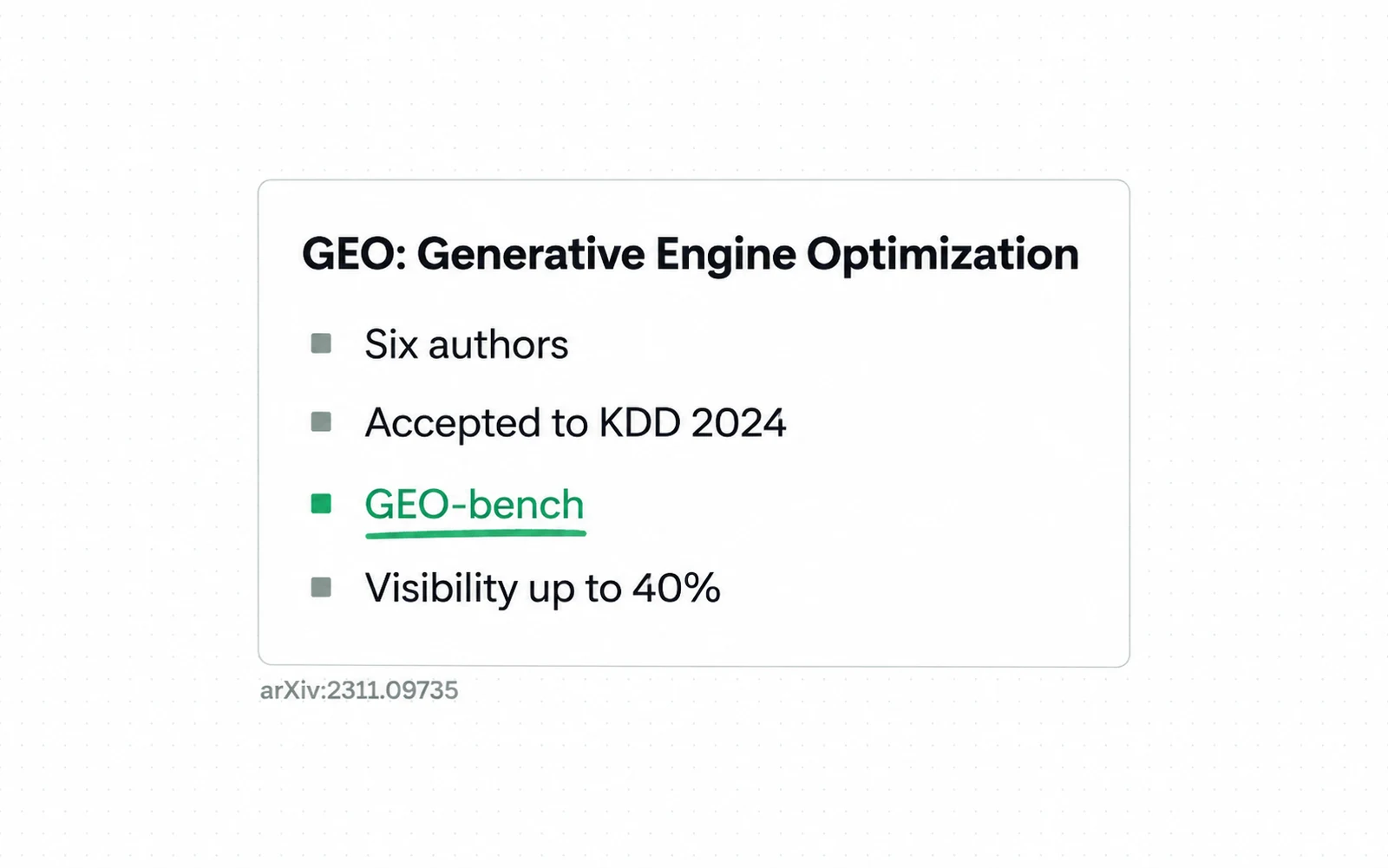
- Six authors, a named venue and a date. Everything a claim needs in order to be checked is on this one page.
- GEO-bench is the part that matters more than the number. A benchmark is what lets somebody else test the same method and disagree.
- The 40 percent figure is the paper’s own, measured on its own benchmark. Read it as the strongest published claim, not as an expected result.
Answer engine optimization has no equivalent. The industry produced the term, and it appears on agency and vendor pages.
The one platform mention of it is Google, listing it among things you do not need to do. That is not an accusation, it marks a difference in what you can check.
AEO vs GEO compared: origin and evidence
Origin is the first row below, and the next two are about evidence too. The last one, whether a platform uses either name, comes out the same for both.
The two names, on what is published behind them
| GEO | AEO | |
|---|---|---|
| Where the name comes from | A 2024 KDD paper, six named authors | Industry usage, no single origin |
| A benchmark to test it | GEO-bench, published with the paper | None published |
| Independent retest | C-SEO Bench, 2025, which found much less | Nothing to retest |
| Used by any platform | No | No |
That third row is why this comparison stays open instead of settling. A method with a benchmark can be retested by somebody with no stake in it, and that happened.
Sellers disagree too. One vendor argues the two terms describe the same thing and another argues they are distinct.
The rows above split that difference. On the work itself the first is right, because neither name changes what you edit on a page.
On definition the second is right. Two terms, and only one has a definition you can look up.
GEO judged as a method
Two terms again, and only one can settle that with a test. Read as a method, GEO claims that editing a page a certain way wins it a larger share of a generated answer, and that claim has been tested twice.
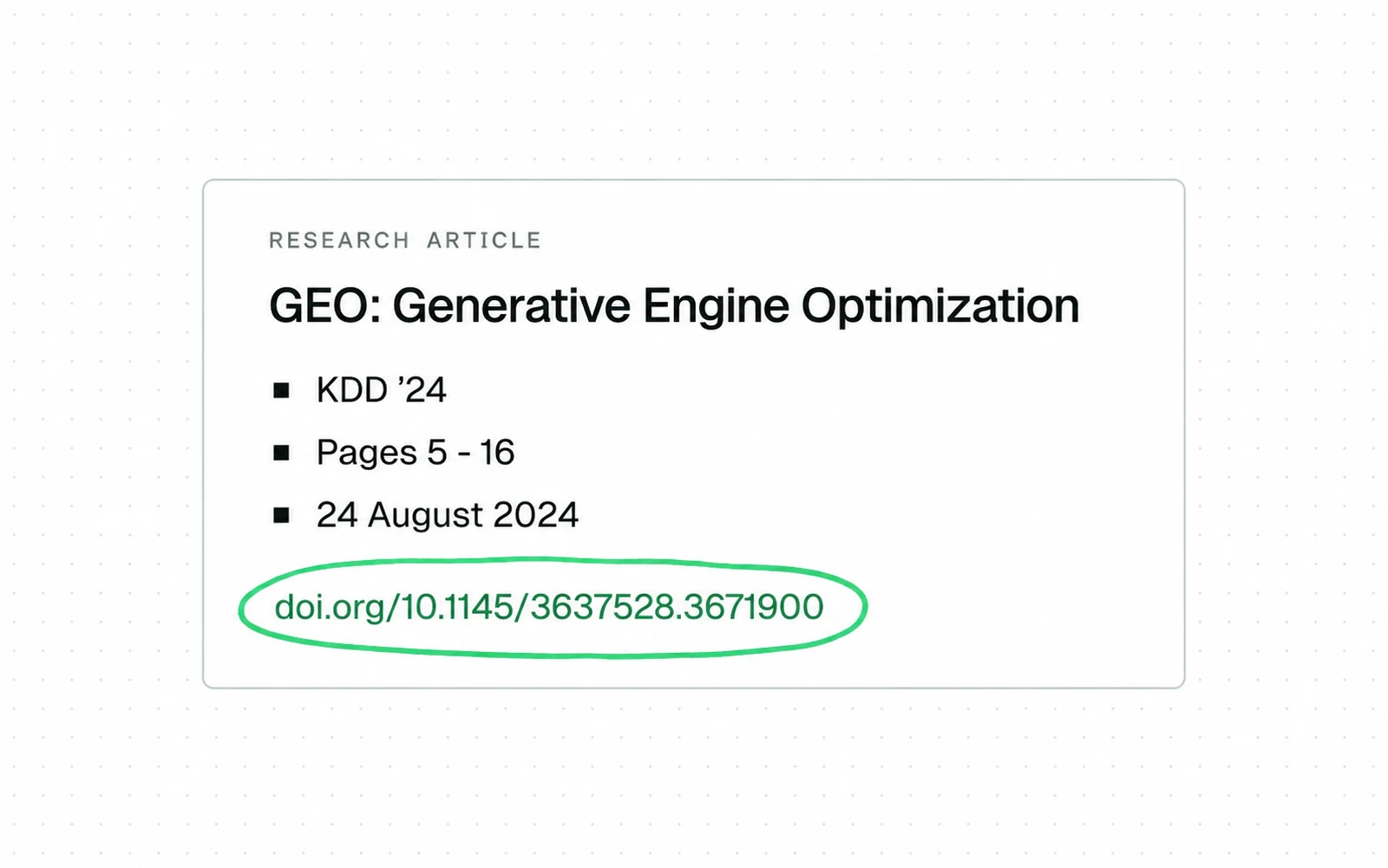
- KDD is a peer-reviewed venue and the record carries a DOI, which is what makes the paper citable, not quotable.
- Pages 5 to 16 in the proceedings. The paper is short, and reading it takes less time than most vendor comparisons of it.
- August 2024 is the date to hold against any page claiming GEO is either brand new or already settled.
The independent retest is the part most summaries skip. C-SEO Bench ran the published methods across two tasks and three domains each, and three of the fifty-four combinations came out better than making no edit at all.
Orbit Media Studios found the same fragility across engines. In 13,184 citations drawn from 1,765 answers, all four models cited the same domain for the same question in 30 of 1,792 combinations.

That is a bounded verdict, not a dismissal, and generative engine optimization works through what the method asks you to change.
AEO judged as a job
Now hold AEO to the same standard: it describes a real job, being the answer instead of a link. The job existed before the name, and the name is doing something useful even without a paper behind it.
It names the shift from ten links to a single response. The work it implies is ordinary editorial work: answer one question completely, in one place, in language a person would use.
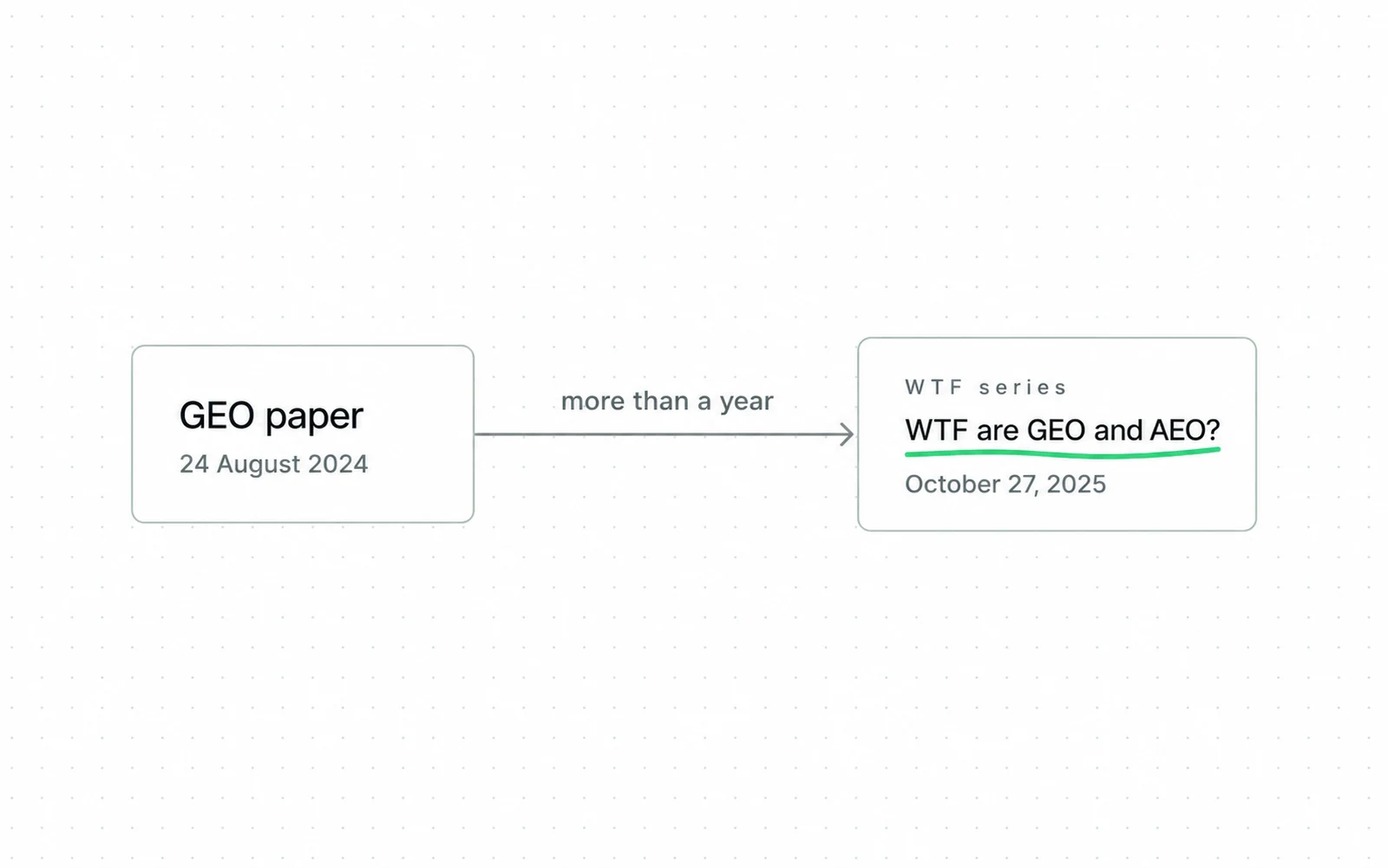
- The WTF series exists for terms the industry uses before it agrees what they mean. Both names landed there in the same article.
- October 2025, more than a year after the GEO paper. The confusion is not because the material is new.
- A trade publication explaining both against SEO gets the framing right: the reader’s question is what changed, not which acronym won.
The weakness is that nothing under the name has a published benchmark, so there is no result an AEO quote can be checked against the way a GEO claim can. The glossary entry on answer engine optimization sets out the definition and where the term came from.
Limits of the AEO vs GEO evidence
A paper is evidence about a method, and it is easy to stretch that into more than it says. Three ways this page could mislead you, stated plainly.
A published method is not automatically the better buy. GEO has a benchmark and an independent retest that found almost nothing. That is more evidence than AEO has, and it points down. Preferring the tested name would be preferring the one with a worse published result.
The paper tests share of a generated answer, not revenue, not traffic and not orders. So a vendor quoting the 40 percent figure at you is quoting a real number for a metric that may not be the one you are paid on.
And neither term is endorsed by the platforms. Google names both together in its own guidance, in a section listing things you do not need to do. It states that many suggested hacks under those names are not effective for Google Search. If a vendor’s pitch depends on either acronym being official, that is checkable and it does not hold.
What survives all three is smaller and more useful. Both names point at the same work, and that work is ordinary search and editorial work. AI SEO sorts out which job you were handed before any of this matters.
Say you want that ordinary work done on your own pages: that is our answer engine optimization engagement.
Sources
- Aggarwal, Murahari, Rajpurohit, Kalyan, Narasimhan and Deshpande GEO: Generative Engine Optimization, arXiv preprint accepted to KDD 2024: introduces GEO as a black-box optimization framework, introduces GEO-bench, and reports visibility gains of up to 40 percent on that benchmark
- ACM Digital Library GEO: Generative Engine Optimization, KDD 24 Proceedings of the 30th ACM SIGKDD Conference, pages 5 to 16, published 24 August 2024, with DOI
- Puerto, Gubri, Green, Oh and Yun C-SEO Bench, NeurIPS Datasets and Benchmarks 2025: the published methods tested across two tasks and three domains each, with three of fifty-four combinations improving on making no edit
- Google Search Central Optimizing your website for generative AI features: names Answer Engine Optimization and Generative Engine Optimization together and states many suggested hacks are not effective or supported by how Google Search works
- Google Search Central AI features and your website: no additional requirements to appear in AI Overviews or AI Mode, nor other special optimizations necessary
- Jessica Davies, Digiday WTF are GEO and AEO? and how they differ from SEO, October 2025, published in the WTF explainer series
- Profound AEO vs GEO: an argument that the two terms describe the same thing
- Adobe AEO vs GEO: Differences and Examples, a page arguing the two are distinct
- OpenAI Overview of OpenAI Crawlers: OAI-SearchBot decides whether a site appears in ChatGPT search answers, set in robots.txt
- Anthropic Crawler documentation: Claude-SearchBot indexes content for search answers, and disabling it may reduce visibility in user-directed web search
- Perplexity Perplexity Crawlers: PerplexityBot indexes, a separate agent fetches on a user request, and a firewall rule can block both without intent
- Orbit Media Studios 13,184 citations across 1,765 answers, four models, three brands: all four cited the same domain for the same question in 30 of 1,792 combinations
- Google Search Central Search Console documentation: traffic from AI features is reported inside overall Search under the Web search type
Questions people ask
Is AEO part of GEO?
Neither term contains the other in any formal sense, because only one of them has a formal definition. GEO is defined in a 2024 paper; AEO is defined differently by whoever is using it.
In practice both describe the same work: making a page more likely to be used in an answer. Treat a vendor’s hierarchy between them as a preference, not a fact.
Is GEO replacing SEO?
No, and Google states the mechanism for why not. Its generative AI features are rooted in the core Search ranking systems and retrieve from the Search index. A page that cannot be found in ordinary search cannot be used in an answer either.
What changes is where the answer gets read, and therefore whether a click follows. That is a measurement problem more than a strategy one.
How to use AEO and GEO?
Ignore both labels and check three things. Your pages are indexed and can show a snippet. You have not blocked the crawler that feeds each assistant’s search answers. One page answers one buying question completely.
The first two you can check in Search Console and in your own robots.txt file, and neither costs anything. The third is editing work, and it is the part the GEO paper put to a test.
Is AEO better than SEO?
The comparison does not hold, because AEO depends on SEO instead of competing with it. On Google’s surfaces a page has to be indexed and snippet-eligible first. OpenAI, Anthropic and Perplexity each fetch through their own crawler instead.
What holds up is that AEO names a newer surface for the same work. If somebody is selling it as a replacement, ask what they would do differently on a page that is not indexed.