
CRO SKILL
Research-first CRO
Conversion Rate Experts’ method as a skill: discover why visitors do not convert, inventory the proof you already have, map every objection to a placed counter-objection, and test bold changes with pre-committed rigour.
No key, no account needed Claude CodeClaude Cowork
 Codex
Codex CursorOpenClawHermesany agent that reads SKILL.md
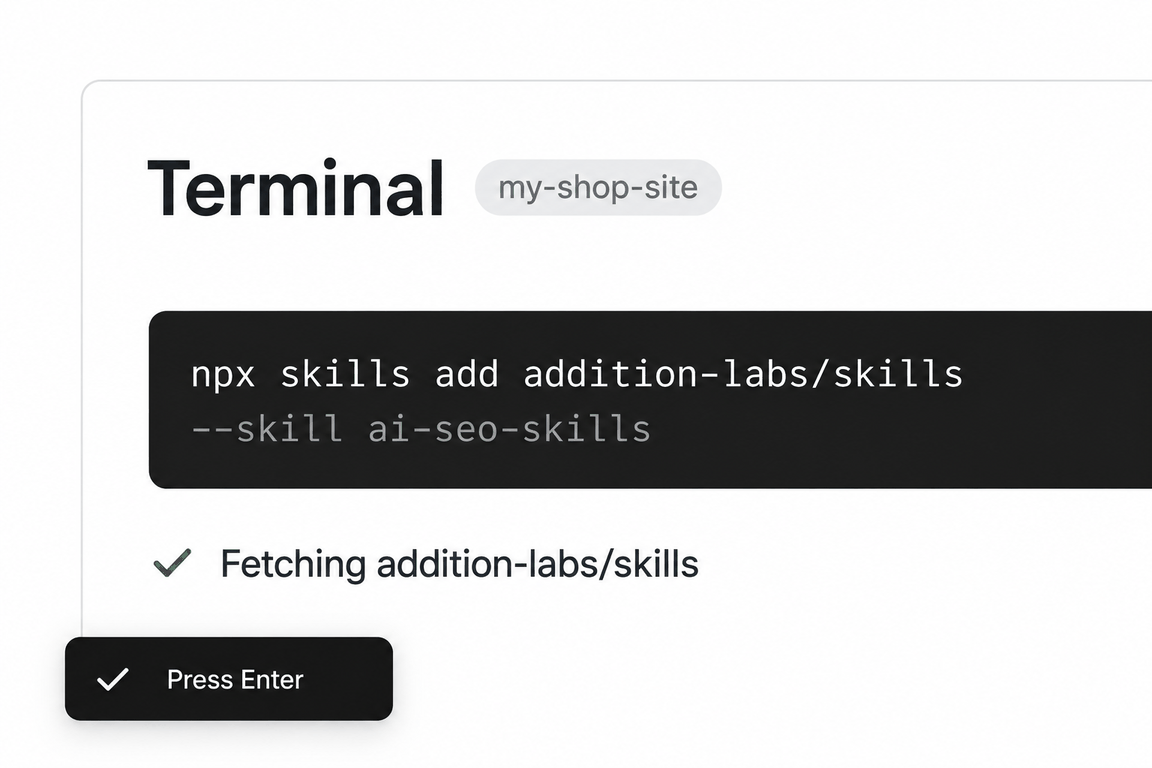
npx skills add addition-labs/skills --skill cro-methodologyRun this in a terminal inside your project folder. Claude Code, Cursor and Codex then read the skill from where it lands.
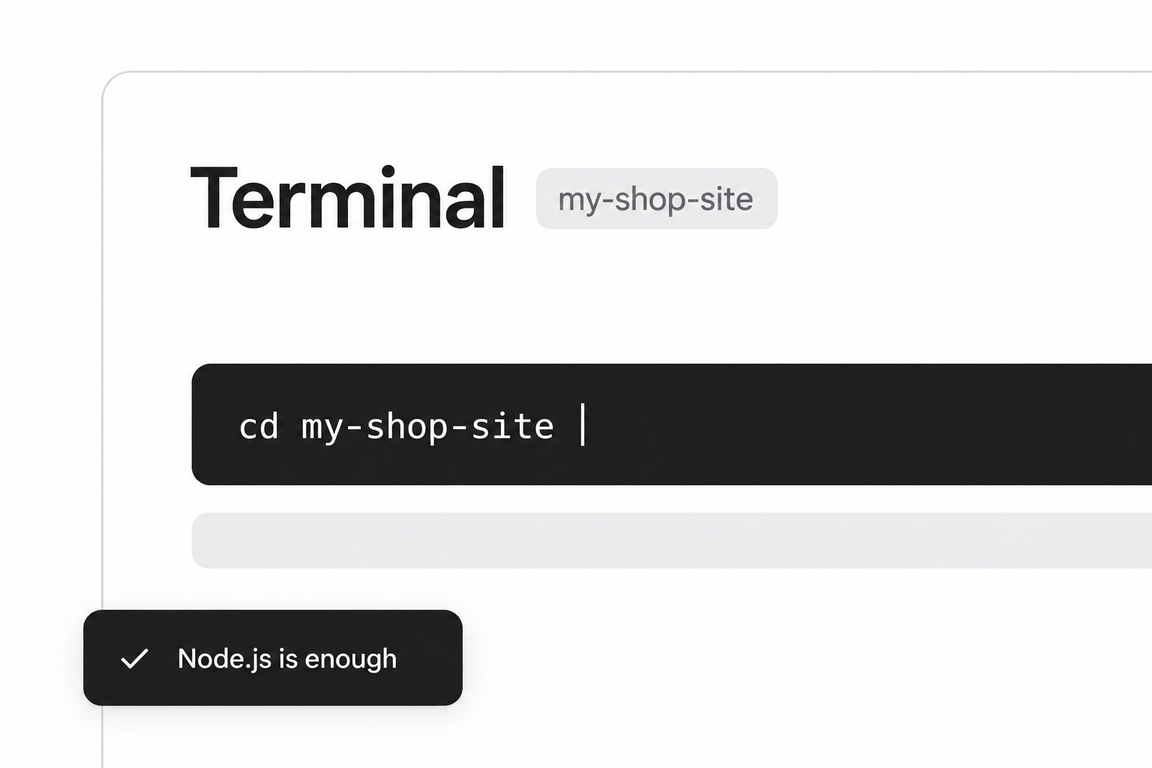
- Step 01Open a terminal in your project folder
- Step 02Paste the command and press Enter
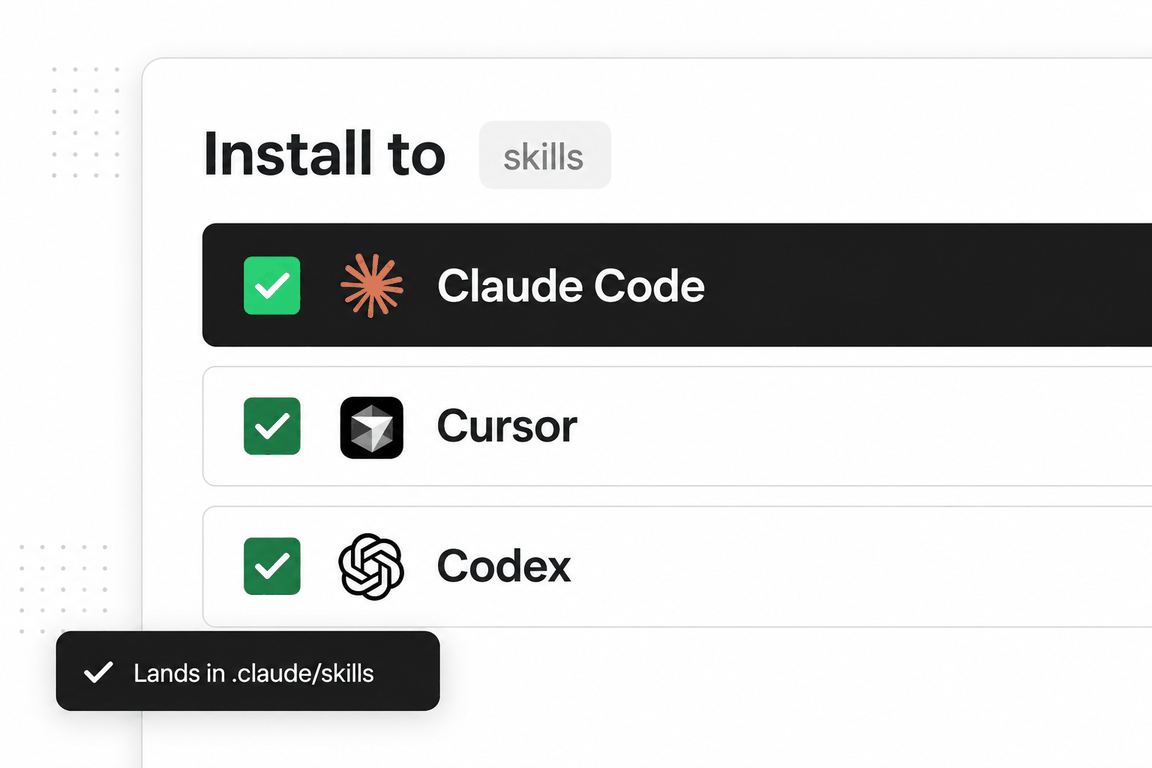
- Step 03Pick the agents to install to
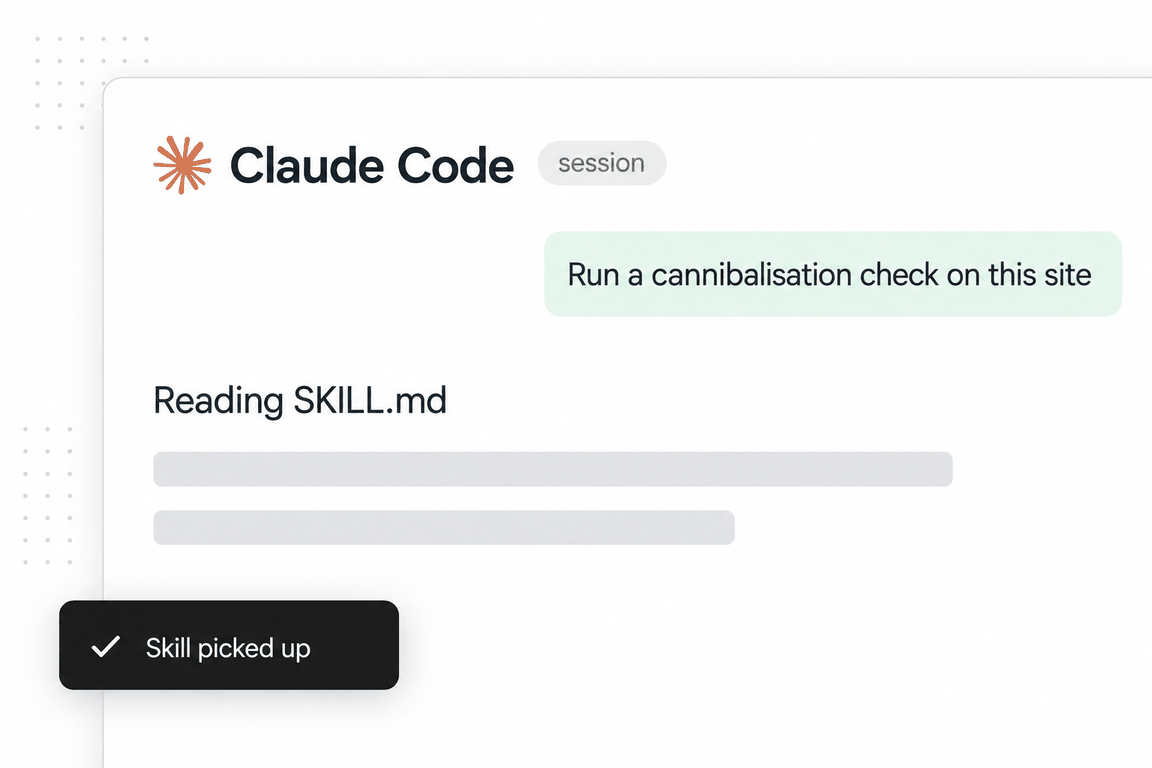
- Step 04Ask the agent for the job; it reads the skill
cro-methodologyaddition-labs/skillsMIT licencev1.5.0updated 2026-09-10
Six frameworks from Blanks and Jesson’s "Making Websites Win": the nine-step CRO process, customer research and the Big 5 objections (trust, price, fit, timing, effort), persuasion assets, the objection/counter-objection table, ICE-scored hypotheses with a ten-times screen, and A/B methodology with one honest-reporting rule.
The Quick Diagnostic is seven yes-or-no rows that score a page out of 10, and the bands are blunt: 9 to 10 means a single clear action and research-grounded objections; 3 or below means competing CTAs and claims with no proof.
The core principle is "don’t guess, discover": exit surveys, chat logs, tickets and sales calls before any change. A page reviewed without that research is scored as such.
When to use it
The phrases that trigger it
Say any of these and an agent that has the skill installed will usually load it; you can also call it by name. The phrases are the skill’s own, from its description.
- landing page isn’t converting
- conversion rate
- A/B test
- why visitors leave
- objection handling
- bounce rate
- conversion funnel
- people add to cart but don’t buy
What’s inside
The playbook, section by section
The nine-step process
Success metrics, funnel map (blocked arteries and missing links), three-dimensional visitor research, market intelligence, ICE prioritisation, bold experiments, scale wins.
Research before change
One-question exit surveys, "what almost stopped you" post-purchase surveys, ticket mining for "but", "however", "worried about".
Persuasion asset audit
Five categories (credentials, social proof, risk reversal, data, process), a wish list for missing assets, the proof sandwich, and a proof hierarchy with specific results first.
The O/CO table
Objection, the visitor’s question, and counter-objections placed at the point of friction; implicit objections countered without being stated.
Hypothesis design with a ten-times screen
If a change could not double the result, deprioritise it; button colour scores 4.7, customer-language headlines 9.0.
A/B methodology
Sample size first, one full business cycle, no peeking, practical significance, multivariate only above 100k monthly visitors.
Reference files the agent loads on demand
6 files in the skill folder, read only when an instruction calls for one.
funnel-analysis.md- Mapping, analysing and optimising conversion funnels.
RESEARCH.md- Quantitative and qualitative research: analytics reports and red-flag metrics, on-site and email surveys, usability testing with five to ten users.
PERSUASION.md- An audit of persuasion assets (credentials, social proof, risk reversal, specificity), a wishlist for acquiring them, and the psychological triggers.
COPYWRITING.md- Headline formulas and testing priority, body copy length, structure and voice, the hierarchy of proof, CTA copy.
OBJECTIONS.md- The objection and counter-objection table: research each objection, then answer it on the page.
testing-methodology.md- Experiment design, statistical rigour and test prioritisation.
See it in action
One real run, in full
The request on the left went to the skill as installed. On the right is everything it returned, unedited; scroll inside the box to read it all.
Fetch https://addition-labs.com/services/seo and run your Quick Diagnostic on it, with the score. The ONE action is a booked call. We have no exit-survey or chat-log data yet; treat the objection research as not done.
Quick Diagnostic: addition-labs.com/services/seo
Conversion goal (as given): a booked call. What was audited: the live HTML (HTTP 200, 21 KB, fetched 2026-09-11) plus the page's four JS bundles, because the header, footer, case-study rail and every CTA handler are rendered client-side and do not exist in the HTML. No analytics, no heatmaps, no survey or chat data were available, and none is assumed below.
Score: 1.4 / 10 (band: 3 or below)
One of seven rows is a "yes". The band description in the methodology fits this page almost word for word: competing CTAs, no funnel map, claims with no proof.
| # | Diagnostic question | Answer | What the page shows |
|---|---|---|---|
| 1 | Do we know the ONE action visitors should take? | No (on the page) | You know it (a booked call). The page does not. It offers four different actions, and the booked call is the last of them: (a) hero form "Send me AI & SEO Audit" (email only, posts to /api/lead); (b) mid-page "If the answer is yes, let's talk" button; (c) "Where do you need support?" with three audit-intake buttons (SEO & AEO / Google Ads / Whole search journey); (d) closing section with two buttons side by side, "Contact our team" (a 5-field contact drawer, posts to /api/lead) and "Schedule a meeting" (the booking modal). The first thing above the fold asks for an email audit, not a call. |
| 2 | Have we researched (not guessed) why visitors don't convert? | No | Confirmed by you: no exit-survey or chat-log data yet. Everything on the page about the visitor's reasons is inferred. |
| 3 | Do we have an O/CO table? | No | The "Hard problems we solve" cards state three pains the visitor may have ("We rank for our brand name and almost nothing else", "written for Google, not for the people buying", "Traffic is up. Revenue is not."). Those are problems with their site, not objections to hiring you (Trust, Price, Fit, Timing, Effort), and none is followed by a counter. Notable: the page's JSON-LD carries an FAQPage block with four answers that are in fact counter-objections (Timing: "60 to 90 days for early signals"; Fit: "Most of the stores we grow are on Shopify"; Effort: "Yes. Collection copy, buying guides... written in your brand voice"; Trust: "No link farms, no private networks"). None of that text is visible anywhere on the page. The counters exist and are hidden from the human. |
| 4 | Is the value proposition clear within 5 seconds? | Yes (provisional) | H1 "Search Engine Optimization. Pages people want to read, that search engines can read too." plus the lead "structured so Google and AI systems read them the same way" says what you do and how you differ, and the two audience tags (E-commerce/DTC, B2B/SaaS) say who it is for. Awarded on reading, not on a test: no 5-second test has been run, and the money outcome ("visits into sales") only appears in the second section. |
| 5 | Are persuasion assets visible (testimonials, awards, guarantees)? | No | Present: a 9-logo client marquee and a 6-card case-study rail. Every number in that rail is the client's own scale ("100,000+ people in Turkey buy their Apple products", "10,000+ dog parents get their bed from here", "72,000+ travellers"), not a result Addition produced. Absent: any named testimonial, any result with context (rankings, organic revenue, before/after), any guarantee or risk reversal, any credential, award or team proof. Logos are the weakest tier of the proof hierarchy and they are the only tier on the page. The "case studies" heading promises the third-strongest tier and delivers logos with descriptions. |
| 6 | Have we mapped the funnel for blocked arteries? | No | No traffic-per-stage data was provided, and nothing on the page or in the bundles indicates a mapped funnel (entry source, page, modal open, slot picked, booked). Cannot be answered "yes" without it. |
| 7 | Is the path free of UX blockers (speed, mobile, form length)? | Not verified | What could be checked: HTML responds in ~0.2 s, viewport meta is present, the hero video is preload="metadata", and /api/slots returns 200 so the booking modal has open times to show. What could not be checked: real load time, mobile layout, the modal on a phone. Two things to fix regardless: the "Schedule a meeting" button is type="button" with no href, and the nav, footer and case-study rail are injected by JS, so with JS blocked or failed there is no navigation, no case studies and no way to book. The booking form asks for up to five fields (email, name, site, company, note) after the time is picked. |
The failing rows, in the order the methodology says to fix them
Row 2 first (research), because rows 3 and 5 depend on it. Do not build the O/CO table from guesses. Two cheapest starts, given there is no chat or survey data:
- Exit-intent survey on this page, one question: "What's preventing you from booking a call today?"
- Post-booking survey to everyone who books: "What almost stopped you from booking?" This validates which objections matter, and the answers arrive in the visitor's own words for the rewrite in row 4.
- Until those run, mine what you already have: sales-call notes and any email threads with prospects who did not book. Search for "but", "however", "worried", "not sure".
Row 3: build the O/CO table from that research, then place counters where the objection arises. The four hidden FAQ answers are the first draft. Put "60 to 90 days for early signals" next to the closing CTA where the Timing objection fires, and "most of the stores we grow are on Shopify" near the audience tags where the Fit objection fires. Do not leave them in a schema block nobody reads.
Row 5: inventory and display the proof you have, then acquire the missing tiers. Wish list, strongest first: one specific ranking or organic-revenue result with context for at least one of the six rail clients; one named testimonial with a photo; a stated risk reversal for the call itself (what the visitor gets even if they never hire you, which the page half-says in the closing copy: "hand you the list of what is costing you rankings"). Every number must be genuine and verifiable. Nothing here is to be invented.
Row 1: make the page's action match yours. If the booked call is the ONE action, it should be the hero action, and the email-audit form, the three intake buttons and the contact drawer are competing CTAs to remove or demote. If in reality the audit email is meant to feed the call, that is a two-step funnel and it needs the row 6 map before anyone touches it, because moving the audit form may move the problem, not fix it.
Row 6: map the funnel before testing. Stages to instrument: page view, any CTA click (by CTA), booking modal open, slot selected, form submitted, /api/book success. The blocked artery is whichever step loses the most people relative to its traffic. Without this, a test on the hero can win on clicks and lose on bookings.
Row 7: verify, do not assume. Run a real mobile check of the booking modal and a load-time measurement. Add a non-JS fallback for the booking button (a plain link to a booking page).
One hypothesis, held until the research is in
Format from the methodology: If we [change X], then [metric Y] will improve because [reason based on research].
Draft: If we make "Schedule a meeting" the single hero action and move the four hidden FAQ counter-objections onto the page at their friction points, then booked calls will increase because the page currently sends the visitor to an email form first and answers Timing, Fit, Effort and Trust nowhere the visitor can see.
ICE is not scored here on purpose. Impact and Ease can be argued from the page; Confidence cannot, because the "reason" is inferred from the page and not from a single visitor's words. Run row 2, then score it.
What this diagnostic could not do
- No 5-second test was run; row 4 is a reading, not a measurement.
- No traffic, heatmap, survey or chat data; rows 2 and 6 are "no" by your statement and by absence, not by measurement.
- The header, footer and case-study content were reconstructed from the JS bundles, not seen rendered.
- No load-time or mobile measurement; row 7 is unverified rather than passed or failed.
What this run could not do
No exit-survey, chat-log or ticket research (none exists yet), no funnel or traffic data, no five-second test, no load-time or mobile measurement, and no rendered view of client-side sections. Each is named as unmeasured rather than filled in.
Method behind it
Where we would differ, and why
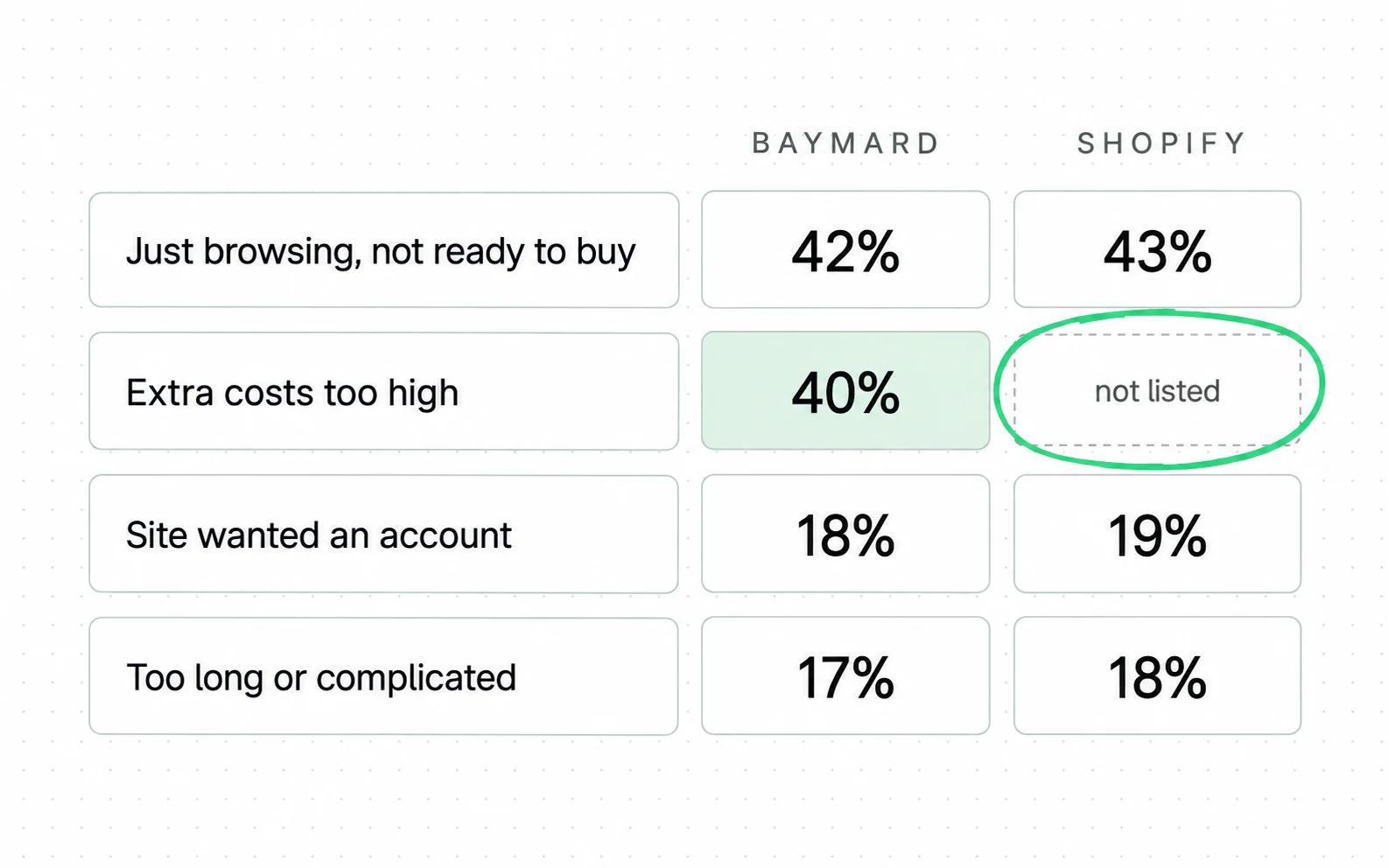
Our checkout optimisation guide is this skill’s funnel-mapping step applied to the last three screens of a store, with Baymard’s published abandonment reasons in place of guesses. The skill gives the method; the guide gives the measured objections a checkout must counter.
The "Further Reading" link to the source book carries the skill author’s Amazon affiliate tag. It does not change the method; you should know it is there.
The 95% confidence and full-cycle rules match ours. The ten-times screen is stricter than our own compounding rule (one researched change a week can be a 5% change); we would keep the screen for what to test and drop it for what to ship without a test.
Checkout optimization: measure and fix the right steps first
SKILL.md
The file the agent reads
Written by Wondel.ai and published under the MIT licence. Read the full file (2,464 words) on GitHub, at the commit we reviewed: wondelai/skills/cro-methodology/SKILL.md. The reference files are in the same folder.
Questions
Questions people ask before installing
What do I need before running it?
A page, its one action, and ideally raw customer words: exit-survey answers, chat logs, reviews. Without them it can still run the Quick Diagnostic and the persuasion-asset audit, and it will mark the research rows as not done.
Is this the same as the cro skill above?
No. The marketingskills cro skill is a seven-dimension page review; this one is a research-first methodology with an objection table and a scored diagnostic. Run cro for a fast read, this for the programme.
Where does the 10/10 score come from?
Seven diagnostic rows at about 1.4 points each, capped at 10. It is the skill author’s scale, and it says so.