

What separates AI agents for SEO from tools
A tool waits for your next request, while an agent continues until it reaches your goal or a rule you set. When you compare products, ask which steps the agent runs without review and where you can require approval.
The agent chooses its next step within your rules, so set them carefully if it can publish or edit live pages.
You can confirm a repaired internal link with one click, so let an agent fix links on its own. Require approval before the agent publishes a rewritten introduction to a category page, so you can read it first.
Ask each vendor for a list of the actions its agent can take without your approval. If publishing or editing live pages is on that list, ask whether you can switch it off.
How to compare SEO agents before you buy
Leave anything on the roadmap out of your comparison until the agent can run it today. Treat audit findings and written pages as separate categories, because they need very different amounts of review.
Before buying, ask for a sample export showing audit findings and changes to pages. Each action in your export should trace back to a rule you set.
For example, a row that reports a rewritten title tag should name the rule that triggered it, such as a title longer than your limit.
If a vendor sells continuous optimisation, ask who reads the output and how soon after each run.
Nightwatch says its agent monitors performance, finds opportunities and implements optimisations. Nightwatch also quotes a 145 percent figure and a weekly visit count without explaining what the percentage measures. Ask Nightwatch to explain the metric and time period behind its 145 percent figure.
Run your own two-week test before you buy. Pick ten tasks you already do by hand, such as fixing broken internal links or rewriting title tags.
Have the agent and a person each complete the ten tasks independently on the same pages.
Sort the agent's results into three groups: tasks that needed no changes, tasks you had to edit, and tasks the agent should have left alone.
For instance, before the test, write down how many of the ten tasks the agent must complete without corrections for you to let it handle that type of work. Setting the threshold after you see the results makes it easier to excuse poor performance.
Suppose you have to edit most of the title tags the agent rewrites. Compare the time you spend correcting the agent's title tags with the time you spend writing them yourself. Use whichever approach is faster.
Repeat the same ten tasks after any change to the agent's permissions to see whether your total review time went down.
What the measurements on SEO agents cover
Use the research below to choose which writing and optimisation tasks to include in your ten-task test. Test each method on your own sales pages before you adopt it.
Research on AI-written pages and SEO optimisation
| Who | Sample | What it measured | What it means for you |
|---|---|---|---|
| Puerto and colleagues, NeurIPS 2025 | 54 task and domain combinations | Compared published optimisation methods with leaving pages unchanged | Try a method on a few pages before an agent applies it everywhere |
| Semrush | 42,000 blog pages, 20,000 keywords | Position one was human-written 80.5 percent of the time against 10 percent classified as AI | Give pages that compete for the top spot a full human edit |
| SE Ranking | Six edited posts against 2,000 unedited, 20 new domains | How AI-assisted pages performed once a person edited them | Budget editing time for every AI draft you publish |
Puerto and colleagues found that three of fifty-four task and domain combinations produced better results than leaving pages unchanged. Ask each vendor which of those optimisation methods its agent applies to your pages by default.
What the Semrush study and Puerto team's study measured
At position five and below, Semrush found a smaller gap between the shares of pages classified as human-written and AI-written. Put your heaviest editing time on pages that compete for the top positions.
You do not need to buy an agent to make your pages eligible for AI Overviews. Google's documentation says AI features require no additional work and no special optimisation.
Google Search Console includes AI feature traffic within overall Search traffic under the Web search type. To assess the agent's effect, compare Search Console clicks for the pages it changes before and after each run.
For instance, export clicks for the changed URLs before the run. After the run, export click counts for the same URLs over a period of the same length.
Where AI agents for SEO get a page wrong
Writing in Search Engine Land, James Allen described an agent that flagged an image URL for a missing meta description. Check the file type of every flagged URL before you accept an audit finding.
Images cannot have meta descriptions, so the agent had misread the type of page it was checking.
A site audit issue list, the output an agent hands backCheck the file type before accepting an audit finding
An example audit list of the kind an agent returns. The third row flags an image for a missing meta description, which an image cannot have.

For example, a rule that checks HTML pages for missing meta descriptions can incorrectly flag image files, PDFs and redirects in the same crawl.
Before publishing an agent's draft, check whether the page helps your buyers. An audit only tests whether a page follows rules. Deciding whether buyers need the page takes editorial judgement.
Before drafting, state in the brief what the page should help the buyer do. A brief for a sofa category page might say: help a buyer compare fabric types before choosing a sofa.
If your brief does not identify a use for the page, revise it before you draft.
Ahrefs found that 96.55 percent of roughly 14 billion indexed pages get no Google traffic.
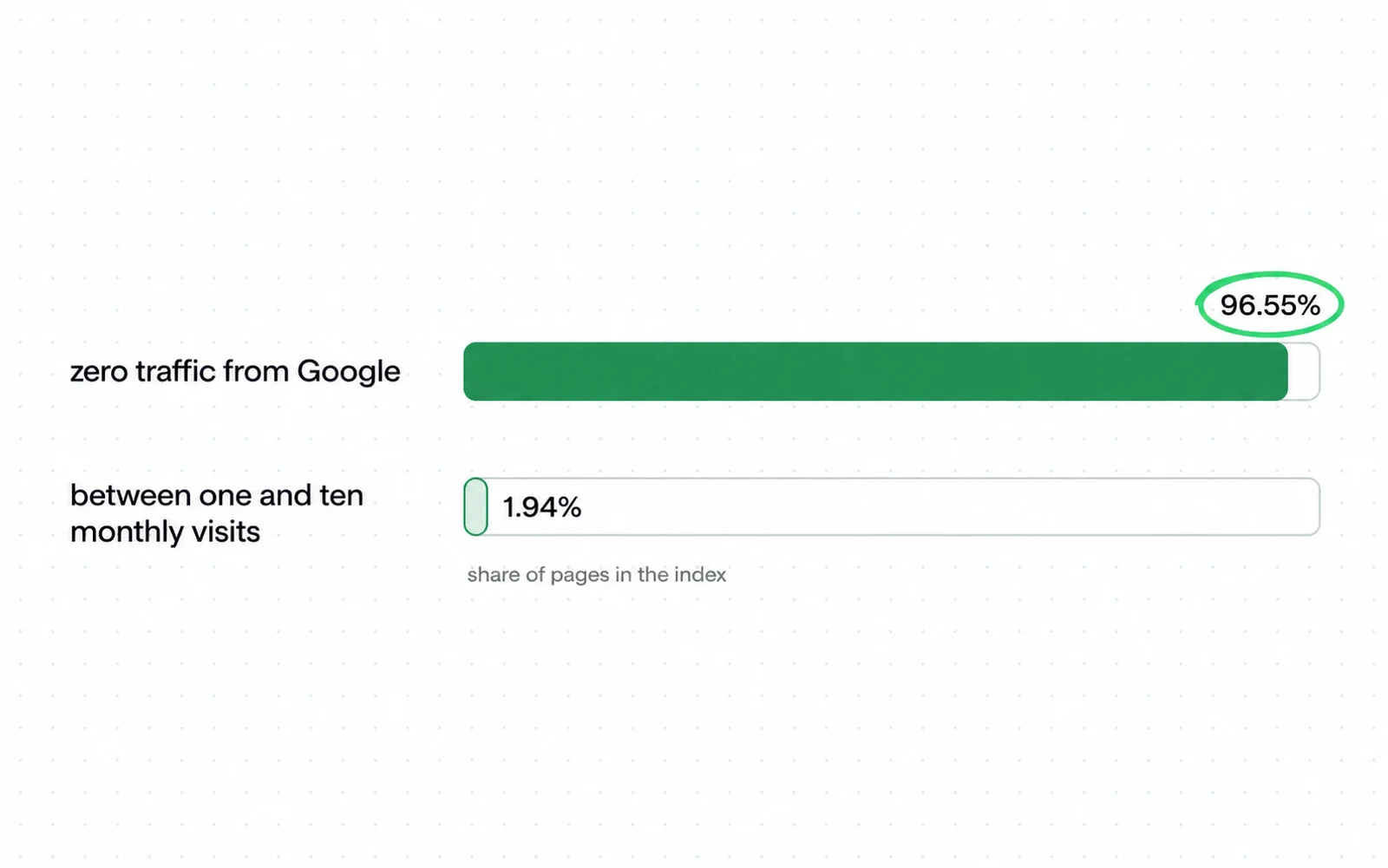
- The sentence carries a second number that matters as much as the first: a further 1.94 percent get between one and ten visits a month.
- An agent mainly adds speed. Use it for audits, monitoring and research, where faster output does not mean more pages to publish.
Google's spam policies focus on why pages are published, whatever tool produced them. Its scaled content abuse policy lists generative AI alongside scraping and automated translation.
If your agent can publish pages in bulk, cap how many it may publish each week without a person reading them.
What an SEO agent costs
Nightwatch includes its automated SEO agent in its rank tracker plans. Nightwatch charges from 79 to 399 euros a month, with a separate credit allowance for agent tasks.
Nightwatch's keyword and site limits apply to rank tracking. Agent tasks use credits, so a plan that fits your keyword list can still run short on agent work.
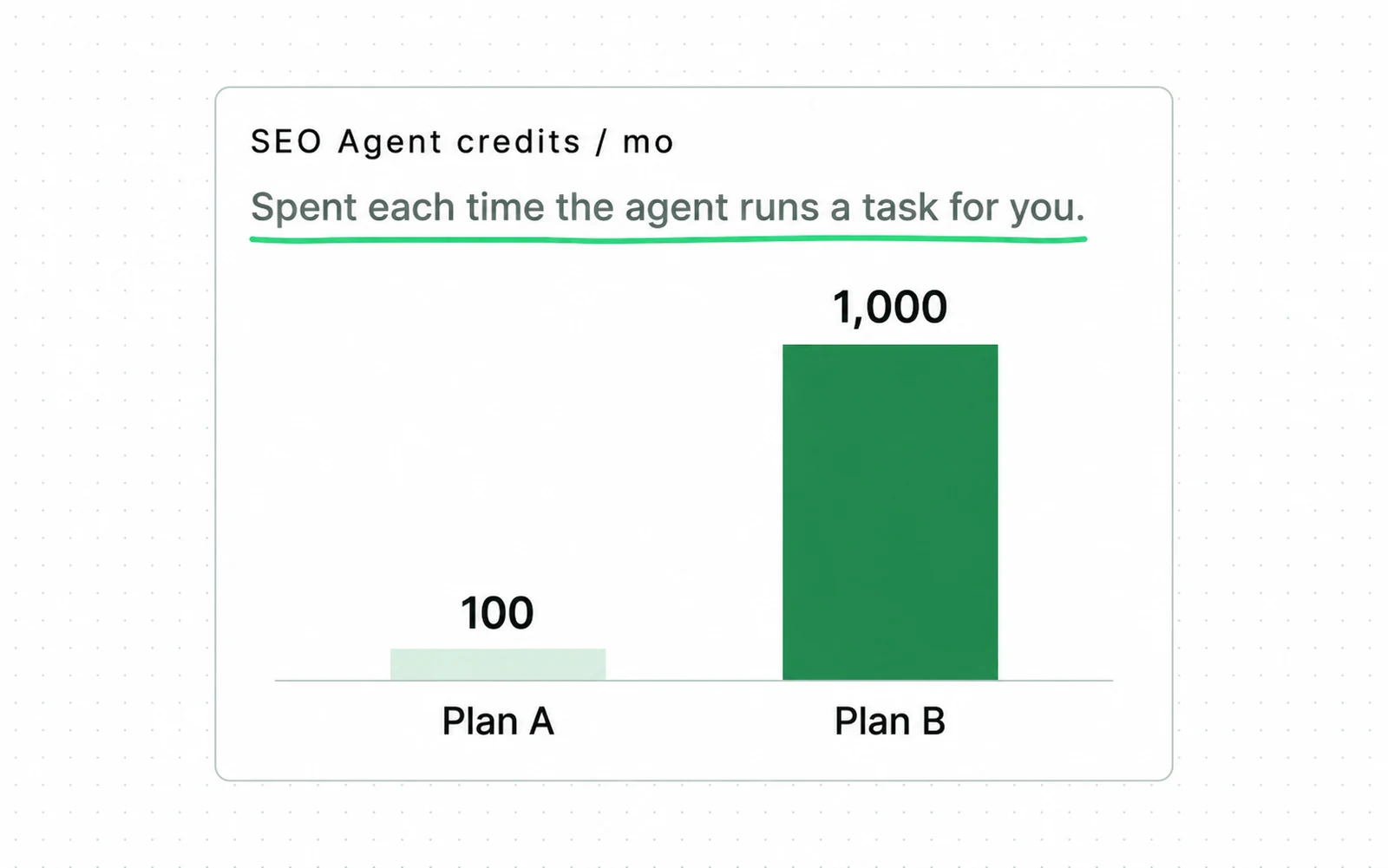
- Credits are spent each time the agent runs a task for you. Nightwatch allowances run 100, 1,000 and 5,000 a month across the three named plans.
- A rank tracker charges for the keywords you watch. Nightwatch's agent charges for each task it runs, so run frequency drives the bill instead of site size.
How long Nightwatch's agent credits last
Nightwatch gives its first two tiers 100 and 1,000 credits. Estimate how many tasks the agent will run, because site limits alone do not tell you whether the allowance covers them.
Imagine a task fails and the agent retries it twice. Each attempt may cost a credit, so ask Nightwatch how retries are billed and count them in your estimate.
Ask Nightwatch whether scheduled checks use credits before you set a schedule. If they do, include checks of unchanged pages in your credit estimate.
Choose the longest interval between runs that still catches the page and ranking changes you need to track.
For instance, if you review audit findings once a week, schedule the audit weekly. Daily runs would use credits to produce findings you would not review until later in the week.
If you want us to manage your ecommerce SEO, see our ecommerce SEO service.
Which SEO tasks to give an AI agent first
Start by giving the agent read-only access to audit your site and report what it finds. Keep the argument of each page and the final approval of its copy with your editor.
Have the agent audit your pages, monitor your rankings and gather research for your next guide: the keyword list, the competing pages and the internal link targets.
What to hand over this week
With read-only access, the agent cannot change a live page. A wrong finding costs you only the time it takes to dismiss it.
Before you grant write access, export the current title tags, meta descriptions and canonical tags for every page it may touch. Keep the export so you can restore the previous tags if clicks drop on a changed URL.
Say you let an agent fix duplicate content on your category pages. It might point the canonical tag of every filtered page at the main category, including a filtered page that was ranking on its own.
That page then drops out of Google's index until you restore the old tag from your export.
Put the limits in the contract as well as in the settings. Ask the vendor to commit in writing that the agent makes no live change without approval.
The same clause should also require the vendor to provide an exportable change log. It should also commit the vendor to delete your site data when you cancel.
If a weekly audit flags several image URLs for missing meta descriptions, change the rule to skip image files before you schedule audits daily.
You can use open-source skills to automate audits, monitoring and research today. The seo-audit skill crawls and scores your site. Find more skills on our agent skills shelf.
Read our guide The two jobs sold as AI SEO for the difference between appearing in AI search results and using AI for SEO work. For tool selection, see which AI SEO tools fit each job.
Sources
- Puerto, Gubri, Green, Oh and Yun C-SEO Bench, NeurIPS Datasets and Benchmarks 2025: published optimisation methods tested across two tasks and three domains each, with three of fifty-four combinations improving on making no edit
- Semrush Does AI content rank in search: 42,000 blog pages across 20,000 keywords classified with GPTZero, position one human-written 80.5 percent against 10 percent classified as AI, with the gap narrowing from position five
- SE Ranking How AI-Generated Content Performs: six edited AI-assisted posts against 2,000 unedited articles on 20 new domains
- Ahrefs Search traffic study: 96.55 percent of roughly 14 billion indexed pages get zero traffic from Google
- Google Search Central AI features and your website: no additional requirements to appear in AI Overviews or AI Mode, nor other special optimizations necessary
- Google Search Central Spam policies: scaled content abuse names a purpose, and lists generative AI alongside scraping and automated translation
- Google Search Console Help Performance report: AI feature traffic is reported inside overall Search traffic under the Web search type
- Nightwatch SEO AI agent product page: the agent continuously monitors performance, identifies new opportunities and implements optimizations automatically, with a 145 percent figure and a weekly visit count and no method published for either
- Nightwatch Pricing: Starter 79 euros, Professional 159 and Agency 399 a month, with SEO Agent credits of 100, 1,000 and 5,000 a month spent each time the agent runs a task
- James Allen, Search Engine Land AI agents and SEO, a practical workflow walkthrough, 20 February 2026: human oversight remains essential, the technology is supplementary, and an agent flagged a missing meta description on a URL that was an image
- Frase Best AI SEO agents 2026, 25 March 2026: ten tools scored against six pipeline stages, research, strategy, write, audit, monitor and fix, based on what each ships today rather than what its roadmap promises
- Surfer What are AI SEO agents, updated 9 September 2026: agents can conduct complete SEO processes with little to no human intervention, although they are not quite there yet, and readers are told to take AI suggestions with a grain of salt
- Lyzr AI agents for SEO, 26 June 2026: software that autonomously executes multi-step SEO work without waiting for prompts, with the human needed in the loop at the points that require judgement, and no sample published
- Omid Ghiam, Marketer Milk Seven ways I use SEO AI agents on client sites, 24 February 2026: one site grew from 100 clicks a day to 230, and the same page states the posts are written entirely by the author because an outline is not a completed article
- Gumloop How to build an SEO AI agent in four steps, 5 December 2025: an autonomous workflow initially created by an SEO professional that completes tasks on its own, eight hours of work reduced to two or three, and a warning against generating slop
Questions people ask
Can AI agents do SEO?
They can run most steps of the work, from research and writing to audits and monitoring. Have a person review work where mistakes would be costly to fix or take time to detect.
Which AI agent is best for SEO?
Compare tools on how well they handle the tasks you can review quickly. Run the same ten tasks through each agent and count how many need no corrections.
Is there an AI tool for SEO?
Yes. Look at whether a product needs a new prompt for each step or runs several steps on its own.
Nightwatch measures agent usage by the tasks it runs. Its three named plans allow 100, 1,000 and 5,000 credits a month.
Can ChatGPT do SEO?
ChatGPT can research a topic and draft copy. As a tool, it waits for a new prompt at every step. Review its research and edit the draft before publishing.