

Which answer engine optimization tools do which job?
Say you have already priced a GEO tool and now somebody tells you that you also need an AEO tool. You do not. Search both terms and the same six products come back: Otterly, Peec AI, Profound, Scrunch AI, Semrush and Writesonic.
Three names, and one of them has a paper behind it. Aggarwal, Murahari, Rajpurohit, Kalyan, Narasimhan and Deshpande introduced generative engine optimization at KDD 2024. What they measured was your share of a generated answer, not your traffic.
The category name is a label on a search result, not a description of a product. All six run prompts against AI assistants, records whether your brand is named, and reports the movement.
The same product, under three different category names
| Tool | Sold as AEO | Sold as GEO | Sold as AI visibility |
|---|---|---|---|
| Profound | Yes | Yes | Yes |
| Peec AI | Yes | Yes | Yes |
| Otterly.AI | Yes | Yes | Yes |
| Scrunch AI | Yes | Yes | Yes |
| Semrush | Yes | Yes | Yes |
| Writesonic | Yes | Yes | Yes |
So the buying question isn’t which category you are in. It is which of these you can afford to run, on the engines your buyers use, often enough to mean something.
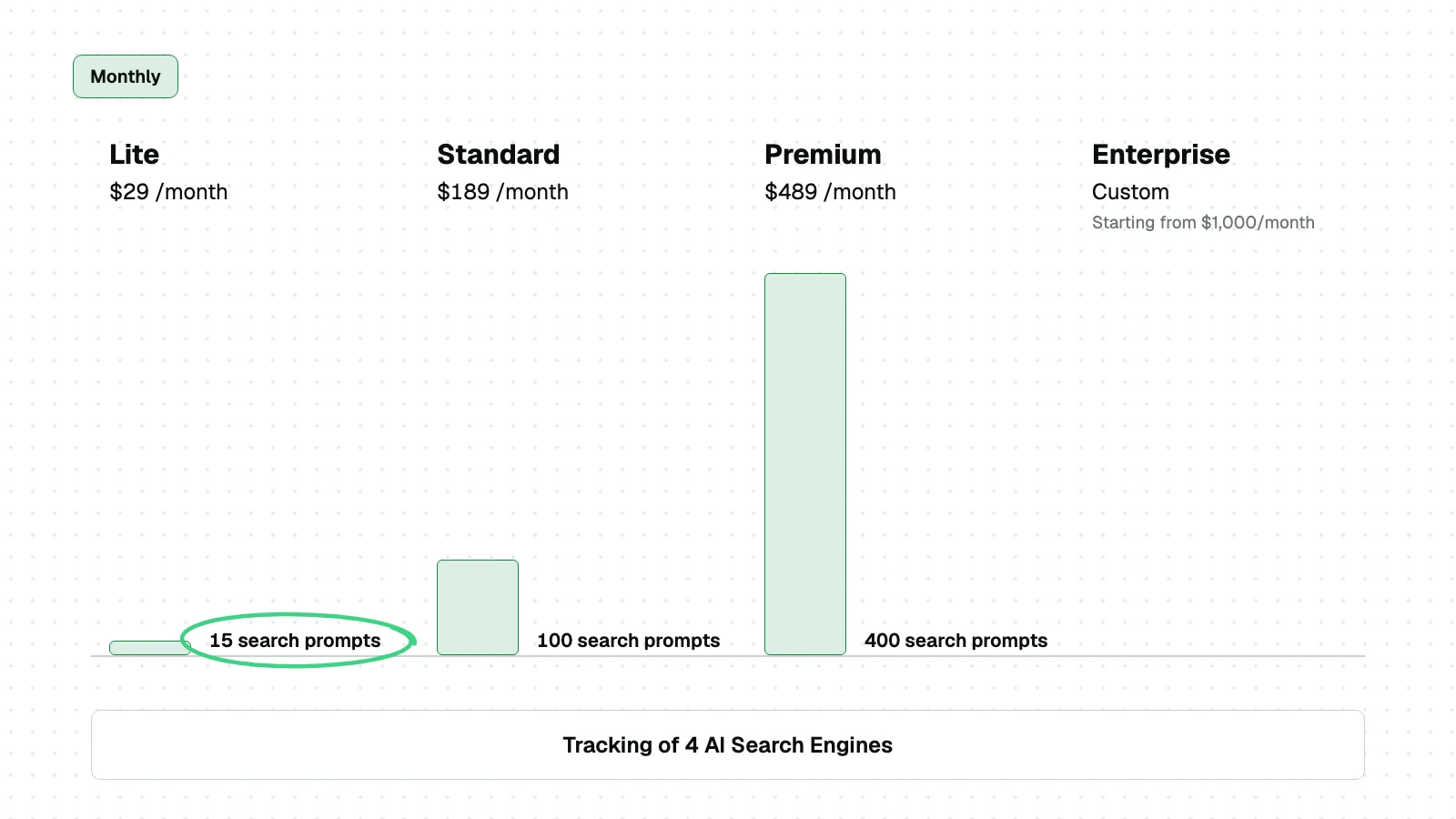
- Fifteen prompts at the entry price. That is the number to hold against your catalogue before the price looks cheap.
- The engines are the same across all four plans. What climbs with the price is how many questions you may ask, not where they are asked.
- The jump from 29 to 189 buys 85 more prompts. Pricing in this category is priced per question, whatever the feature list says.
Coverage and cadence in AEO tools
Feature lists barely help here, because every product describes the same job in the same words. Two things do separate them, and both are printed on the pricing pages: how many engines a plan watches, and how many questions it asks.
Say you sell running shoes and your buyers ask ChatGPT. A plan that watches four engines but allows twenty-five questions gives you six questions per engine. A plan that watches one engine and allows fifty gives you fifty on the one that matters. Neither is better until you know which engines your buyers use.
Say you sell one product line and your buyers ask about it in three or four ways. Twenty-five questions is generous. Say you carry nine categories and each one has its own set of buying questions. The same twenty-five is under three per category, and a reading built on three questions moves when nothing has changed.
Coverage is a real trade because the engines disagree about you. Orbit Media Studios read 13,184 citations across 1,765 answers from four models. All four named the same domain for the same question in 30 of 1,792 query and domain combinations.
Count your own questions before you look at any plan. Write down what a buyer would type, category by category, and stop when you run out. That number is the plan you need, and it is the only number in this purchase that comes from your business, not from a vendor.

Then check the suite you already pay for, because that is the cheapest answer available. Ahrefs and Semrush both fold prompt tracking into their main SEO plans now. Semrush states 50 daily prompts on its $199 tier and 100 on its $299 tier, read 8 September 2026.
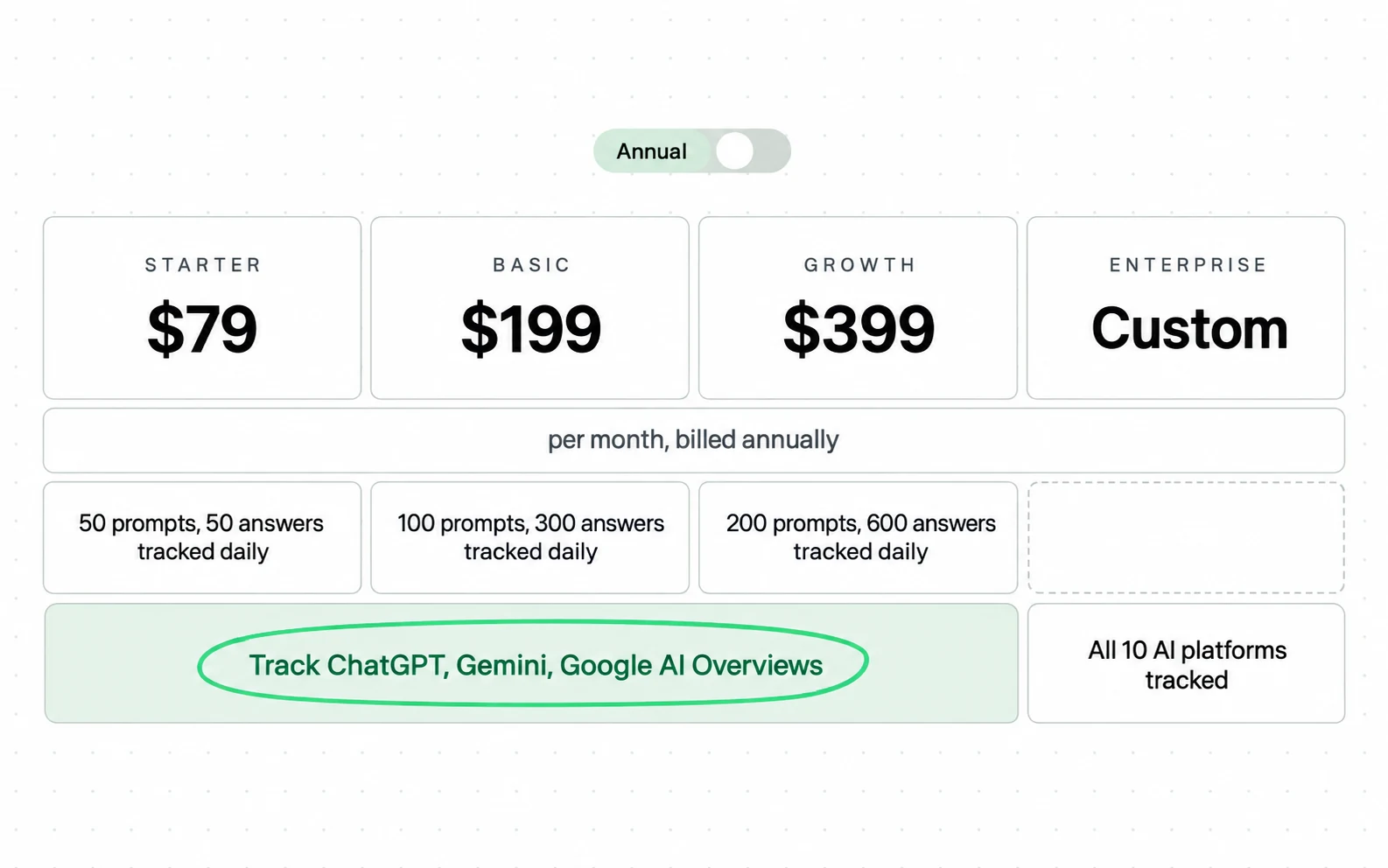
- The plan names differ from every other page in this comparison and the dials do not. Prompts tracked and engines covered, climbing together.
- Each plan prints its own engine list instead of promising coverage in general, and that is the line to read before you compare two prices.
- Put this beside Otterly and Scrunch and the category resolves: three vendors, three price points, one product shape.
Whether any of this is worth paying for at all is a question about the method behind the name, and GEO tools works through what has been tested.
Cheapest versus dearest: the real gap
The two ends of that chart are the comparison worth making. The gap between them is not a feature list, it is what the plan is shaped for, and the shape tells you which one you are.
The two ends of the price range, on their own pages
| Otterly.AI | Scrunch AI | |
|---|---|---|
| Entry price | $29/month | $250/month, Core plan |
| What it is shaped for | One brand, watching answers | A site, watching what agents do on it |
| Free tier | Yes | Seven-day trial |
| Top published tier | $489/month | Not published |
That is the choice in one line. If you want to know what an assistant says about your brand, start at the cheap end. If you want to know what an assistant’s crawler does on your site, that is a different product and the price reflects it.
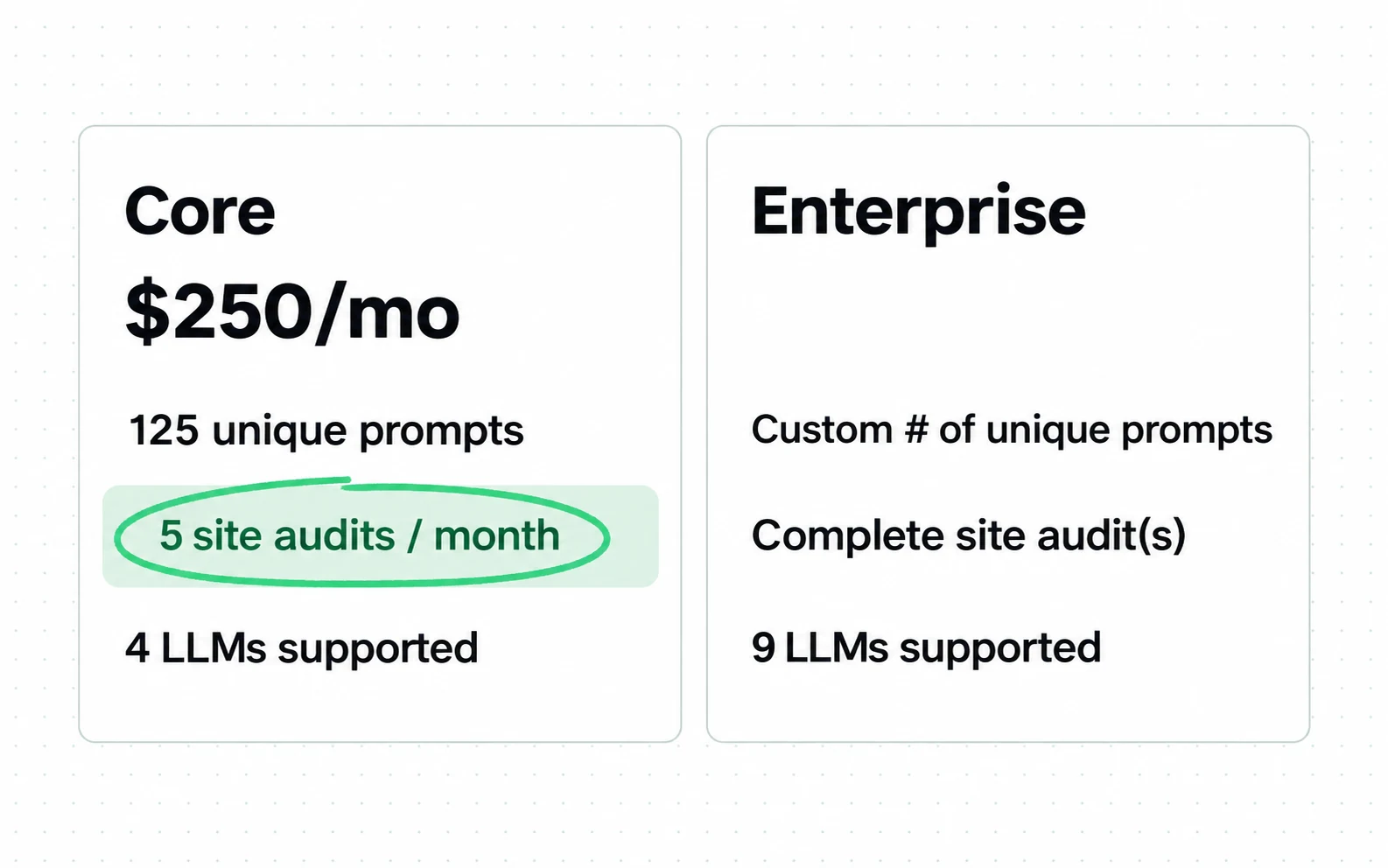
- Site audits appear on the plan, and no tracker in this category sells those. That line is the tell: this product watches your site, not only the answers.
- Four engines at Core against nine at Enterprise. Coverage is the upgrade path here, where Otterly sells prompts.
- A hundred and twenty-five prompts for 250 dollars is $2.00 a prompt; fifteen for 29 is $1.93. Per question the two are within a few cents, and the 250 buys site audits the 29 does not.
Who is each AEO tool wrong for?
Every product here is a poor fit for somebody, and the fit is decided by something you can settle before you look at any of them. This comes from what each vendor publishes, not from running them side by side, which nobody has published either.
Otterly.AI
Cheapest published subscription at $29 a month, with a free tier above it. If you are testing whether this measurement is worth anything to your store, start with Mangools’ free grader and pay only once that has told you something.
Skip it if you need one dashboard for several brands. The plans climb to $489, so the cheap entry is the start of a ladder, not the whole product.
Profound
At $99 the Starter plan tracks ChatGPT and fifty prompts, and its frequency is daily. Nothing else in the chart above reaches fifty questions below $199, so at this price the count is the reason to look at it.
Skip it if ChatGPT is not where your category gets asked. One engine at that price is a deliberate trade and it only pays if you picked the right engine.
Semrush
Four engines and a published refresh rate for $99, with the terms next to the price. If you already pay Semrush for keywords, the prompt tracking sits inside plans you hold.
Skip it if twenty-five questions is thin for your catalogue. Say you carry nine categories: that is under three questions each.
Scrunch AI
A different job at $250. It watches what AI agents do on your site, not only what answers say about you.
Skip it until you have read your own logs. That check costs nothing and tells you whether there is agent traffic to watch.
Limits of AEO tool measurement
Everything above is what these vendors publish about their own measurement. The harder question is what happens after a reading arrives, and that is where the published evidence stops.
No vendor publishes a test of its own recommendations. Not one shows pages that took its advice, comparable pages that did not, and what happened to citations across both.
The only major AEO tool that starts with your customer data. … Leads from AI convert at 3X the rate. Generate them with HubSpot AEO.
hubspot.com read 5 September 2026
- The dashboard half is the measurement, and it is the same measurement every product on this page sells: a visibility percentage and a sentiment line.
- The line under it is the other half: leads from AI convert at three times the rate. No sample, no comparison group and no period.
- Three times what, measured on whom, is the question to put to any vendor. It is not a reason to dismiss the product; it is the difference between the half you can check and the half you cannot.
That gap has a size. Puerto and colleagues published C-SEO Bench at NeurIPS 2025, running the AEO and GEO edits across more settings. Three of fifty-four combinations beat making no edit at all. It tests the method and not any product, so it bounds the claim instead of settling it. GEO tools carries the full reading.
Your own reporting will not close the gap either. Google folds visits from its AI features into overall search traffic under the Web search type, so an answer that names you without sending a click never reaches the number at all.
One more thing is worth doing before any of this, and it costs nothing. Ask an assistant the questions yourself, from a signed-out window, and write down what comes back. Ten minutes of that tells you whether your category gets answered at all, which engine answers it, and whether your name appears anywhere near the answer. A subscription measures that continuously. It does not tell you anything the first ten minutes will not.
What the subscription buys is repetition. Inspeccia measured how far the answers move: across 167 domains read twice, the visible ones swung by an average of 30.8 points.
One reading of a number that swings that much is an anecdote, so repetition is worth paying for. That half of the pitch carries enough published detail to check. The other half, that the tool will move your number, carries none.
Say you want the page changes themselves and no dashboard. The seo-aeo-geo skill audits five layers, plans the fixes on your pages, and tells you where it cannot measure.
So ask any vendor one question before the optimisation half of the pitch: what did you change, on how many pages, compared against what, over how long. A vendor who can answer that has done the expensive part.
Suppose you want that half answered with pages changed and no dashboard: that is the AEO services work at Addition, an AI search agency.
Sources
- Profound Pricing: Starter $99 a month billed yearly, ChatGPT tracking only, 50 prompts, daily prompt frequency; Growth $399 with three answer engines and 100 prompts
- Otterly.AI Pricing: entry plan at $29 a month with a free tier, rising to $489 a month on the published plans
- Scrunch AI Pricing: Core plan at $250 a month with a seven-day trial; the product watches what AI agents do on a site, not only what answers say
- Semrush Pricing: the cheapest plan carrying AI search tracking is $139 a month; 50 daily prompts at $199 and 100 at $299. On 5 September the entry plan read $117, so this page moved inside three days
- Ahrefs Pricing: plans from $129 a month, with brand prompt tracking listed at 80 and 100 prompts on the tiers where it appears
- Writesonic Pricing: $79, $199 and $399 a month, with 50, 100 and 200 prompts tracked respectively
- Peec AI Product site naming ChatGPT, Perplexity and Claude as tracked surfaces, and publishing no price
- HubSpot AEO product page: plans published at $50 and $900 a month, with 50 prompts named on the lower tier
- Puerto, Gubri, Green, Oh and Yun C-SEO Bench, NeurIPS Datasets and Benchmarks 2025: tests the published GEO methods across two tasks and three domains each, with three of fifty-four combinations positive
- Google Search Central AI features traffic is reported inside overall Search traffic under the Web search type, not broken out separately
- Google Search Central AI features and your website: states there are no additional requirements to appear in AI Overviews or AI Mode, nor other special optimizations necessary
- Mangools AI Search Grader: a free tool with three AI models open without payment, defining visibility as the percentage of prompts where the brand appears in the top 20
- Orbit Media Studios 13,184 citations across 1,765 answers, four models, three brands: all four models cited the same domain for the same question in 30 of 1,792 query and domain combinations
- Aggarwal, Murahari, Rajpurohit, Kalyan, Narasimhan and Deshpande GEO: Generative Engine Optimization, KDD 2024: the paper that named the method and measured share of a generated answer, not traffic
Questions people ask
What is the difference between AEO tools and GEO tools?
In practice, the name. The mechanism under all three labels, including AI visibility, is the same: run prompts, record whether the brand is named, report the movement. Six products are sold under every one of them.
The names came from different places. Answer engine optimization is an industry term the platforms do not use. Generative engine optimization is the name of a specific method from a 2024 paper. Neither describes a different product.
Do I need an AEO tool if I already pay for an SEO suite?
Check the suite first. Ahrefs and Semrush both include prompt tracking in their main plans now, at 80 and 50 prompts on the tiers where it appears, so a store on either may already hold the measurement.
Buy a separate product when you need something the suite does not give you: more engines, more questions, or a different job like watching what agents do on your site.
What is the cheapest AEO tool?
Otterly.AI publishes the lowest entry price of the products here, at $29 a month, with a free tier above it. Mangools publishes a free grader that is not a subscription at all.
Cheapest is only useful if it watches the engine your buyers use. A plan at half the price that covers the wrong assistant costs you the whole subscription.
Do AEO tools improve your visibility?
No vendor has published a test that would show it. Their pages carry outcome claims without a sample, a comparison group or a period.
That is not proof they do nothing. It means the improvement half of the purchase is unmeasured, so buy the measurement for what it is and treat the advice as an experiment you are funding.