

Which conversion rate optimization tools do which job?
Say a list recommends a tool and you cannot tell what it competes with. That is the category’s real problem: four different products answer to the same name, and each one answers a different question about your site.
Sort by the question you have and the shortlist gets short quickly.
Two products recommended side by side may not compete with each other in any way. That is what makes a ranking of thirty-five hard to act on.
The lists do not even agree on how many tools belong in the category. One ranking names 25, a second 11 and a third 8, so check the boundary a list drew before you trust where it put your shortlist.
Your question, and the class that answers it
| Your question | The class | Named examples |
|---|---|---|
| Does this change beat the current page | Testing platform | VWO, Optimizely |
| What are people doing on the page | Session recording and heatmaps | Microsoft Clarity, Hotjar |
| Why did they leave | Survey and voice of customer | Hotjar, Qualaroo |
| Where in the funnel do they drop | Analytics | Google Analytics, your own database |
Only the first class needs a budget decision before you start. The second has a free option running on more than two million sites, the third is often bundled with the second, and the fourth is already installed.
That order matters more than the choice within any class. A store that buys a testing platform first usually has nothing to test. A store that starts with its own funnel report finds two things to try.
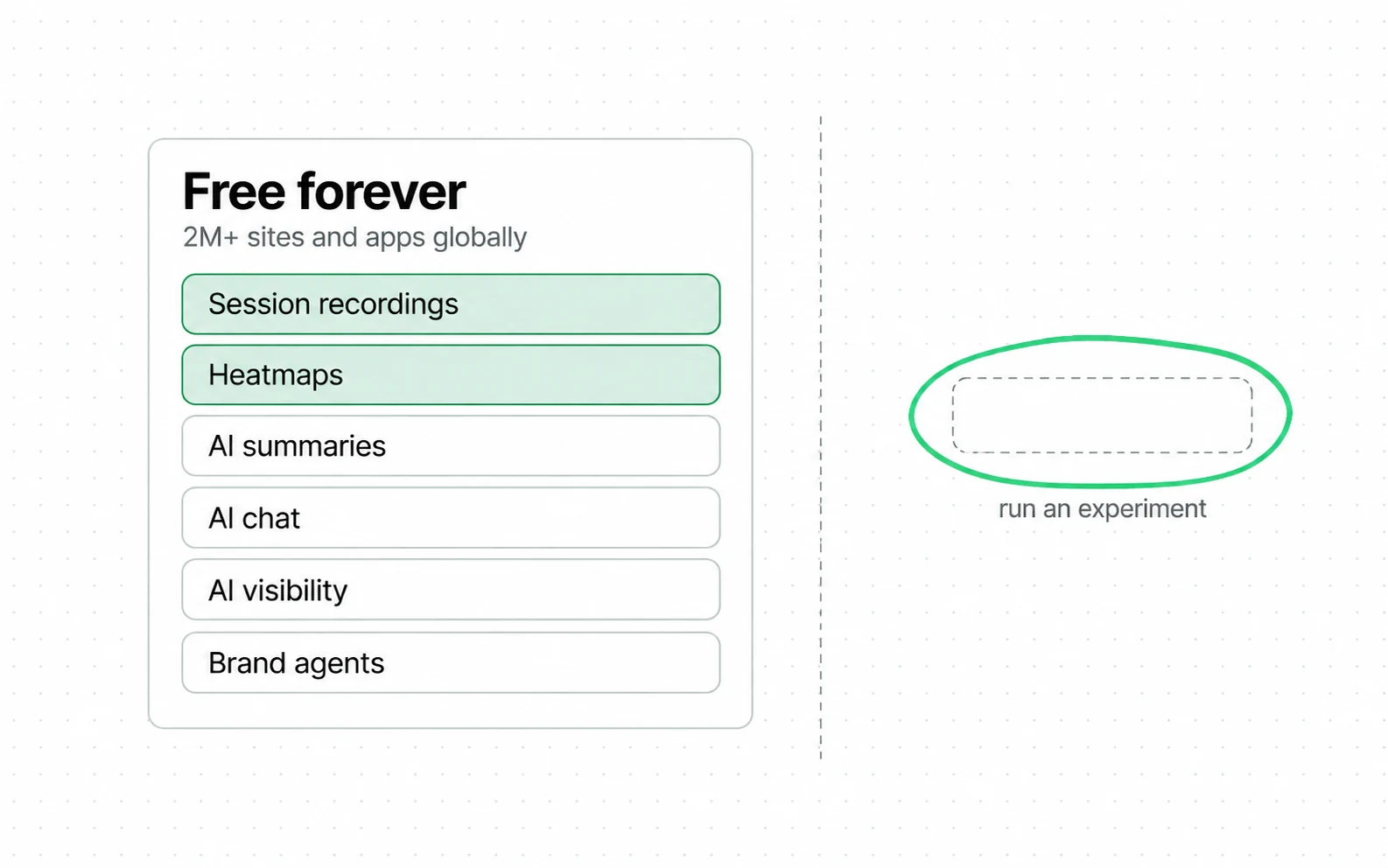
- Free forever is on the page, not in a footnote, and the scale line underneath is the vendor’s own claim about adoption.
- Session recordings and heatmaps are the two things most CRO lists put behind a subscription. Both are in the free tier.
- What it does not do is run an experiment. That is the boundary between this class and the expensive one.
CRO tool pricing: two large platforms publish no price
For the class that costs money, the ordinary comparison does not work. You cannot line up entry prices, because they are not published. That is a fact about the market, not an oversight on any list.
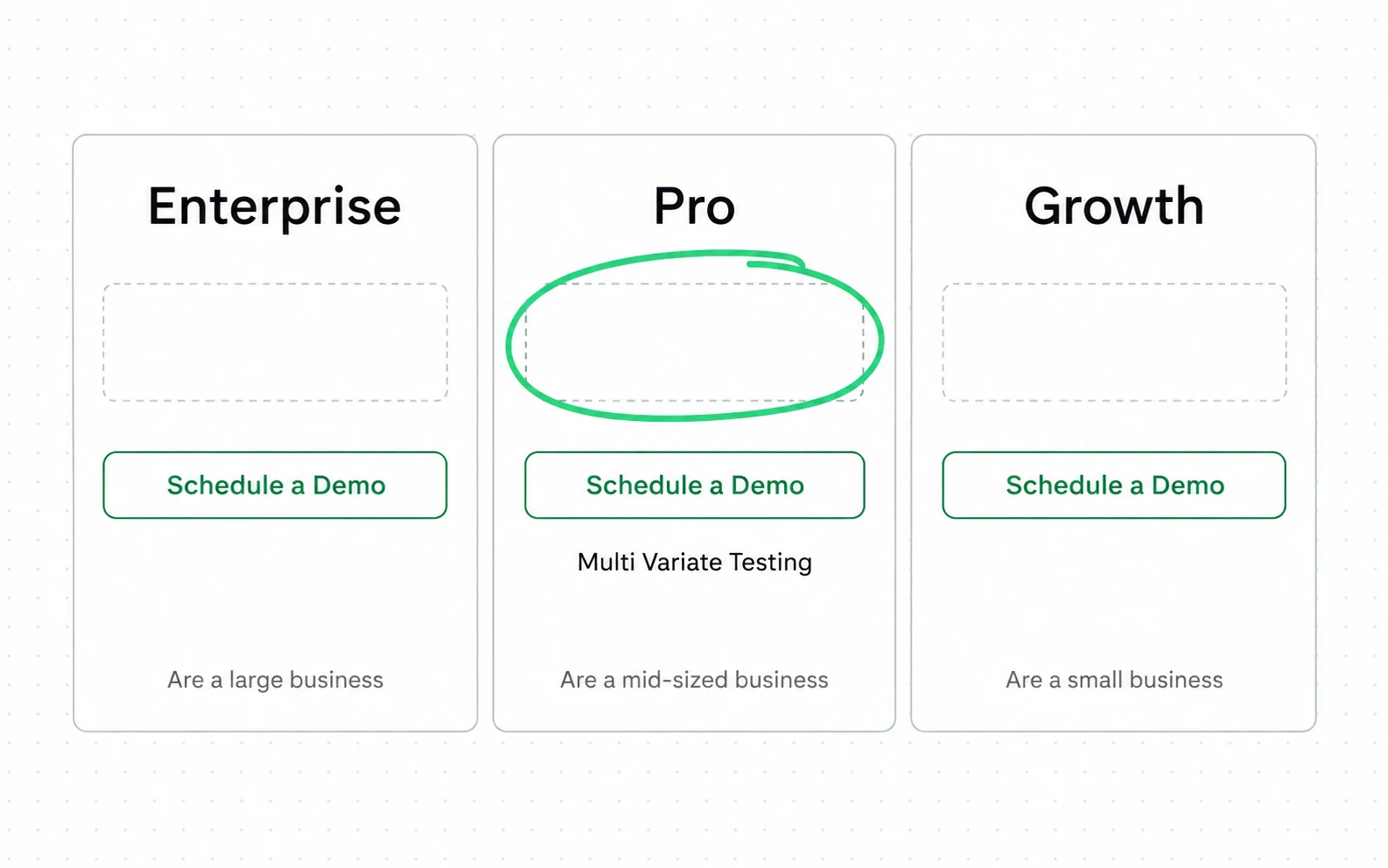
- Every tier ends in Schedule a Demo. There is no number on the page for any of the three.
- The Choose X if you lines underneath are more useful than most third-party comparisons: small business, mid-sized, large, with the reason attached.
- Multivariate testing appears on the two upper tiers. That is the feature that needs the most traffic, and it sits behind the plans that need a call.
The other large platform replaces its pricing page with a form. Neither prints a number. Both ask for a call instead, and both tie their plans to traffic volume, so what you pay depends on a figure you supply on that call.
It also means a published comparison that prints a monthly figure for either is repeating something it was quoted, on traffic that is not yours. Take the number as an anecdote and get your own.
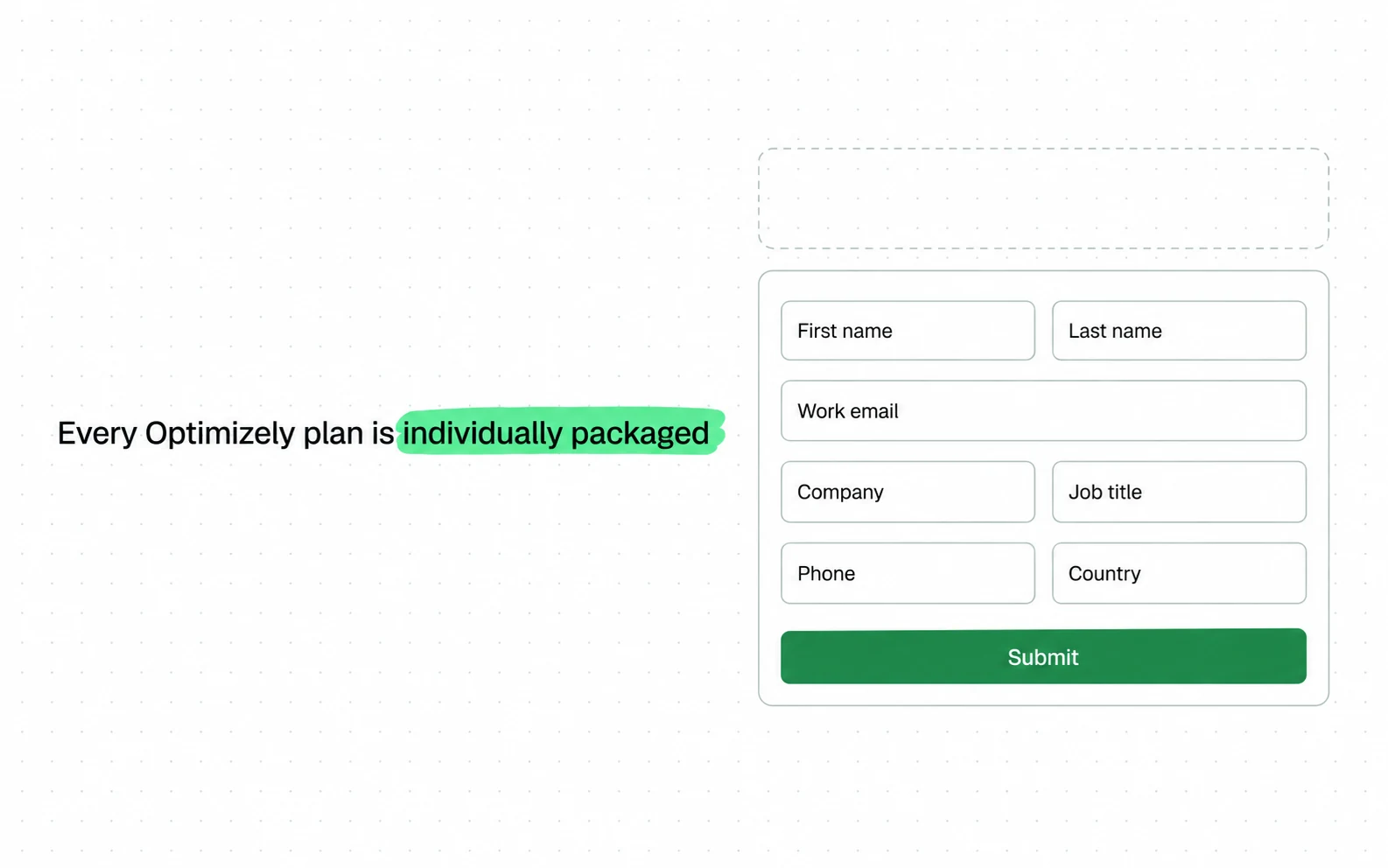
- Individually packaged is the vendor’s own phrase for it, and it says plainly what the form is for.
- Seven fields and a free-text box before a number. That is what finding out costs, and it changes how you plan a comparison.
- Neither this nor the previous page is hiding anything unusual. Traffic-priced software works this way, and a list that prints a price for either is quoting something it was told.
CRO tool sample size: arithmetic before a demo
A testing platform can only report a result your traffic can support. That number is arithmetic, it does not depend on the vendor, and it decides whether the whole class is worth a call.
Say your page converts at 2 percent and you want to know whether a change helped. How much traffic you need depends entirely on how big a change you are willing to detect.
The relationship is not gentle. Halving the effect you want to detect roughly quadruples the traffic you need, because the sample size moves with the square of the difference.
Fixed-horizon design means you pick the threshold before launch, run to the planned sample, and read the result once. Stopping early to look at a promising result is what inflates the false positive rate.

Run your own numbers before the call. Two variants at 19,600 visitors each is 39,200 to detect a 20 percent lift. If the page sees four thousand a month, the test runs for most of a year.
This is also why the class below is not a consolation prize. A recorder shows you twenty people failing at the same field, and fixing that field does not need a significance test because nobody is claiming a measured lift for it.
That is the case for starting in the second class instead. Clarity is free and does both, and it answers a different question, and conversion rate optimization sets out what to do with what they show.
Poor fits among the four classes
Every class here is a poor fit for somebody. Two things you can settle before opening any product decide it: your traffic, and whether you already know what is wrong.
Testing platforms
The traffic threshold is the first filter and the hypothesis is the second. Both are yours to check, and neither depends on which vendor you talk to.
Right when a page has the traffic above and somebody has a specific change to try. The platform is the only class that can tell you a change caused an improvement.
Wrong below the traffic threshold, and wrong when nobody has a hypothesis yet. A test with no hypothesis is a coin flip you paid for, and A/B testing sets out the rest of what makes a result trustworthy.
Session recording and heatmaps
Right at the start, and free. Watching twenty sessions on a checkout page usually produces more to fix than a month of reading analytics.
This class works early because it produces specific complaints. A form field people retype, a button below the fold on a common phone size, a shipping line that appears late. Those are fixes, not experiments.
Wrong as evidence for a decision. What you saw twenty people do is a source of hypotheses, not a measurement of anything.
Survey and voice of customer
Right when the analytics shows where people leave and nothing explains why. One question on the exit is often enough.
Keep it to one question and put it where the drop happens. A five-question survey on a checkout page is a second reason to leave.
Read the answers as language, not as data. What you are looking for is the phrase people use for the thing that stopped them, because that phrase is usually the fix for the page.
Wrong as a substitute for behaviour. What people say they wanted and what they did are different data, and checkout optimization covers where the two usually diverge.
Analytics
Right always, and you have it. The funnel report tells you which step to look at before any other tool is opened.
Wrong as an answer on its own. It tells you where, never why, and buying a bigger analytics product does not change that.
Evidence on conversion rate optimization tool results
Everything above compares what these products do. The harder question is what a purchase in this category can be expected to produce, and that is where the published evidence thins out.
All CRO tools have a similar purpose in that they help you optimize, but they can all help in different ways by providing different insights. There are eight categories listed below, so you can choose to focus on one, some, or even all.
Unbounce, 35 best CRO tools and software for marketers (Unbounce sells a landing page builder) updated 10 January 2026, read 7 October 2026
- Thirty-five tools in the title, sorted on the same page into eight categories, from A/B testing and landing pages to SEO and survey tools. They do different jobs, so the ranking compares things that are not substitutes.
- How to choose the right CRO tool comes after that. Both sections are the right question and they arrive after a ranked list of thirty-five.
- The publisher sells a landing page builder, a fifth class again. That is worth knowing when reading the order.
These vendors publish what their software does and not a test of its own recommendations. That is not a claim they do nothing. It means the improvement half of the purchase is unmeasured, and the measurement half is the part you can check.
It can be done, and it has been done next door. Puerto and colleagues published C-SEO Bench at NeurIPS 2025, testing published optimisation methods at scale, and three of fifty-four combinations came out ahead of making no change.
The measurement half is real and checkable: a recording either shows the session or it does not, a funnel report either counts the step or it does not. Those are the parts to buy on.
One published benchmark sets a realistic expectation. DRIP Agency read thousands of tests across more than 90 European ecommerce brands between 2020 and 2026, and reports 36.3 percent reaching a statistically significant winner.
Those winners move conversion rate by a median of 1.88 percent and revenue per visitor by 2.77 percent. DRIP sells this work, so read its win rate as an interested figure; the size of a winner is the number that matters to you here.
Read that number as a budget, not as a discouragement. A programme shipping one well-researched test a week compounds. A programme buying a platform and running a redesign does not, and the second is what most of this category is sold for.
One more thing is worth settling before any of this. Decide which number the programme is judged on, and write it down where somebody else can read it. Revenue per visitor catches both a conversion move and an average order move in one figure; conversion rate on its own can rise while revenue falls.
So hold a vendor to the question you would hold any tool to. One change, across how many pages, against what control, over what period. Answering that is the expensive part, and most of this category has not paid for it.
Suppose you want the research the tools skip. The cro-methodology skill writes it up as a method for you: exit surveys, ticket mining and an objection table before any test.
Suppose no vendor answers it: the page changes on your own site are landing page optimization at Addition, a search marketing agency.
Sources
- VWO Pricing page: three testing tiers, Enterprise, Pro and Growth, each ending in Schedule a Demo with no figure published for any of them
- Optimizely Pricing page: a seven-field contact form, plus a free-text box, under the line that every Optimizely plan is individually packaged
- Microsoft Clarity homepage: free forever, more than 2 million sites and apps globally, with session recordings and heatmaps in the free tier
- Karine Bengualid, Unbounce 35 best CRO tools and software for marketers, updated January 2026, with sections on types of CRO tools and how to choose the right one
- Perspective Conversion Rate Optimization Tools: 25 Best Platforms, a second ranking list drawing the category boundary at a different number
- Wisepops 8 Best CRO Tools, a third list at a much narrower boundary
- WhatConverts The 11 Best Conversion Rate Optimization Tools for 2026
- Georgi Georgiev Statistical methods in online A/B testing: fixed-horizon design, pre-registered significance thresholds, and the false positive cost of repeated peeking
- Google Analytics Help Funnel exploration: reports where users continue and where they drop between defined steps
- Google Search Central Google Optimize was retired in September 2023, with Google stating it lacked features customers requested and pointing to third-party testing tools
- Google Search Central Core Web Vitals thresholds: LCP under 2.5 seconds, INP under 200 milliseconds, CLS under 0.1
- Google Analytics Help Conversion definitions: a conversion is an event you mark as one, so the denominator of any rate is a configuration choice
- Microsoft Clarity documentation: recordings and heatmaps are collected without sampling for sites within the published limits
- DRIP Agency A/B Testing Statistics 2026: thousands of A/B tests across more than 90 European ecommerce brands between 2020 and 2026, 36.3 percent reaching a statistically significant winner, median winning uplift 1.88 percent conversion rate and 2.77 percent revenue per visitor, published 26 February 2026
- Puerto, Gubri, Green, Oh and Yun C-SEO Bench, NeurIPS Datasets and Benchmarks 2025: published optimisation methods tested at scale, with three of fifty-four combinations positive
Questions people ask
What are the best tools for conversion rate optimization?
No single answer exists, because four different product classes carry the name. A testing platform, a session recorder, a survey tool and an analytics product each answer a different question.
Start with the one you already have. Your analytics shows where people drop, a free recorder shows what they do there, and only then does a paid testing platform have something worth testing.
How much do CRO tools cost?
The range runs from nothing to a quoted enterprise figure. Microsoft Clarity publishes free forever for session recordings and heatmaps, and the two largest testing platforms publish no price at all.
That is normal for software priced on traffic volume. Expect a call, not a checkout page, and go into it with your own traffic numbers already worked out.
Can you provide some examples of CRO tools?
By class: VWO and Optimizely for testing, Microsoft Clarity and Hotjar for session recording and heatmaps, Hotjar and Qualaroo for surveys, and Google Analytics for the funnel view.
Naming them by class matters more than naming them at all, because two products from the same list may not compete with each other in any way.
What is the difference between SEO and CRO?
SEO changes how many people arrive. CRO changes how many of the arrivals do what you wanted. They are measured on different numbers and neither substitutes for the other.
The practical difference is where the work lands: SEO is mostly on pages that rank or could rank, CRO is on the pages people already reach.

