
What shapes a SaaS recommendation?
Category questions and pricing questions can produce different source lists, even when buyers are looking at the same product. Your product might appear in category recommendations but be absent from pricing answers.
The software review marketplace G2 surveyed 1,076 B2B decision makers in March 2026 and found that 51 percent start research with an AI chatbot more often than Google.
A buyer might ask an AI chatbot to recommend security review tools for a small finance team. If the answer leaves out your product, that buyer may never visit your website.
If you are new to the term, read what AI visibility is first. Some teams call the same work answer engine optimization or generative engine optimization. To measure it, track whether answer engines name your brand and how they describe it.
A mention means the answer names your company. A citation is a link to a page the answer uses as evidence.
In 2026, Semrush tracked 3,981 domain appearances across 115 prompts and four engines; 61.7 percent were citations without a brand mention.
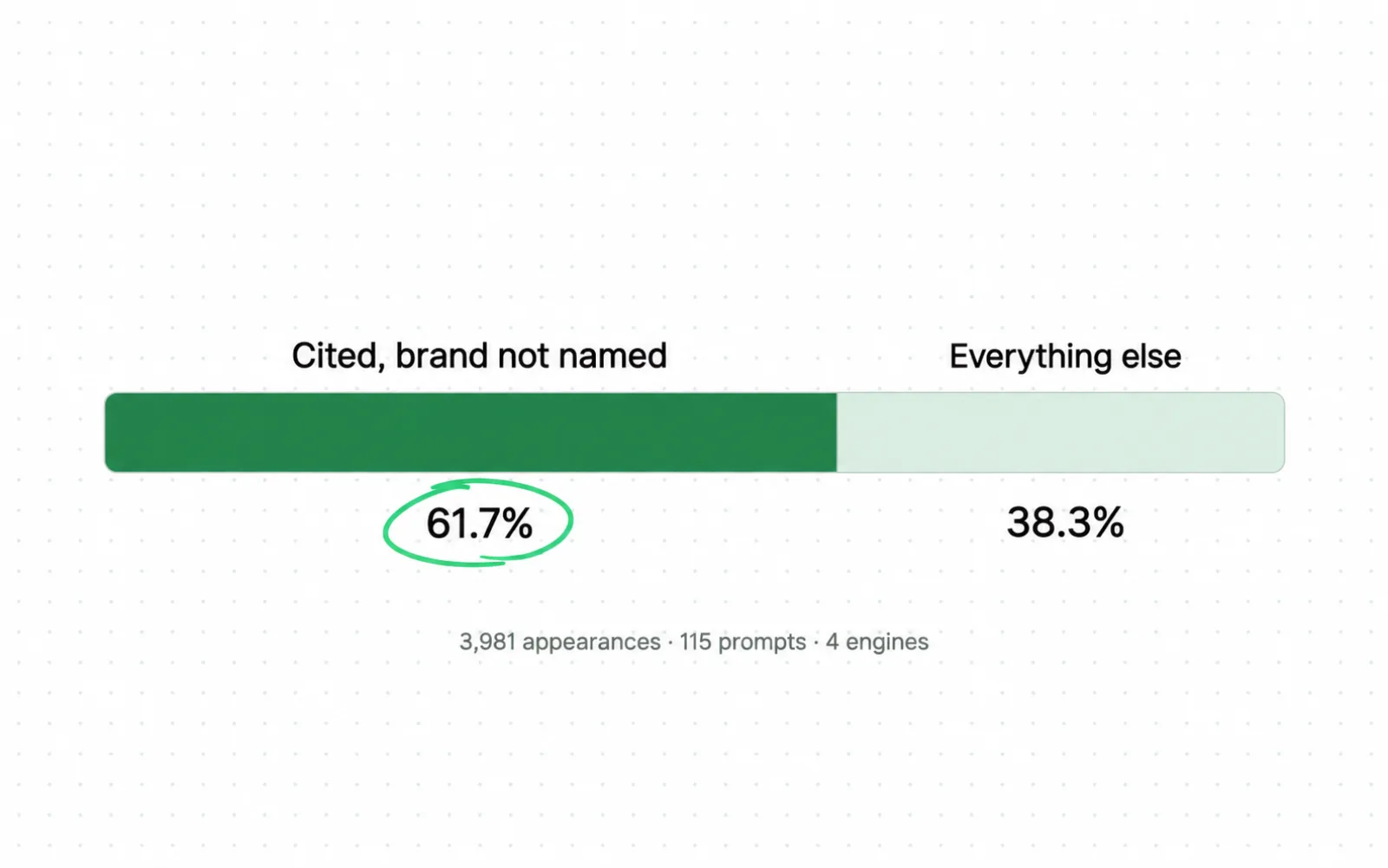
For example, ChatGPT might name Northstar CRM without linking northstar.example. It might also cite the company's pricing page while leaving Northstar out of the shortlist.
Map cited sources before updating your SaaS site
List every cited URL for each of your ten buyer questions. Next to each one, note who runs the site. Then mark its type: your own page, a review site, a list, a forum or a marketplace.
In 2025, Ahrefs analysed 26,283 source URLs across 750 recommendation prompts and found that "best" lists made up 43.8 percent of cited page types.
So when buyers ask for the best tool in your category, start with the third-party lists that engines cite.
In 2026, Profound classified 11.84 billion citations across eight models and found that company-operated sites supplied about 57 percent of citations in its full sample.
The same Profound study found a median earned-media share of 11.4 percent for SaaS and software categories.
Muck Rack classified more than one million links from four engines between July and December 2025, identifying 82 percent as earned media. So plan for pages you do not run, even if your own site is cited often.
For comparison questions, record which comparison pages the answers to your questions cite.
Answer pricing questions with current plan details. Use your documentation to answer setup questions.
For example, "best customer success tools for agencies" can draw on lists and reviews. An answer to "Does AcmeFlow support SAML?" should cite your product documentation.
In Semrush's 2025 study of five industries, review platforms were prominent in digital-technology answers, while official company sites rarely led the source lists.
So check the category and plan names on your review profiles early.
Which sources do AI answers about SaaS cite?
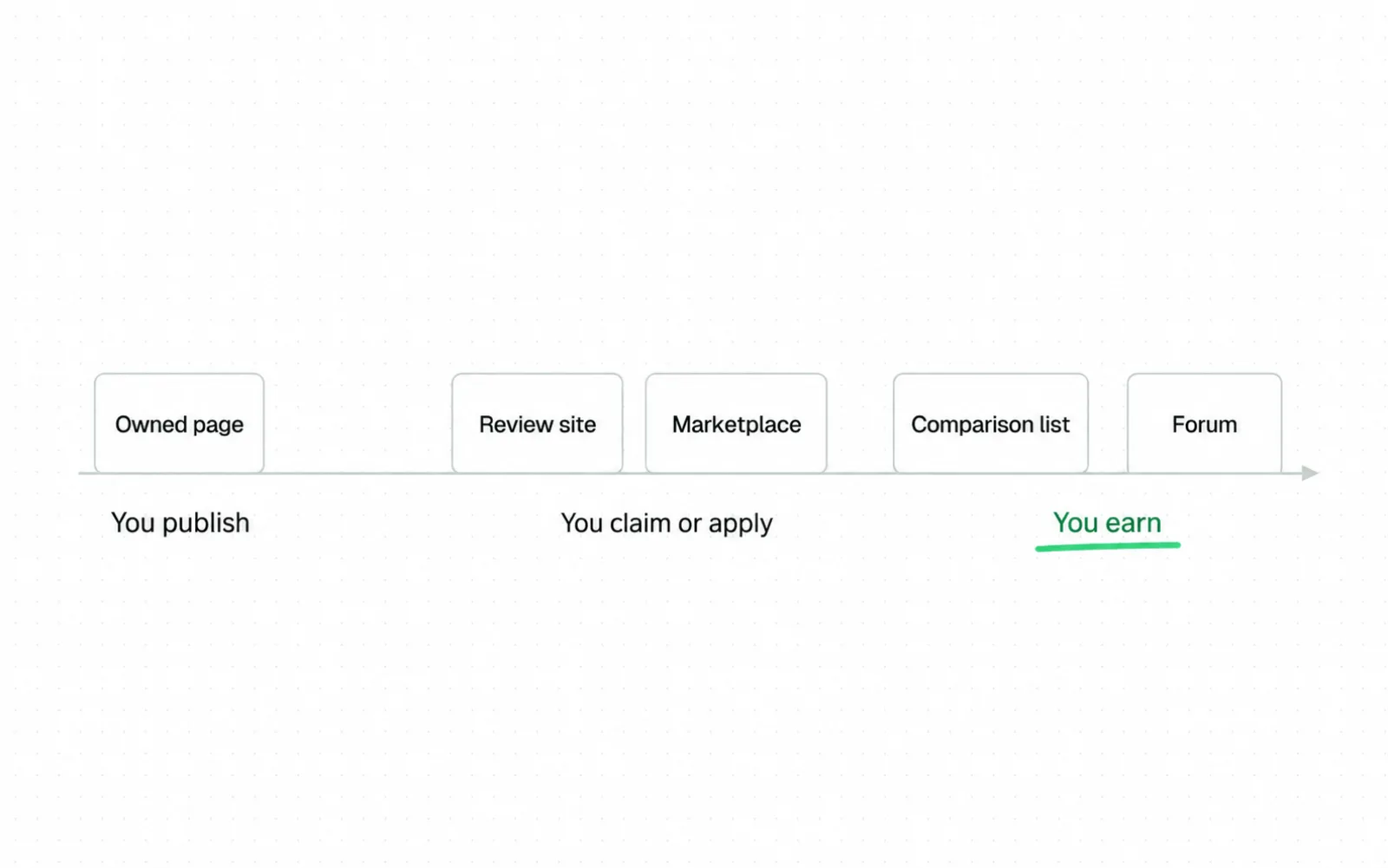
The type of source determines how you can get your product onto the page an engine cites. You publish your own pages, claim review profiles, apply for marketplace listings and pitch editors for lists.
| Source type | Typical evidence | Your route | Track |
|---|---|---|---|
| Review site | Peer reviews and product profile | Claim profile and earn reviews | Mention and citation |
| Comparison list | Category shortlist and trade-offs | Earn editorial inclusion | Brand mention and citation to the list |
| Forum | Users' accounts of using the product and their objections | Participate and disclose your connection | Brand mention and citation to the thread |
| Marketplace | Integration details showing compliance with marketplace requirements | Apply if your product qualifies | Listing citation |
| Owned page | Pricing, docs and product facts | Publish and maintain | Citation of your page |
Say you sell renewal analytics. On your review profile, describe the product as renewal analytics software. On your marketplace listing, name the tools your buyers already use that integrate with your product.
Check where the cited comparison list ranks you against rivals. Read forum threads for reports of what breaks during setup.
Assign one person to manage each type of source.
One answer exposes five access decisions
fictional-ai-answer.txt
[FICTIONAL EXAMPLE] Buyer: best renewal analytics tools for HubSpot teams
Answer: Consider Northstar Metrics and CedarLoop for renewal-risk reporting.
1REVIEW stackreview.example/northstar | CLAIM PROFILE
LIST revopsfield.example/renewal-tools | EARN INCLUSION
FORUM community.example/t/renewal-risk | PARTICIPATE
MARKETPLACE apps.example/northstar | APPLY
2OWNED northstar.example/pricing | PUBLISH
- 1Every brand and domain is fictional. We drew this surface to explain the idea; no AI engine produced it.
- 2The action label shows whether the SaaS team has direct access to the source.
- 3A direct route does not guarantee inclusion in an AI answer.
Update your SaaS pages and claim product profiles
Start with the source types you manage directly: the pages you can publish and the profiles you can claim. Correct any errors in the product facts on each one, from plan names to integrations.
On your domain, maintain a category page and a pricing page. Add integration pages and documentation for the product facts buyers use to narrow a shortlist.
For example, don't bury SAML support inside a sales deck. On a security or documentation page with a stable URL, state which plan includes SAML and any limits.
Follow G2's documentation to submit your product if it is not listed, complete verification and claim the profile.
Capterra lets vendors submit and update profile information. Its 2026 listing guidelines reserve final editorial control for Capterra. Update your fields there, then check what the live profile shows.
HubSpot validates submitted app listings and their destination URLs. You can apply for a marketplace listing only if your integration qualifies.
Choose a directory where you can document the integration or product relationship required for a listing.
A listing does not guarantee a recommendation
| Direct action | Boundary | |
|---|---|---|
| Owned page | Publish and update the evidence | The engine decides whether to retrieve it |
| Claimed profile | Maintain verified product fields | The platform controls reviews and display |
| Marketplace you qualify for | Submit a verified integration | The marketplace controls acceptance |
Get included on pages you cannot edit
You can edit your marketplace listing; you cannot edit independent editorial lists, customer reviews or community discussions. You can supply the evidence, but the publisher decides what goes on the page.
Before pitching an editor, check which category the list covers and how products are selected. Send one product fact, a link to public evidence and a line on why your product fits the list's use case.
Say a list covers "customer success tools for Salesforce teams." Link to your Salesforce integration page and explain the workflow it supports. Leave the backlink request out.
Ask reviewers to describe how they used your product and under what conditions. Don't write reviews for users or offer rewards only for positive reviews.
For forums, answer the question in the thread and disclose your connection. Answer it well even when your product is the wrong fit for the person asking.
Search Engine Journal reported a 2026 Clovion study of 69,120 conversations across 36 B2B software and fintech categories.
In the Clovion study reported by Search Engine Journal, only 28 percent of the initial recommendations remained in the follow-up answer after the buyer added one detail.
Publish evidence that your product meets the buyer's added requirement.
For example, "for a ten-person support team" calls for per-seat costs and setup effort. "For a bank" calls for security controls and procurement evidence.
Publish product details for SaaS buyers
Write a passage on your website explaining what the product does, which uses it suits and what its limits are. Make the passage self-contained, so it still makes sense when quoted on its own.
Your pricing page should state what each plan includes and where its limits apply.
Your documentation should state prerequisites and exceptions beside each feature.
Your comparison page should explain who each product suits, using criteria readers can check. For example, compare deployment models and supported integrations without making up flaws in a competitor's product.
Your integration page should explain which data is transferred and in which direction. A logo wall does not show whether an integration is native or when its data syncs.
Ahrefs found that 79.1 percent of 1,100 cited comparison lists with visible dates were updated during 2025.
Add pricing, comparison and integration pages to the page-update schedule in your SaaS SEO strategy.
OpenAI says OAI-SearchBot controls which sources are eligible in ChatGPT search. If your pages are missing from ChatGPT search, first check that your robots.txt allows OAI-SearchBot. See LLM SEO for how to check crawler access.
Google says pages linked from AI Overviews must be indexed and eligible for a search snippet; they do not need separate AI markup.
For example, if robots.txt blocks your documentation subdomain, ChatGPT search cannot cite the SAML page there.
Run a one-week AI visibility audit
Give each buyer question a row in a spreadsheet and each search engine a column. Collect results for one week before you change any pages or profiles.
Run the same ten buyer questions in ChatGPT, Gemini and AI Overviews. For each engine's answer, record whether it mentions your brand, which pages it cites and the type of each source.
For instructions on repeating the audit every month, see how to measure AI visibility.
Your ten questions should come from sales calls, demos and lost-deal notes. For example, use "best contract review tools for a three-person legal team" if buyers ask it.
Keep the wording stable during the week. If you change "small legal team" to "enterprise legal department," you are asking a different question.
If you sell in more than one country, run each question from the same location setting all week.
Orbit Media tracked 13,184 citations across 1,765 answers for 72 prompts. The four engines in that study rarely cited the same domains.
If you need scheduled checks or exports, compare AI visibility tools to see which can track your questions.
Before you buy, confirm the tool covers each engine your buyers use, including AI Overviews if Google matters in your category.
Mention and citation stay in separate columns
weekly-source-log.csv
prompt_id,engine,brand_mentioned,brand_url_cited,source_class
1Q03,ChatGPT,no,yes,owned
2Q03,Gemini,yes,no,review
Q03,AI Overview,no,no,comparison-list
- 1The rows are fictional and show the shape of a source log.
- 2One buyer question can produce different mention and citation outcomes by engine.
Suppose Gemini names your company and cites a review page, while ChatGPT cites your pricing URL without naming your company. Log each outcome in its own column.
At the end of the week, count how often each domain appears, as Search Engine Land recommends for tracking trends. Prioritize domains cited across several buyer questions.
Choose your next AI visibility move
For each domain that keeps appearing across your buyer questions, decide whether to update a page, claim a profile, apply for a listing or pitch the editor.
Choose an action based on recurring sources
| Observed pattern | Next move | Proof to watch | |
|---|---|---|---|
| Review profile cited but brand absent | Profile lacks category or use-case evidence | Complete verified fields | Mention changes while citation remains |
| Competitor list repeats | The list editor decides who is in the category | Check criteria and earn consideration | List inclusion and later mention |
| Owned page cited without mention | Page supplies facts but weak brand association | Put product name beside the supported claim | Mention and owned citation |
| Marketplace repeats | Buyers ask for a specific integration | Apply only with a verified integration | Listing citation |
| Source mix changes by engine | No single source type covers every engine | Keep product facts current on your own pages | Engine-level trend |
For example, answers to three prompts might cite the same comparison list without naming your company. Read the list's inclusion criteria.
If the list accepts editorial submissions, send the evidence it requests.
Reply under your own name to forum threads that raise the same issue. Fix the product problem those threads keep raising. Never post from a disguised customer account.
If the missing source is a page on your own website, publish that page with the facts the question needs.
For each planned action, record the target domain, the buyer question it answers and one owner.
How much does AI visibility tracking cost?
A tracker re-runs each buyer question for you every week. The published plans from Otterly.AI and Peec AI range from under $30 to just under $500 a month.
Read from each vendor's pricing page on 8 October 2026, monthly billing.
| Tool | Entry plan | Higher plan, add-on or enterprise option |
|---|---|---|
| Otterly.AI | $29 a month, 15 prompts | $489 a month, 400 prompts |
| Peec AI | $95 a month, 50 prompts | $495 a month, 350 prompts |
| Semrush AI Visibility Toolkit | $99 a month per domain | 50 more prompts for $60 a month |
| Profound | No price published | Enterprise, custom |
The entry plans listed above can track your ten buyer questions. Tracking more engines, markets or competitors increases the answers the tool collects and the price you pay.
Profound no longer publishes prices; on 4 September 2026, its pricing page listed monthly prices of $99 and $399.
On 8 October, Profound's pricing page listed a free trial with 50 prompts a day for seven days and an Enterprise tier with custom pricing. If you need Profound's coverage, ask for a quote before you set a budget.
Allow an afternoon to create a missing review profile.
Common AI visibility mistakes for SaaS
You can waste budget on tracking or outreach if you act on one answer or assume your team can edit independent pages. Check your plan against these four mistakes.
First, don't merge mentions and citations into one total.
Second, don't assume an aggregate study or a single AI visibility score tells you which sources appear in answers about your category.
Third, avoid buying a position on a list that does not disclose paid placements. Before paying for a placement, check whether the engines you track cite the list you are considering.
In 2026, SparkToro asked 600 volunteers to run 12 recommendation prompts 2,961 times and found that the brand lists were highly inconsistent between runs.
For example, one Monday answer might omit you while Tuesday's answer includes you. Save both answers with the prompt wording and engine name before you decide which source to work on.
Finally, don't report a citation as a recommendation. If an answer cites your URL in a competitor comparison without naming your brand, record a citation only.
Start with ten SaaS buyer questions
Your first source map needs only a shared spreadsheet and one owner who records each answer on the day you run the question. Keep that owner the same all week.
-
Write ten buyer questions
Use the words buyers type, plus one requirement from their use case. For example, "best inventory forecasting tools for a Shopify brand with two warehouses."
-
Run each question and save every cited domain
Label each domain you find as an owned site, review site, comparison list, forum or marketplace.
-
Mark your own presence
Note mentions and citations in separate columns.
-
Choose one action your team can take
Update documentation, claim a profile or prepare an editorial submission.
-
Save the first map
Date the first map and compare each later week's results with it.
If people in your buying group ask different questions, see B2B AI visibility for mapping sources by role. For help maintaining the weekly log and acting on the results, see our ai visibility for SaaS service.
Sources
- Otterly.AI Pricing: Lite $29 a month for 15 prompts, Standard $189 for 100, Premium $489 for 400, billed monthly
- Peec AI Pricing: Starter $95 a month for 50 prompts, Pro $245 for 150, Advanced $495 for 350, three chosen models
- Semrush AI Visibility Toolkit: $99 a month per domain, 50 extra prompts for $60 a month, no free trial
- Profound Pricing page: a free trial of 50 prompts a day for seven days and a custom Enterprise tier, no published price (on 4 September 2026 the page showed $99 and $399 a month)
- Ahrefs Do Self-Promotional Best Lists Boost ChatGPT Visibility? Study of 26,283 Source URLs Dated 2025 with no month given, so its exact age is not knowable from the source.
- Semrush How AI Search Really Works: Findings from Our AI Visibility Study Dated 2025 with no month given, so its exact age is not knowable from the source.
- Semrush Why 62% of AI Citations Do Not Lead to Brand Mentions
- G2 The Answer Economy: How AI Search Is Rewiring B2B Software Buying
- Profound Where Do AI Citations Come From?
- Orbit Media Studios I Tracked 13,184 AI Citations Across 4 LLMs
- SparkToro AIs Are Highly Inconsistent When Recommending Brands or Products
- Muck Rack What Is AI Reading? Dated 2025 with no month given, so its exact age is not knowable from the source.
- Search Engine Journal 62% of AI Brand Recommendations Vanish After One Buyer Question
- Search Engine Land LLM Optimization in 2026: Tracking, Visibility, and What Is Next for AI Discovery Dated 2025 with no month given, so its exact age is not knowable from the source.
- OpenAI Overview of OpenAI Crawlers
- Google Search Central AI Features and Your Website
- G2 Finding or Listing a Product on G2 Dated 2025 with no month given, so its exact age is not knowable from the source.
- Capterra Listing Guidelines
- HubSpot Developers New Validation Rules for App Marketplace Listings Dated 2024 with no month given, so its exact age is not knowable from the source.
Questions people ask
What is AI visibility for SaaS?
AI visibility for SaaS is whether answer engines name your software company and how they present it. Results vary with the engine, question wording and date. Repeat each check across the week before you act on it.
How can a SaaS company get recommended by ChatGPT?
Look at which pages ChatGPT cites for your buyers' questions. If it cites a comparison list, pitch the editor with one product fact and a page that proves it. If it cites a review site, claim your profile and ask recent customers for reviews.
Do more blog posts increase SaaS AI visibility?
Only if your audit finds a buyer question for which engines have no page from your website to cite. Otherwise, put your effort into the review profile, list, forum thread or marketplace listing the engines already cite.
What is the difference between an AI mention and citation?
A mention names your company; a citation links to a page used as evidence. Semrush's ghost citations study found that most appearances were citations without a brand mention.
Which SaaS source should I work on first?
Choose the source type that repeats across buyer questions and engines. If several types tie, start with the one your team can update this week, such as a pricing page or a claimed profile.