
What is a B2B landing page?
A B2B landing page presents one campaign offer to one audience and asks them to take the next step. Usually that step is a demo, a pricing request or a consultation, and the page collects only the details your team needs to respond.
Your company website lets visitors explore products and review evidence for your claims. Your landing page narrows that choice to a demo or consultation.
You can also use it for a pricing request or paid audit.
For example, a search ad about warehouse forecasting should land on the matching forecasting offer. You shouldn't send that visitor to a homepage with six product families.
| Surface | Visitor job | Business job | Next action |
|---|---|---|---|
| B2B website | Explore the company | Help visitors explore different products or services | Choose a product or service to explore |
| B2B landing page | Judge one offer | Qualify one request | Take the promised next step |
6sense surveyed nearly 4,000 buyers in North America, APAC and EMEA in 2025. Typical purchases involved more than 10 people.
Gartner surveyed 632 B2B buyers in August and September 2024. Their teams ranged from five to 16 people across as many as four functions.
Give your first visitor material they can share with the rest of the buying team.
You might see a security lead request a demo while your buyer's finance team reviews the cost and scope. Include the information each member of your buyer's team needs in the material you give them to share.
Set the criteria your form submission must meet before you count it as a conversion.
Choose the B2B landing page offer first
That offer determines the page structure and every form question. For example, demos, trials and pricing requests ask different commitments of the buyer. Decide what you will deliver before you write the headline or choose your form fields.
For your demo, explain who it is for and what the buyer will learn during the meeting. For a pricing request, explain what pricing information you will send and ask only for the details that affect your price.
For a paid audit, explain what access you need to diagnose the problem and what you will deliver. Offer a conversation when your buyers need help choosing an offer.
| Offer | What you must establish | What the answer determines |
|---|---|---|
| Demo | Who the demo is for and what the buyer will learn | Which product to show or salesperson to assign |
| Pricing request | Scope and what the pricing response will include | Which package or pricing options to offer |
| Paid audit | What the audit covers and delivers | Access needed or work required for the audit |
| Conversation | Which problem the buyer needs help choosing to discuss | Which questions to ask next or where to direct the request |
HockeyStack analyzed 31 million unique visitors across 80 B2B SaaS companies in a report published on 15 December 2025. Demo pages averaged 5.5 percent conversion and pricing pages averaged 3.8 percent.
Set separate targets for your demo and pricing pages, using each page's current conversion rate as your baseline.
A Journal of Business Research study tested WhatsApp chatbots against conventional landing pages with more than 16,000 participants. The chatbot produced more leads, and more qualified leads, than the conventional page.
Test a conversational path when your buyer needs guided answers, and keep the conventional page as your control.
Remove a field only when its answer changes nothing
b2b landing page / form test specification
1CONTROL FORM TEST FORM
2Visible fields: 5 Visible fields: 4
Name Name
Work email Work email
Company Company
Employee band Employee band
3Phone Removed: no route changes
PROOF BLOCK: security review included
SINGLE ACTION: Request an evaluation
4QUALITY CHECK: sales acceptance and pipeline value
- Keep the proof block and action fixed, so the test isolates the field decision.
- Measure completed requests first. Then compare sales acceptance and pipeline value.
- Keep Phone when it changes the promised response. This worked example gives it no job.
NP Digital looked at 404 form pages in December 2024. NP Digital reported conversion rates of 18.2 percent for forms with one field and 4.2 percent for forms with nine or more fields.
Use NP Digital's findings to choose how many fields to test first, then judge the result by the sales opportunities generated.
HubSpot analyzed more than 40,000 customer landing pages. Conversion fell slightly as total field count rose, and fell further with multiple text areas and drop-down fields.
Google Ads Help offers More volume and More qualified lead-form modes. The qualified mode adds steps and can produce fewer leads with greater stated interest.
Say you sell only to companies above an employee threshold. Keep the field when its answer changes eligibility or routing. Use submission volume as the first signal, then judge the change by qualified pipeline.
Use A/B testing to isolate one decision per test, for example the form length or the offer, never both at once.
Before changing the form, write down how each answer changes who handles the request or what happens next.
Build the B2B landing page in order
Build the page in the order the visitor meets it: the promise, the offer, the proof, then the form. The form comes last because visitors answer questions only after the first three parts convince them the request is worth making.
-
1. Match the campaign's promise
Repeat the promise made in the campaign that brought the visitor to the page. Put that promise on your first screen.
-
2. Name the offer
State what the visitor receives and what happens after the request. Don't hide the response behind a generic contact label.
-
3. Define which requests sales will accept
List the answers that determine whether the buyer qualifies, who handles the request, what the offer covers, or how your team prepares.
-
4. Address objections with evidence
Support claims a buyer might question with a customer result or a view of the product. You can also explain how the work is done or state the limits of your offer.
-
5. Give each field a job
State which decision each answer affects. Remove any field whose answer does not change a decision you make, such as when nobody reads the job title before routing.
-
6. Design the response
Tell buyers what happens next, whether you accept or reject their requests.
-
7. Track requests through to sales outcomes
Record the campaign and landing page for each request in the CRM. If the ad platform supports it, send back data showing which requests qualified and which became won deals.
Keep your Employee band field if, for example, the answer determines package eligibility or who owns the account. If all requests go to the same salesperson regardless of the answer, the field does not affect assignment.
| Field | Decision changed | Ask now when | Ask later when |
|---|---|---|---|
| Work email | Identity and follow-up | You need the email address to deliver the offer | Another verified identity exists |
| Company | Account match and territory | The company determines who handles the request | Your data enrichment system already provides the company name |
| Employee band | Eligibility or package | The employee range changes where the request is sent | Every band receives the same response |
| Monthly ad spend | Audit scope | Ad spend affects the audit scope you must agree before accepting the request | The first call can collect it |
| Phone | How to contact the buyer by phone | A promised call follows | Email is the promised response |
The W3C's accessibility guidance says every field needs a visible label, and an instruction wherever the right answer is not obvious. Placeholder text should not carry the whole label because it disappears after entry begins.
Adobe Experience League describes how Marketo's progressive profiling shows new questions without asking again for information already stored. So you can ask for more across several visits instead of putting every question on the first form.
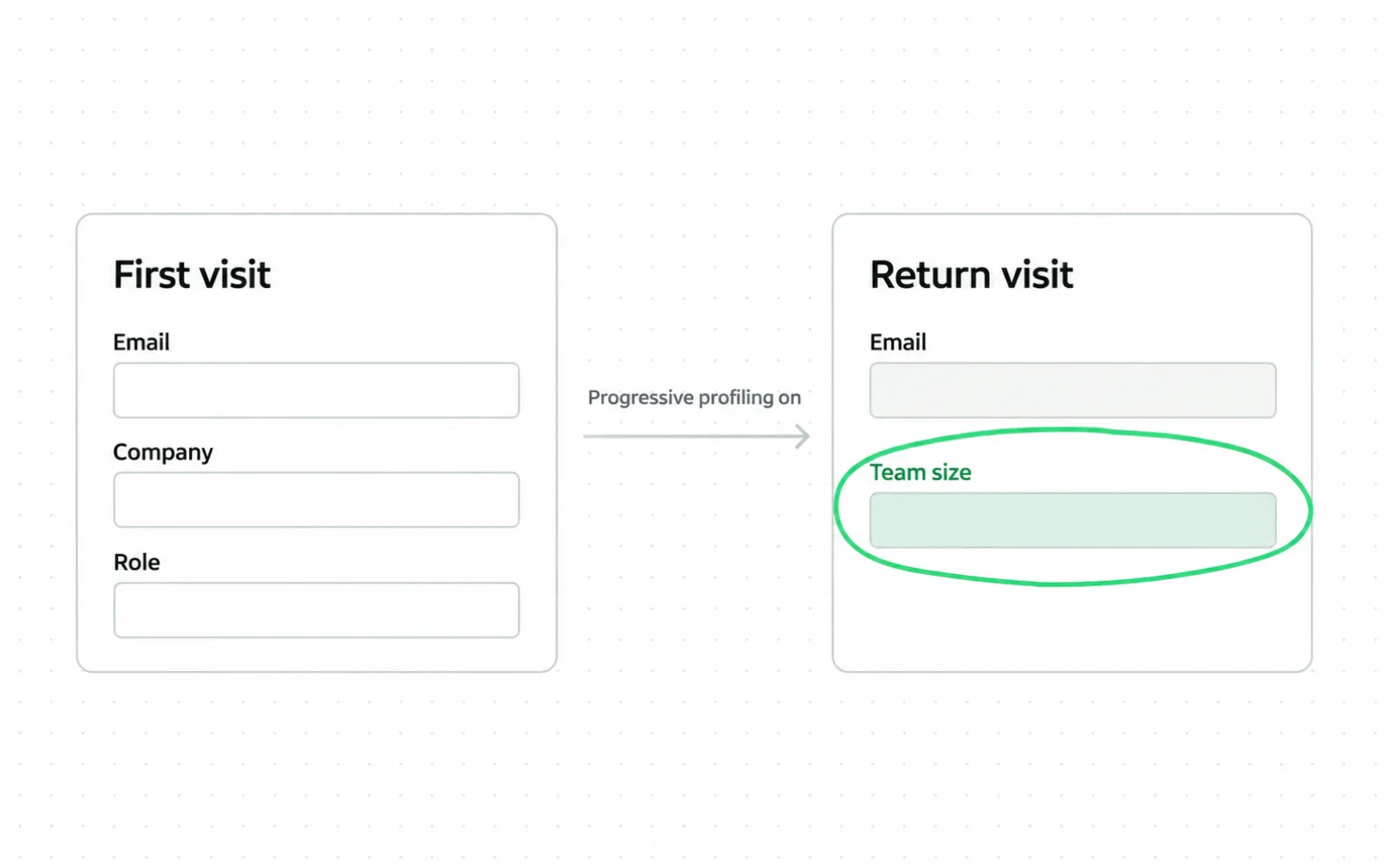
- The form setting enables progressive profiling before you choose the deferred fields.
- The field editor moves a question into the progressive set.
- Known visitors can receive a later question instead of seeing every field at once.
Use both form answers and visitor behavior in your lead scoring model. Give sales the information they need to explain to the buyer why the lead qualifies.
Before launch, define when marketing hands a lead to sales, the MQL vs SQL handoff. You'll need an owner, acceptance rule, and rejection reason.
Match the page message to the ad that sent the visitor, as Semrush advises. Then count qualified leads in your CRM, the measure Search Engine Land uses for lead-gen PPC.
Price B2B landing page work by scope
How form answers affect routing and follow-up determines the scope of the landing page project. A simple copy edit and a build that connects form answers to routing and measurement are different jobs. Define the scope before you compare quotes.
- Offer definition. Unsettled fit or response requires an offer and accepted-request rule.
- Copy and proof. Several buyers or risky claims require a claim-to-proof map.
- Design and build. New components or form states require a responsive tested page.
- Routing. Territory or product branches require rules and a fallback owner.
- Measurement. CRM stages and offline outcomes require source continuity and event definitions.
- Experiment. Traffic splits and downstream windows require a hypothesis and decision rule.
Say you already have a tested offer and a stable component library. You shouldn't pay for the discovery or design-system work that another project needs.
Unbounce's 2024 SaaS benchmark covers 41,000 pages, 57 million conversions and 464 million pageviews. Use the conversion rate for your category.
Use the value of a closed deal from your B2B lead generation data to set the maximum you will spend on the landing page.
Ask whether the quote includes offer research and copy. Check whether the quote also covers finding evidence for claims and building the page for different screen sizes.
You'll also need integration, quality assurance, and analysis. Compare two quotes only once both cover the same list of work.
You should also put a cost on delay and rework. Your low cost per submission can hide the time sales spends fixing routing errors.
Fix these B2B landing page errors
Sales first notices page errors when requests go to the wrong person, buyers interpret the offer differently on the first call, or leads cannot be qualified.
How page errors affect your sales pipeline
| Pipeline cost | Repair | |
|---|---|---|
| Message mismatch | You must reinterpret the offer | Carry the traffic promise into the first screen |
| Generic next step | The request has no shared meaning | Name the response and output |
| Detached proof | Doubt survives beside the claim | Move the matching proof next to the risk |
| Unused fields | Effort rises without a route change | Remove or defer the field |
| Hidden response | You expect the wrong follow-up | State what happens after submission |
| Submit-only test | Low-value volume wins | Carry the outcome into pipeline |
For example, your ad promises a pricing range while the page offers only Contact us. You're asking for the visitor's details before showing the pricing range promised in the ad.
NinjaPromo audited 700 landing pages between May and July 2026. NinjaPromo's audit found that eighty percent of visitor losses occurred before visitors reached the second screen.
Start your audit with what a visitor sees before scrolling. After each change, check how visitors use your page and what happens to their requests.
Another error is forcing every qualification question into the form. For some buyers, qualification depends on how they use the product after signup. Track product use to identify each product qualified lead.
You also shouldn't hide friction by moving it to sales. If every first call asks the same eligibility question, decide whether the page or routing system should collect it.
Read rejected requests before you change the page. Their rejection reasons show you whether the problem lies in the traffic, the evidence, the form, or the follow-up.
Leave the repaired page alone for a full sales cycle, so the pipeline numbers you compare all come from one version.
Measure B2B landing page pipeline after the form
Link each of those requests to its campaign and eventual revenue, or you risk choosing the cheapest submissions even when they generate little business. For a fair comparison of pipeline results, use requests from the same page version.
Measure what happens after submission
- 1 Visit The intended traffic reaches the promised offer.
- 2 Submit The visitor completes the next step.
- 3 Qualified The request meets the written fit rule.
- 4 Accepted Sales accepts ownership and starts the response.
- 5 Pipeline A commercial opportunity receives stage and value.
- 6 Won Revenue closes and stays linked to the source.
Google Ads Help distinguishes leads, qualified leads, and converted leads. Enhanced conversions for leads can match hashed first-party data with later offline outcomes.
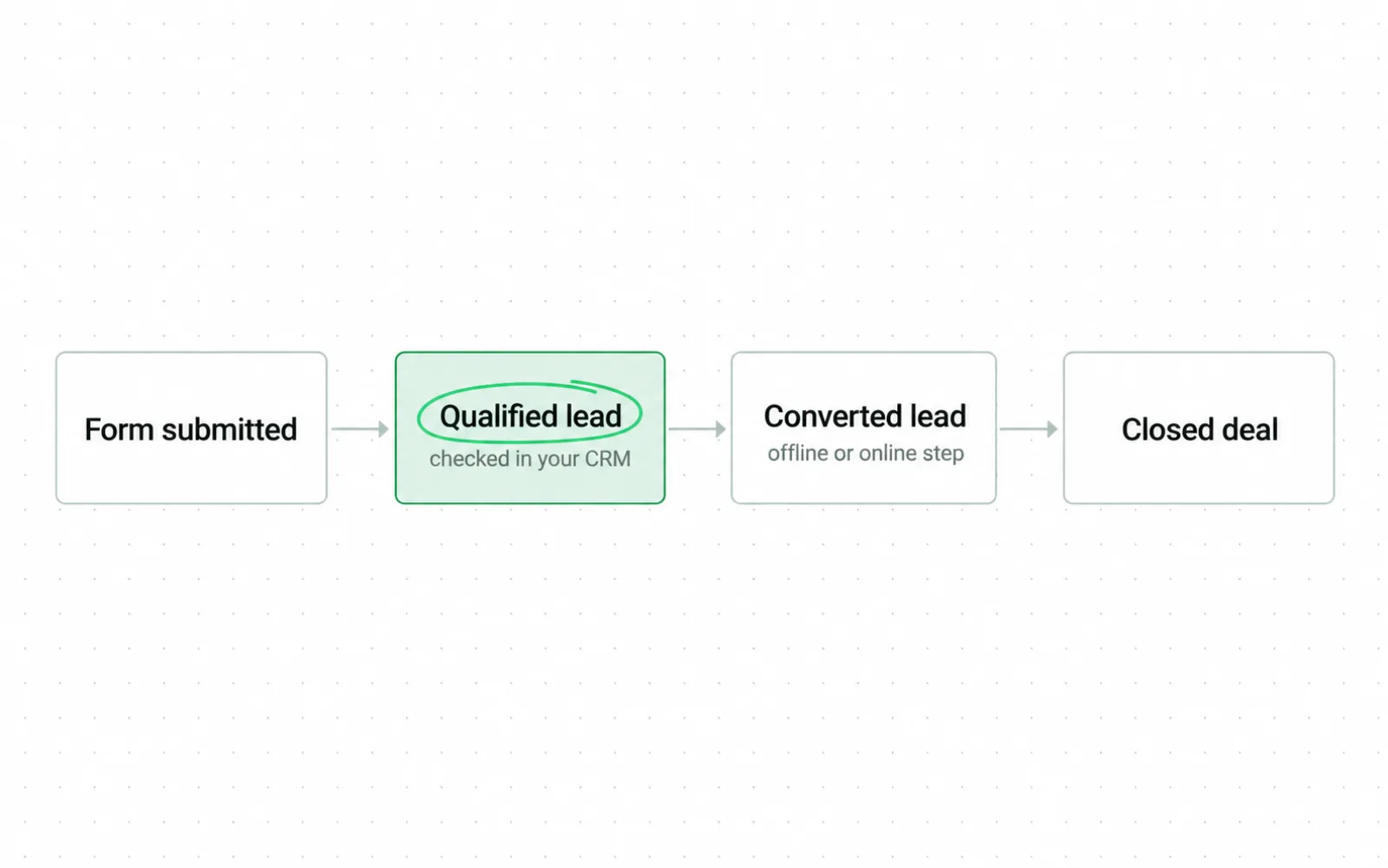
- Qualified leads have passed a further offline check in a CRM or lead system.
- Converted leads have completed the chosen offline or online conversion step.
- Google's own diagram carries form submissions through sales qualification to a closed deal.
In your CRM, record when each request moves through a sales stage and how much the opportunity is worth.
Log rejection reasons at each stage so you can see why requests leave the pipeline.
| Stage | Primary measure | Question for the person responsible |
|---|---|---|
| Visit | Visits that match the page's offer | Did the intended traffic arrive? |
| Submit | Completed requests | Could the visitor finish the form? |
| Qualified | Requests that meet the qualification criteria | Did the request meet the qualification criteria? |
| Accepted | Requests owned by sales | Did routing and response work? |
| Pipeline | Opportunity count and value | Did accepted requests become sales opportunities? |
| Won | Revenue and contribution | What revenue and contribution came from this source? |
The 2022 LeanData study surveyed 311 revenue professionals. It found 26 percent measured win rate by lead source and 13 percent measured cost per lead against revenue.
Say you remove Phone and submissions rise. Before you choose a winner, compare the variants' qualification and sales acceptance rates, then weigh pipeline value against the extra work your sales team must do.
Track pipeline velocity and volume together. Check whether an increase in opportunities also means deals take longer to close.
For paid search traffic, our B2B PPC service reports on the sales pipeline each campaign generates.
B2B landing page questions
A B2B website serves every audience at once, while a landing page serves one offer to one audience and reports what that offer earned in pipeline. Most of the short answers below turn on that difference.
Sources
- Journal of Business Research From static to conversational: The role of landing pages and chatbots in B2B lead generation
- HubSpot Which Types of Form Fields Lower Landing Page Conversions? Measured 15 months ago, on a surface that has moved since.
- NP Digital How Form Length Impacts Conversion Rate Measured 21 months ago, on a surface that has moved since.
- HockeyStack The State of Pricing, Demo, and Case Study Pages
- 6sense The 2025 B2B Buyer Experience Report
- Gartner Gartner Sales Survey Finds 74% of B2B Buyer Teams Demonstrate Unhealthy Conflict During the Decision Process Measured 16 months ago, on a surface that has moved since.
- NinjaPromo The State of the Landing Page 2026: 700 CRO Audits, One Pattern
- Semrush What Is Landing Page Optimization? And How to Do It
- Search Engine Land Lead gen PPC: How to optimize for conversions and drive results Measured 15 months ago, on a surface that has moved since.
- Google Ads Help How to use lead forms in responsive search ads and campaigns
- Google Ads Help About qualified leads and converted leads
- Google Ads Help About enhanced conversions for leads
- Adobe Experience League Configure form progressive profiling
- W3C Web Accessibility Initiative Form Instructions This page carries no publication date of its own.
- Unbounce SaaS Conversion Rates Dated 2024 with no month given, so its exact age is not knowable from the source.
- LeanData 2022 Inbound and Outbound Sales Pipeline Performance Benchmarking Report
Questions people ask
What is a B2B website?
A B2B website lets you learn about a company, explore its products or services, and review evidence for its claims. A B2B landing page presents one campaign offer and helps qualify a request, such as a demo.
What is the rule of 7 in B2B?
A B2B landing page does not require seven exposures. Measure your own path from first visit to accepted request before you set a frequency rule.
What is a good example of B2B?
A software company selling forecasting tools to warehouse operators is a B2B example. Its landing page could offer an evaluation and ask only questions whose answers determine whether the buyer qualifies or who handles the request.
Which B2B site is the best?
Choose the site or landing page that matches your campaign's offer and prompts a qualified request. Judge your page by whether sales accepts its leads and how much pipeline they generate. Another company's layout was built for its own buyers.